Misir Wat.
Ethiopian Red Lentil Stew
ምስር ወጥ · Misir wet · say it: mih-SEER WUHT
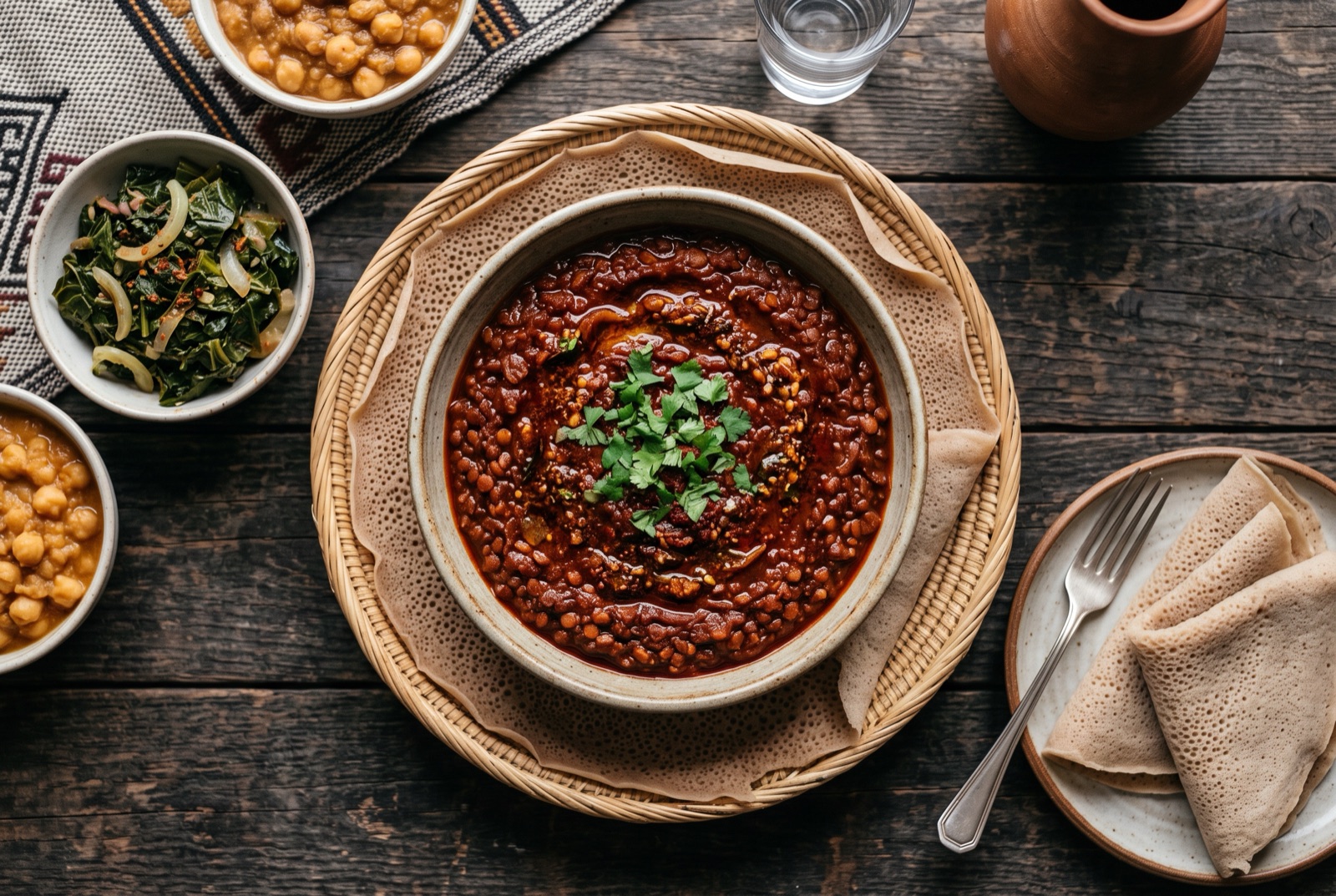
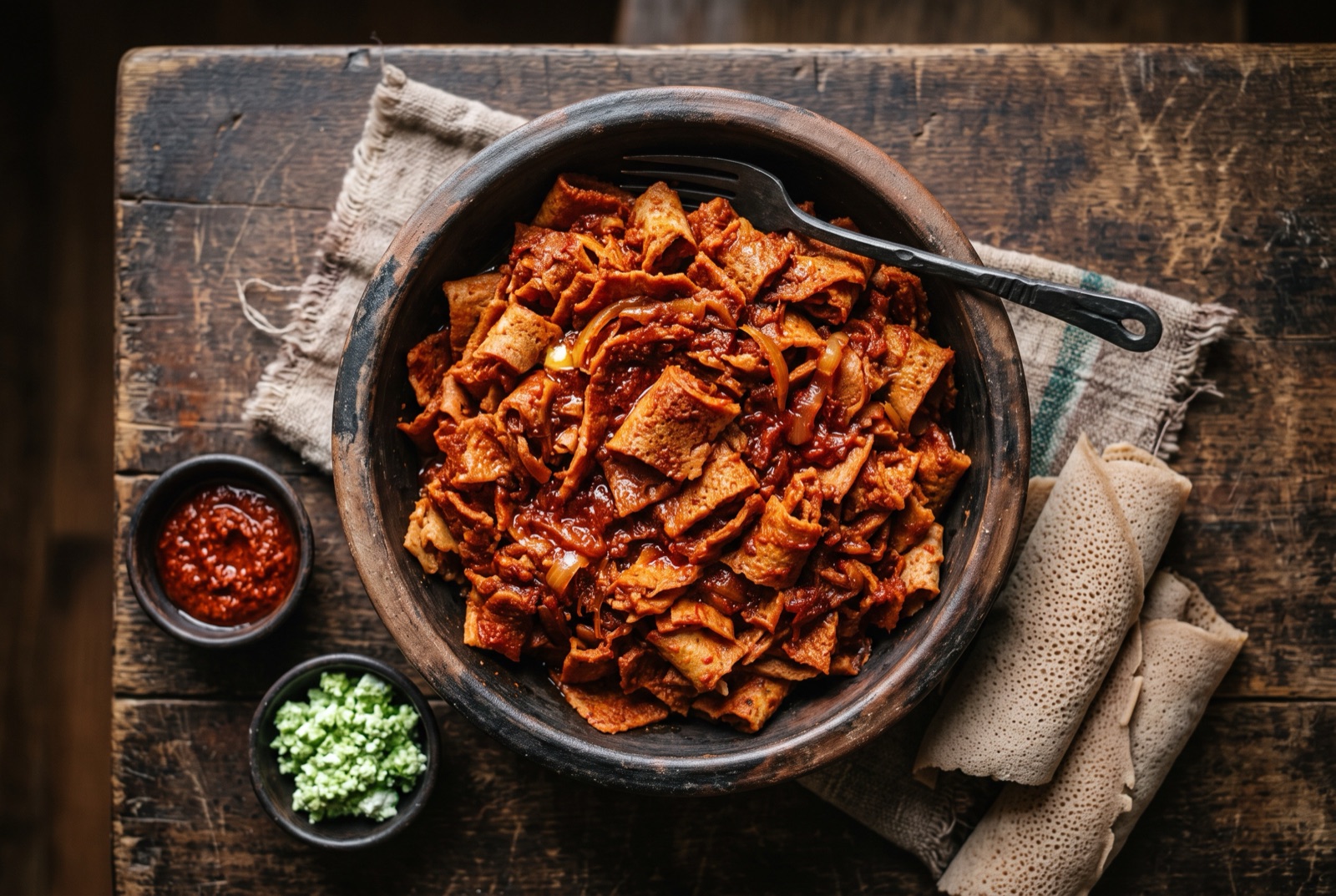
Misir wat is red lentils simmered into a thick, dark crimson stew with berbere, onion, garlic and ginger — no stock, no dairy, no meat, and nothing that needs replacing to make it vegan, because it never contained animal products in the first place. Split red lentils break down entirely as they cook, so the finished dish has no distinct pieces in it: it is smooth, heavy and slightly sweet from the long-cooked onion, with a chilli heat that arrives after the sweetness rather than before it. On a beyaynetu platter it is the deepest red section and usually the first one people finish. It also happens to be one of the cheapest hot meals in this atlas.

- Gate
- Ethiopia
- Prep
- 15 min
- Cook
- 55 min
- Total time
- 1 hr 10 min
- Serves
- 4
- Status
- Easy
- Nutrition / serving · estimated
- Calories 420 kcal
- Protein 19 g
- Carbs 51 g
- Fat 15 g
- Fiber 12 g
- Sodium 580 mg
Why this recipe works.
- Builds the onion base properly first, which is the difference between a deep stew and lentils in chilli water.
- Uses water rather than stock, as the fasting-day original does, and still gets a full-bodied result.
- Explains how to hit the exact consistency that works on injera, rather than leaving you with lentil soup.
- Freezes and reheats better than almost anything else in this collection, so a double batch is worth cooking.
Ingredients.
9 itemsEquipment
- Heavy saucepan or small Dutch oven
- Wooden spoon
- Fine sieve for rinsing
Instructions.
Cook the onions down
Put the finely chopped onions in a heavy pan with 2 tablespoons of the oil over medium-low heat and cook for 20 minutes, stirring regularly. They are ready when the pile has shrunk by more than half, turned an even honey brown, and smells sweet with no raw sting left.
Tip Resist raising the heat. Browned edges on otherwise raw onion give bitterness, not sweetness.
Bloom the berbere
Add the rest of the oil, then the garlic and ginger, and stir for 1 minute until fragrant. Tip in the berbere and tomato paste and fry for 4 minutes, stirring without pause, until the mixture darkens to a deep brick red and oil rises around the edges.
Add the lentils
Stir in 300 g of rinsed lentils and turn them through the paste for a minute so every one is coated. Pour in the water, bring to a boil, then drop the heat to a slow simmer.
Simmer until they collapse
Cook uncovered for 30 minutes, stirring every five so nothing catches on the base. The lentils are done when no individual pieces are visible, the stew has darkened from orange to deep crimson, and a spoon dragged through the middle leaves a track that closes slowly.
Tip Add hot water in small amounts if it tightens before the lentils have broken down.
Season and adjust
Salt generously and cook for a final 5 minutes so the seasoning settles in. Taste for heat and add more berbere if the stew can take it; loosen with boiling water until it mounds gently on a spoon rather than running off.
Rest before serving
Take the pan off the heat and leave it to stand for 10 minutes, which lets the stew set to its final consistency and rounds off the chilli. Spoon onto injera in a thick band and serve warm rather than piping hot.
Tips from our kitchen.
- Rinse the lentils under cold water until it runs clear. The starchy dust that comes off them otherwise turns the stew cloudy and slightly gluey.
- Use split red lentils, sometimes sold as masoor dal. Whole brown or green lentils hold their shape and give you a completely different dish.
- Add salt only in the last ten minutes. Salted lentils take noticeably longer to break down.
- The stew should mound slightly on a spoon rather than run off it. If it is soupy, uncover the pot and cook it down; if it seizes, loosen it with boiling water rather than cold.
- Taste before you finish it: berbere blends vary from mild and paprika-heavy to genuinely fierce, and the same three tablespoons can land very differently.
- A knob of niter kibbeh stirred in at the end is the non-fasting-day treatment and makes the stew rounder — leave it out and the dish stays vegan.
Substitutions.
- Berbere → 2 tbsp sweet paprika + 1 tsp cayenne + ½ tsp ground fenugreek + ½ tsp ground cardamom + ¼ tsp ground cloves
- A rough approximation of the colour and heat. It misses korarima and besobela entirely, so treat it as a stopgap rather than an equal.
- Split red lentils → Yellow split peas
- This gives kik alicha territory rather than misir wat — the peas take about twice as long to soften and stay sweeter and less earthy. Add 20 minutes and extra water.
- Neutral oil → Niter kibbeh
- Traditional on non-fasting days and richer for it. The stew is then no longer vegan or dairy-free, so keep the oil version if you are cooking for a mixed table.
Variations.
- Misir alicha
- The mild sibling: turmeric, ginger and slit green chillies in place of berbere, giving a golden stew with warmth but no real heat. Served alongside the red version so a platter has both.
- Azifa
- A cold lentil salad from the same pantry — boiled green lentils dressed with mustard, onion, green chilli and lemon, eaten as a fasting-day starter rather than a stew.
- Misir wat with tomato
- A common home addition: two diced tomatoes fried into the berbere base, which brightens the stew and cuts its density. Purists leave them out; plenty of cooks do not.
Storage & reheating.
Refrigerated in a sealed container, misir wat keeps 5 days and tastes better on day two. It thickens hard when cold — reheat over low heat with a splash of boiling water, stirring until it loosens and steams evenly. It freezes for up to 4 months with no loss of texture, which makes it worth cooking double and portioning it flat in bags so it thaws quickly. Avoid reheating in a microwave without added water, as the surface sets into a skin while the middle stays cold.
Serve with
Injera, ideally as part of a beyaynetu with shiro, gomen and a cabbage alicha so the plate has three textures.
The story behind Misir Wat.
Lentils reached the Horn of Africa early and have stayed central ever since, and misir wat is what the Ethiopian kitchen does with them. The dish exists in three registers that map onto the religious calendar. Misir wat proper is the red, berbere-driven version. Misir alicha is its mild counterpart, coloured with turmeric and warmed with green chilli and ginger instead of chilli powder, made for people who cannot take heat and for children. Ye misir kik is the plainer boiled-lentil form. All three are fasting food, which in Ethiopian Orthodox practice means strictly vegan.
What separates a good misir wat from a mediocre one is the same thing that separates a good doro wat: the treatment of the onion. Ethiopian cooks chop it fine and cook it down slowly with little or no fat until the water is gone and the sugars have concentrated, then add oil and berbere and fry the spice into the collapsed onion base. The lentils are not added until that base tastes finished. Reversing the order — lentils and berbere together in water, onions softened alongside — gives a stew that reads as thin and sour, because there is no sweetness to hold the chilli up.
Misir wat also travels better than almost anything else on the platter. It reheats without deteriorating, freezes cleanly, and thickens rather than splits, which is why Ethiopian households cook it in large batches and why it is a fixture in the diaspora. In restaurants abroad it is often the first dish put in front of anyone unsure about Ethiopian food, on the reasonable grounds that it is intensely flavoured, has no unfamiliar textures, and lets you decide how much injera to use to moderate the heat.
Questions, answered.
Do I need to soak red lentils first?
No. Split red lentils are hulled and split, which is why they cook in 25 to 30 minutes and collapse completely without soaking. Rinsing is worth doing to remove starchy dust and the occasional stone, but soaking gains you nothing and can make them disintegrate before the stew has developed any body.
Is misir wat vegan?
In its traditional form, yes, entirely — it is fasting food in the Ethiopian Orthodox calendar, which excludes meat, dairy and eggs. The only thing to watch is the cooking fat: some non-fasting-day versions use niter kibbeh, which is butter-based. Made with oil, as in this recipe, it is vegan without any substitution.
My stew tastes harsh and one-dimensional. What went wrong?
Two likely causes. Either the onions were not cooked down far enough before the spices went in, so there is no sweetness to balance the chilli, or the berbere was added to liquid rather than fried in fat, which leaves a raw, dusty edge. Both are fixable in the pot: cook it longer with the lid off, and if it still tastes flat, fry a fresh spoonful of berbere in a little oil in a separate pan and stir that in.
Can I make it less spicy without losing the character?
Yes. Cut the berbere by half and make up the volume with sweet paprika, which keeps the colour and much of the aromatic backbone while dropping the heat considerably. Alternatively cook misir alicha instead — the turmeric-based version is not a watered-down misir wat but a dish Ethiopians make deliberately, and it is served next to the red one rather than instead of it.
What else goes on the plate with it?
Misir wat is rarely eaten alone. On a beyaynetu platter it appears alongside shiro, gomen, cabbage and potato alicha, split peas and often a fresh tomato salad, all spooned onto one sheet of injera. If you are cooking a single dish, injera or rice plus something cool and green is enough to keep the richness in check.
You might also like.
All recipes →
Keep exploring Ethiopia.
Ethiopia has 9 more dishes in the atlas — Berbere and Doro Wat, and 7 more.
All Ethiopia recipes Lentils recipes Onion recipes Garlic recipes mainveganvegetariandairy freegluten freenut freeRecipe by The DishRoute Kitchen · published August 20, 2026 · updated August 20, 2026