Tamales Colorados.
Guatemalan Red Masa Parcels
Tamales colorados · say it: tah-MAH-less koh-loh-RAH-dohs
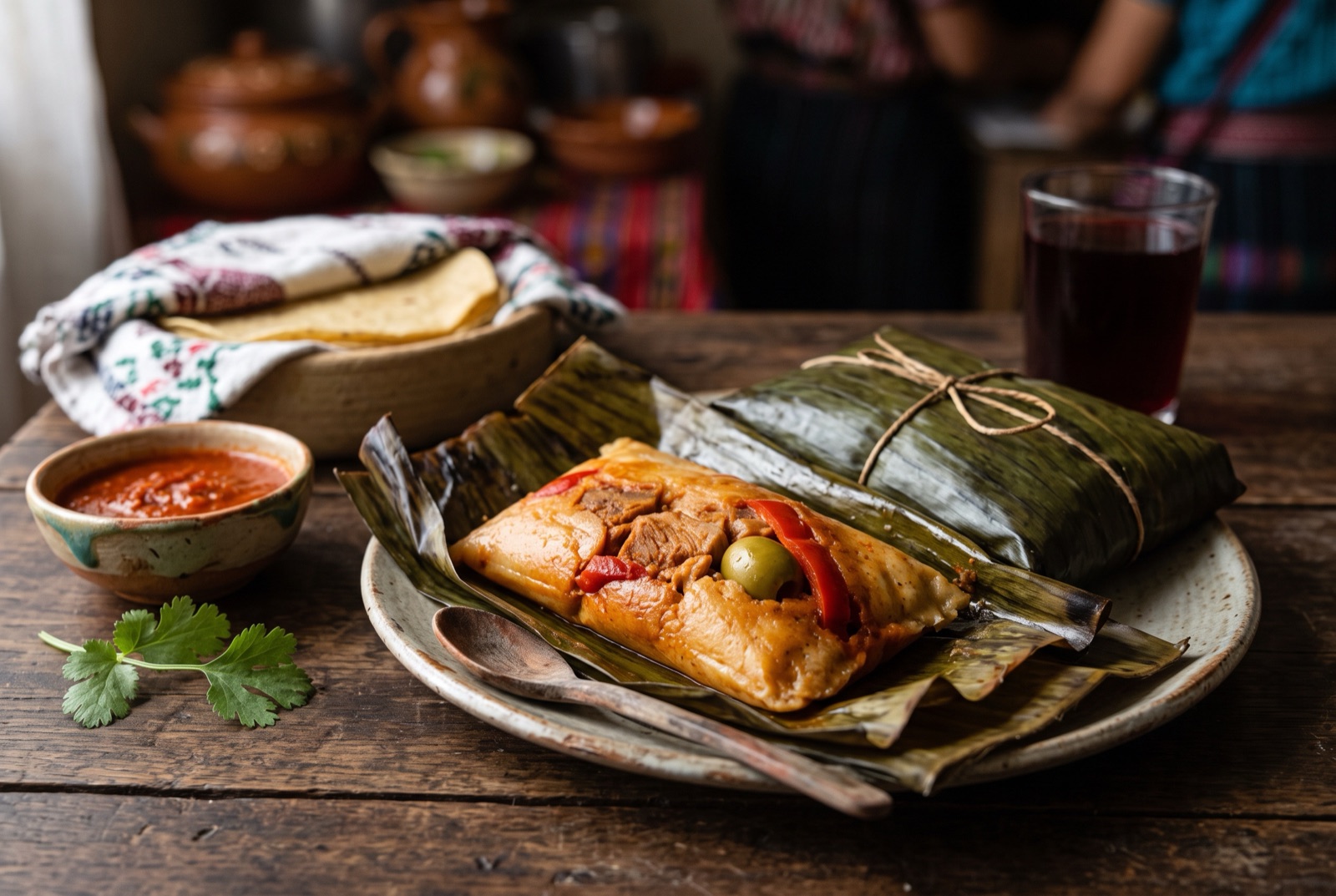
Guatemalan tamales are softer and wetter than their Mexican cousins — closer to a set corn pudding than to a firm cake — and the colorados are the classic weekend version. Corn masa is cooked with fat and broth until it thickens into a smooth paste, spread on a banana leaf, topped with a piece of pork, a ladle of red recado thickened with toasted sesame and pumpkin seeds, an olive and a strip of sweet pepper, then wrapped and steamed until the parcel sets. Unwrapping one at the table releases a smell of hot banana leaf and toasted chile that is unmistakably Guatemalan. The taste is gentle and savoury, faintly smoky, with a briny hit from the olive cutting the richness.

- Gate
- GuatemalaNationwide, strongest in Guatemala City
- Prep
- 1 hr
- Cook
- 3 hr
- Total time
- 4 hr 20 min incl. 20 min rest
- Serves
- 8
- Status
- Takes skill
- Nutrition / serving · estimated
- Calories 590 kcal
- Protein 27 g
- Carbs 52 g
- Fat 31 g
- Fiber 6 g
- Sugar 6 g
- Sodium 940 mg
Why this recipe works.
- Masa cooked on the stove before wrapping, which is what gives Guatemalan tamales their soft, spoonable texture.
- Scaled to eight tamales rather than the family-sized forty, so it fits one pot and one afternoon.
- Clear guidance on softening and folding banana leaves, the step that most often goes wrong outside Guatemala.
- The recado uses the same toasted-seed technique as pepián, explained rather than assumed.
Ingredients.
19 itemsFor the pork
For the red recado
For the masa
For wrapping
Equipment
- Large heavy pot for the masa
- Wooden spoon
- Blender
- Large pot with a lid for steaming
- Kitchen string (optional)
Instructions.
Poach the pork
Simmer the pork chunks with the water, halved onion and salt for 60 minutes, skimming the foam, until a knife slides in with no resistance but the meat still holds together. Lift the pork out and strain the broth — you need about 1.8 litres for the masa and recado.
Toast and char for the recado
Toast the pumpkin seeds in a dry pan until they pop and freckle brown, then the sesame until straw-coloured. Toast the chiles 20 seconds a side until fragrant, then char the tomatoes, quartered onion and unpeeled garlic until the skins blister and blacken in patches.
Tip Seeds burn in seconds. Pull them off the heat while a few are still pale.
Blend and fry the recado
Peel the garlic and blend everything toasted and charred with the achiote and 400 ml of hot broth until smooth. Fry the paste in a spoonful of lard for 8 minutes until it darkens to brick red, thickens, and a slick of oil breaks at the edge of the pan. Season with salt and set aside.
Cook the masa
Whisk the masa harina into 1.4 litres of the warm broth in a heavy pot until lump-free, then add the lard and salt. Cook over medium-low heat, stirring constantly with a wooden spoon, for about 20 minutes, until it thickens into a glossy paste and a spoon dragged across the base leaves a trail that holds.
Tip It will feel like stirring wet cement near the end. That resistance is the sign it is ready.
Prepare the leaves
Pass each banana leaf briefly over a gas flame or dip it in boiling water until it turns glossy, deep green and pliable enough to fold without cracking. Wipe both sides dry and lay them out on the counter.
Assemble
Spread a heaped ladle of masa into a 1 cm thick rectangle in the centre of each leaf. Lay a piece of pork on top, spoon over 2 tablespoons of recado, and add an olive, a strip of red pepper and a few capers.
Wrap and stack
Fold the long sides of the leaf over the filling so they overlap, then tuck both ends underneath to make a sealed parcel. Stack the tamales fold-side down in a large pot lined with spare leaves, over about 4 cm of water.
Steam
Cover and steam over a gentle simmer for 2 hours, topping up with boiling water as needed so the pot never runs dry. The tamales are done when the masa has set firm enough that a parcel feels solid rather than sloshing when lifted.
Rest and serve
Let the tamales sit for 20 minutes off the heat before opening — the masa firms considerably as it cools. Serve in the leaf, opened at the table, with black coffee and bread.
Tips from our kitchen.
- Pass the banana leaves briefly over a flame or dip them in boiling water until they turn glossy and deep green and go floppy. Brittle leaves crack along the fold and the masa leaks out.
- Cook the masa until a spoon dragged across the bottom of the pan leaves a clean line that holds for a second or two. Undercooked masa never sets and the tamal collapses when opened.
- Keep the masa layer about 1 cm thick. Guatemalan tamales are mostly masa, and a thin layer with a big filling falls apart.
- Fold the parcel like a letter, then fold the ends underneath and stack them fold-side down in the pot so their own weight holds them shut. String is optional if the stack is tight.
- Steam over gently simmering water, never a hard boil, and top up with boiling water so the pot never runs dry. Two hours is not negotiable.
- Rest the tamales at least 20 minutes after steaming. Straight out of the pot the masa is loose; it firms as it cools and opens cleanly.
Substitutions.
- Banana leaves → Baking parchment wrapped inside aluminium foil
- You lose the leaf aroma, which is a real loss, but the parcel steams properly and holds its shape. Frozen banana leaves from Asian and Latin grocers are cheap and work perfectly once thawed.
- Fresh masa → Masa harina rehydrated with warm broth
- Fresh nixtamalised masa is better if a tortillería is within reach, but masa harina is the standard home shortcut and gives a very good result.
- Pork shoulder → Bone-in chicken thighs
- Tamales de pollo are equally traditional. Poach the chicken instead of the pork and use its broth in the masa and recado exactly as written.
Variations.
- Tamales negros
- The Christmas version, sweetened and darkened with chocolate, raisins and prunes in the recado — sweet-savoury and much richer.
- Tamales de pollo
- The same red recado and masa built around poached chicken instead of pork, common when feeding a crowd cheaply.
- Paches
- A Quetzaltenango speciality where the masa is made from grated potato rather than corn, traditionally eaten on Thursdays.
Storage & reheating.
Wrapped tamales keep 4 days refrigerated and 3 months frozen, which is exactly why families make so many at once. Reheat them still in their leaves by steaming for 20 minutes, or 35 minutes from frozen. Microwaving works if you leave the parcel wrapped and add a splash of water to the plate, but the masa dries at the edges faster than it does in a steamer.
Serve with
Black coffee, and a bread roll on the side — the standard Guatemalan Saturday-night pairing.
The story behind Tamales Colorados.
Tamales are Mesoamerican, older than any nation on the map, and they remain the food most tied to occasion in Guatemala. The rule in much of the country is simple: tamales are for Saturday night. Families buy or make them in quantity, eat them late with coffee, and reheat the survivors for Sunday breakfast. Then there are the tamales that mark the calendar — the enormous, black chocolate-and-chile tamales negros at Christmas, the tamales de arroz on other holidays, the paches made from potato instead of corn eaten on Thursdays in Quetzaltenango. Colorados are the everyday flagship among them.
The wrapper matters. Mexican tamales are usually tied in corn husks; Guatemalan ones are folded in banana leaves, which are wider, hold more moisture and lend a green, tea-like aroma to the masa. That leaf is one reason Guatemalan tamales are so much softer — the parcel steams almost sealed, so nothing dries out. The other reason is the masa itself, which is cooked on the stove with fat and broth before wrapping rather than simply beaten raw, giving a texture that spreads like thick porridge and sets like custard.
The olive is the giveaway of the Spanish half of the recipe, along with the capers and sweet pepper strips some families add. The recado underneath is the Maya half: seeds and chiles toasted on a comal and ground, exactly as in pepián. Making tamales has always been collective work — someone toasts, someone stirs the masa, someone folds — and a household making forty of them at once is a normal Saturday afternoon, not an event. Making eight at home is a much shorter job, and the method scales down without losing anything.
Questions, answered.
What is the difference between Guatemalan and Mexican tamales?
Guatemalan tamales are wrapped in banana leaves rather than corn husks and use masa that is cooked with fat and broth on the stove before wrapping, so they come out soft, moist and almost custard-like. Mexican tamales are usually beaten raw with lard and steamed in husks, producing a firmer, fluffier, drier crumb.
Why did my tamales fall apart when I unwrapped them?
Either the masa was not cooked long enough before wrapping, or they were opened too soon. The masa must thicken on the stove until a spoon leaves a clear trail, and the finished tamales need at least 20 minutes of resting after steaming so the masa sets. Opening one straight from the pot almost always ends in a puddle.
Where do I find banana leaves?
Frozen banana leaves are sold in Latin American, Caribbean and Southeast Asian grocery stores and keep for months in the freezer. Thaw them, wipe them down, and pass them over a flame until they turn glossy and pliable. Parchment paper inside foil is a workable fallback if you cannot get them at all.
Can I make tamales without a steamer basket?
Yes. Line the base of a large pot with extra banana leaves or a folded tea towel, add about 4 cm of water, and stack the tamales on top so they sit above the waterline. Keep the lid on and top up with boiling water every 40 minutes so the pot never boils dry.
Why is there an olive inside?
It is the Spanish inheritance in an otherwise Mesoamerican dish, alongside the capers and sweet pepper some families add. Beyond tradition it does real work: the brine cuts through the fat of the pork and the richness of the masa, and finding it is part of eating the tamal.
You might also like.
All recipes →
Keep exploring Guatemala.
Guatemala has 9 more dishes in the atlas — Atol de Elote and Chiles Rellenos Guatemaltecos, and 7 more.
All Guatemala recipes Pork shoulder recipes Tomato recipes Sesame seeds recipes maingluten freedairy freeRecipe by The DishRoute Kitchen · published August 20, 2026 · updated August 20, 2026