Gudeg.
Yogyakarta Sweet Jackfruit Stew
Gudeg · say it: GOO-deg
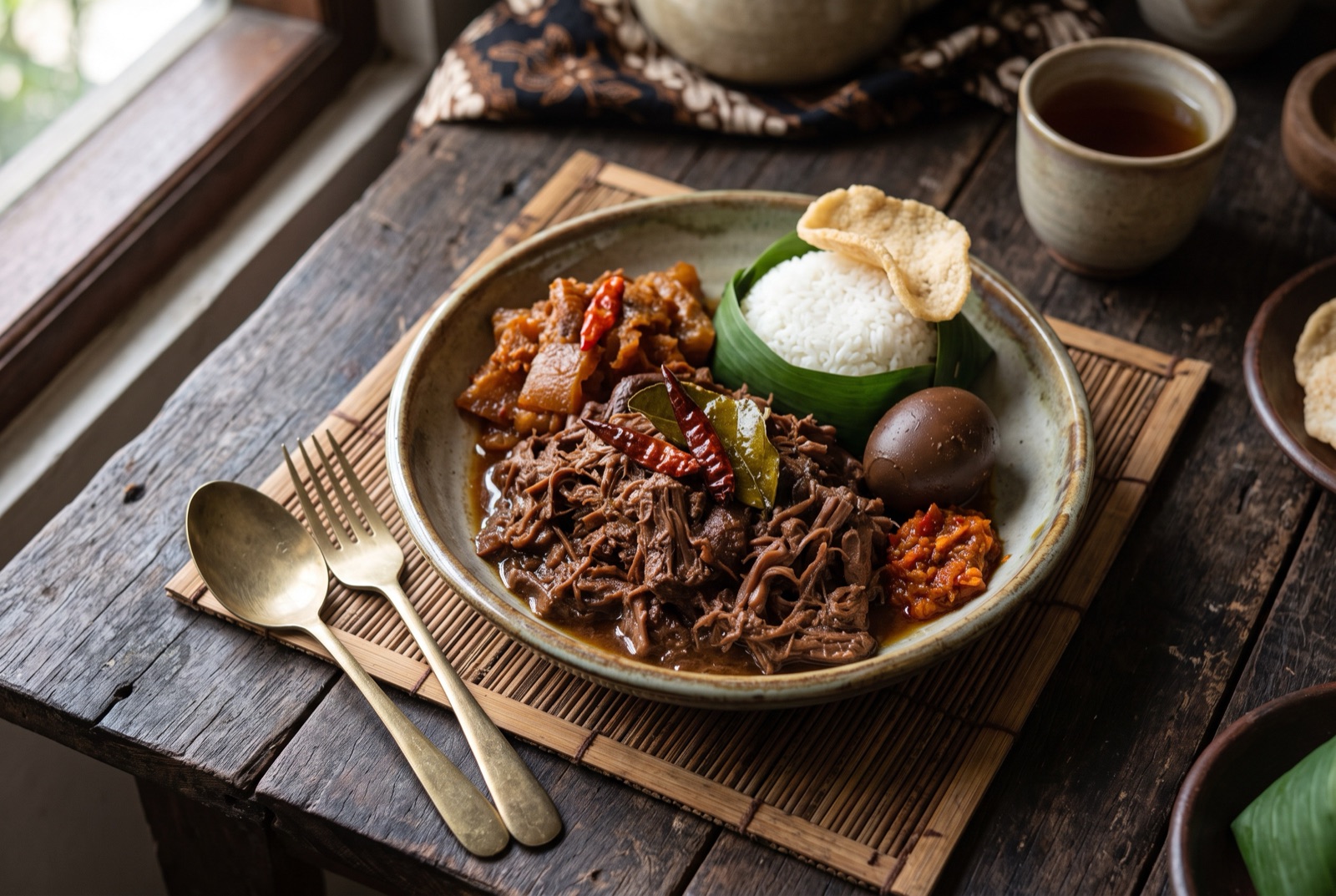
Gudeg tastes like nothing else in Indonesia, and the first spoonful surprises most people: it is properly sweet, closer to a savory jam than a curry, with palm sugar and coconut milk cooked into young jackfruit until the fruit falls apart into soft brown strands. Underneath the sweetness sits garlic, coriander, candlenut and salam leaf, and the dish is never eaten alone — it comes with hard-boiled eggs stewed in the same pot, a fiery-crunchy stew of beef rind called krecek, and rice, so the sweetness always has something salty and hot beside it. Yogyakarta is nicknamed Kota Gudeg, the gudeg city, and this is why.

- Gate
- IndonesiaYogyakarta, Central Java
- Prep
- 25 min
- Cook
- 3 hr
- Total time
- 3 hr 25 min
- Serves
- 6
- Status
- Medium
- Nutrition / serving · estimated
- Calories 445 kcal
- Protein 12 g
- Carbs 46 g
- Fat 25 g
- Fiber 7 g
- Sugar 30 g
- Sodium 690 mg
Why this recipe works.
- Cooks the jackfruit long enough to actually collapse — most shortcut recipes stop while it is still fibrous and crunchy, which is the usual failure.
- Uses black tea and shallot skins to reproduce the mahogany color that teak leaves give in Java, since teak leaves are unavailable almost everywhere else.
- Stews the eggs in the same pot from the start, so they take on the color and the spice instead of being boiled separately and dropped on top.
- Balances the sugar for a palate that has not grown up with gudeg, with a note on how to take it all the way to Yogya sweetness.
Ingredients.
16 itemsFor the stew
For the spice paste
For the pot
To serve
Equipment
- Heavy lidded pot or Dutch oven
- Blender or mortar and pestle for the spice paste
- Wooden spoon
Instructions.
Prepare the jackfruit
Rinse the drained jackfruit under cold water, then boil it in fresh water for 5 minutes and drain again. This strips the tinny brine flavor that otherwise stays in the finished stew. Squeeze the chunks gently to shed excess water.
Blend the spice paste
Blend the shallots, garlic, candlenuts, coriander, cumin and galangal with 3–4 tablespoons of water into a smooth pale paste. Keep the papery shallot skins to one side — they go in the pot for color.
Line and load the pot
Scatter the shallot skins across the base of a heavy pot and lay the jackfruit on top. Add the spice paste, salam leaves, lemongrass, tea bags, salt, the water and half the coconut milk, then nestle in the whole raw eggs, shells on.
Tip The eggs cook and dye in the pot. Tap each shell lightly against the counter first for the marbled pattern Yogya stalls are known for.
Simmer covered
Bring to a boil, then drop to a low simmer, cover and cook for 60 minutes. Lift out the eggs after the first 20 minutes, peel them, and return them to the pot so they keep absorbing color and spice.
Add the sugar and reduce
Fish out the tea bags, stir in the palm sugar and the remaining coconut milk, and continue uncovered at a low simmer for 90–120 minutes. Stir every 15 minutes and press the jackfruit against the side of the pot to help it break down.
Tip Low heat only. Palm sugar and coconut milk scorch on the base well before you can smell it.
Judge the finish
Gudeg is done when the jackfruit has collapsed into soft brown strands, the liquid has reduced to a thick glaze clinging to the fruit, and the color has gone deep reddish brown. Taste and adjust — it should read clearly sweet with a savory, coconut-rich base.
Serve as a set
Spoon the gudeg over hot rice with a stewed egg per person and, if using, a spoonful of salted reduced coconut cream. Put something hot and salty on the plate as well — the sweetness needs a counterweight, and Yogyakartans never serve it without one.
Tips from our kitchen.
- Buy young green jackfruit in brine or water, never the ripe yellow kind in syrup. Ripe jackfruit is a fruit for dessert and turns to sweet mush in ten minutes.
- Rinse canned jackfruit thoroughly and boil it for five minutes in fresh water first. Straight from the tin it carries a metallic brine taste that survives the whole stew.
- Crack the eggshells gently before they go in the pot and the marbled brown pattern will show when you peel them — a small thing Yogya stalls do on purpose.
- Palm sugar is not optional flavor. Its slight smokiness is the reason gudeg does not taste like white sugar syrup; brown sugar plus a teaspoon of molasses is the closest fix.
- Keep the heat low once the sugar is in. Sugar and coconut milk scorch on the base long before you smell it, and burnt gudeg is unsalvageable.
- Make it a day ahead. Gudeg is one of those stews that is measurably better after a night in the fridge, and Yogyakartan cooks reheat the pot repeatedly over several days.
Substitutions.
- Teak leaves → 2 black tea bags plus the papery skins of 6 shallots
- Both bring tannins and a reddish-brown dye without changing the flavor much. Teak leaves are effectively unobtainable outside Java, and no reputable substitute exists for their exact effect.
- Fresh young jackfruit → Canned young green jackfruit in water or brine
- Canned is what almost everyone will use, and it works well — it is already partly softened, so you can take 45 minutes off the total cooking time.
- Salam leaves → Bay leaf, using half the quantity
- Not the same plant and not the same flavor, but it fills the aromatic gap. Salam is milder and slightly sour; a full quantity of bay leaf overwhelms the pot.
- Candlenuts → Macadamia nuts or blanched almonds
- Candlenut is used for body rather than flavor — it thickens the spice paste. Macadamia is the standard swap and behaves almost identically.
Variations.
- Gudeg Solo
- The wetter, paler rival from Surakarta: far more coconut milk, much less palm sugar, no long reduction. Served soupy with areh spooned over the top.
- Gudeg kering
- The dry travelling version, cooked even further until barely any moisture remains. It keeps for days unrefrigerated and is the style sold in cans and boxes as souvenirs.
- Gudeg manggar
- Made with young coconut flower buds instead of jackfruit, a rarer Bantul specialty with a firmer, slightly crunchy texture and a more floral aroma.
Storage & reheating.
Gudeg keeps 4 days refrigerated and genuinely improves for the first two. Reheat gently in a pan with a splash of water or coconut milk, stirring so the sugar does not catch. It freezes for 2 months, though the jackfruit softens further on thawing. The eggs should be stored in the stew rather than peeled, so they keep taking on color and seasoning.
Serve with
Steamed white rice, hard-boiled eggs from the pot, and something sharp and hot alongside — sambal goreng krecek if you can get beef rind, otherwise a chile-heavy sambal and stir-fried greens.
The story behind Gudeg.
Gudeg is Yogyakarta food in a way few dishes belong to a single city. It is sold from dawn at streetside stalls where women ladle it from clay pots, from all-night warungs on Jalan Wijilan where the pots have been going since the afternoon, and packed into sealed containers as oleh-oleh — the gift of local food that Indonesians are expected to bring home from a trip. The name is said to come from hangudek, the Javanese word for the endless stirring the pot demands, and anyone who has made it will find that plausible.
The classic version, gudeg Yogya, is the sweet dry one. The jackfruit is cooked down for many hours with palm sugar until almost no liquid is left and the strands turn deep reddish brown. That color is not caramel alone — cooks line the pot with teak leaves, whose tannins bleed a natural mahogany dye into the stew. Solo, ninety minutes away, makes gudeg differently: wetter, paler, with more coconut milk and far less sugar, and Solonese will happily tell you the Yogya version is dessert pretending to be lunch. Neither city concedes.
What arrives on the plate is a study in contrast, and gudeg is always served as a set. Nasi gudeg means rice topped with the jackfruit, plus telur pindang (eggs simmered so long in the spiced liquid that the whites turn brown and dense), sambal goreng krecek (puffed beef rind cooked in chile until it crackles), opor ayam in coconut gravy, and a spoonful of thick areh — reduced coconut milk. The sweetness only makes sense in company. Eating gudeg on its own is like eating the jam and skipping the toast, and Yogyakartans would consider it an odd thing to do.
Questions, answered.
Why is my gudeg still tough and stringy after two hours?
Either the jackfruit was too mature or the heat was too low to break it down. Young green jackfruit collapses; anything approaching ripeness stays fibrous no matter how long you cook it. If the fruit is right, cover the pot and hold a steady gentle simmer rather than the barest flicker, and crush the pieces against the side of the pot with a spoon halfway through to help them along.
Is gudeg supposed to be this sweet?
Yes, if it is Yogyakarta gudeg. Sweetness is the defining trait of the style, and locals eat it with salty, fiery accompaniments that reset the palate between bites. If it is too much for you, halve the palm sugar and add a squeeze of lime at the end — you will have something closer to Solo-style gudeg, which is a real dish rather than a compromise.
What can I use instead of teak leaves for the color?
Black tea and shallot skins, both of which are in this recipe. Teak leaves work because of their tannins and red pigment, and strong black tea supplies tannin while shallot skins supply a warm brown dye. The color will be a shade lighter than a Yogyakarta pot, which is worth accepting rather than reaching for food coloring.
Is gudeg vegan?
The jackfruit stew itself is, once you leave out the eggs — it is jackfruit, coconut milk, palm sugar and spices. But gudeg is almost never served alone, and the traditional accompaniments are not vegan: eggs, chicken in coconut gravy, and krecek made from beef rind. Serve a vegan gudeg with tempe orek and sambal instead and you have a complete, honest plate.
Can I make gudeg in a pressure cooker?
You can shorten the first stage. Pressure cook the jackfruit with the spice paste and stock for 20 minutes to soften it, then release, add the coconut milk and palm sugar, and finish uncovered on the stove for at least 45 minutes. The final open reduction is where the sugar concentrates and the color deepens, so it cannot be skipped.
You might also like.
All recipes →
Keep exploring Indonesia.
Indonesia has 9 more dishes in the atlas — Bakso and Bubur Ayam, and 7 more.
All Indonesia recipes Eggs recipes Garlic recipes Onion recipes mainvegetariangluten freedairy freehalal friendlyRecipe by The DishRoute Kitchen · published August 19, 2026 · updated August 19, 2026