Soto Ayam.
Javanese Turmeric Chicken Noodle Soup
Soto ayam · say it: SOH-toh AH-yahm
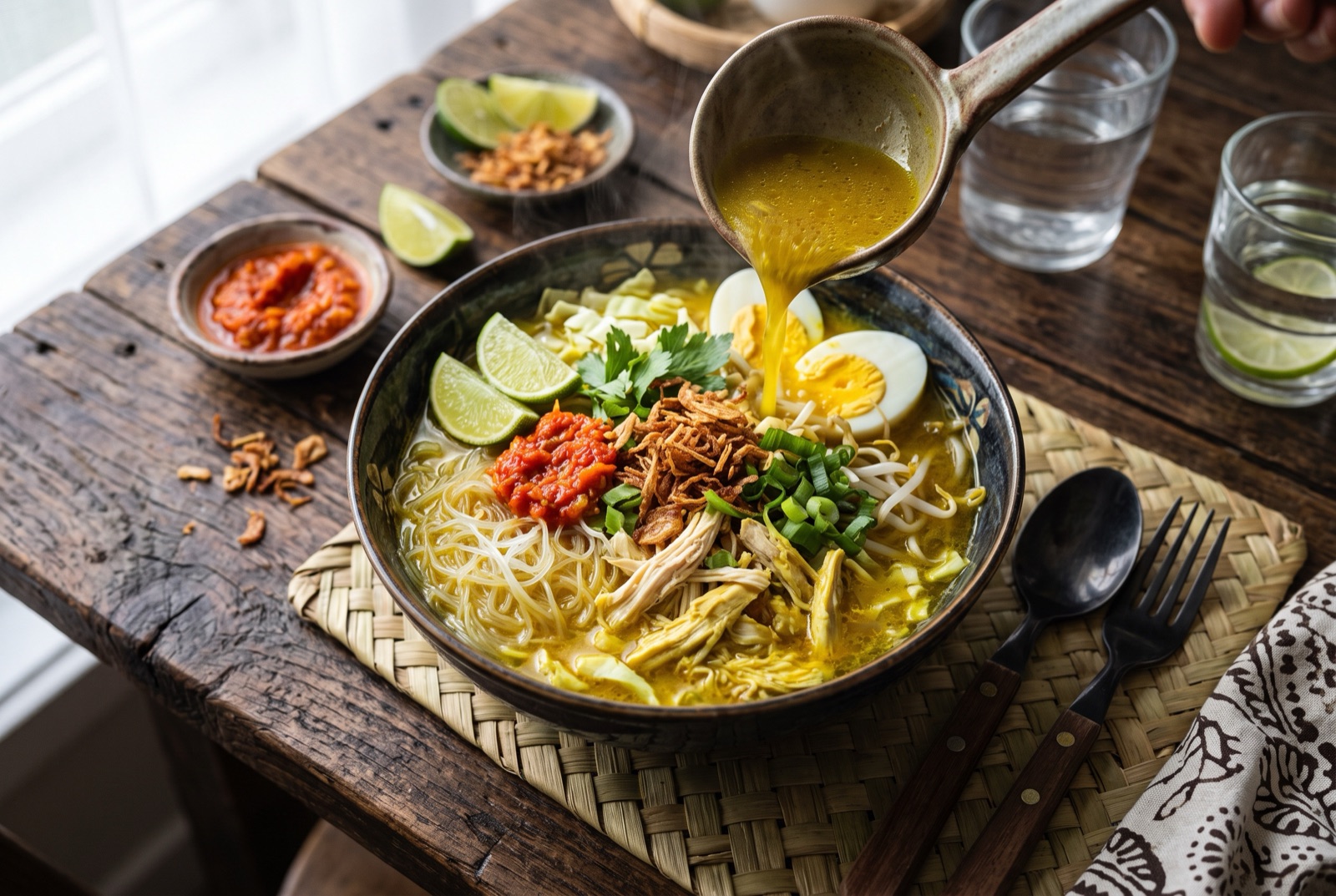
Soto ayam is the chicken soup Indonesians reach for when they are tired, hungover, unwell or just hungry at an odd hour. The broth is stained yellow with turmeric and perfumed with lemongrass, galangal and kaffir lime, but it stays light — this is a clear soup, not a curry, and the coconut milk that Western recipes often add belongs to other regional versions rather than this one. Assembly is the fun part: noodles, shredded poached chicken, cabbage, bean sprouts and boiled egg go in the bowl first, hot broth goes over, and then you finish it yourself with lime, sambal, sweet soy and a heavy handful of crisp fried shallots. It takes about an hour and most of that is the pot working alone.

- Gate
- IndonesiaJava
- Prep
- 25 min
- Cook
- 45 min
- Total time
- 1 hr 10 min
- Serves
- 4
- Status
- Easy
- Nutrition / serving · estimated
- Calories 480 kcal
- Protein 38 g
- Carbs 36 g
- Fat 20 g
- Fiber 4 g
- Sugar 6 g
- Sodium 1180 mg
Why this recipe works.
- Poaches the chicken and builds the broth in a single pot, so nothing is wasted and the soup tastes of chicken rather than of stock cubes.
- Keeps the broth clear and turmeric-yellow the way Javanese soto ayam should be, instead of turning it into a coconut curry.
- Fries the shallots from scratch with timing that actually produces crisp ones rather than bitter brown ones.
- Sets up the bowl as an assembly, so everyone at the table seasons their own with lime, sambal and sweet soy.
Ingredients.
24 itemsFor the broth
For the spice paste
For the bowls
To finish
Equipment
- Large pot
- Small frying pan for the shallots and paste
- Blender or mortar and pestle
- Slotted spoon
Instructions.
Fry the shallots first
Cover the sliced shallots with 1 cm of neutral oil in a cold pan, set it over medium-low heat, and fry for 12–15 minutes, stirring, until they turn pale gold and the bubbling slows. Lift them out while still light — they darken as they drain on paper.
Tip Keep the fragrant shallot oil. A teaspoon spooned over each finished bowl is standard practice in Javanese warungs.
Start the broth
Put the chicken in a large pot with the water, bring to a boil, and skim off the grey foam that rises in the first few minutes. Add the lemongrass, kaffir lime leaves, salam leaves, salt and sugar, then drop the heat so bubbles only break occasionally.
Blend and fry the spice paste
Blend the shallots, garlic, turmeric, ginger, galangal, candlenuts, coriander and white pepper with a splash of water into a smooth yellow paste. Fry it in the oil over medium heat for 6–8 minutes until it darkens slightly, smells sweet rather than raw, and oil beads at the edge.
Combine and simmer
Scrape the fried paste into the broth, rinsing the pan out with a ladle of stock so nothing is left behind. Simmer gently for 30 minutes until the chicken is fully tender and the broth has turned deep golden and clearly aromatic.
Shred the chicken
Lift out the chicken and let it cool enough to handle, then pull the meat off the bones in rough shreds and discard skin and bones. Return the bones to the pot for another 10 minutes if you have time, then strain the broth and taste for salt.
Prepare the bowl components
Soak the glass noodles in hot water for 5 minutes until pliable, then drain well. Blanch the cabbage and bean sprouts for 30 seconds so they soften slightly but keep their bite, and halve the boiled eggs.
Assemble and serve
Divide noodles, cabbage, sprouts and shredded chicken between four bowls, add half an egg to each, and ladle the hot broth over until everything is just covered. Top with scallions and a generous heap of fried shallots, then serve with lime wedges, sambal and kecap manis on the table.
Tip Assemble at the last minute. Noodles left standing in broth swell and drink half the soup.
Tips from our kitchen.
- Use bone-in chicken. Thighs and drumsticks give you a broth with body; boneless breast gives you hot yellow water and dry meat.
- Skim the foam in the first ten minutes and never let the pot boil hard afterwards. A rolling boil emulsifies the fat and turns a clear broth cloudy.
- Fry the spice paste before it goes into the broth. Raw turmeric paste stirred straight into liquid tastes chalky and slightly bitter for the whole meal.
- Fried shallots need low, patient heat and must come out of the oil while still pale gold — they keep darkening on the paper towel and go bitter if you wait for brown in the pan.
- Soak glass noodles rather than boiling them, and put them in the bowl dry-ish. Noodles left sitting in broth swell up and drink the soup.
- Season the broth slightly stronger than you would want to sip, because the noodles, cabbage and egg in the bowl dilute it noticeably.
Substitutions.
- Fresh turmeric → 2 tsp ground turmeric, added with the other dry spices
- Fresh has a cleaner, faintly citrus edge, but ground turmeric gives the same color and is what most Indonesian home cooks abroad use. Add it to the paste as it fries so it loses its raw taste.
- Glass noodles (bihun) → Thin rice vermicelli, or a scoop of steamed rice
- Rice is the more traditional base in much of Java — soto ayam with rice is called soto ayam nasi and is not a lesser version.
- Kaffir lime leaves → A strip of lime zest added at the end of simmering
- Weaker but recognizable. Kaffir lime leaves freeze indefinitely, so buy a bag when you find them and keep them in the freezer.
- Candlenuts → Macadamia nuts, or 1 tbsp raw cashews
- They thicken and round out the spice paste rather than adding flavor of their own, so any soft, oily nut does the job.
Variations.
- Soto Lamongan
- Finished with koya — prawn crackers and fried garlic crushed to a powder — dusted heavily over the bowl. It thickens the broth slightly and adds a savory, toasty depth.
- Soto Betawi
- The Jakarta version, and a different animal: beef and offal in a rich broth loosened with milk or coconut milk, garnished with tomato and fried potato.
- Soto mie
- Made with wheat noodles instead of glass noodles and bulked out with beef tendon and risoles — spring-roll pastry cut into the bowl. A Bogor speciality.
Storage & reheating.
Store the broth separately from the noodles, chicken and garnishes — a bowl assembled and refrigerated turns into swollen noodles in cloudy soup. The broth keeps 3 days refrigerated or 3 months frozen and reheats perfectly. Shredded chicken keeps 3 days in a little of the broth so it does not dry out. Fried shallots go soft in the fridge; keep them in a sealed jar at room temperature for up to a week.
Serve with
Steamed rice on the side, extra sambal, lime wedges, kecap manis, and prawn crackers for crunch.
The story behind Soto Ayam.
Soto is less a recipe than a category. Across Indonesia there are dozens of named sotos, each belonging to a town and each convinced of its superiority: soto Lamongan with its koya powder of crushed crackers and fried garlic, soto Kudus served in small bowls and traditionally made with buffalo, soto Betawi from Jakarta thick with milk or coconut, soto Madura darker and heavier on the candlenut, coto Makassar in Sulawesi built on offal and peanuts. Soto ayam — the clear yellow chicken one from Java — is the version that travelled furthest and became the default abroad.
Where soto came from is genuinely contested. Food historians have traced likely roots to Chinese caudo or jao to, a meat-and-offal soup brought by immigrants to Java, with the name shifting as it took local form and local spices. Others emphasize the indigenous Javanese jamu tradition and its turmeric-heavy medicinal broths. The honest answer is that soto is a hybrid, like most Indonesian street food, and the argument about which parent counts more is not settled.
What is not in dispute is how it is eaten. Soto belongs to warungs and to carts — the seller keeps a pot at a permanent simmer, the bowls are assembled to order in seconds, and the condiments sit on the table for you to attack: sambal, sweet kecap manis, lime wedges, and often a plate of satay-like skewers of chicken heart or quail egg to add on. In much of Java it is served with rice rather than noodles, and in Lamongan the koya is dusted over the top so thickly the broth turns cloudy. The one non-negotiable is bawang goreng, the fried shallots, added last so they are still crisp when the bowl reaches you.
Questions, answered.
Why is my soto broth cloudy instead of clear and golden?
Usually because it boiled. Hard bubbling breaks up the fat and protein and suspends them in the liquid, and once the broth is cloudy it will not clarify again. Bring it to a boil once, skim the grey foam that rises in the first ten minutes, then hold it at a bare simmer where bubbles break only occasionally on the surface.
Does soto ayam have coconut milk in it?
Javanese soto ayam does not — it is a clear turmeric broth, and the coconut belongs to other members of the soto family such as soto Betawi or the Sumatran soto Padang style. Many international recipes add coconut milk anyway, which produces a pleasant soup but not this one. If you want richness, add a spoonful to your own bowl rather than the pot.
Can I make soto ayam ahead of time?
Yes, and the broth is better on day two. Cook the broth and chicken up to three days ahead and refrigerate them separately, then reheat the broth, soak fresh noodles and assemble bowls just before eating. The only thing that cannot be prepared far ahead is the fried shallots, which lose their crunch after a day or two.
What are the fried shallots on top and can I skip them?
Bawang goreng — shallots sliced paper thin and fried slowly until crisp. They are not decoration: they add the sweet, toasty crunch that carries the whole bowl, and Indonesians add them to almost everything. You can buy them in tubs at any Asian grocery, which is a completely normal shortcut. Skipping them entirely leaves the soup noticeably flat.
What is the difference between soto and other Indonesian soups?
Soto is a specific family: a spiced broth built on a fried aromatic paste, served over a starch with garnishes and finished by the eater with lime and sambal. Sop, by contrast, is a plainer clear soup closer to European broth, usually with vegetables and no spice paste. Nearly every Indonesian region has at least one soto of its own, named after the town it comes from.
You might also like.
All recipes →
Keep exploring Indonesia.
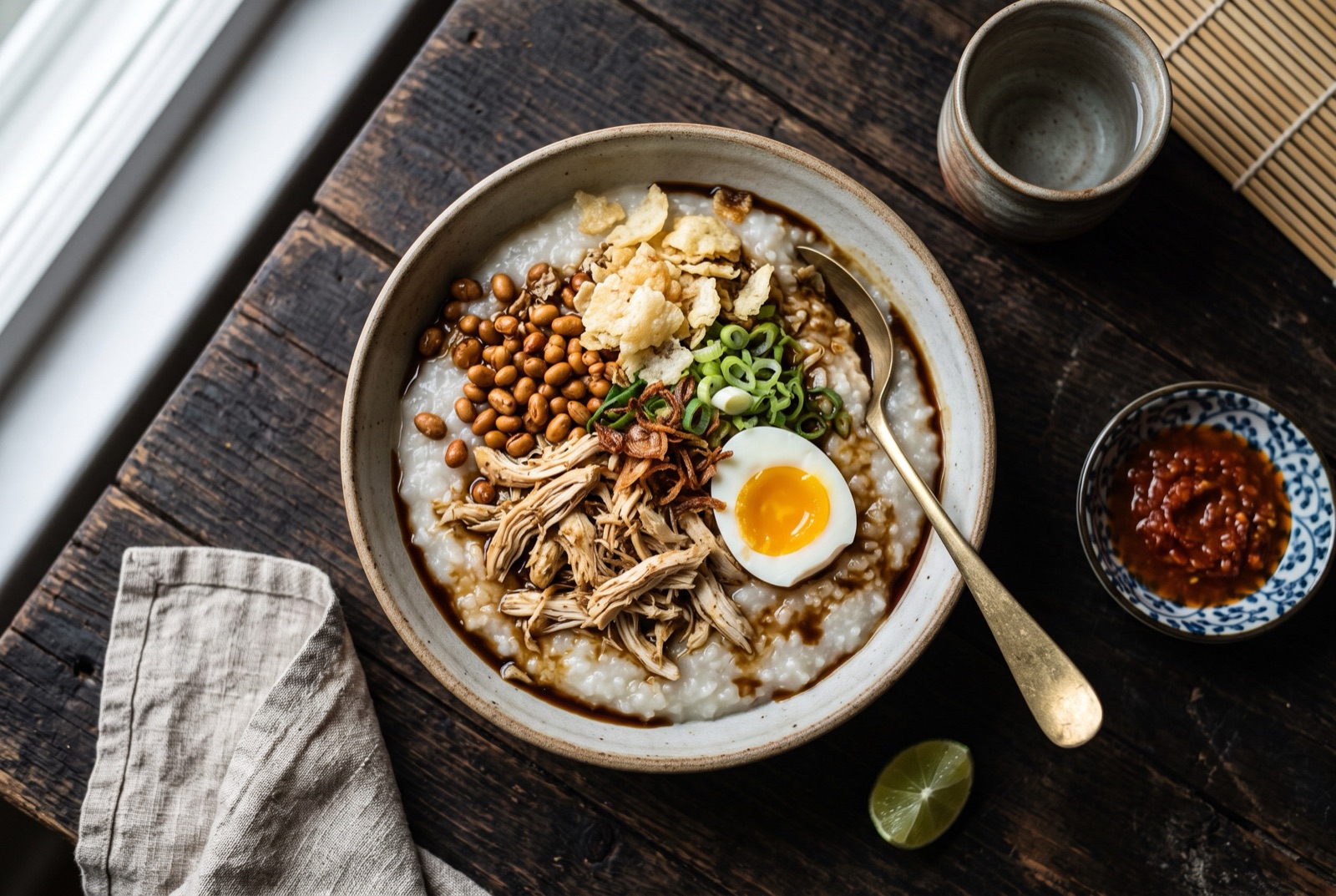
Indonesia has 9 more dishes in the atlas — Bakso and Bubur Ayam, and 7 more.
Recipe by The DishRoute Kitchen · published August 19, 2026 · updated August 19, 2026