Bubur Ayam.
Indonesian Chicken Rice Porridge
Bubur ayam · say it: BOO-boor AH-yahm
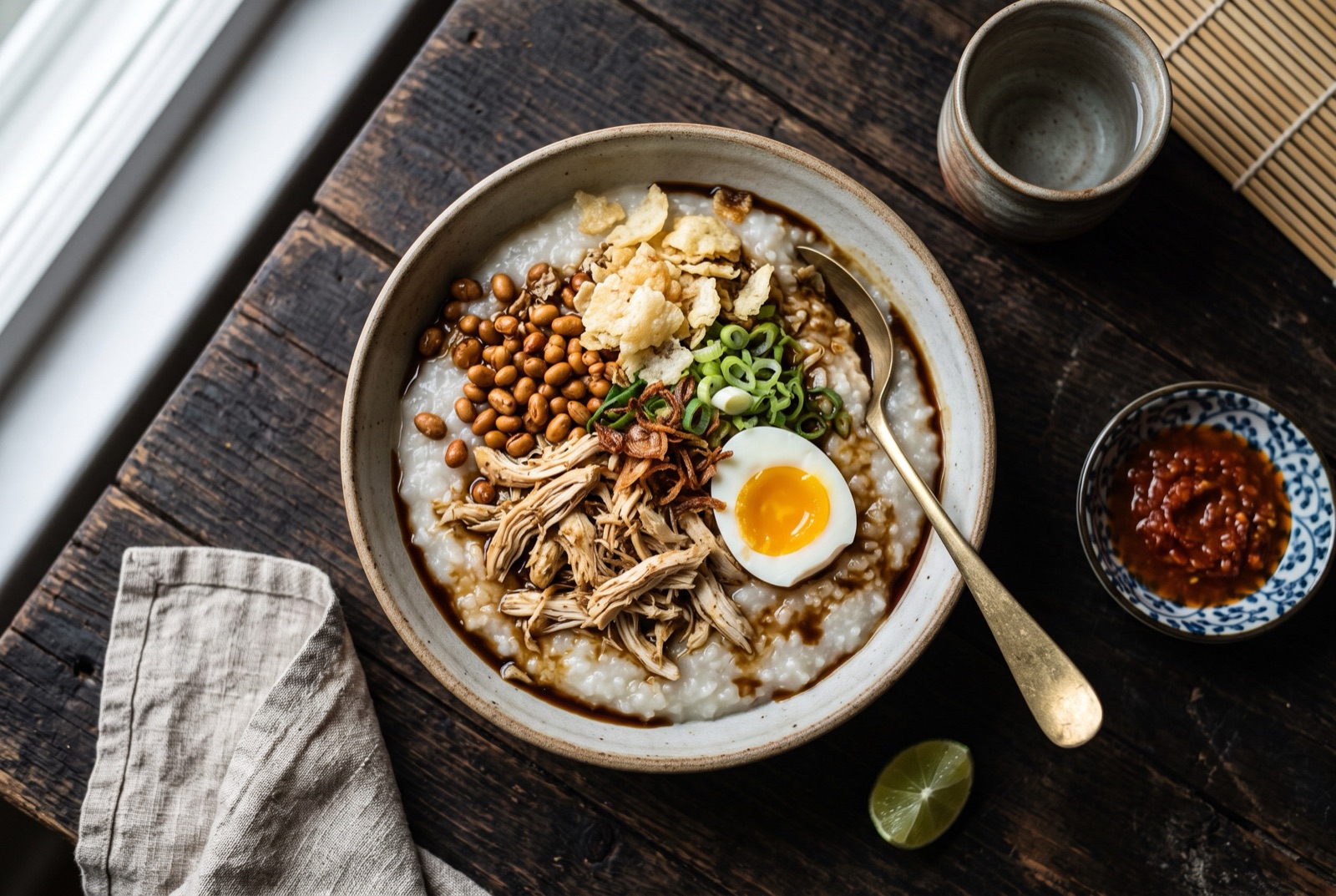
Bubur ayam is breakfast in Indonesia, sold from carts that appear at dawn and are gone by ten. The base is rice cooked far past done in chicken broth until the grains dissolve into a loose, glossy porridge, faintly sweet from ginger and rich enough that it never tastes like invalid food. What turns it into a proper meal is what goes on top, and the toppings are the entire personality of the dish: shredded poached chicken, a drizzle of dark kecap manis, fried soybeans, crushed prawn crackers, scallions, fried shallots and a spoon of sambal, all of it added in a pile so each mouthful gets some crunch. Traditionally you are asked one question when you order — mixed or not.

- Gate
- IndonesiaJava
- Prep
- 15 min
- Cook
- 1 hr 10 min
- Total time
- 1 hr 25 min
- Serves
- 4
- Status
- Easy
- Nutrition / serving · estimated
- Calories 470 kcal
- Protein 30 g
- Carbs 55 g
- Fat 15 g
- Fiber 3 g
- Sugar 9 g
- Sodium 1250 mg
Why this recipe works.
- Poaches the chicken first and cooks the rice in that broth, so the porridge itself is seasoned rather than needing to be rescued by toppings.
- Gives a ratio that produces a loose, pourable porridge instead of the stiff rice pudding most recipes end up with.
- Includes the thin yellow kuah kuning gravy that carts ladle around the bowl and most home recipes leave out entirely.
- Sets out the full topping tray so you can build it layered or stirred and settle the national argument for yourself.
Ingredients.
21 itemsFor the porridge
For the yellow gravy
To finish
Equipment
- Heavy-bottomed pot
- Flat-edged wooden spoon
- Small saucepan for the gravy
- Ladle
Instructions.
Poach the chicken
Put the chicken, water, ginger, salam leaves, lemongrass and salt in a heavy pot. Bring to a boil, skim the foam, then simmer gently for 25 minutes until the meat pulls easily from the bone. Lift the chicken out and set the broth aside.
Shred the chicken
When cool enough to handle, pull the meat into fine shreds and discard the skin and bones. Toss the shreds with a tablespoon of the broth so they do not dry out while the porridge cooks.
Cook the porridge
Return 1.5 litres of the strained broth to the pot, add the rinsed rice, and simmer over low heat for 45–55 minutes, stirring every few minutes and scraping the base. Add hot broth or water whenever it thickens past pourable.
Tip Done is when the grains have lost their shape entirely and the porridge falls off a lifted spoon in a thick, unbroken ribbon.
Make the yellow gravy
Blend the shallots, garlic, turmeric, candlenuts and coriander with a splash of water, then fry the paste in the oil over medium heat for 5 minutes until it darkens and smells sweet. Pour in the 300 ml of broth and simmer 10 minutes to a thin, deep yellow sauce.
Season the porridge
Taste the porridge and correct with salt and a little white pepper. It should be savory and satisfying on its own — if it needs the toppings to taste like anything, add more salt now rather than at the table.
Build the bowls
Ladle the porridge into four bowls, spoon the yellow gravy around the edge, and heap the shredded chicken in the centre. Add scallions, celery leaf and a drizzle of kecap manis over the top.
Add the crunch last
Scatter the fried shallots, fried soybeans and crushed crackers over each bowl at the moment you serve it, with sambal and lime on the side. Do not add them earlier — they go soft in under a minute in hot porridge.
Tips from our kitchen.
- Use short or medium-grain rice. Long-grain basmati resists breaking down and gives you soup with rice in it rather than porridge.
- The ratio is roughly 1 part rice to 9 parts liquid by volume, and you will still need to add more broth as it cooks — porridge thickens dramatically as it sits.
- Stir every few minutes and scrape the base with a flat-edged spoon. Rice starch settles and scorches, and burnt porridge cannot be saved.
- Season the porridge itself, not just the toppings. Taste it at the end and it should be pleasant to eat plain; if it needs the kecap manis to be edible, it is underseasoned.
- Add crackers and fried soybeans at the very last second, at the table. Ten seconds in hot porridge and the crunch is gone.
- If it stiffens while you serve, whisk in hot broth a splash at a time. Cold liquid makes it gluey and lumpy.
Substitutions.
- Kecap manis → 3 tbsp soy sauce simmered with 2 tbsp dark brown sugar until syrupy
- This gets you very close for a single meal. If you cook Indonesian food more than occasionally, a bottle of the real thing is cheap and lasts for months.
- Fried soybeans (kacang kedelai) → Roasted salted peanuts, roughly crushed
- Not the same nut, but the same job — salty crunch scattered over the top. Skip both if you are cooking nut-free and lean harder on crackers.
- Prawn crackers (krupuk) → Plain rice crackers, or fried wonton skins broken into shards
- Krupuk are sold at every Asian grocery and keep for months. Any airy fried cracker fills the role.
- Cakwe (fried dough sticks) → Sliced Chinese youtiao from a bakery, or leave it out
- Cakwe is the same fried cruller as youtiao and often sold frozen. It is a common topping rather than a required one.
Variations.
- Bubur ayam Bandung
- Richer, with a thicker yellow chicken gravy poured generously over the porridge and often a skewer of chicken hearts or quail eggs served alongside.
- Bubur Manado (tinutuan)
- A North Sulawesi porridge and a different dish entirely: rice cooked with pumpkin, sweet corn, cassava and a mass of greens, served with salted fish and chile sambal.
- Bubur ayam diaduk
- Not a recipe change but a serving stance — everything stirred into the porridge before eating rather than kept in layers. Indonesians argue about this constantly.
Storage & reheating.
Porridge keeps 3 days refrigerated but sets almost solid when cold — this is normal. Reheat in a pan with plenty of hot broth or water, whisking until it loosens back to a pourable consistency. Keep the chicken and the gravy in separate containers, and never store the crunchy toppings anywhere near the porridge. It freezes for a month, though the texture comes back slightly grainier.
Serve with
Sambal on the side, a squeeze of lime, and skewers of quail egg or fried tofu if you want the full cart experience.
The story behind Bubur Ayam.
Rice porridge belongs to all of Asia, and Indonesia's version came in with Chinese congee before being rebuilt around local aromatics and street-cart logic. What makes bubur ayam its own thing is the topping architecture. A Chinese congee tends to be seasoned within the bowl; an Indonesian bubur is a plain, well-made canvas with a market stall's worth of textures piled on top — the crunch of krupuk and kacang kedelai, the sweetness of kecap manis, the sharpness of sambal, the savory hit of the thin kuah kuning gravy that many sellers ladle around the edge.
The cart is the institution. Sellers push their gerobak into position before sunrise, work through the morning rush of schoolchildren and office workers, and pack up when the pot is empty. Alongside the standard toppings, many carts keep a tray of skewers to add on: chicken intestine, quail eggs, chicken hearts, fried tofu. Bandung is particularly associated with the dish and its style tends to be richer, with a thicker chicken gravy; Jakarta carts lean sweeter with more kecap manis.
And then there is the argument. Indonesians divide, loudly and permanently, over whether bubur ayam should be stirred — diaduk — or eaten in layers, so each spoon takes a bit of everything without the toppings dissolving into the porridge. It is a running national joke, the subject of endless online sparring, and asking someone which camp they belong to is a reliable way to start a conversation over breakfast. There is no correct answer, but everybody has one.
Questions, answered.
What kind of rice should I use for bubur ayam?
Short or medium-grain white rice, which has enough surface starch to break down into a creamy porridge. Jasmine works reasonably well and is what most Indonesian households use. Avoid basmati and parboiled rice: both are bred to stay separate and firm, so they float in the liquid instead of dissolving into it, no matter how long you cook them.
Should I stir the toppings in or eat them in layers?
Genuinely a matter of taste, and one Indonesians argue about with real enthusiasm. Stirring gives every spoonful the same flavor and softens the crackers; eating in layers keeps the crunch distinct against the smooth porridge. Try it unstirred the first time, since you can always mix it later, and the reverse is not true.
My porridge went thick and gluey. Can I fix it?
Yes. Whisk in hot chicken broth a ladle at a time over low heat until it flows off the spoon in a thick ribbon rather than sitting in a lump. Always use hot liquid — cold broth shocks the starch and makes the texture stringy. Porridge also thickens sharply as it cools, so make it looser than you think you want.
Can I make bubur ayam in a rice cooker or slow cooker?
A rice cooker with a porridge or congee setting handles it well and removes the risk of scorching. In a slow cooker, use the same rice-to-broth ratio and cook on low for 4 hours, stirring once or twice. Either way, cook the chicken separately and shred it, because chicken left in a slow cooker for hours turns dry and stringy.
Is bubur ayam eaten only for breakfast?
Mostly, yes — the carts run from before dawn until mid-morning and then disappear. It is also standard food for someone unwell, and some sellers work evenings for a late-night crowd. Outside those windows it is unusual to see it, and an Indonesian would find lunchtime bubur a slightly odd choice.
You might also like.
All recipes →
Keep exploring Indonesia.
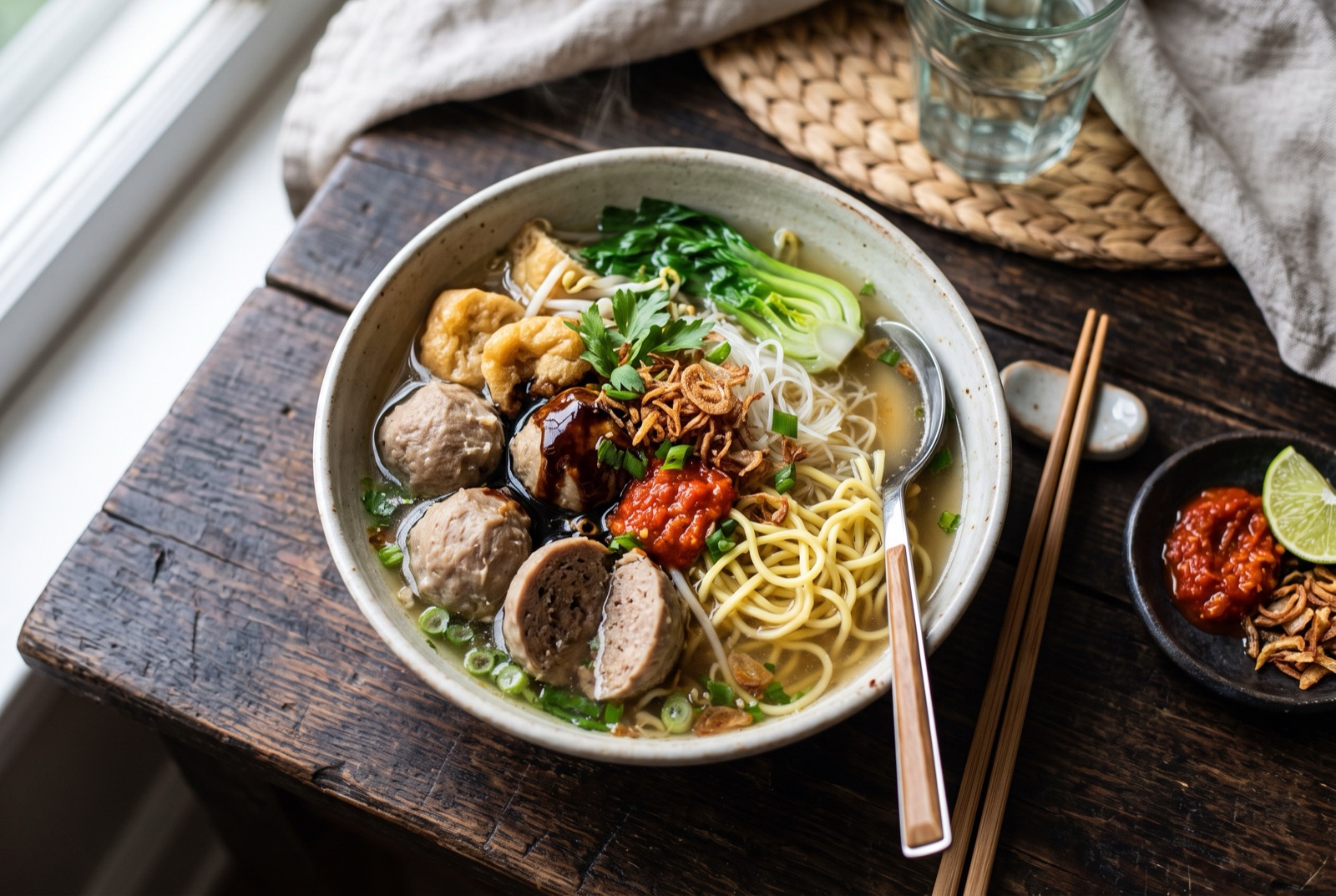
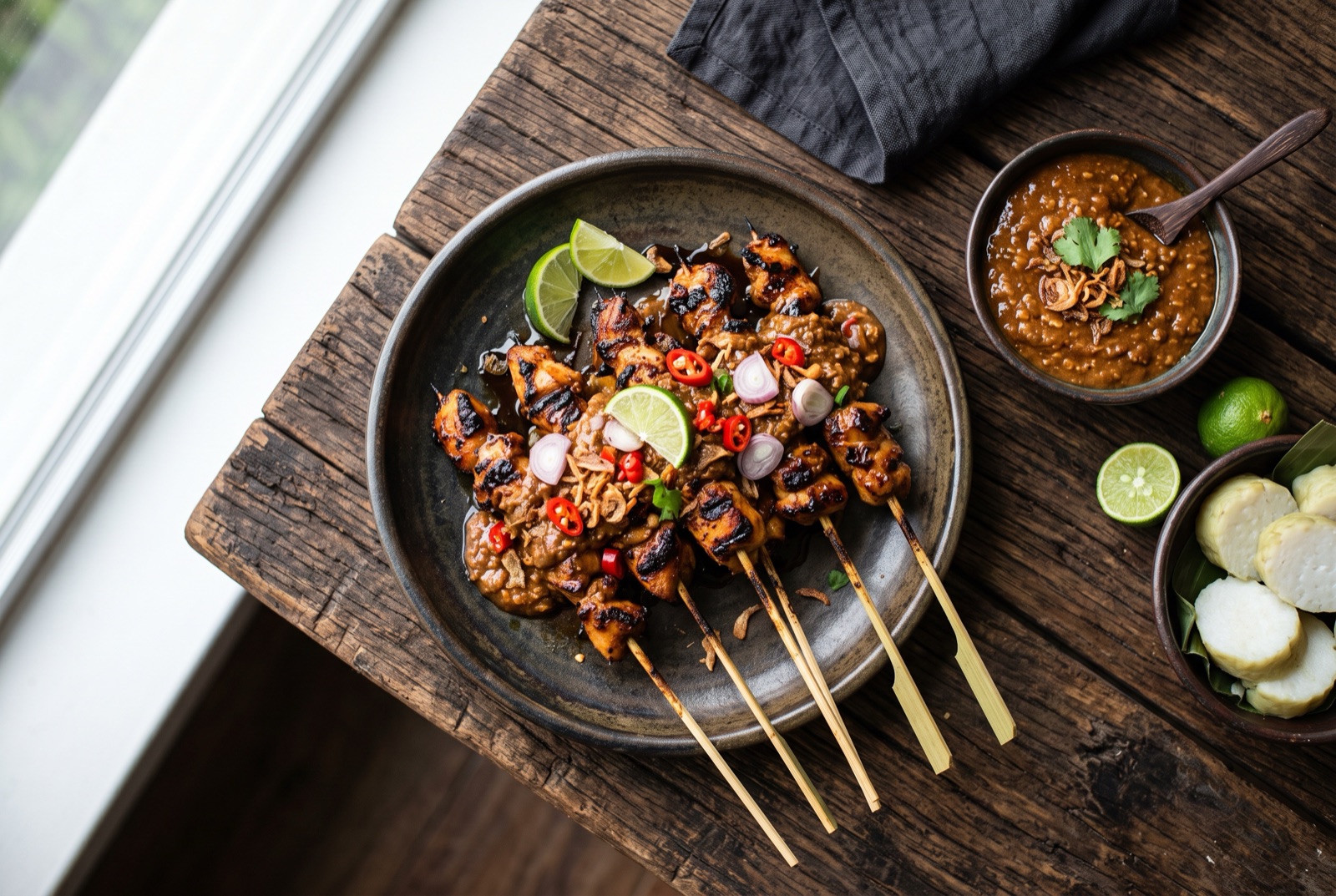
Indonesia has 9 more dishes in the atlas — Bakso and Chicken Satay with Peanut Sauce, and 7 more.
All Indonesia recipes Rice recipes Chicken recipes Ginger recipes breakfastmaindairy freehalal friendlyRecipe by The DishRoute Kitchen · published August 19, 2026 · updated August 19, 2026