Chicken Satay with Peanut Sauce.
Sate ayam · say it: SAH-teh AH-yam
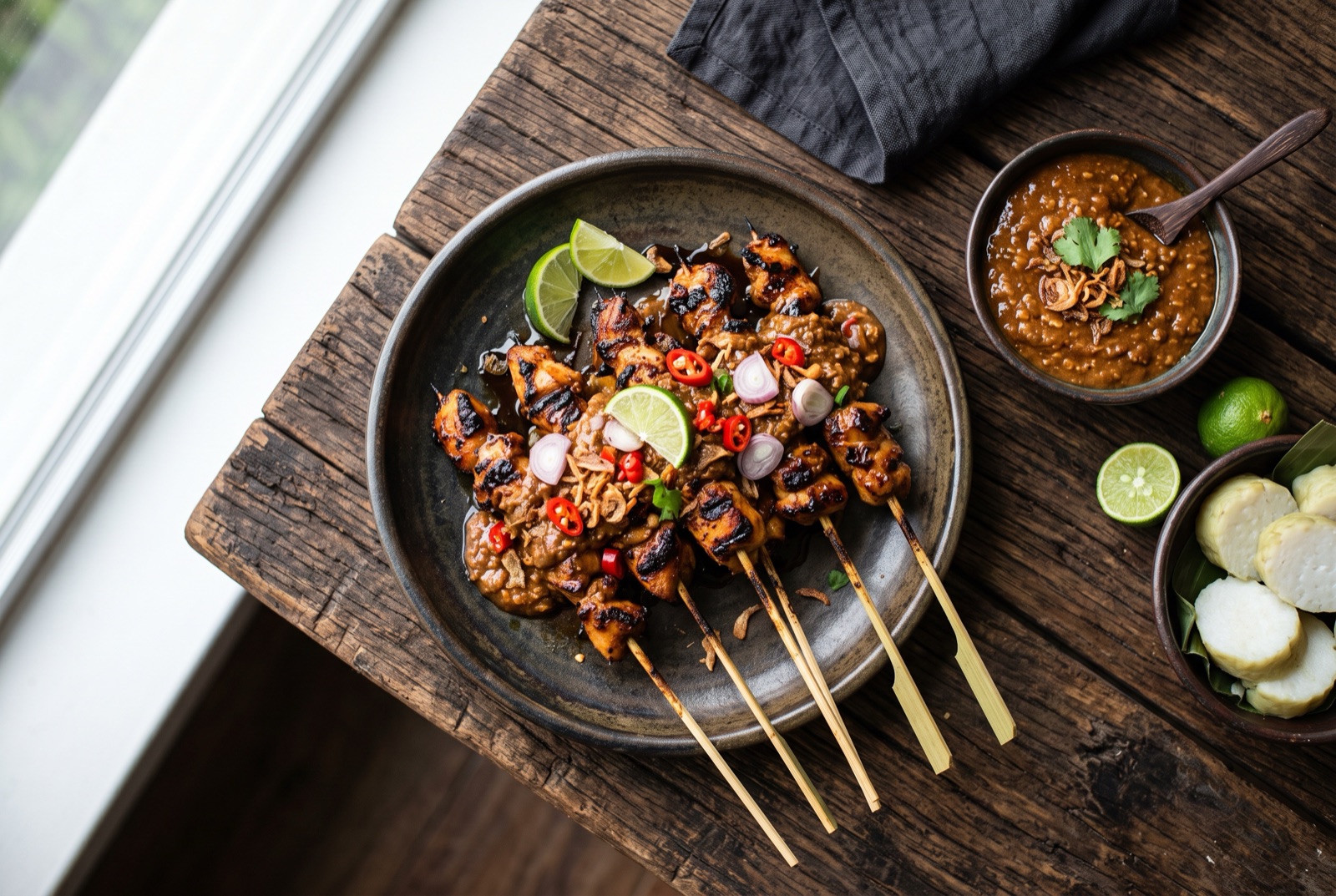
Sate ayam is Indonesia's chicken satay: small pieces of thigh meat threaded onto bamboo skewers, marinated in sweet soy sauce, garlic and turmeric, and grilled fast over charcoal until the edges char and the sugars caramelize. It comes buried under a warm peanut sauce — ground roasted peanuts loosened with kecap manis, garlic and lime — that is sweet, salty, nutty and gently hot all at once. The pleasure is in the contrast: smoky charred meat against creamy sauce. At home, a screaming-hot grill pan or broiler gets you honest char, and the sauce comes together in ten minutes from peanut butter without losing its character.

- Gate
- Indonesia
- Prep
- 30 min
- Cook
- 20 min
- Total time
- 1 hr 50 min incl. 1 hr rest
- Serves
- 4
- Status
- Easy
- Nutrition / serving · estimated
- Calories 520 kcal
- Protein 40 g
- Carbs 22 g
- Fat 31 g
- Fiber 3 g
- Sugar 14 g
Why this recipe works.
- Thigh meat and a kecap-based marinade keep the chicken juicy through fierce, fast grilling.
- The peanut sauce is built the warung way — sweet, salty, garlicky — but from pantry peanut butter, honestly.
- Works on charcoal, a grill pan or the broiler, with the technique adjusted for each.
- Small pieces and soaked skewers mean real char in minutes, not dried-out meat.
Ingredients.
14 itemsFor the skewers
For the peanut sauce
For serving
Equipment
- Bamboo skewers (about 16)
- Charcoal grill, grill pan or broiler
- Small saucepan for the sauce
- Basting brush
Instructions.
Marinate the chicken
Stir the kecap manis, soy sauce, garlic, turmeric, coriander and oil together in a bowl, then toss in 700 g of chicken pieces until every piece is coated. Cover and refrigerate for at least 1 hour, up to overnight. Soak the bamboo skewers in water while it marinates.
Make the peanut sauce
Warm the peanut butter, kecap manis, garlic, sambal and hot water in a small saucepan over low heat, whisking, until the sauce is smooth and just coats a spoon, 3–5 minutes. Take it off the heat and stir in the lime juice; it should taste sweet, salty and nutty with a gentle burn.
Tip The sauce thickens as it cools — loosen it with hot water a spoonful at a time before serving.
Thread the skewers
Thread 4–5 pieces of chicken snugly onto each soaked skewer, leaving the bottom half of the stick bare as a handle. Pat the threaded skewers lightly with paper towel so surface moisture does not fight the char.
Grill hard
Heat a grill pan or grill until it smokes (or the broiler to its highest setting). Cook the skewers in batches, turning every minute, until the edges char to a deep brown, the sugars catch in dark spots, and the meat feels firm when pressed — 8–10 minutes total.
Tip Shield the bare skewer ends with a strip of foil so they do not burn through.
Rest and check
Pile the skewers on a plate and rest them for 2–3 minutes. Cut into the thickest piece to check: the juices should run clear with no pink at the center.
Sauce and serve
Pour the warm peanut sauce generously over the skewers, drizzle a little extra kecap manis on top, and scatter with chopped shallots. Serve hot with rice or lontong and lime wedges, while the char is still crisp.
Tips from our kitchen.
- Use boneless chicken thighs, not breast. Satay cooks fast over brutal heat, and thigh fat is the only insurance against dry meat.
- Cut the chicken small — about 2 cm pieces — and thread them snugly. Small pieces are the whole point: maximum charred surface, minimum cooking time.
- Soak bamboo skewers in water for at least 30 minutes so they do not ignite, and shield the exposed ends with a strip of foil on a grill pan.
- Marinate at least 1 hour so the sweet soy penetrates; the sugars in the marinade are also what give you those caramelized, charred edges.
- Do not walk away while grilling. The line between beautifully charred and burnt is about thirty seconds — turn the skewers every minute or so.
- Loosen the peanut sauce with hot water to a pourable, just-coats-a-spoon consistency; it thickens as it sits.
Substitutions.
- Kecap manis (sweet soy sauce) → Equal parts soy sauce and brown sugar, simmered until syrupy
- A faithful stand-in for both marinade and sauce. The real bottle is inexpensive at Asian groceries and worth keeping.
- Smooth peanut butter → 150 g roasted peanuts, ground in a food processor
- Ground whole peanuts are the traditional route and give a coarser, deeper sauce — more work, better texture.
- Chicken thighs → Pork shoulder or firm tofu, cut the same size
- Sate babi (pork) is common in Bali; tofu needs a 30-minute press first and gentler turning on the grill.
Variations.
- Sate Madura style
- The famous Madurese street version: a thinner peanut sauce mixed with extra kecap manis brushed on during grilling, so the skewers lacquer and char more deeply.
- Sate kambing
- Java's goat satay, usually skipping peanut sauce entirely in favor of kecap manis with chopped shallots, chiles and tomato — try it with lamb.
- Grilled satay platter
- Serve with lontong or compressed rice cakes, cucumber chunks and extra sauce as a full meal rather than a snack — the way satay houses in Jakarta do.
Storage & reheating.
Cooked skewers keep 3 days refrigerated; reheat them in a hot dry pan or under the broiler so the edges re-crisp — a microwave turns them rubbery. The peanut sauce keeps 5 days refrigerated and loosens back to life with a splash of hot water. Raw marinated chicken can be frozen on or off the skewers for up to 2 months.
Serve with
Steamed rice or lontong (compressed rice cakes), cucumber chunks, and the remaining peanut sauce for dipping.
The story behind Chicken Satay with Peanut Sauce.
Satay is one of the great street foods of Southeast Asia, and Indonesia has the strongest claim to its modern form. Food historians generally trace it to Java in the nineteenth century, where street cooks are thought to have adapted the skewered-meat idea from kebabs brought by Arab and Indian Muslim traders, shrinking the meat to small pieces suited to quick charcoal grilling and to local bamboo skewers. From Java it spread across the archipelago and far beyond — Malaysia, Singapore and Thailand all have deep satay traditions of their own, and each will defend its version. The dish belongs to the whole region now; Indonesia is where the story starts.
In Indonesia, satay is inseparable from the vendor who makes it. The classic image is a man crouched over a narrow charcoal brazier barely wider than the skewers themselves, fanning the coals with a woven bamboo fan in one hand while turning a dozen sticks with the other. The fanning is not theater: it drives the coals to a fierce, fat-dripping heat that chars the meat in a couple of minutes, before the small pieces can dry out. Smoke billows down the street and does the advertising.
Sate ayam — chicken satay — is the most common of dozens of varieties: sate kambing (goat) is beloved in Java, sate lilit in Bali wraps spiced minced meat around lemongrass stalks, and Madura island is so famous for its satay that "sate Madura" is a genre in itself, sold by Madurese vendors in every Indonesian city. The peanut sauce is the standard partner for chicken, usually with a slick of kecap manis over the top, chopped shallots, and lontong — compressed rice cakes — to mop up what is left. It is celebration food and Tuesday-night food at once.
Questions, answered.
Where does satay come from — Indonesia or Thailand?
Satay is most widely traced to Java, Indonesia, in the nineteenth century, where street vendors are thought to have adapted skewered-kebab ideas from Arab and Indian traders into small, fast-grilling skewers. From there it spread across Southeast Asia, and Malaysia, Singapore and Thailand all developed strong satay traditions of their own. So Indonesia has the strongest origin claim, but satay genuinely belongs to the whole region today.
Is chicken satay peanut sauce just peanut butter?
Traditionally no — Indonesian vendors grind roasted peanuts fresh, then simmer them with kecap manis (sweet soy sauce), garlic, chile and water. Smooth peanut butter is an honest home shortcut that gets you most of the way there, because the flavor is really defined by the seasonings: sweet soy, garlic, lime and a little heat. Grinding your own roasted peanuts gives a coarser, more authentic texture if you have a food processor.
Can I make satay without a charcoal grill?
Yes. A cast-iron grill pan heated until it smokes, or a broiler with the skewers close to the element, both give real charred edges. What matters is fierce heat and small pieces of meat, so the outside caramelizes before the inside dries out. Charcoal adds smoke you cannot fully fake, but pan and broiler satay is still very good.
Is satay safe for someone with a nut allergy?
No — the classic sauce is made almost entirely of peanuts, and even the skewers themselves are often brushed with peanut sauce during grilling at street stalls. For a nut-allergic guest, skip the peanut sauce entirely and serve the grilled skewers with kecap manis mixed with chopped shallots, chile and lime — a genuine Indonesian alternative (it is how goat satay is usually served in Java).
Why do satay vendors fan the coals?
The woven bamboo fan drives air through a narrow charcoal brazier, pushing the coals to a very fierce heat for short bursts. Satay pieces are small and would dry out over slow, gentle coals; the vendor's constant fanning chars the outside in a couple of minutes while the inside stays juicy, and flares the dripping fat into the smoke that flavors the meat.
You might also like.
All recipes →
Keep exploring Indonesia.
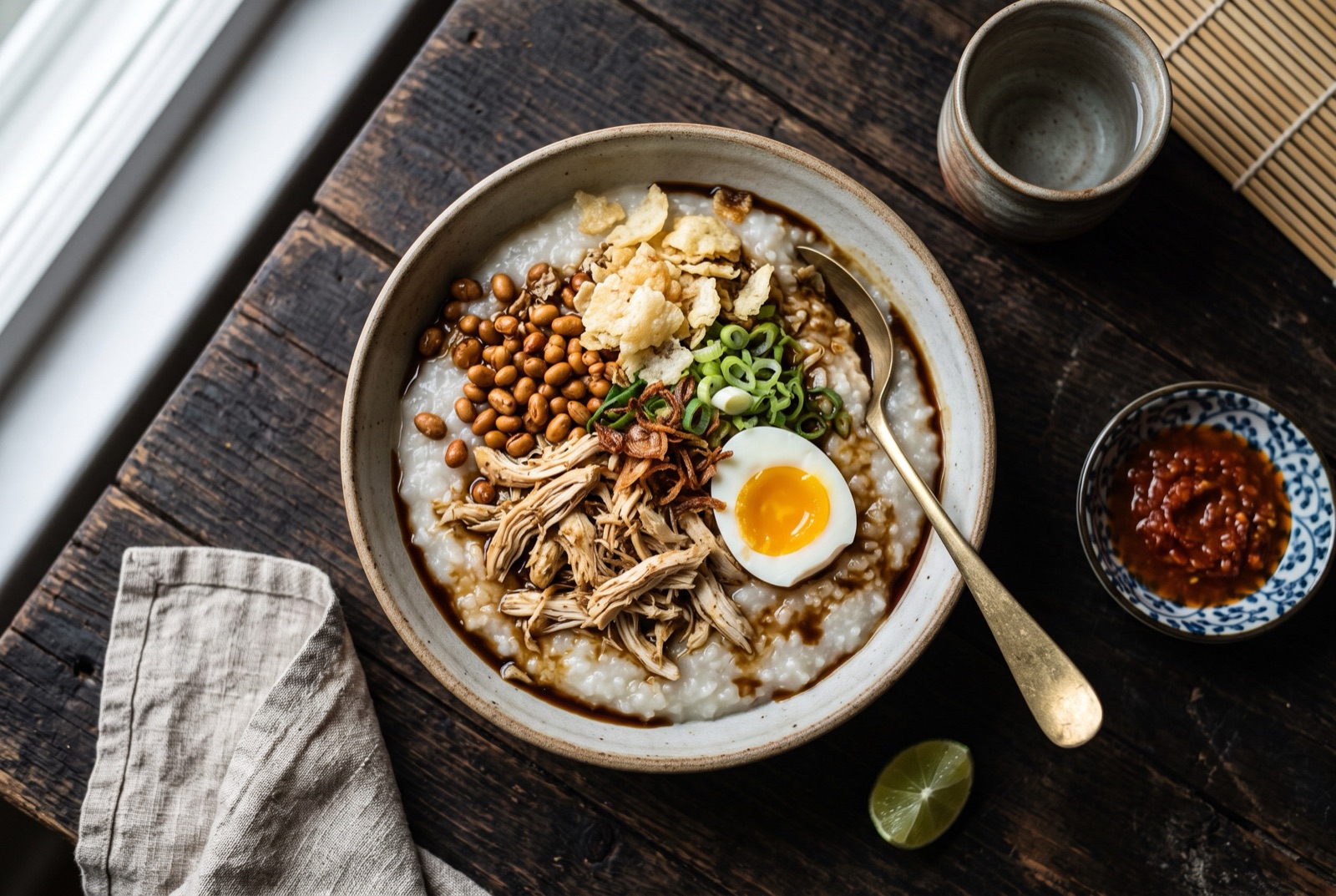
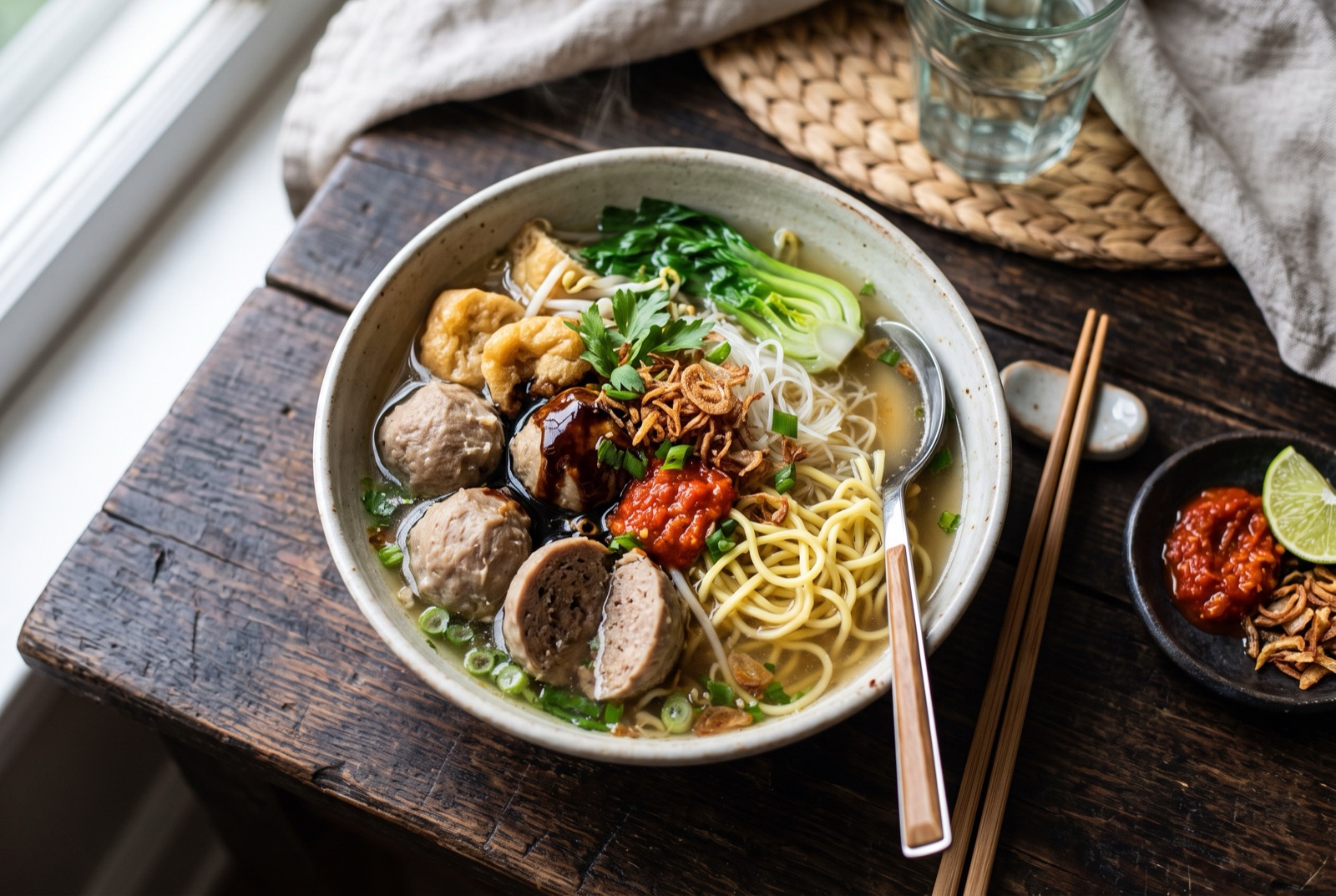
Indonesia has 9 more dishes in the atlas — Bakso and Bubur Ayam, and 7 more.
Recipe by The DishRoute Kitchen · published August 18, 2026 · updated August 18, 2026