Gado-Gado.
Indonesian Salad with Peanut Dressing
Gado-gado · say it: GAH-doh GAH-doh
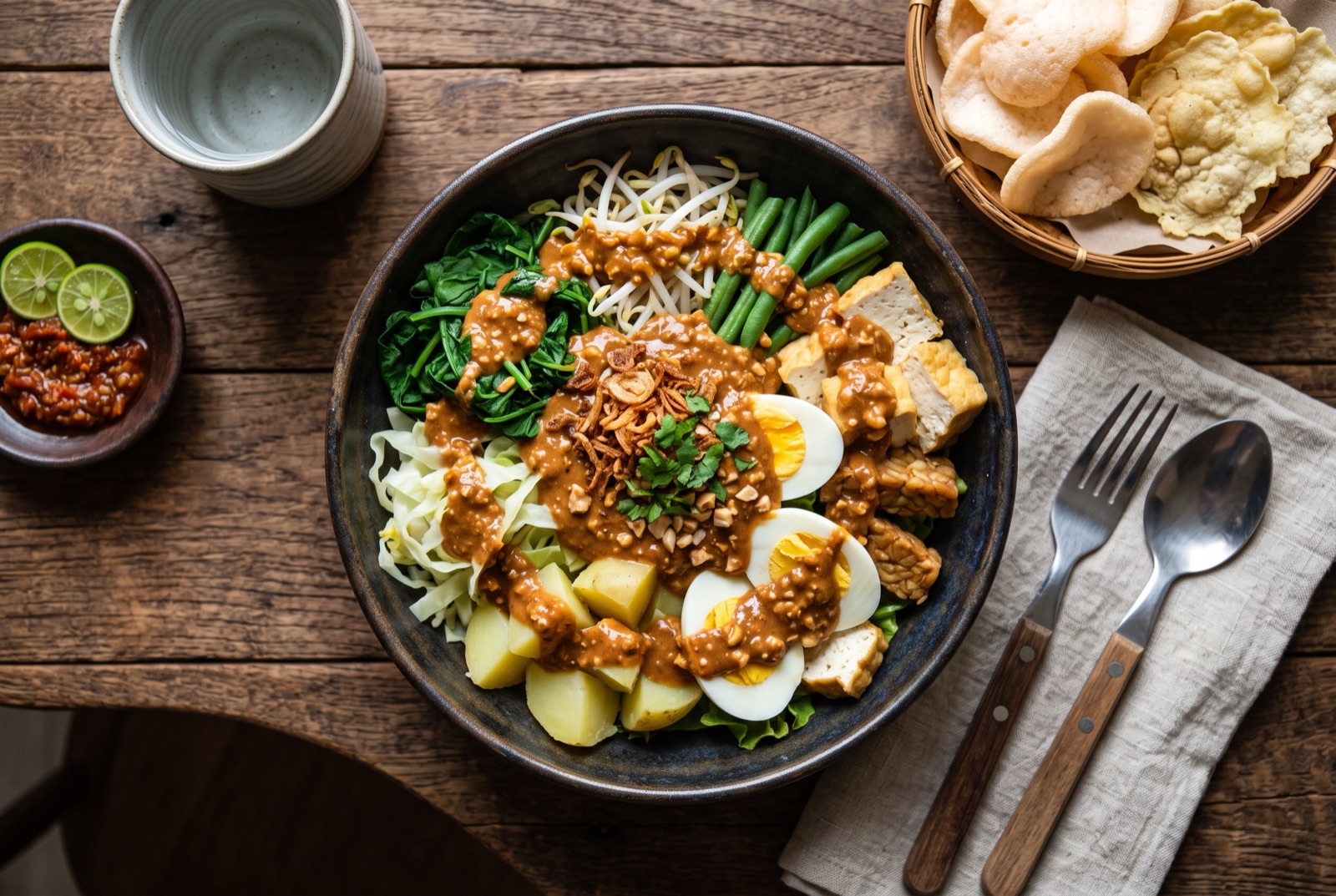
Gado-gado is an Indonesian salad in the loosest, best sense of the word: blanched green beans and cabbage, boiled potatoes, crisp cucumber and bean sprouts, fried tofu and halved boiled eggs, all bound together in a warm peanut dressing that is sweet, salty, garlicky and gently hot. Unlike a Western salad, the dressing is not an accent — it is the dish, generous enough to coat everything. The vegetables are cooked just to tenderness so they keep some bite, and the contrast of textures is the point: soft potato, snappy beans, creamy egg, crunchy crackers on top. It is a full meal from the vegetable drawer, and it comes together from mostly ordinary ingredients.

- Gate
- IndonesiaJakarta
- Prep
- 30 min
- Cook
- 25 min
- Total time
- 55 min
- Serves
- 4
- Status
- Easy
- Nutrition / serving · estimated
- Calories 520 kcal
- Protein 22 g
- Carbs 42 g
- Fat 30 g
- Fiber 9 g
- Sugar 13 g
Why this recipe works.
- Each vegetable is blanched separately to its own doneness, so nothing arrives gray or squeaky.
- The dressing follows the vendor formula — peanuts, garlic, palm sugar, tamarind, chile — balanced to coat, not drown.
- Egg and fried tofu make it a genuine full meal, not a side pretending otherwise.
- Everything can be prepped ahead and dressed at the table, which makes it ideal warm-weather cooking.
Ingredients.
16 itemsFor the salad
For the peanut dressing
For serving
Equipment
- Large pot for blanching
- Spider or slotted spoon
- Small saucepan for the dressing
- Frying pan for the tofu
Instructions.
Boil the potatoes and eggs
Boil 400 g of potatoes in salted water until a knife slides in without resistance, 15–20 minutes; lower the eggs into the same pot for the final 9 minutes. Peel both once cool enough to handle, quarter the potatoes and halve the eggs.
Blanch the vegetables
Bring a pot of salted water to a rolling boil and blanch each vegetable separately: green beans until bright green and just tender, about 3 minutes; cabbage until wilted but still squeaky, 1 minute; bean sprouts 30 seconds. Lift each into cold water, then drain thoroughly.
Tip One pot, worked in order from cleanest to strongest-tasting vegetable — no need to change the water.
Fry the tofu
Pat the tofu dry and fry it in hot oil over medium-high heat until golden and taut on both sides, 3–4 minutes per side. Drain on paper towel and cut into bite-size pieces.
Make the peanut dressing
Blend or pound the peanuts, garlic, chile, palm sugar, tamarind and salt into a coarse paste, then warm it in a saucepan with the water over low heat, stirring, until it thickens enough to coat a spoon and small bubbles break the surface, about 5 minutes. Taste against a blanched bean and adjust salt, sugar or tamarind.
Tip Left slightly coarse, the dressing has the true street-stall texture — do not blend it silky.
Toss and compose
Toss the potatoes, beans, cabbage and tofu gently with most of the warm dressing until every piece is coated but not drowned. Arrange on a platter with the cucumber and bean sprouts, and nestle the egg halves on top.
Finish and serve
Spoon the remaining dressing over the eggs, and top with krupuk at the last second so they stay crisp. Serve at warm room temperature — the dressing should still be soft and pourable when the platter hits the table.
Tips from our kitchen.
- Blanch each vegetable separately — beans need 3 minutes, cabbage 1, bean sprouts 30 seconds. One pot, one order, lifting each out with a spider as it is done.
- Shock the blanched vegetables briefly in cold water to stop the cooking, then drain them well; a watery vegetable thins the dressing on the plate.
- Taste the dressing against a piece of blanched bean, not from the spoon. It should read slightly too intense alone — the vegetables dilute it.
- Serve the dressing warm, not hot and not fridge-cold. Warm peanut sauce clings; cold peanut sauce sets into paste.
- Fry the tofu until the outside is golden and taut so it holds its shape when tossed through the sauce.
- Add the krupuk and bean sprouts at the very end, on top — buried under dressing they go soggy in minutes.
Substitutions.
- Palm sugar (gula jawa) → Dark brown sugar, same amount
- Loses a little of the smoky caramel depth but is a completely serviceable swap.
- Tamarind paste → 1 tbsp lime juice
- Brighter and less fruity than tamarind, but it does the same balancing job against the sweetness.
- Fried tofu → Fried tempeh
- Equally traditional in Indonesia — nuttier and firmer. Or use both, as many vendors do.
Variations.
- Vegan gado-gado
- Skip the eggs and add extra fried tofu and tempeh; the peanut dressing is already plant-based. A completely traditional-tasting result.
- Gado-gado siram
- "Poured" style: the vegetables arranged in neat piles on the plate and the warm dressing ladled over at the table instead of tossed — prettier, and everyone controls their own sauce.
- Pecel style
- The East Javanese cousin: the same idea with a spicier, more tamarind-forward dressing and kaffir lime leaf, usually over rice with no potato.
Storage & reheating.
Store the dressing and the components separately: the dressing keeps 5 days refrigerated and re-warms gently with a splash of water, blanched vegetables and boiled eggs keep 2 days. Dressed gado-gado does not keep — the vegetables weep and the crackers collapse — so toss only what will be eaten. The dressing freezes well for up to 2 months.
Serve with
Steamed rice or lontong (compressed rice cakes), extra krupuk, and sambal for those who want more heat.
The story behind Gado-Gado.
Gado-gado means, roughly, "mix-mix" in Indonesian — the name is the recipe. It is most closely associated with Jakarta and the Betawi people, the capital's original inhabitants, whose cuisine grew out of centuries of trade and mixing in the old port city: Malay, Chinese, Arab and European influences layered over local Javanese cooking. A dish that takes whatever vegetables are on hand and unifies them with peanut sauce is a fair portrait of the city itself, and Jakartans treat gado-gado as theirs, though versions of vegetables-with-peanut-dressing exist across Java under other names — pecel in the east, lotek in the west — each with its own seasoning balance.
The traditional heart of the dish is the dressing, ground fresh to order. A gado-gado vendor works over a broad clay mortar (cobek), crushing fried peanuts with garlic, chile, palm sugar and a little tamarind into a coarse paste, loosening it with water, then tumbling the customer's chosen vegetables directly in the mortar so every piece gets dragged through the sauce. Watching a good vendor build a portion in ninety seconds — grind, splash, toss, plate, crown with egg and krupuk — is half the reason to order it.
Gado-gado is everyday food: sold from carts and market stalls, eaten as lunch by office workers and schoolchildren alike, cheap and filling and incidentally packed with vegetables. Because it is vegetable-forward and the protein comes from tofu, tempeh and egg, it has also traveled well into modern menus abroad as a naturally meat-free Indonesian classic. In 2018 it was named one of Indonesia's five official national dishes, alongside nasi goreng, satay, soto and rendang — the only salad in that company.
Questions, answered.
What does "gado-gado" mean?
Roughly "mix-mix" in Indonesian. The name describes the dish: an assortment of blanched and raw vegetables, potato, boiled egg and fried tofu, all mixed together with a peanut dressing. Indonesians also use "gado-gado" figuratively for anything jumbled or mixed — a gado-gado conversation switches between languages.
Where in Indonesia is gado-gado from?
It is most strongly associated with Jakarta and the Betawi people, the capital's original population, whose port-city cuisine mixed Malay, Chinese, Arab and European influences. Similar vegetables-with-peanut-dressing dishes exist across Java under other names — pecel in East Java, lotek in West Java — so it belongs to a wider family, but gado-gado itself is Jakarta's version and a recognized national dish of Indonesia.
Is gado-gado served warm or cold?
In between, by design. The vegetables are typically at room temperature or just-blanched warm, the eggs and fried tofu are warm, and the peanut dressing is served warm so it stays pourable and clings to everything. Nothing should be refrigerator-cold — a cold peanut dressing stiffens into paste and the flavors go mute.
Is gado-gado vegetarian or vegan?
As usually made it is vegetarian: the protein comes from boiled eggs, fried tofu and often tempeh, and the peanut dressing contains no meat. Some vendors add shrimp paste (terasi) to the dressing or shrimp crackers on top, so strict vegetarians should ask. Made without egg and with plain crackers, it is naturally vegan — no substitutions needed in the dressing itself.
What vegetables go in gado-gado?
There is no fixed list — the name means "mix-mix" for a reason. The common core is boiled potato, blanched green beans, cabbage and bean sprouts, plus raw cucumber, with spinach or water spinach (kangkung) frequent additions. The rule of thumb: a mix of soft, crisp and leafy, each cooked only to its own tenderness, generous enough that the plate is a meal.
You might also like.
All recipes →
Keep exploring Indonesia.
Indonesia has 9 more dishes in the atlas — Bakso and Bubur Ayam, and 7 more.
Recipe by The DishRoute Kitchen · published August 18, 2026 · updated August 18, 2026