Martabak Manis.
Indonesian Thick Stuffed Sweet Pancake
Martabak manis · say it: mar-TAH-bak MAH-nis
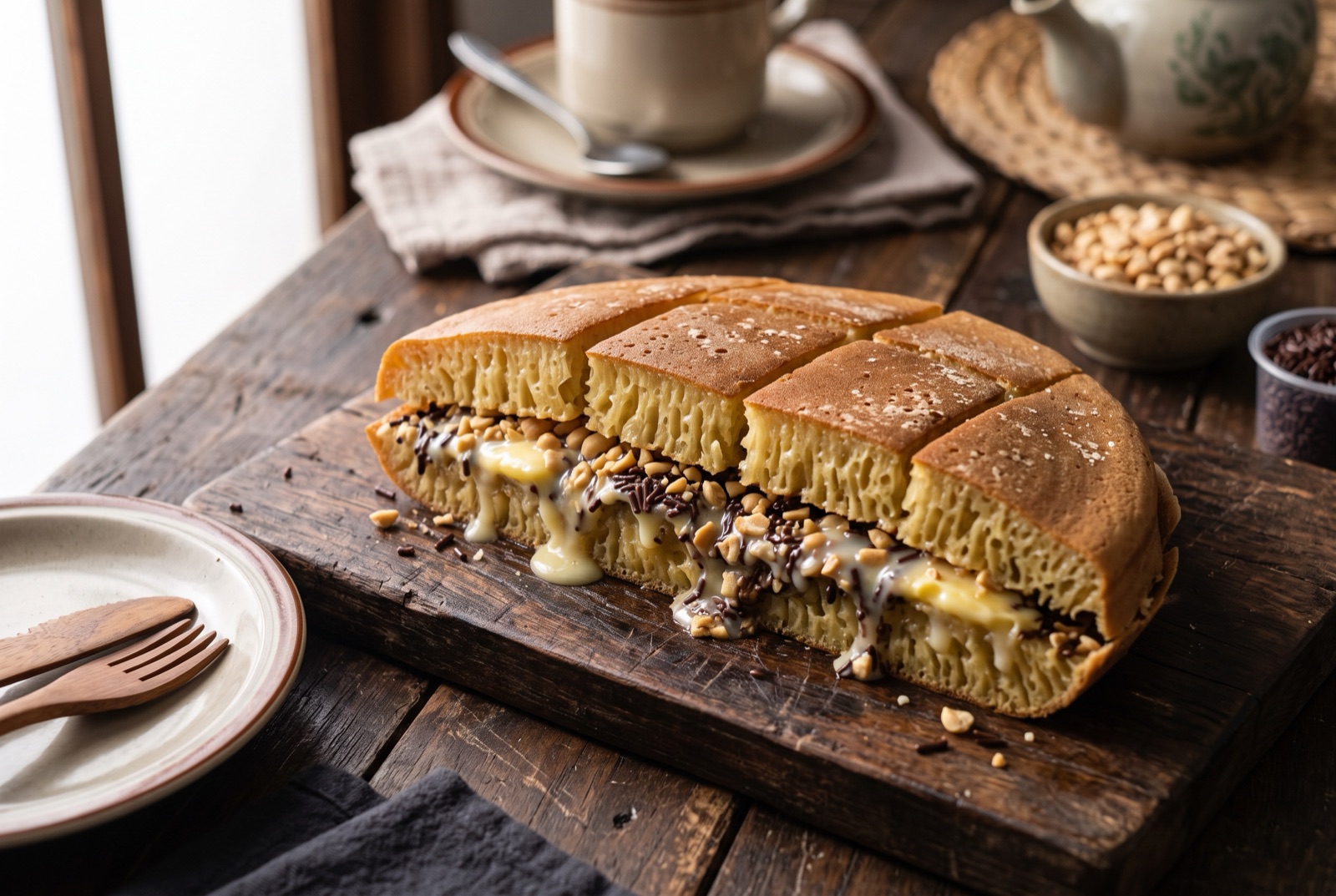
Martabak manis is a night-market pancake built like a cake: a thick, yeasted batter goes into a deep pan, bubbles rise and burst across the surface until the inside sets into a spongy honeycomb, and the finished round is split open and packed with melted butter, sweetened condensed milk, crushed peanuts and chocolate sprinkles before being folded over and cut into fat wedges. It is unapologetically rich — nobody eats martabak manis as a light snack — with a crisp brown base, a soft interior and a filling that starts running the moment it hits a warm surface. One pan feeds eight people and takes about half an hour of actual work.

- Gate
- Indonesia
- Prep
- 20 min
- Cook
- 25 min
- Total time
- 1 hr 45 min incl. 1 hr rest
- Serves
- 8
- Status
- Medium
- Nutrition / serving · estimated
- Calories 470 kcal
- Protein 12 g
- Carbs 56 g
- Fat 22 g
- Fiber 3 g
- Sugar 30 g
Why this recipe works.
- A batter rest long enough for the yeast to actually work, which is where the honeycomb crumb comes from.
- Baking soda whisked in at the last minute — the vendor trick that forces the big surface bubbles open.
- Written for an ordinary heavy skillet with a lid, not the specialised brass martabak pan.
- Filling quantities that are generous like the street version but stop short of collapsing the pancake.
Ingredients.
13 itemsFor the batter
For the filling
Equipment
- Heavy 20–22 cm pan with straight sides and a lid
- Whisk
- Large mixing bowl
- Offset spatula or palette knife
Instructions.
Mix and rest the batter
Whisk the flour, 60 g sugar, yeast and salt in a large bowl. Beat in the eggs and lukewarm milk until you have a smooth batter about the consistency of double cream, with no lumps. Cover and leave in a warm spot for 1 hour.
Tip The batter is ready when the surface is domed with small bubbles and it smells faintly of bread. If your kitchen is cold, give it 90 minutes.
Wake it up with soda
Whisk the bicarbonate of soda into the rested batter and use it within a couple of minutes. You will see the mixture loosen and foam slightly — that reaction is what forces the big holes open in the pan.
Pour into a hot pan
Heat a lightly greased heavy pan over medium-low for a couple of minutes, then pour in all the batter at once. Swirl it once to level, and let it sit undisturbed while bubbles start rising and popping across the surface.
Tip A drop of batter should set slowly rather than hiss. If it sizzles hard, the pan is too hot — let it cool for a minute first.
Sugar the surface and cover
When the top is covered in open bubble holes but still visibly wet, about 5 minutes in, scatter the tablespoon of sugar evenly over it. Put the lid on and cook 8–10 minutes more, until the surface is matte and dry to the touch and the base is deep golden.
Butter it while it is hot
Slide the pancake onto a board and immediately spread the softened butter over the whole top surface, letting it melt down into the open holes. This is the step that keeps the crumb from tasting dry.
Fill and fold
Drizzle over the condensed milk, then scatter the crushed peanuts, chocolate sprinkles and cheddar if using across the entire surface. Fold the round in half firmly so the filling presses together, and press the edge gently to seal.
Cut into fat wedges
Cut across the fold into 8 thick wedges with a serrated knife, sawing rather than pressing so you do not squash the crumb. Serve warm, with the filling still molten, or let it cool completely for the firmer version.
Tips from our kitchen.
- Let the batter rest a full hour at warm room temperature. Under-proved batter makes a dense, cakey pancake with a closed crumb and no honeycomb.
- Whisk in the baking soda only right before cooking. It reacts immediately, and batter that has sat with it for twenty minutes has already spent its lift.
- Use a heavy pan with straight sides, around 20–22 cm, and a lid. A sloping crêpe pan gives you a thin disc, not the deep round this dish needs.
- Medium-low heat throughout. High heat browns the base before the middle has set, and you cannot fix an underdone centre once the outside is dark.
- Sprinkle the tablespoon of sugar over the surface while the top is still wet. It melts into the setting batter and gives the interior its characteristic sweet, slightly chewy pockets.
- Butter the cut surface while the pancake is still hot enough to absorb it. Butter sitting in a cold puddle is the difference between a good martabak and a greasy one.
Substitutions.
- Chocolate sprinkles (meses) → Chopped dark chocolate, or chocolate hazelnut spread
- Sprinkles melt into thin ribbons rather than pools, which is why vendors use them. Chopped chocolate works but makes the filling heavier and harder to fold.
- Sweetened condensed milk → Dulce de leche, thinned with a splash of milk
- Condensed milk is the traditional binder and it is worth seeking out. Honey or syrup are too thin and soak into the crumb instead of sitting on it.
- Roasted peanuts → Toasted sesame seeds, or leave out entirely
- For a nut-free martabak, sesame gives a similar toasty contrast. Plenty of Indonesian vendors also sell a plain chocolate-and-cheese version with no nuts at all.
Variations.
- Martabak keju
- The cheese version: coarsely grated mild cheddar over the butter and condensed milk instead of, or alongside, the chocolate. The salt against the sweet milk is the entire appeal.
- Martabak pandan
- Green batter flavoured with pandan extract, common in Java. The pandan is grassy and floral rather than sweet, which balances the very rich filling.
- Mini martabak
- Cooked in individual egg-ring moulds or a blini pan, folded into half-moons. Faster, easier to judge doneness, and the version to make if you do not own a suitable big pan.
Storage & reheating.
Wrap the cut wedges in foil or an airtight box and keep at room temperature for a day, or refrigerate for three. Cold martabak is a legitimate way to eat it and many Indonesians prefer it that way, with the chocolate set firm. To bring back the fresh texture, warm wedges in a dry pan over low heat for two or three minutes with a lid on, so the crumb softens and the filling melts again. It freezes reasonably well for a month if wrapped tightly — reheat from frozen in a covered pan.
Serve with
Hot unsweetened tea or black coffee — the filling is sweet enough that anything sugary alongside it becomes exhausting.
The story behind Martabak Manis.
The name is a source of permanent confusion, because Indonesia has two entirely unrelated dishes called martabak. Martabak telur is savoury — a thin sheet of dough wrapped around egg, spring onion and minced meat, then shallow-fried flat, and it descends from the Arab and Indian murtabak found across the Middle East and South Asia. Martabak manis, the sweet one, has nothing to do with it: it is a thick yeasted pancake, and vendors selling both often keep two completely separate carts because the equipment has nothing in common.
The sweet version also travels under different names depending on where you buy it. In Jakarta and much of the country it is martabak manis. In Surabaya and across East Java it is terang bulan, meaning bright moon, after the pale full round it makes in the pan. In Bandung people call it kue bandung, and in Pontianak it is apam pinang. It has close relatives elsewhere in the region — Malaysia and Singapore know a thinner folded cousin as apam balik — and the family resemblance to a very thick crumpet is not a coincidence, since the honeycomb texture comes from the same combination of yeast and a raising agent added just before cooking.
What has changed most is the filling. The old standard is butter, condensed milk, ground peanuts and chocolate sprinkles — meses, the Dutch-legacy hagelslag that Indonesians took to with enthusiasm — sometimes with a scatter of grated cheddar, which sounds wrong and works. Since the 2010s the martabak stall has become a showcase for excess: Nutella, Toblerone, red velvet batter, matcha, Ovomaltine, salted egg, shredded cheese piled centimetres deep. Prices climbed accordingly, and a premium martabak became a recognisable gift to bring to someone's house. The classic combination below is still the one most vendors sell most of, and still the one that tastes best cold at midnight.
Questions, answered.
What is the difference between martabak manis and martabak telur?
They are unrelated dishes that share a name. Martabak telur is savoury — a thin dough parcel filled with egg, spring onion and minced meat and fried flat, descended from Arab and Indian murtabak. Martabak manis is a thick yeasted sweet pancake filled with butter, condensed milk, chocolate and peanuts. Vendors often sell both, from separate pans.
Why doesn't my martabak have the honeycomb holes?
Three usual causes: the batter did not rest long enough for the yeast to produce gas, the baking soda was added too early and had already fizzed out, or the pan was too hot and the surface set before bubbles could rise and burst. Rest the batter a full hour, whisk the soda in seconds before pouring, and cook over medium-low heat.
Do I need a special martabak pan?
No. Vendors use a thick brass or cast-iron pan with high straight sides, which holds steady heat and gives the classic tall round. A heavy 20–22 cm nonstick or cast-iron skillet with a lid does the same job at home. What matters is thick walls for even heat and a lid to set the top without flipping.
Can I make the batter the night before?
Yes — mix everything except the baking soda, cover, and refrigerate overnight. Take it out an hour before cooking so it comes to room temperature and the yeast wakes up, then whisk in the baking soda just before it goes in the pan. Overnight resting actually improves the flavour, giving the crumb a slight tang.
How do I know when the pancake is cooked through?
The surface goes from wet and glossy to matte and dry, the bubble holes stay open instead of closing over, and the edges pull very slightly from the pan. Total time is around 12–15 minutes covered on medium-low heat. If the top still looks shiny in the centre, leave the lid on longer — do not raise the heat.
You might also like.
All recipes →
Keep exploring Indonesia.
Indonesia has 9 more dishes in the atlas — Bakso and Bubur Ayam, and 7 more.
All Indonesia recipes Flour recipes Eggs recipes Condensed milk recipes dessertstreet foodsnackvegetarianRecipe by The DishRoute Kitchen · published August 19, 2026 · updated August 19, 2026