Legim.
Haitian Mashed Vegetable Stew
Legim · say it: lay-GEEM
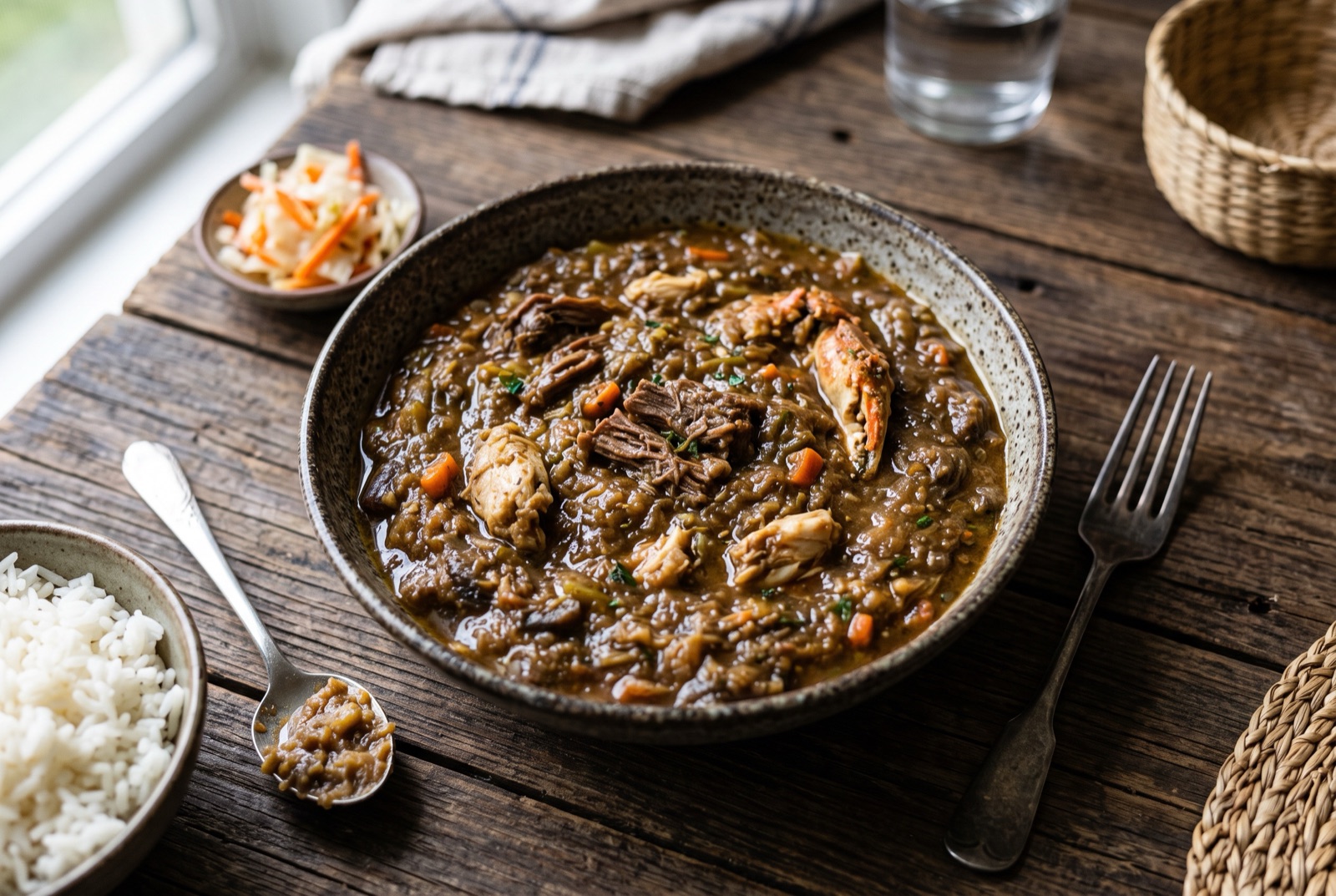
Legim is a vegetable stew cooked so far past the point most cuisines stop that the vegetables lose their identity entirely and become one glossy, dark green-brown mass, thick enough to hold the shape of a spoon. Eggplant, chayote, cabbage, carrot and spinach go in whole or roughly chopped, are simmered until soft, then mashed and cooked down again with beef, crab or both until the water has gone and the fat has come back to the surface. The flavour is concentrated and faintly sweet from the long cooking, savoury from the meat, and lifted at the end with Scotch bonnet and lime. It is served over rice, and it is the dish Haitian cooks are proudest of and most protective about.

- Gate
- Haiti
- Prep
- 40 min
- Cook
- 2 hr 30 min
- Total time
- 3 hr 10 min
- Serves
- 6
- Status
- Takes skill
- Nutrition / serving · estimated
- Calories 400 kcal
- Protein 32 g
- Carbs 22 g
- Fat 21 g
- Fiber 8 g
- Sodium 760 mg
Why this recipe works.
- The full two-stage method — boil and mash, then reduce hard — rather than a shortcut vegetable stew.
- Explains exactly what the pot should look like at each stage so you know when to stop.
- Beef and crab handled separately, so both stay good instead of one overcooking.
- Includes the meatless Lenten version Haitian households actually make, not as an afterthought.
Ingredients.
17 itemsFor the meat
For the vegetables
For the pot
Equipment
- Large heavy pot
- Wide sauté pan or Dutch oven for reducing
- Potato masher or wooden pestle
- Colander
Instructions.
Wash and season the beef
Rub the beef with the juice of one lime and a splash of water, rinse and pat dry, then coat it in the epis. Leave it to sit for at least 30 minutes while you prepare the vegetables.
Salt the eggplant
Toss the cubed eggplant with a teaspoon of salt in a colander and leave for 20 minutes, then squeeze out the liquid with your hands. Skipping this adds a lot of unwanted water to the reduction later.
Brown the beef
Heat 2 tablespoons of the oil in a large pot and brown the beef in batches until the surfaces are deeply coloured, about 8 minutes per batch. Scrape up the browned bits with a splash of stock — that fond is the base of the stew.
Braise the vegetables with the meat
Return all the beef, add the onion, garlic, tomato paste, thyme, whole Scotch bonnet and the remaining stock, then pile in the eggplant, chayote, cabbage and carrot. Cover and simmer for 50–60 minutes, until everything is falling apart at the touch of a spoon.
Mash the vegetables
Lift out the beef, thyme stalks and Scotch bonnet and set them aside. Mash the vegetables in the pot with a potato masher until no lumps remain and the mixture looks like a coarse, dark purée — never use a blender.
Tip A wooden pestle gives the traditional texture: smooth but not slick.
Reduce hard
Return the beef and add the remaining oil, then cook uncovered over medium-low heat for 60–90 minutes, stirring the bottom every few minutes. It is ready when the stew pulls away from the sides of the pot and a spoon dragged through leaves a track that holds for a second.
Tip This is the stage where legim burns. Keep the heat low and keep the spoon moving.
Add crab and greens
Tuck the crab pieces and chopped spinach into the stew for the last 30 minutes of the reduction so the shells perfume the pot without the meat turning stringy. Stir them under the surface rather than sitting them on top.
Finish and serve
Off the heat, squeeze in the juice of the second lime and taste for salt — hours of cooking dull seasoning, so it will probably need more than you expect. Serve thick spoonfuls over white rice with pikliz on the side.
Tips from our kitchen.
- Salt the eggplant for 20 minutes and squeeze it before cooking — otherwise it dumps a lot of water into the reduction.
- Mash by hand with a potato masher or wooden pestle. A blender turns legim into baby food and kills the texture.
- Use a wide pot for the reduction stage; a narrow pot traps steam and the stew never thickens properly.
- Add the crab in the last 30 minutes only. Cooked from the start it goes stringy and the shells cloud the stew.
- Stir the bottom of the pot every few minutes during the reduction — this is when legim scorches, and burnt legim cannot be saved.
- Finish with lime juice off the heat. It sharpens hours of sweetness back into focus and takes ten seconds.
Substitutions.
- Chayote (militon) → Green papaya, or an equal weight of extra eggplant plus one peeled courgette
- Chayote is sold in Latin and Caribbean shops as christophine or mirliton. Courgette breaks down faster, so add it later.
- Crab → Extra beef, or leave it out entirely
- Crab is the celebratory addition rather than a requirement. Blue crab or small whole crabs work better than picked meat, which disappears.
- Watercress or Haitian cress → Spinach or chard
- Any tender leafy green works. Cress brings a peppery edge that spinach does not, so add a pinch more Scotch bonnet if you swap.
Variations.
- Legim mèg (meatless)
- The Lenten version: no beef or crab, seasoned harder with epis, thyme and bouillon, and often finished with a little oil so it still tastes rich.
- Legim ak vyann bèf sèlman
- Beef only, browned first in the pot so the fond flavours the whole stew — the everyday household version and considerably less work than the crab one.
- With smoked pork
- A piece of smoked pork or bacon simmered in from the start gives the stew a smoky backbone; skip the added salt until the end, as smoked cuts are salty.
Storage & reheating.
Legim keeps 4 days refrigerated and genuinely improves overnight as the flavours settle. Reheat it in a covered pan over low heat with a splash of water, stirring so the bottom does not catch. It freezes very well for 3 months — freeze it before adding the crab, then add fresh crab when reheating. Do not reheat crab-containing legim more than once.
Serve with
White rice or rice and red beans, with pikliz and fried plantains on the side.
The story behind Legim.
Legim — from the French légumes — is a technique dish disguised as a vegetable side. Anyone can boil vegetables; the skill is in what happens afterwards. The vegetables are cooked until collapsing, then mashed by hand with a pilon or pressed through a sieve, then returned to the pot and cooked down for another hour or more while the cook stirs and watches for the moment the mixture stops being wet and starts pulling away from the sides. Rushing that reduction leaves a watery vegetable soup; taking it too far scorches the bottom. There is no shortcut, and Haitian cooks will tell you so.
The base vegetables are consistent across the country: eggplant (berejèn), chayote (militon), cabbage, carrot, and something leafy — spinach, watercress or Haitian cress. What varies is the protein. Beef is the common choice, seared and braised alongside; crab is the prestige version, added late so the shells perfume the stew; some cooks use both, and some use smoked pork or goat. There is also a fully meatless legim, seasoned hard with epis and bouillon, which is what many households eat during Lent.
The long reduction is not just about texture. As the water leaves, the eggplant and chayote break down into a natural thickener, the sugars in the carrot and cabbage concentrate, and the epis stops tasting raw. The finished stew should be dense enough that a spoonful sits on rice without running, and dark rather than bright — a legim that still looks like identifiable vegetables has not been cooked long enough.
Because it takes the better part of an afternoon, legim is Sunday and holiday food, made in large quantities and often better the next day. It is eaten with white rice or diri kole ak pwa, with pikliz on the side and, if the household is doing things properly, a whole fried fish or fried plantains alongside.
Questions, answered.
What is chayote and where do I find it?
Chayote is a pale green, pear-shaped squash from the Americas, sold as militon in Haitian shops, christophine in the English-speaking Caribbean, and chayote or mirliton in Latin American groceries. It has a mild flavour and a firm flesh that breaks down slowly, which is exactly what legim needs.
How long does legim really take?
Around three hours from start to finish for the classic version: roughly an hour to soften the vegetables and braise the beef, then a long reduction of 60 to 90 minutes after mashing. The reduction is the part that cannot be shortened without changing the dish into an ordinary vegetable stew.
Can I make legim in a pressure cooker?
Partly. A pressure cooker handles the first stage well — 20 minutes brings the beef and hard vegetables to collapsing point. The reduction afterwards still has to happen uncovered on the stove, because thickening depends on evaporation, which a sealed pot prevents.
Why is my legim watery?
Nearly always because the reduction was stopped too early, or because the pot was too narrow for steam to escape. Keep cooking uncovered over medium-low heat, stirring often, until a spoon dragged across the bottom leaves a track that holds for a second before filling in.
Can legim be made vegetarian?
Yes, and it commonly is during Lent. Leave out the beef and crab, increase the epis, add a vegetable bouillon cube and a little extra oil to replace the richness the meat provided. The long reduction gives it plenty of depth on its own.
You might also like.
All recipes →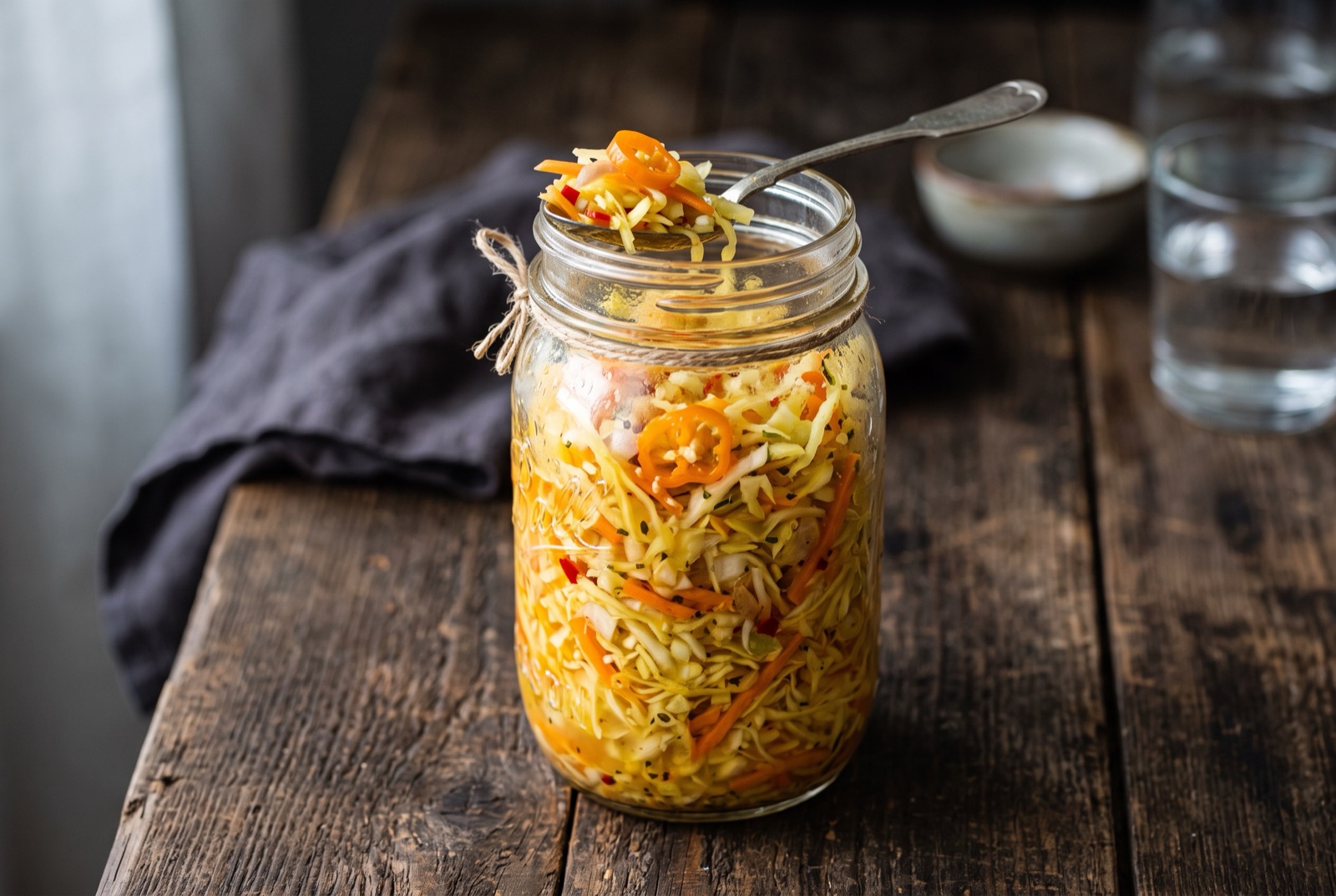
Keep exploring Haiti.
Haiti has 9 more dishes in the atlas — Akra and Bannann Peze, and 7 more.
Recipe by The DishRoute Kitchen · published August 20, 2026 · updated August 20, 2026