Hawawshi.
Egyptian Spiced Meat Stuffed Bread
حواوشي · Ḥawāwshī · say it: ha-WAW-shee
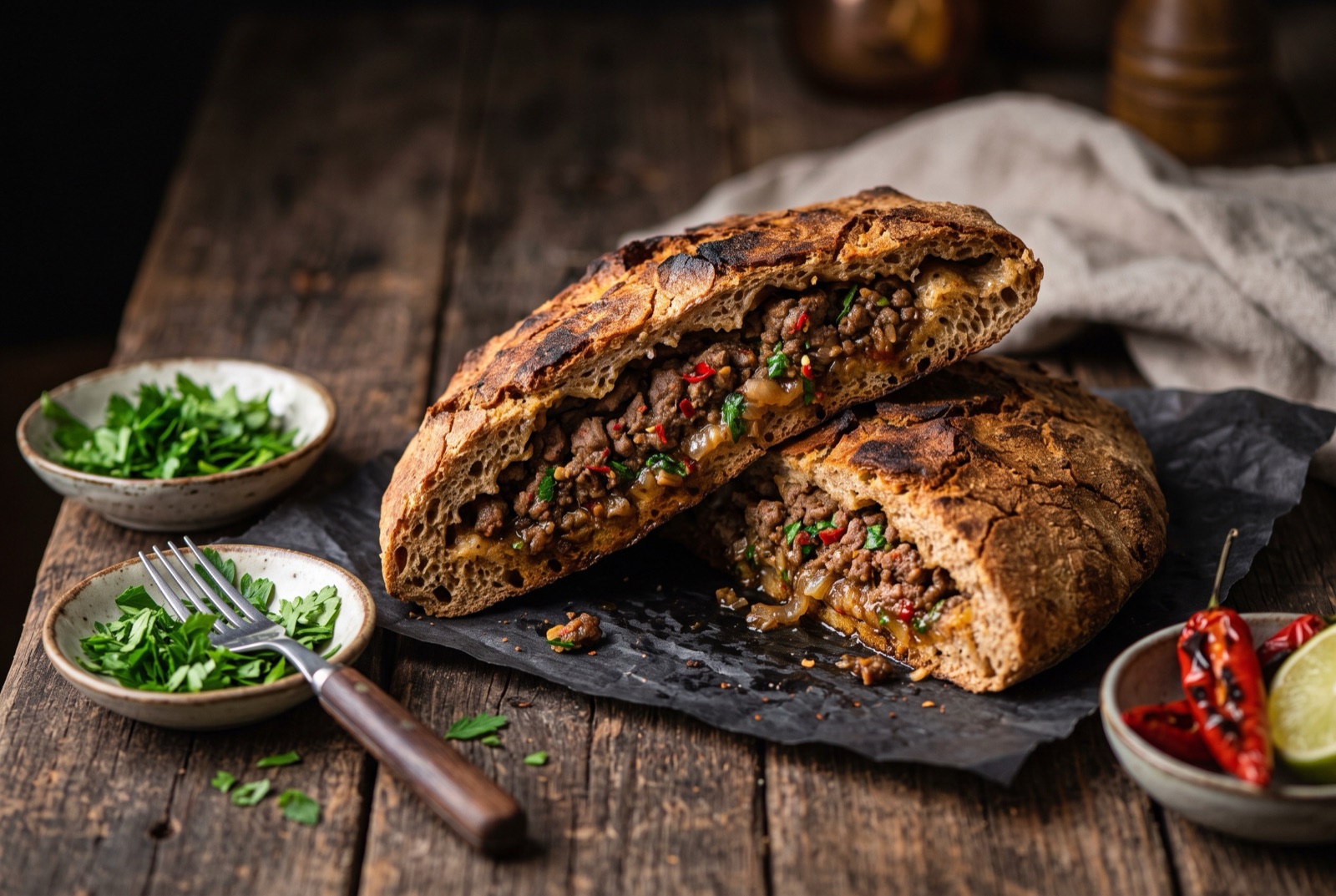
Hawawshi is a flat round loaf opened at the edge, filled with raw spiced mince, and baked until the bread goes brittle on the outside and greasy-soft where it meets the meat. There is no browning step and no sauce. The filling — beef, grated onion, parsley, green chilli, black pepper and allspice — cooks inside its own sealed envelope, so the juices have nowhere to go except into the crumb underneath. What you bite into is crisp shell, then a thin dense seam of meat, then bread that has drunk everything the meat released. It takes twenty minutes of work, needs a very hot oven, and is best eaten standing up while it is still too hot to hold comfortably.

- Gate
- EgyptCairo
- Prep
- 20 min
- Cook
- 25 min
- Total time
- 50 min incl. 5 min rest
- Serves
- 4
- Status
- Easy
- Nutrition / serving · estimated
- Calories 630 kcal
- Protein 34 g
- Carbs 47 g
- Fat 32 g
- Fiber 5 g
- Sugar 4 g
- Sodium 950 mg
Why this recipe works.
- Grates and squeezes the onion dry, so the filling seasons the meat instead of steaming it into a wet grey layer.
- Bakes on a preheated tray at full heat, which is the only way a home oven gets near a Cairo bakery floor.
- Keeps the meat layer thin and even — the mistake that makes home hawawshi raw in the middle and burnt at the edge.
- Whole thing is on the table in under an hour, and one loaf per person genuinely feeds a person.
Ingredients.
13 itemsThe filling
To assemble
Equipment
- Heavy baking tray or baking stone
- Box grater
- Clean cloth for squeezing the onion
Instructions.
Heat the oven and the tray
Set the oven to its highest setting, at least 240°C, and slide a heavy baking tray or a baking stone onto the middle shelf to heat with it. Give it a full 20 minutes — the tray must be properly hot before any bread touches it.
Tip A cold tray is the single most common reason home hawawshi turns out pale and damp on the bottom.
Dry the onion
Grate 1 of onion on the coarse side of a box grater, pile it into a clean cloth and wring it out hard over a bowl. Keep the squeezed juice and discard nothing else; the pulp should look dry and fluffy rather than wet.
Mix the filling
Work the minced beef together with the dried onion, a tablespoon of the reserved onion juice, parsley, chilli, green pepper, garlic, allspice, black pepper, cumin, coriander and salt. Knead with your hands for a minute, until the mixture turns slightly tacky and holds its shape when squeezed.
Tip Fry a teaspoon of the mix in a pan and taste it. Under-seasoned filling cannot be fixed once the loaves are closed.
Open and fill the loaves
Cut a wide opening along one edge of each flatbread and ease it open into a pocket without splitting the sides. Divide the filling between the four loaves and press it flat inside with your fingers so it reaches the rim in an even layer no thicker than 1 cm.
Tip If a loaf tears, patch it by pressing the meat back from the outside — the crust will seal as it bakes.
Brush and pierce
Brush both sides of each loaf with melted butter and prick the top two or three times with a knife tip. Lay them directly onto the preheated tray; they should hiss quietly the moment they land.
Bake hard
Bake for 12 minutes, flip each loaf with tongs, and bake another 10 to 13 minutes. They are done when the crust is deep brown and crackles under a fingernail, fat has beaded through the top, and a skewer pushed into the centre comes out hot.
Rest, then cut
Move the loaves to a rack and leave them for 5 minutes so the filling firms up enough to stay put. Cut each into quarters and eat immediately, with tahini and pickles alongside.
Tip Do not stack them or cover them while resting — trapped steam softens the crust you just worked for.
Tips from our kitchen.
- Use mince with around 20 percent fat. Lean beef gives you a dry loaf, because the rendered fat is what the bread is supposed to absorb.
- Grate the onion and wring it out in a cloth. The squeezed juice can go into the mince; the water cannot, or the filling boils rather than roasts.
- Spread the filling no thicker than a centimetre and take it right to the rim. A thick centre stays pink while the edges scorch.
- Preheat a heavy baking tray or stone in the oven for at least 20 minutes so the base of the loaf sets instantly on contact.
- Prick the top of each loaf two or three times before baking. Steam trapped inside inflates the bread and lifts the crust away from the meat.
- Let the loaves sit for five minutes before cutting. Cut straight from the oven and the filling slides out in one piece.
Substitutions.
- Aish baladi → Large thick pita, Turkish pide bread, or naan
- Choose a bread with a real crumb and a pocket. Thin sandwich-style pita tears when you open it and burns before the meat is cooked.
- Minced beef → Minced lamb, or half beef and half lamb
- Lamb is richer and slightly sweeter and works well with the allspice. Drop the added fat if you use lamb shoulder mince.
- Green chilli → A teaspoon of chilli flakes, or leave it out
- Egyptian bakeries vary from barely warm to properly hot. The dish does not depend on heat, only on pepper and allspice.
Variations.
- Hawawshi bil gebna
- A layer of grated mozzarella or Egyptian rumi laid over the meat before the loaf is closed, so it melts into the seam as it bakes.
- Alexandrian hawawshi
- Made with a wetter filling that includes chopped tomato and green pepper, giving a softer loaf that is closer to a baked sandwich than a crisp one.
- Pan-fried hawawshi
- Cook the stuffed loaf in a dry heavy pan under a weight, turning once, until each side is blistered. Faster than the oven and gives a flatter, crunchier result.
Storage & reheating.
Hawawshi holds for 2 days refrigerated, wrapped tightly so the bread does not dry out. Reheat in a 200°C oven for 8 minutes straight from the fridge — the crust comes back and the meat stays juicy. A microwave turns the bread to leather and is not worth it. You can also assemble the loaves raw, wrap and freeze them for a month, then bake from frozen with 8 extra minutes.
Serve with
Tahini thinned with lemon for dipping, a plate of pickled turnips and chillies, and cold cucumber and tomato salad to cut the fat.
The story behind Hawawshi.
Hawawshi is a bakery dish before it is a home dish. In Cairo it belongs to the ovens that already run hot all day for bread, and the usual arrangement was that you brought your own seasoned mince to the baker, he stuffed and baked it, and you carried it home in paper. The name is a family name, and the dish is widely credited to a Cairo butcher whose surname it carries. That attribution is repeated in every account of the dish and documented in almost none of them, so it is worth treating as the trade's own origin story rather than as established history.
What makes it specifically Egyptian is the bread. Aish baladi has a thick, bran-dusted skin and a hollow middle, which means it can be opened like an envelope without falling apart and can take a serious quantity of raw filling. Levantine arayes does something similar with pita and lamb, and Turkish and Anatolian breads get comparable treatments, but hawawshi is heavier-handed: more meat, more onion, more chilli, and a bake long enough that the loaf gives up its softness entirely.
It is street and neighbourhood food rather than a table centrepiece. Bakeries sell it by the loaf in the late afternoon, football nights involve large quantities of it, and it turns up at Ramadan iftar because one loaf per person is a full meal. Cairo versions run plainer and beefier; other cooks add a spoonful of tomato, chopped green pepper, or a layer of cheese that melts into the meat. The argument, where there is one, is about how much fat belongs in the mince — too lean and the bread stays dry, too fatty and the loaf swims.
Questions, answered.
Why is my hawawshi soggy underneath?
Too much moisture in the filling, or a cold baking tray. Squeeze the grated onion dry before it goes into the mince, skip watery additions like fresh tomato, and always preheat a heavy tray or baking stone so the bottom of the loaf sears the moment it lands rather than sitting in its own steam.
Do I need to cook the meat before stuffing the bread?
No, and you should not. The mince goes in raw and cooks inside the closed loaf, which is what forces its fat and juices into the bread. Pre-cooked meat has already lost that liquid, so the loaf bakes dry and the filling turns crumbly instead of holding together in a slice.
What bread should I use if I cannot find aish baladi?
Any sturdy flatbread with a pocket and a proper crumb: thick Greek-style pita, Turkish pide, or a small naan. Avoid thin supermarket pita designed for wraps — it has almost no interior, so it tears as you fill it and turns to charcoal before the meat is done.
How do I know when the meat inside is cooked?
The loaf will feel firm rather than squashy when pressed, fat will have started to bead through the top crust, and a skewer pushed into the centre for five seconds comes out hot to the lip. If you are unsure, cut one loaf open — the meat should be evenly brown-grey with no pink seam.
Can I make hawawshi for a crowd in advance?
Yes. Stuff the loaves, wrap them individually and refrigerate for up to a day or freeze for a month, then bake straight from cold. Baking is only about 25 minutes, so the practical approach for a large group is to assemble everything ahead and put trays in the oven in rotation as people arrive.
You might also like.
All recipes →
Keep exploring Egypt.
Egypt has 9 more dishes in the atlas — Aish Baladi and Fattah, and 7 more.
All Egypt recipes Ground beef recipes Onion recipes Parsley recipes mainstreet foodhalal friendlynut freeRecipe by The DishRoute Kitchen · published August 20, 2026 · updated August 20, 2026