Khuushuur.
Mongolian Fried Meat Pastries
Хуушуур · say it: HOO-shoor
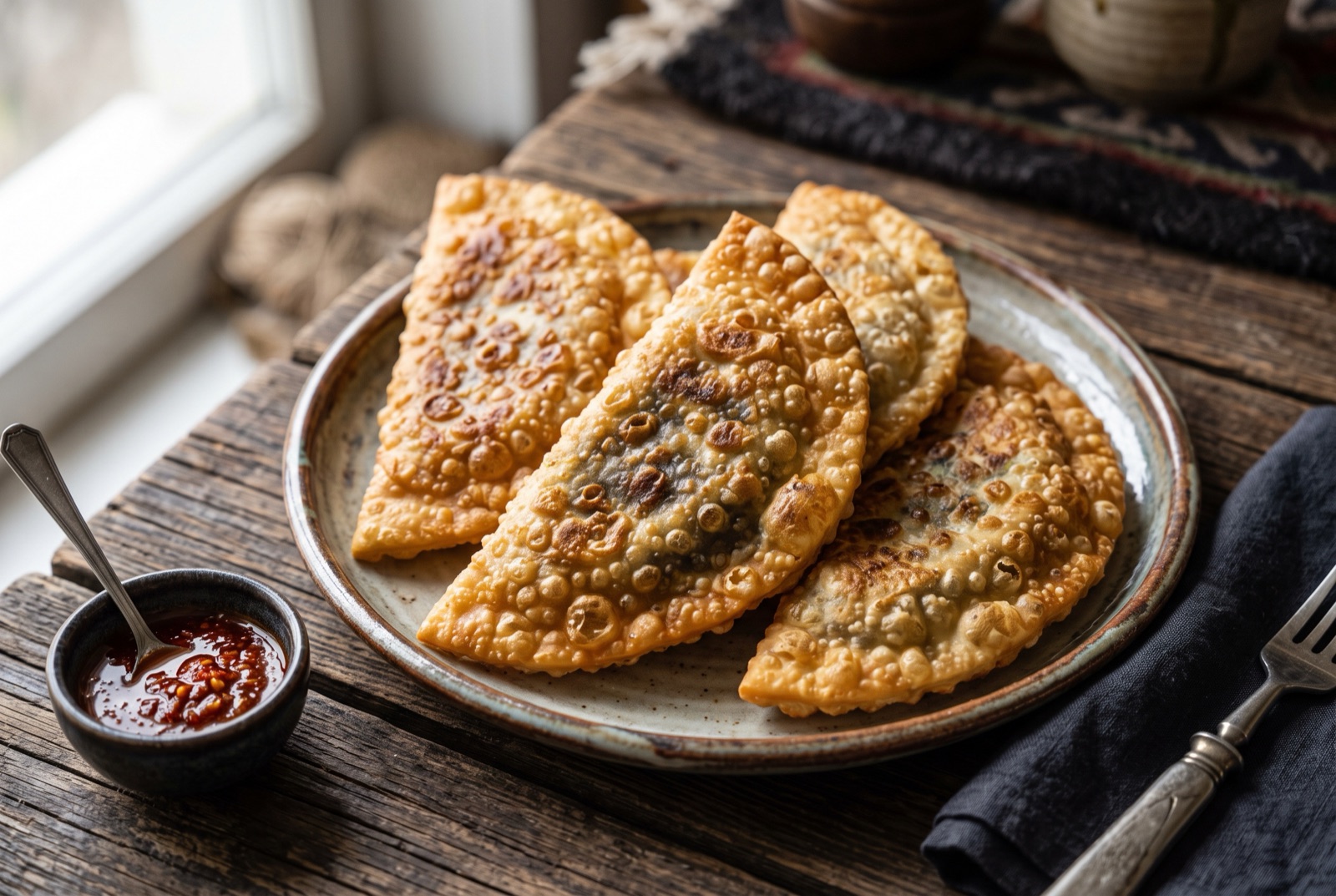
Khuushuur is a flattened meat pie about the size of a hand, filled with chopped mutton and onion and fried in a shallow pool of fat until the dough puffs into blisters and turns the colour of strong tea. Inside, the filling steams in its own juices, so the first bite is crisp shell followed by hot broth. It is not delicate food: the seasoning is salt, pepper, onion and garlic, and everything else comes from the meat and the frying fat. Mongolians eat them by the stack, standing up, from paper plates.

- Gate
- Mongolia
- Prep
- 45 min
- Cook
- 25 min
- Total time
- 1 hr 40 min incl. 30 min rest
- Serves
- 4
- Status
- Medium
- Nutrition / serving · estimated
- Calories 610 kcal
- Protein 24 g
- Carbs 45 g
- Fat 38 g
- Fiber 2 g
- Sodium 940 mg
Why this recipe works.
- Explains the frying temperature by what you can see, so the pastries blister instead of soaking up fat.
- A rolling and sealing method that keeps the filling in a thin, even layer right to the edge.
- Uses the same filling logic as buuz, with the extra water that makes the inside juicy rather than dry.
- Realistic about pan frying at home instead of assuming a festival-sized cauldron of fat.
Ingredients.
11 itemsFor the dough
For the filling
For frying
Equipment
- Heavy frying pan or wok
- Rolling pin
- Slotted spoon or tongs
- Colander for draining
Instructions.
Make the dough
Work the salt, flour and warm water into a firm dough and knead for 5 minutes until smooth and springy. Cover and rest 30 minutes, which lets the gluten relax so it rolls thin without pinging back.
Mix the filling
Combine the chopped mutton, cold fat, onion, garlic, salt and pepper, then beat in the cold water a spoon at a time until the mixture is sticky and just loose. Refrigerate until you are ready to fill.
Roll the rounds
Divide the dough into 12 pieces and roll each into a 13 cm round, aiming for about 2 mm thick and even from edge to edge. Stack them under a cloth with a dusting of flour between so they do not dry out.
Fill and seal
Spread 2 tablespoons of filling over half of each round, leaving a clear 1.5 cm border, then fold the dough over and press the edge shut. Crimp the seam with a fork or roll it into a rope, and flatten the whole pastry gently with your palm.
Tip Any air trapped inside will expand and split the seam — press outward from the filling toward the edge as you seal.
Heat the oil
Pour oil into a heavy pan to a depth of about 1.5 cm and heat over medium until a scrap of dough rises and bubbles briskly within 3 seconds without browning immediately — roughly 175°C.
Fry in batches
Slide in two or three khuushuur at a time and fry 3 to 4 minutes a side, until the surface raises into blisters that go deep golden and the pastry feels light and firm when tapped. Spoon a little hot oil over the top as they cook.
Tip Blisters are the doneness signal. A smooth, pale surface means the oil is too cool.
Drain and serve
Lift them out and stand them upright in a colander so steam escapes and the underside stays crisp. Bring the oil back to temperature before the next batch, and eat them while the filling is still hot enough to run.
Tips from our kitchen.
- Roll the filling out flat inside the pastry with your palm before sealing — a lump in the middle leaves raw dough at the edges and a burst seam.
- Test the fat with a scrap of dough: it should rise and bubble within 3 seconds without darkening. If it sits still, wait; if it browns instantly, pull the pan off the heat.
- Press the sealed edge with a fork or fold it over in a rope so it cannot spring open in the fat and spray.
- Fry two or three at a time at most. A crowded pan drops the temperature and every pastry comes out pale and oily.
- Drain them upright in a colander rather than flat on paper — flat draining traps steam and softens the underside.
- Salt the filling a touch more generously than seems right; the dough is unsalted and dilutes it.
Substitutions.
- Mutton → Lamb shoulder, or 80/20 beef
- Lamb is the easiest match. Beef works but needs added fat, and the pastry loses the distinct mutton flavour Mongolians recognise as the whole point.
- Shallow frying in oil → Deep frying, or an air fryer at 200°C
- Deep frying is closer to how festival stalls cook them. An air fryer gives a passable crisp shell but no blistering, and the result is drier — brush both sides with oil if you go that route.
- Onion → Leek or scallion, finely sliced
- Herders use whatever allium is available. Leek makes the filling slightly sweeter and less sharp.
Variations.
- Potato khuushuur
- Filled with mashed potato, onion and a little rendered fat instead of meat — common in lean months and on Buddhist fasting days.
- Round khuushuur
- Instead of a folded half-moon, two rounds of dough are sealed around the filling like a sandwich, giving a thinner, wider pastry that blisters more.
- Cabbage and mutton
- Finely shredded cabbage mixed into the meat stretches the filling and adds moisture, producing a lighter pastry.
Storage & reheating.
Khuushuur are best within an hour of frying. They keep 2 days refrigerated and reheat well in a dry pan over medium heat, 2 minutes a side, which brings back most of the crispness — an oven at 200°C for 8 minutes also works. Uncooked, shaped khuushuur freeze on a floured tray and fry straight from frozen at slightly lower heat for a couple of minutes longer. Do not freeze after frying: the shell goes soft and never fully recovers.
Serve with
Salted milk tea, a bowl of sharp shredded cabbage salad, and chili sauce or ketchup if you want it — Mongolians do.
The story behind Khuushuur.
Khuushuur and buuz are siblings — the same mutton filling, the same simple dough — separated by shape and cooking method. Where buuz belong to the lunar new year in winter, khuushuur belong to Naadam, the summer festival of wrestling, horse racing and archery held across the country in July. For those days the fried-pastry stalls run continuously, and the smell of mutton frying in deep pans is as much a part of the festival as the wrestlers' jackets. Regulars have opinions about which stall gets the blistering right and which serves them limp.
The form makes sense for a mobile, fuel-conscious kitchen. A flat pastry cooks through fast in a small amount of fat, needs no steamer and no long simmer, and travels well once cooked — it can be carried cold on a journey and is still perfectly edible hours later. Herding families make them in quantity when there is meat to use, and roadside guanz canteens across the country keep a tray of them warm all day for drivers.
The technique that separates a good khuushuur from a bad one is heat control. The fat has to be hot enough that the dough seals and puffs immediately, but not so hot that the outside colours before the meat inside has cooked. Cooks judge it by the blisters: a proper khuushuur develops raised bubbles across its face that go crisp and slightly darker than the surrounding dough. A pale, flat, greasy one means the fat was too cool and the pastry drank it. Mongolians also disagree, cheerfully, about thickness — some want a thin shell that crackles, others a sturdier one that holds more juice.
Questions, answered.
Why are my khuushuur greasy instead of crisp?
The oil was not hot enough. Cool fat soaks into dough rather than sealing it, so the pastry absorbs oil for the whole cooking time. Bring the oil back up to temperature between batches, and never crowd the pan — each pastry you add drops the heat noticeably.
How do I stop the filling bursting out during frying?
Seal the edge properly and leave a clear 1.5 cm border of dough with no filling in it. Press the seam flat, then crimp it with a fork or fold it into a rope. Also flatten the filled pastry gently before frying so there is no thick lump forcing the seam apart.
Can I bake khuushuur instead of frying them?
You can bake them at 200°C for about 20 minutes with both sides brushed in oil, and they will be pleasant. They will not be khuushuur in texture, though — the characteristic bubbled, crackly shell comes from dough hitting hot fat, and baking produces a smooth, bread-like surface instead.
What is the difference between khuushuur and buuz?
The filling is the same seasoned mutton. Khuushuur are flattened into a half-moon and shallow-fried until blistered, associated with the summer Naadam festival. Buuz are gathered into a small pleated parcel and steamed, and are the dumpling of the lunar new year.
What size should they be?
Roughly the size of your palm, about 12 to 14 cm across, and flat enough that the filling is a thin even layer. Larger ones are hard to cook through before the outside darkens; much smaller ones end up mostly dough and lose the juicy centre that defines the pastry.
You might also like.
All recipes →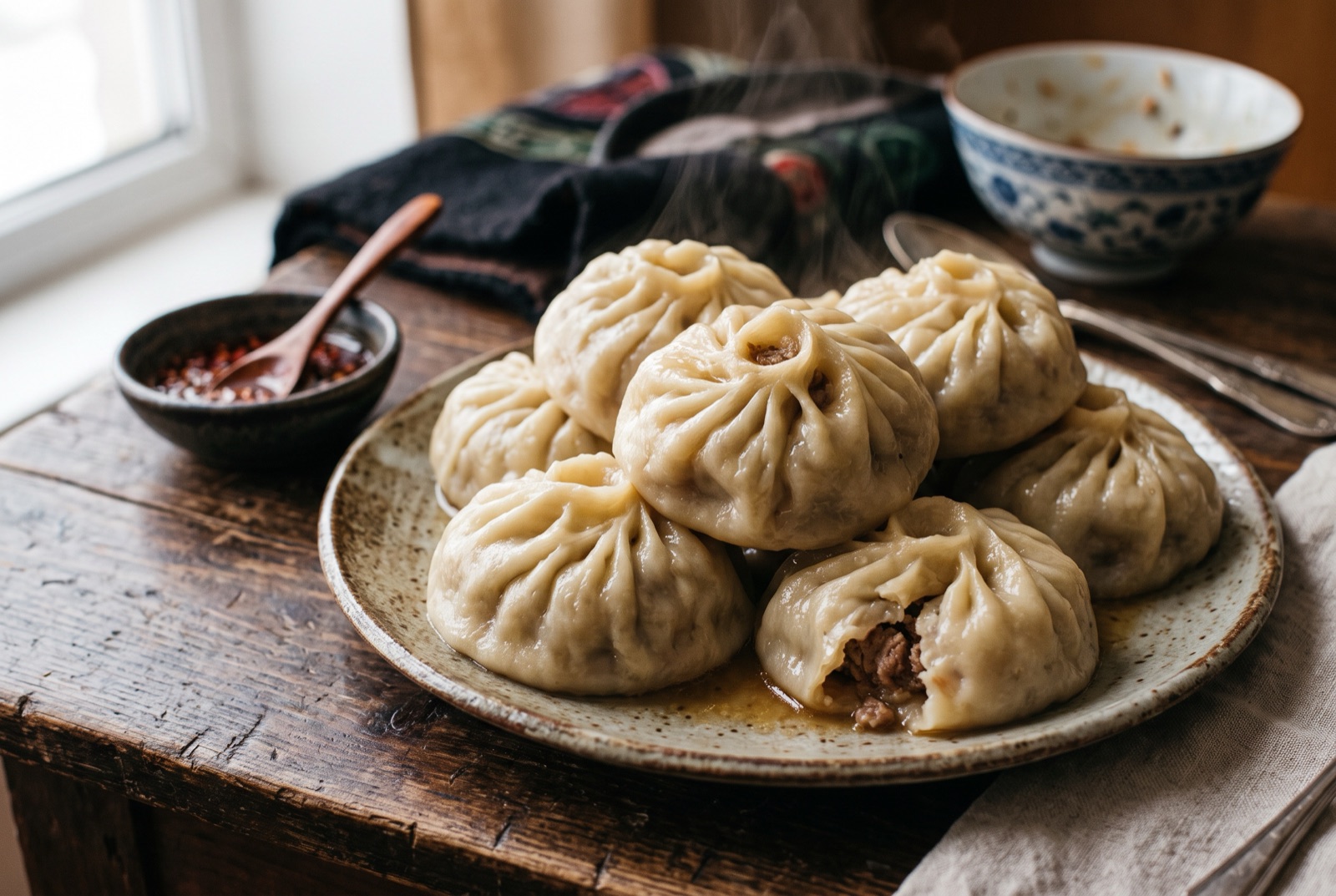
Keep exploring Mongolia.
Mongolia has 9 more dishes in the atlas — Aaruul and Bantan, and 7 more.
Recipe by The DishRoute Kitchen · published August 20, 2026 · updated August 20, 2026