Llapingachos.
Ecuadorian Cheese-Stuffed Potato Patties
Llapingachos · say it: yah-peen-GAH-chohs
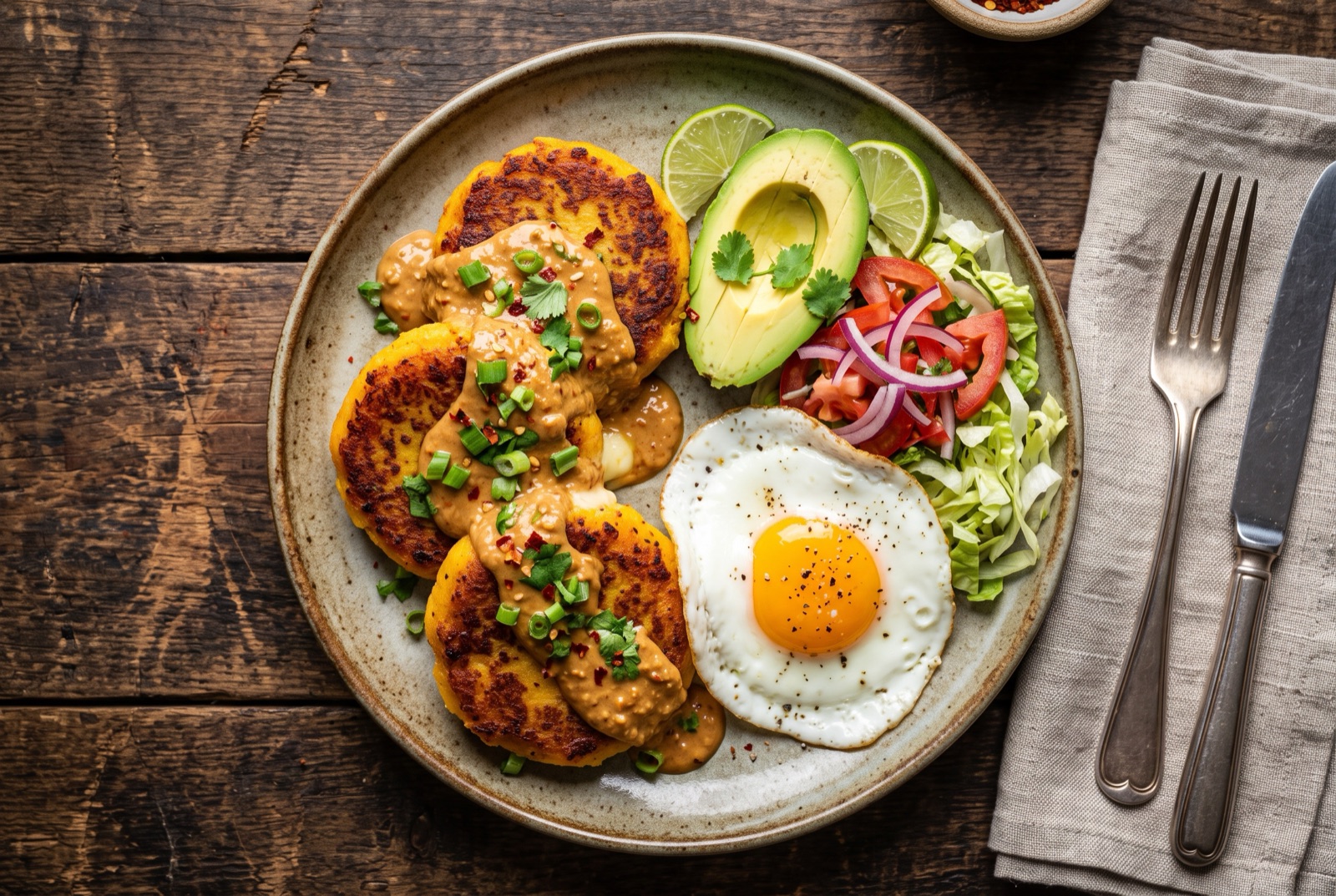
A llapingacho is a mashed potato patty with fresh cheese sealed inside it, tinted orange with achiote and cooked on a flat griddle until the outside forms a thin, blistered crust and the middle goes soft and stringy. On its own it would be a side dish; in the Ecuadorian highlands it is the center of a full plate, arriving with salsa de maní — a warm, loose peanut sauce thinned with milk — plus sliced avocado, a lightly dressed tomato and onion salad, and a fried egg with a runny yolk laid on top. The flavors are mild and comforting rather than sharp, and the whole plate is built for altitude: starchy, rich and slow to leave you hungry.

- Gate
- EcuadorTungurahua and the central Sierra
- Prep
- 30 min
- Cook
- 35 min
- Total time
- 1 hr 25 min incl. 20 min rest
- Serves
- 4
- Status
- Medium
- Nutrition / serving · estimated
- Calories 655 kcal
- Protein 24 g
- Carbs 61 g
- Fat 35 g
- Fiber 8 g
- Sugar 8 g
- Sodium 780 mg
Why this recipe works.
- Dries the mashed potato over direct heat before shaping, which is the single step that decides whether the patties crust or fall apart.
- Builds the achiote flavor through infused oil and softened onion rather than dumping in powder for color alone.
- Chills the shaped patties so they hold their edges on a hot griddle without needing flour or egg as a binder.
- Includes the full highland plate — peanut sauce, avocado, salad and fried egg — because llapingachos are a main course, not a garnish.
Ingredients.
16 itemsFor the patties
For the peanut sauce
To serve
Equipment
- Large pot
- Potato masher or ricer
- Heavy frying pan or flat griddle
- Blender
Instructions.
Boil and dry the potatoes
Cook 1 kg of peeled potatoes in well-salted water for about 20 minutes, until a knife slides through with no resistance and the edges are starting to crumble. Drain, return them to the empty hot pot, and shake over low heat for a minute until the surfaces turn matt and chalky.
Tip That chalky look means the steam is gone. Skip it and the dough will be too wet to hold together.
Make the achiote refrito and mash
Soften the finely chopped onion in 2 tablespoons of the achiote oil over low heat for 5 minutes, until it turns translucent and stains orange without browning. Mash it through the hot potatoes with the salt until smooth and stiff — add no milk, no butter and no egg.
Chill, then stuff and shape
Cool the dough, then refrigerate for 20 minutes. Divide it into 8 balls, press a deep well into each with your thumb, push in a heaped tablespoon of crumbled cheese, and close the dough over it completely before flattening into discs about 2 cm thick.
Build the peanut sauce
Blend the peanuts with the milk until completely smooth. Sweat the onion and garlic in the remaining achiote oil with the cumin, pour in the peanut milk, and simmer gently for 8 to 10 minutes, whisking, until it coats a spoon and leaves a clean line when you draw a finger through it. Season with salt and keep warm.
Tip If it tightens too far, loosen it with milk a tablespoon at a time — it should pour, not sit.
Griddle the patties
Film a heavy pan with a little oil over medium heat and cook the patties in batches for 4 to 5 minutes a side, without moving them, until a deep golden crust forms and the surface blisters slightly. They should feel firm at the edge and give in the middle when the cheese has softened.
Fry the eggs and build the plate
Fry the eggs so the whites are set and the yolks still liquid. Give each person two patties, ladle peanut sauce over them, and add the avocado, the tomato and red onion dressed with lime and salt, and the egg on top. Serve immediately, while the cheese is still soft.
Tips from our kitchen.
- Use floury potatoes such as Russet, Maris Piper or King Edward. Waxy varieties stay gluey and the patties will not develop a proper crust.
- Return the drained potatoes to the dry pot over low heat for a minute and shake them until the surfaces look chalky — steam driven off here is steam that will not tear your patties later.
- Mash the potatoes while hot but shape them cold. Warm dough sticks to your hands and slumps the moment it hits the pan.
- Seal the cheese completely and pat the seam closed. Any gap becomes an escape route and you will be scraping cheese off the griddle instead of eating it.
- Cook on medium, not high. These need four or five minutes a side to build color slowly; a hard sear browns the surface before the inside is even warm.
- Make the peanut sauce a shade looser than you think you want, since it thickens noticeably as it sits and needs to pour rather than sit in a lump.
Substitutions.
- Queso fresco → Mild mozzarella, halloumi, or a firm feta rinsed to cut the salt
- You want a young cheese that softens without going oily. Mozzarella gives the best pull; feta gives the closest crumbly texture but needs its salt reduced.
- Achiote (annatto) seeds → 1 tsp sweet paprika plus a pinch of turmeric, warmed in oil
- This lands close on color and gives a gentle warmth. Achiote has a faint peppery-earthy note that neither substitute reproduces exactly.
- Whole roasted peanuts → 4 tbsp smooth unsweetened peanut butter
- Whisk it into the warm milk off the heat. Avoid sweetened peanut butter, which pushes the sauce in completely the wrong direction.
Variations.
- With chorizo and fritada
- The full market plate adds sliced Ecuadorian chorizo or a few pieces of fritada — pork simmered then crisped in its own fat — alongside the patties.
- Llapingachos de yuca
- Boiled cassava mashed and stuffed the same way. Denser and chewier than the potato version, common where yuca is cheaper than potato.
- As a side for hornado
- In Cuenca and Ambato, llapingachos most often turn up beside slow-roasted pork rather than as the main event, with the pork juices doing the work of the peanut sauce.
Storage & reheating.
Shaped raw patties keep 2 days in the fridge between sheets of baking paper and freeze well for a month — griddle them from frozen over lower heat. Cooked llapingachos hold overnight and reheat best in a dry pan, which restores the crust; a microwave turns them soft and slightly rubbery. The peanut sauce thickens in the fridge and needs a splash of milk and a gentle warm-through to come back.
Serve with
Salsa de maní, sliced avocado, a tomato and red onion salad, and a fried egg per person.
The story behind Llapingachos.
Ecuador is one of the places where potatoes have been cultivated the longest, and the Andean provinces still grow dozens of native varieties that never leave the local markets. Llapingachos come out of that abundance, and they belong specifically to the central Sierra around Ambato and Latacunga, where they are cooked on wide steel plates at market stalls in front of whoever is queueing. The name is Kichwa in origin, though its exact derivation is argued about and no one version has settled the matter.
What marks a good one is discipline in the mash. The potato has to be floury, cooked until it is falling apart, and dried out over the heat before anything else touches it, because wet mash refuses to form a crust and splits open on the griddle. The achiote goes in as infused oil rather than powder, both for the color and because the softened onion carried in that oil is what keeps the patty from tasting like plain potato. The cheese is queso fresco — barely salted, crumbly, and made to soften rather than melt into oil.
The accompanying peanut sauce is worth understanding on its own terms. Ecuadorian salsa de maní is not the sweet, chile-heavy peanut sauce of Southeast Asia; it is a savory dairy-based sauce, thinned with milk and colored with achiote, and it appears across the country on potatoes, on grilled meat and inside other dishes. Served over llapingachos with an egg on top, it turns a plate of potatoes into the sort of lunch that gets you through an afternoon at three thousand metres.
Questions, answered.
Why do my llapingachos fall apart in the pan?
Almost always too much moisture in the mash. Drain the potatoes thoroughly, dry them in the hot pot until the surfaces look chalky, and never add milk or butter to the dough. Chilling the shaped patties for at least twenty minutes also firms them enough to survive being flipped.
What is salsa de maní?
A savory Ecuadorian peanut sauce made by blending roasted peanuts with milk and simmering them with onion, garlic and achiote until the sauce is smooth and pourable. It is mild rather than spicy and quite different from Southeast Asian satay sauces, which are usually sweetened and built on coconut milk and chile.
Can I make llapingachos without a griddle?
Yes. A heavy non-stick or cast iron frying pan works fine — the only requirement is a flat surface, steady medium heat and enough room that the patties are not touching. Cook them in batches rather than crowding the pan, since crowding drops the temperature and steams them instead of crisping them.
Can I make the dough in advance?
The potato dough is actually better made ahead. Mash and season it, then refrigerate it for a few hours or overnight before stuffing and shaping — cold dough is far easier to seal around the cheese and holds a neater disc shape.
Are llapingachos a main course or a side?
Both, depending on where you are. Around Ambato and Latacunga they are served as a complete plate with peanut sauce, avocado, salad and egg. In Cuenca and much of the southern highlands they show up as an accompaniment to roast pork, in which case two small patties per person is normal rather than four.
You might also like.
All recipes →
Keep exploring Ecuador.
Ecuador has 9 more dishes in the atlas — Bolón de Verde and Ceviche de Camarón, and 7 more.
Recipe by The DishRoute Kitchen · published August 20, 2026 · updated August 20, 2026