Mustikkapiirakka.
Finnish Blueberry Tray Pie
Mustikkapiirakka · say it: MOO-stik-kah-pee-RAH-kah
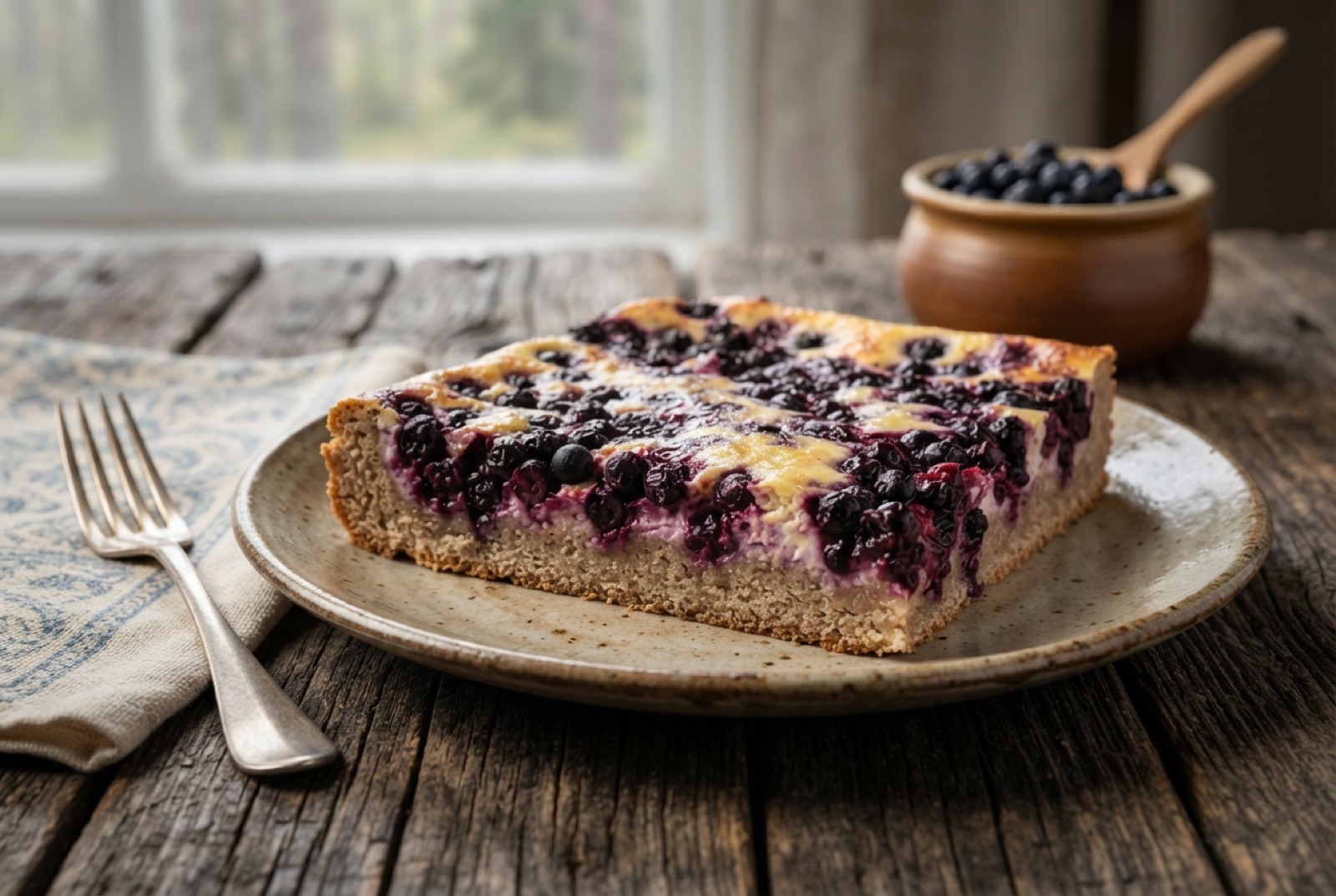
Mustikkapiirakka is a tray bake, not a pastry pie: a soft, cakey base pressed thinly across a tin, a heavy layer of small dark bilberries, and a pourable custard of quark and soured cream that seeps between the berries and sets into something between cheesecake and set cream. Baked, the berries collapse and bleed purple into the pale custard, the base underneath stays tender rather than crisp, and the whole thing is only lightly sweet — Finnish baking assumes the fruit is doing most of the work. It is eaten warm or cold in squares with coffee, and it is one of the standard things a Finnish household makes in August when the forest floor turns blue.

- Gate
- FinlandNationwide
- Prep
- 25 min
- Cook
- 35 min
- Total time
- 2 hr incl. 1 hr rest
- Serves
- 12
- Status
- Easy
- Nutrition / serving · estimated
- Calories 285 kcal
- Protein 6 g
- Carbs 34 g
- Fat 14 g
- Fiber 2 g
- Sugar 19 g
Why this recipe works.
- The base is pressed rather than rolled, so it stays soft under the fruit instead of turning to biscuit.
- A quark-and-soured-cream custard in the proportion that actually sets, rather than weeping around the berries.
- Says plainly what changes if you use cultivated blueberries instead of wild bilberries, and how to compensate.
- One tin, no pastry technique, and it is better made a few hours ahead than served straight from the oven.
Ingredients.
13 itemsFor the base
For the filling
For the custard
Equipment
- 24 x 30 cm baking tin or roasting tray
- Mixing bowls
- Whisk
Instructions.
Make the base
Heat the oven to 200°C. Beat the soft butter and sugar until pale and fluffy, about 2 minutes, then beat in the egg. Fold in the flour, baking powder and cardamom to a soft, sticky dough that just holds together.
Press it into the tin
Scrape the dough into a lined 24 x 30 cm tin and press it out with damp fingertips into an even layer roughly 5 mm thick, carrying it about 1 cm up the sides to make a shallow wall for the custard.
Tip Re-wet your fingers whenever the dough starts sticking; a rolling pin will compact it and make the base tough.
Add the berries
Toss the frozen berries with the tablespoon of flour until lightly dusted, then tip them over the base in a single generous layer, pushing them gently into the dough so they sit rather than roll.
Mix and pour the custard
Whisk the quark, soured cream, egg, sugar and vanilla until completely smooth and pourable, with no lumps of quark left. Pour it evenly over the berries and tilt the tin so it settles into every gap.
Bake until just set
Bake for 30–35 minutes, until the custard is set and lightly golden at the edges, the centre still has a faint wobble when the tin is nudged, and purple juice has bled up around the berries.
Cool before cutting
Cool the pie in its tin for at least an hour so the custard firms fully, then cut into squares with a wiped knife. Serve at room temperature or cold, with coffee.
Tips from our kitchen.
- Use frozen bilberries straight from the freezer without thawing. Thawed berries release their juice into the base and give you a soggy bottom before the custard has a chance to set.
- Toss the berries with a tablespoon of the flour before they go in — it binds the juice they release and stops the custard splitting into purple and white layers.
- Press the base with damp fingers, not a rolling pin, and take it about 1 cm up the sides of the tin so the custard has a wall to sit against.
- Crush cardamom pods fresh if you can. Pre-ground cardamom loses most of its aroma within weeks and is the reason many home bakes taste of nothing in particular.
- The pie is done when the custard is set at the edges but still has a slight wobble in the middle — it firms considerably as it cools.
- Let it cool at least an hour before cutting. Warm, the custard is loose and the squares slump; at room temperature they lift out cleanly.
Substitutions.
- Wild bilberries → Cultivated blueberries, or frozen blackcurrants and blueberries mixed
- Cultivated blueberries are milder and pale inside, so the pie will be less purple and less sharp. Adding a handful of blackcurrants or a squeeze of lemon restores the acidity.
- Quark (rahka) → Thick Greek yoghurt strained for an hour, or ricotta blended smooth
- Both work. Avoid low-fat versions, which release water during baking and leave a wet layer under the custard.
- Soured cream → Crème fraîche, or double cream with a teaspoon of lemon juice stirred in
- The acidity matters more than the fat here; sweet cream alone makes the pie taste flat.
Variations.
- Raparperipiirakka
- The same base and custard with rhubarb cut in short lengths instead of berries. Sharper still, and the version that appears first in the Finnish season.
- Oat-crumble top
- A rubbed-in topping of oats, butter and sugar scattered over the custard before baking, giving a crisp lid over the soft fruit.
- Mustikkakukko
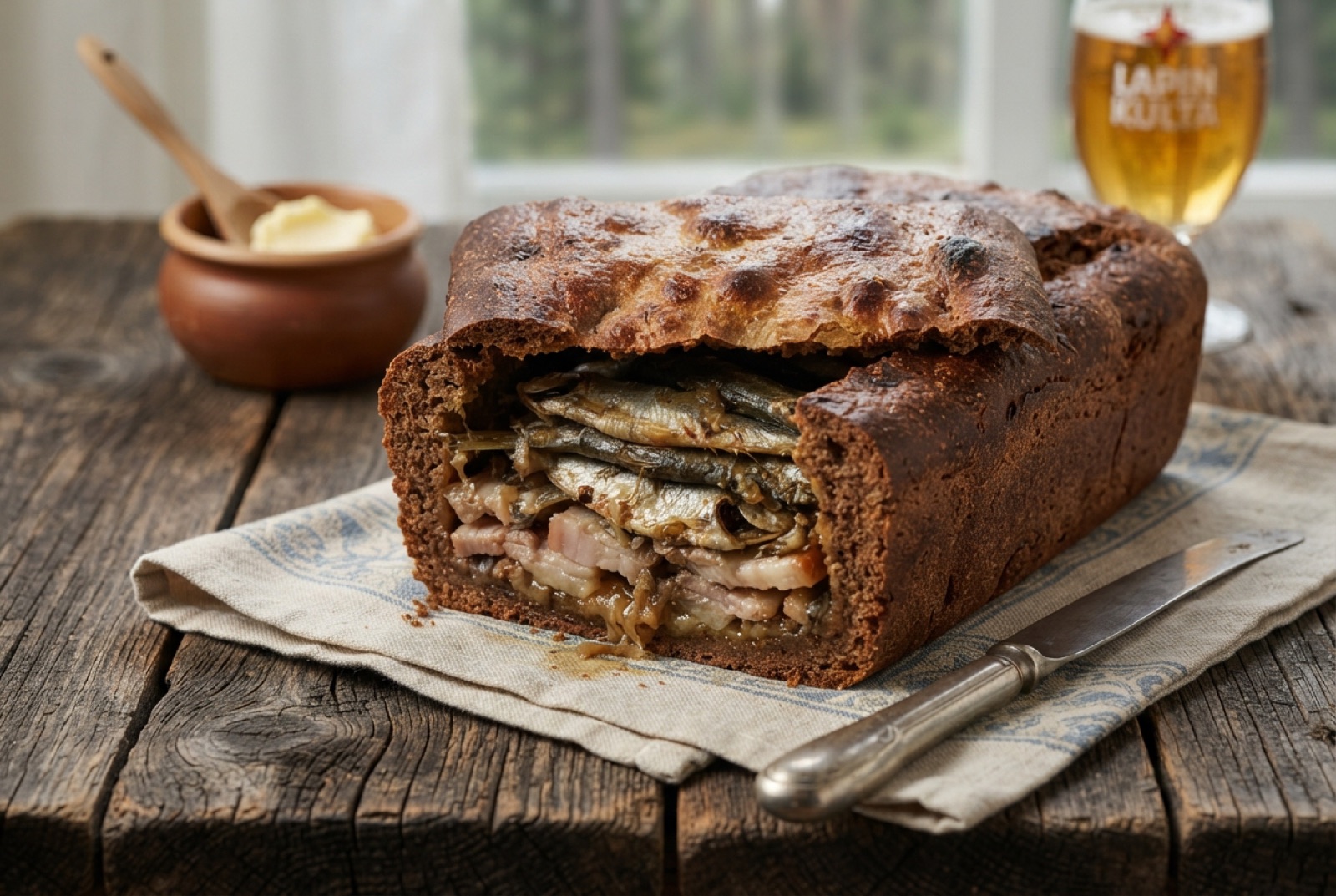
- The older, rustic ancestor: bilberries baked inside a rye crust rather than under custard, closer to a sweet version of the savoury kukko loaves of Savonia.
Storage & reheating.
Mustikkapiirakka keeps 3 days refrigerated, covered, and the flavour deepens overnight as the berry juice works through the custard. Serve it cold or let squares come to room temperature for twenty minutes; do not reheat, since warming loosens the set custard. It freezes for up to 2 months as individual squares wrapped separately — thaw in the fridge rather than at room temperature, which makes the base damp.
Serve with
Coffee, and either cold milk or a spoon of lightly whipped unsweetened cream on each square.
The story behind Mustikkapiirakka.
The berry here is mustikka, the wild bilberry — Vaccinium myrtillus — and it is not the same thing as a cultivated blueberry, however similar the two look on a screen. Bilberries are smaller, softer, and stained dark purple all the way through rather than green-white inside, which is why a Finnish blueberry pie comes out an intense violet-black while one made with supermarket blueberries stays pale and patchy. They also taste considerably sharper and more perfumed. They grow across virtually the whole of Finland in open forest, and under everyman's right anyone may pick them anywhere, which makes them free food in a country where the season is short and the harvest is genuinely enormous.
That abundance shapes the recipe. Nobody is rationing the fruit: the berry layer is thick, and the base exists mainly to hold it. The custard element — variously made with rahka (quark), kermaviili (a soured cream), smetana or plain sour cream — is characteristically Finnish and appears across the whole family of tray pies, from rhubarb to redcurrant. It adds acidity rather than richness, keeping the pie from tasting like dessert in the heavy sense.
The cardamom in the base is optional but very Finnish, and it links this pie to the wider pulla tradition. So does its social role: mustikkapiirakka is coffee-table baking, made for the afternoon coffee that punctuates every Finnish day and every occasion from a summer cottage weekend to a funeral. Cut into squares, served on a flat plate with a jug of cold milk or a pot of coffee, no forks required.
Questions, answered.
What is the difference between bilberries and blueberries?
Bilberries are the small wild European berry, dark purple right through the flesh and noticeably sharper and more aromatic. Cultivated blueberries are larger, firmer and green-white inside. A pie made with bilberries turns deep violet throughout; one made with blueberries stays pale, which is the most visible difference in the finished bake.
Can I use frozen berries?
Yes, and frozen bilberries are how most Finns make this outside the short picking season. Use them straight from the freezer without thawing and toss them in a little flour first. Thawed berries flood the base with juice and prevent the custard from setting properly.
Why did my custard stay runny in the middle?
Either it was underbaked or the dairy was too low in fat. The pie should come out with set edges and a slight wobble at the centre, then firm up over an hour of cooling. Low-fat quark or yoghurt releases water during baking and will not set no matter how long it stays in the oven.
Do I need to blind bake the base?
No. This is a soft cake-style base rather than a pastry shell, and it bakes through in the same time as the filling. Pressing it thinly and taking it slightly up the sides of the tin is enough — blind baking would dry it out and defeat the point of a tender base.
Is it very sweet?
No, and that is deliberate. Finnish tray pies are lightly sweetened so the tartness of the fruit and the sourness of the dairy come through, and this one has roughly half the sugar of a typical fruit tart. If you prefer it sweeter, add sugar to the custard rather than the base, where it would change the texture.
You might also like.
All recipes →
Keep exploring Finland.
Finland has 9 more dishes in the atlas — Kalakukko and Karjalanpaisti, and 7 more.
Recipe by The DishRoute Kitchen · published August 19, 2026 · updated August 19, 2026