Pavlova.
New Zealand Meringue Cake
pavlova · say it: pav-LOH-vuh
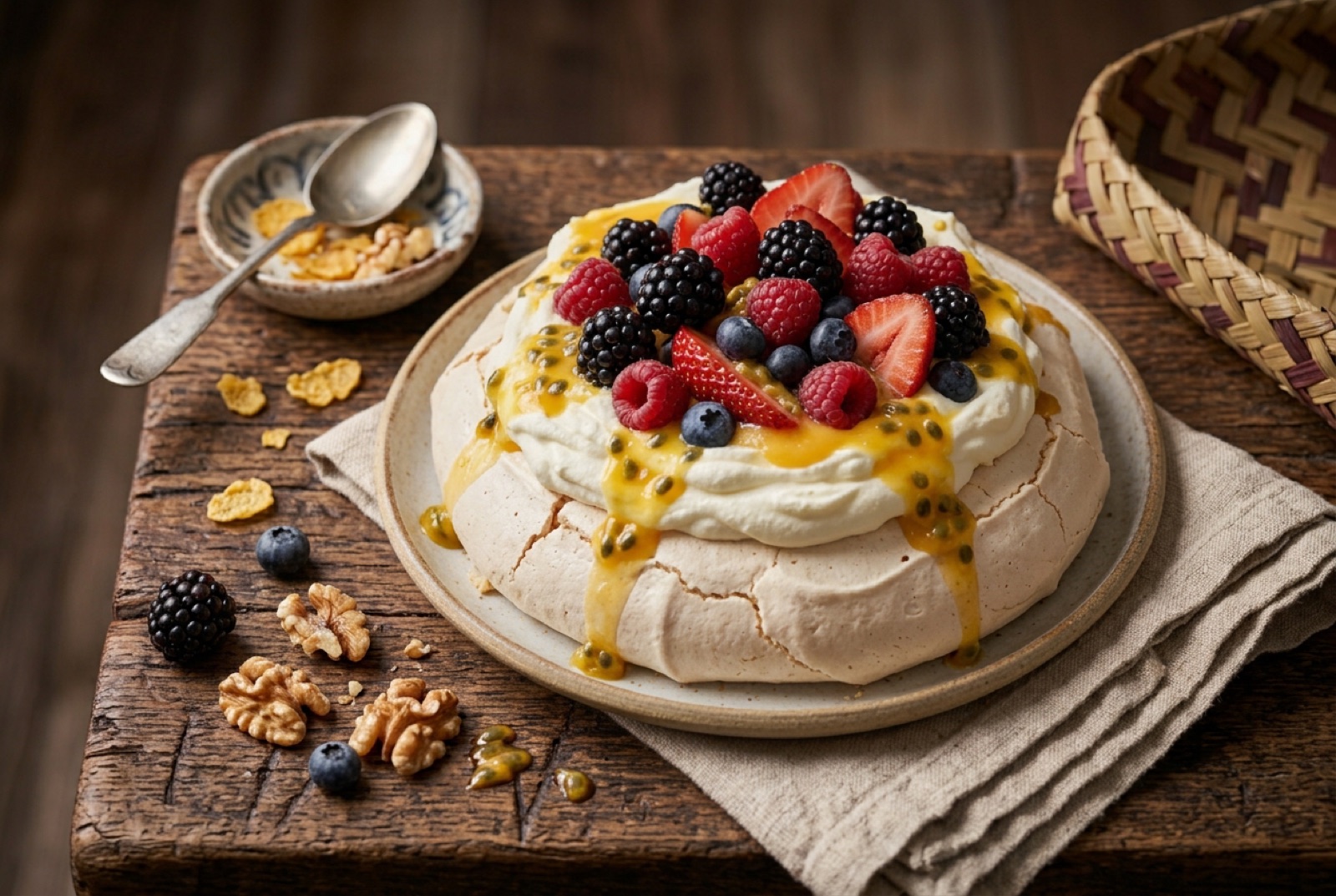
Pavlova is a single large meringue with a thin crisp shell and a centre that stays soft and marshmallowy, cooled slowly so it does not collapse, then topped with whipped cream and fruit sharp enough to cut the sugar. Cornflour and a little vinegar are what make the difference between a pavlova and a plain meringue: they slow the egg white proteins down so the inside never fully dries out. It is a summer dessert in the southern hemisphere, which is why it turns up on Christmas tables here alongside cold ham rather than in the middle of winter, and it is assembled at the last minute because cream on meringue is a countdown.

- Gate
- New ZealandNationwide, and disputed with Australia
- Prep
- 25 min
- Cook
- 1 hr 15 min
- Total time
- 5 hr 40 min incl. 4 hr rest
- Serves
- 10
- Status
- Medium
- Nutrition / serving · estimated
- Calories 330 kcal
- Protein 4 g
- Carbs 45 g
- Fat 15 g
- Fiber 2 g
- Sugar 42 g
- Sodium 60 mg
Why this recipe works.
- Sugar is added slowly and beaten to full dissolution, which is the single thing that stops a pavlova weeping syrup.
- Cornflour and vinegar go in at the end, so the centre sets soft rather than drying into a hard meringue.
- The meringue cools completely in a switched-off oven, which prevents the sudden temperature drop that cracks and sinks it.
- Cream is left unsweetened and the fruit is sharp, so the finished dessert is not sugar on sugar.
Ingredients.
10 itemsMeringue
Topping
Equipment
- Stand mixer or electric hand beaters
- Baking tray and baking paper
- Palette knife
Instructions.
Prepare the oven and tray
Heat the oven to 120C conventional. Draw a 22cm circle on baking paper, flip the paper ink-side down onto a tray, and wipe the mixing bowl and whisk with a little vinegar on kitchen paper to strip any grease.
Whip the whites to soft peaks
Beat the egg whites with the pinch of salt on medium speed until they hold a soft peak that flops over at the tip. Stop here — whites beaten to stiff dry peaks before the sugar goes in will not take the sugar properly.
Add the sugar slowly
With the beaters running, add the caster sugar one tablespoon at a time, waiting about 15 seconds between additions. Keep beating until the meringue is thick, glossy and holds a firm upright peak, about 8 minutes in total.
Tip Rub a little between your fingers. Gritty means undissolved sugar and a pavlova that will weep — keep going.
Fold in cornflour and acid
Sift the cornflour over the meringue, add the vinegar and vanilla, and fold through with a spatula in a few large strokes. Do not stir it in vigorously or you will knock out the air you just spent ten minutes building.
Shape and bake
Pile the meringue inside the drawn circle and shape it into a tall cylinder with straight sides and a slightly hollowed top. Bake for 75 minutes without opening the door; the shell should feel dry and lift cleanly from the paper at the edge.
Cool it in the oven
Turn the oven off and leave the pavlova inside with the door closed for at least 4 hours, or overnight. This slow cooling is what stops the sudden contraction that sinks the middle and shatters the shell.
Top and serve straight away
Whip the cream to soft, spoonable peaks without sugar and spread it over the meringue. Scatter the strawberries and kiwifruit, spoon passionfruit pulp over the lot, and take it to the table within the hour.
Tips from our kitchen.
- Wipe the bowl and whisk with vinegar or lemon juice first. Any trace of fat or egg yolk stops the whites reaching full volume.
- Add the sugar a spoonful at a time and keep beating. Rub a little between your fingers — if it feels gritty, the sugar has not dissolved and the pavlova will bead with syrup.
- Bake low, around 120C, and treat the oven as a dryer rather than an oven. Anything hotter browns the shell and cooks the middle firm.
- Do not open the oven while it bakes or during the cooling hours. A draught of cold air is what causes the crater in the top.
- Cracks are normal and expected. The cream goes on top precisely because it hides them, so do not keep rebaking to chase a perfect surface.
- Assemble within an hour of serving. Cream draws moisture out of meringue and the shell softens to a chew within a few hours.
Substitutions.
- Caster sugar → Granulated sugar blitzed briefly in a food processor
- Whole granulated sugar dissolves too slowly and is the usual reason a meringue weeps.
- White vinegar → Lemon juice or cream of tartar
- All three do the same job of acidifying the whites. Use half a teaspoon of cream of tartar in place of a teaspoon of vinegar.
- Passionfruit and kiwifruit → Strawberries, raspberries, tamarillo or poached tamarind-sharp stone fruit
- The topping needs acidity from somewhere; sweet fruit alone leaves the whole thing cloying.
Variations.
- Individual pavlovas
- Piped into six nests and baked for about 45 minutes. Crisper overall, since there is less soft interior relative to shell.
- Pavlova roulade
- The same mixture spread flat, baked briefly, then rolled around cream and fruit while still flexible. Softer and less prone to cracking dramatically.
- Brown sugar pavlova
- Part of the caster sugar replaced with soft brown sugar for a caramel note and a beige shell. Less stable, so beat it a little longer.
Storage & reheating.
The bare meringue shell keeps 2 days in an airtight container at room temperature, and stays crisp only if the room is dry — humidity is its enemy, so never refrigerate it undressed. Once cream and fruit are on, pavlova is at its best within the hour and acceptable for perhaps four; after that the shell has absorbed moisture and gone chewy throughout. Leftovers can be refrigerated overnight and eaten as a soft mess, which is genuinely pleasant, but it will not go back to being crisp. Do not freeze it.
Serve with
Strong black coffee, and a second bowl of fruit for people who want more topping than meringue.
The story behind Pavlova.
Pavlova is named for Anna Pavlova, the Russian ballerina who toured New Zealand and Australia in 1926 and again in 1929, and both countries claim to have invented the dessert in her honour. The dispute is genuine and it is not settled. Helen Leach, an anthropologist at the University of Otago, worked through hundreds of cookbooks and found meringue cakes under the pavlova name printed in New Zealand earlier than any Australian example she could locate, and the Oxford English Dictionary took the same view of the earliest recorded use. Australian writers have contested the reading of that evidence ever since, and other researchers have traced the whole form further back again, to the layered meringue and cream cakes of Central Europe and North America that migrants carried outward long before either country claimed the name. What is not in doubt is that both places adopted it completely.
The reason it stuck here has more to do with farming than with ballet. New Zealand ran on eggs, butter and cream long before it ran on anything else, and a dessert that turns six egg whites and a bag of sugar into something big enough for a whole table was exactly the right shape for a country with a dairy surplus and a habit of bringing a plate. It became the fixed end of Christmas dinner, which in the southern hemisphere falls in high summer, and the fruit on top follows the season — passionfruit and strawberries first, then whatever the garden or the roadside stall has.
Beyond the ownership argument, the two national versions differ slightly in practice. New Zealand pavlova is usually built tall and softer in the middle, close to marshmallow, while the Australian style tends to be shallower with a firmer crust, though every cook and every oven blurs that line. The topping is where households really diverge: kiwifruit is standard, passionfruit pulp is near-obligatory, and there is a long-running quiet disagreement about whether tinned passionfruit is acceptable when fresh ones are dear.
Questions, answered.
Did pavlova come from New Zealand or Australia?
Both countries claim it, and the argument is unresolved. Research by Helen Leach at the University of Otago found the name attached to a meringue cake in New Zealand print earlier than any Australian example she located, and the Oxford English Dictionary followed that finding, but Australian writers dispute the interpretation and other researchers trace the dessert form itself back to older European and American meringue cakes.
Why did my pavlova weep sticky syrup?
Undissolved sugar. If the sugar is added too fast or the meringue is not beaten long enough, sugar crystals stay whole and later draw water out of the egg white, forming syrup beads on the surface. Add caster sugar one spoonful at a time and keep beating until a pinch rubbed between finger and thumb feels completely smooth.
Why did the middle sink and crack?
A sunken crater usually means the meringue was cooled too quickly, so switch the oven off at the end of baking and leave the pavlova inside with the door shut for several hours or overnight. Some cracking is unavoidable and normal in a soft-centred pavlova, which is exactly why the cream and fruit go on top.
What is the cornflour actually doing?
Cornflour absorbs moisture and interferes with the egg white proteins bonding too tightly, so the inside of the meringue sets soft and marshmallowy instead of drying right through. Vinegar works alongside it by acidifying the whites, which makes the foam more stable and less likely to collapse during a long low bake.
Can I make pavlova ahead of time?
Bake the meringue shell up to two days ahead and keep it in a sealed airtight container at room temperature, never in the fridge, where damp air will soften it. Whip the cream and cut the fruit on the day, and assemble no more than an hour before it goes to the table, because cream starts dissolving the crisp shell on contact.
You might also like.
All recipes →

Keep exploring New Zealand.
New Zealand has 9 more dishes in the atlas — Afghan Biscuits and Boil Up, and 7 more.
All New Zealand recipes Eggs recipes Heavy cream recipes Cornstarch recipes dessertvegetariangluten freenut freeRecipe by The DishRoute Kitchen · published August 21, 2026 · updated August 21, 2026