Norske Vafler.
Heart-Shaped Cardamom Waffles
Norske vafler · say it: NORS-keh VAHF-lerr
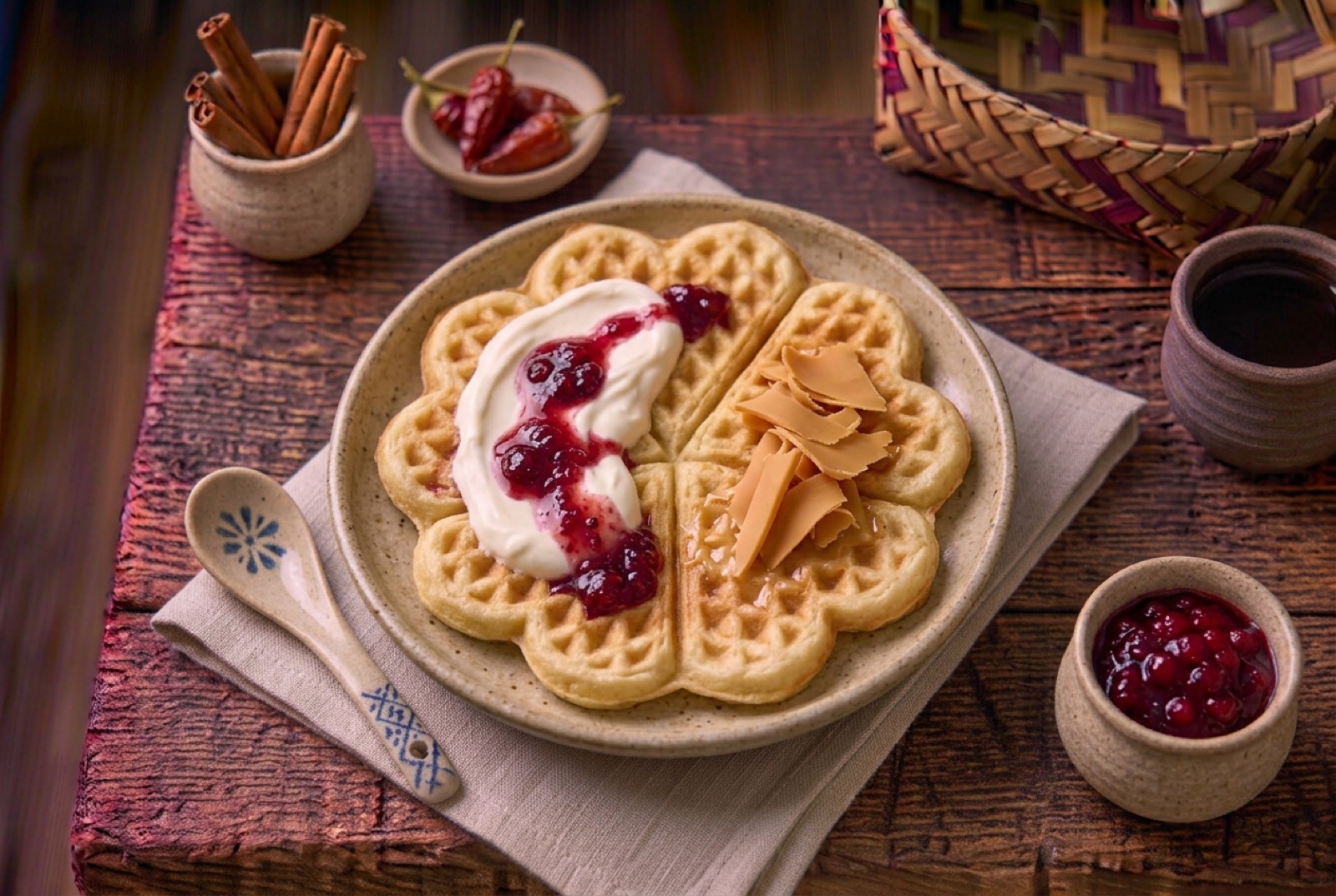
Norwegian waffles are soft, not crisp. The batter is thin, heavily scented with cardamom and slackened with cultured buttermilk, and it bakes in a hinged iron shaped like five hearts joined at the centre so the finished waffle can be torn apart and shared. Straight off the iron they are pale gold, pliable enough to fold, and faintly tangy from the buttermilk under the warm sweetness of the cardamom. The standard toppings are sour cream and strawberry jam, or butter and thin shavings of brown cheese, and the whole thing is eaten with coffee at any hour by anyone, which is more or less the national position on waffles.

- Gate
- Norway
- Prep
- 15 min
- Cook
- 20 min
- Total time
- 1 hr 5 min incl. 30 min rest
- Serves
- 4
- Status
- Easy
- Nutrition / serving · estimated
- Calories 590 kcal
- Protein 15 g
- Carbs 68 g
- Fat 28 g
- Fiber 2 g
- Sugar 24 g
Why this recipe works.
- Rests the batter properly so the flour hydrates and the cardamom infuses, which visibly changes both texture and aroma.
- Uses cultured buttermilk rather than plain milk, giving the faint sourness that Norwegian waffles are supposed to have.
- Calls for cardamom ground from pods, with an honest note on what pre-ground loses.
- Aims for soft, foldable waffles rather than the crisp Belgian kind, and tells you how to spot the moment to lift the lid.
Ingredients.
11 itemsFor the batter
To serve
Equipment
- Norwegian heart-shaped waffle iron (or any waffle iron)
- Whisk
- Mortar and pestle for the cardamom
Instructions.
Grind the cardamom
If using pods, crush 8–10 green cardamom pods in a mortar, pick out and discard the papery husks, and grind the black seeds to a fine powder. The smell should be sharp and almost eucalyptus-like — that is what pre-ground cardamom has lost.
Mix the dry ingredients
Whisk 250 g of flour with the sugar, cardamom, baking powder and salt in a large bowl until evenly combined and no pockets of baking powder remain.
Build the batter
Beat the eggs into the dry mix with about a third of the buttermilk to make a thick, lump-free paste, then whisk in the rest of the buttermilk gradually. Finally whisk in the melted butter until the batter is smooth and roughly the consistency of single cream.
Tip Starting thick and thinning down is how you avoid lumps. Adding all the liquid at once guarantees them.
Rest the batter
Cover and leave at room temperature for 30 minutes. It will thicken and small bubbles will rise to the surface. If it has gone thicker than double cream, whisk in a splash of milk to bring it back.
Heat and grease the iron
Heat the waffle iron fully — a drop of batter should sizzle on contact — and brush it once with melted butter. Do not grease it again between waffles.
Bake the waffles
Ladle enough batter into the centre to almost fill the plate, close the lid and cook for 3–4 minutes. Watch the steam at the hinge: when the thick plume thins to a wisp, the waffle is set and pale gold. Lift the lid and check — if it resists, close it for another 30 seconds.
Tip Opening early tears the waffle in half. Judge by the steam, not the clock.
Keep them soft and serve
Stack the waffles on a plate under a clean tea towel as they come off. Serve warm, torn into hearts, with sour cream and jam, or with butter and shavings of brown cheese, and a pot of strong coffee.
Tips from our kitchen.
- Grind cardamom from green pods if you possibly can — crush the pods, discard the husks and grind the black seeds. Pre-ground cardamom loses most of its aroma within weeks of opening.
- Let the batter rest at least 30 minutes. It thickens noticeably as the flour absorbs liquid, and the waffles come out more tender and less rubbery.
- If the rested batter is thicker than double cream, thin it with a splash of milk. Thick batter gives dense, bready waffles.
- Grease the iron once at the start with a brush of melted butter, then not again. Re-greasing every waffle makes them greasy and unevenly coloured.
- The waffle is done when the steam escaping from the sides thins from a heavy plume to a light wisp — usually 3 to 4 minutes. That signal is more reliable than any timer.
- Stack them on a plate under a clean tea towel to stay soft. If you want them crisp instead, lay them in a single layer on a rack — but soft is the Norwegian way.
Substitutions.
- Cultured buttermilk (kulturmelk) → Plain kefir, thin natural yogurt, or whole milk soured with 1 tbsp lemon juice per 250 ml
- You want acidity, both for flavour and because it reacts with the baking powder for lift. Plain milk works but gives a flatter, sweeter waffle.
- Ground cardamom → Seeds from 8–10 green cardamom pods, crushed in a mortar
- This is the upgrade rather than the compromise. If you only have pre-ground, use a generous teaspoon and a half, since it will have faded.
- Brunost (brown cheese) → Sour cream and strawberry jam, or butter and honey
- Brown cheese is a genuinely acquired taste and hard to find outside Scandinavia and its diaspora. The sour cream and jam combination is equally traditional and much easier.
Variations.
- Sour cream waffles (rømmevafler)
- Replace 100 ml of the buttermilk with thick sour cream for a richer, more tender waffle with a pronounced tang. Common at cabins and church cafés.
- Savoury waffles
- Leave out the sugar and cardamom, add a pinch of salt and some chopped chives, and serve with smoked salmon and sour cream. A modern Norwegian café standard.
- Waffles with vanilla and lemon zest
- Swap the cardamom for the zest of a lemon and a teaspoon of vanilla — a lighter, more summery version that goes well with fresh berries and whipped cream.
Storage & reheating.
Waffles are best within minutes of coming off the iron, but they keep two days in a sealed bag at room temperature and reheat well for 60 seconds in a dry pan or a few minutes in a low oven. They freeze for two months stacked with baking paper between them; reheat straight from frozen in a toaster or on a warm dry pan. Batter can be made a day ahead and kept covered in the fridge — it thickens overnight, so whisk in a splash of milk before baking, and expect slightly less lift from the baking powder.
Serve with
Sour cream and strawberry jam, brown cheese, or simply butter and sugar — with strong black coffee.
The story behind Norske Vafler.
It is difficult to overstate how routine waffles are in Norwegian social life. They turn up at workplace meetings, in church basements, at school fundraisers, on ferries, at mountain cabins after a ski, and at the volunteer work days called dugnad, where making waffles for everyone is as much a part of the job as the painting. The five-heart iron is standard equipment in Norwegian kitchens in a way it is not anywhere else, and the shape itself has become shorthand for Norwegian hospitality — a waffle heart is what you offer someone who has just arrived, cold, from outside.
The cardamom is the interesting part. Cardamom is a tropical spice from South India and it has no business dominating a Nordic baking tradition, but northern European ports traded heavily in it from the medieval period onward, and Scandinavian bakers absorbed it into buns, breads and batters until it became the region's defining sweet spice. Norwegians use it the way other cuisines use vanilla, and a waffle batter without it tastes to a Norwegian palate like it is missing something rather than like it has been simplified.
The accompaniments run along a preserved-food logic that connects the waffle to the older Norwegian larder. Rømme, the thick cultured sour cream, is milk stabilised by fermentation. Brunost is whey boiled down for hours until the milk sugars caramelise, invented so that nothing from a summer of mountain dairying went to waste. The jam is berries put up in sugar at the end of a short northern summer. A plate of waffles is a plate of things that were originally made to last, served on top of the softest, most immediate bread in the country.
Questions, answered.
Do I need a Norwegian heart-shaped waffle iron?
No — any standard thin waffle iron works, and the batter behaves the same. The heart iron gives the shape Norwegians recognise, bakes thinner and softer waffles than a Belgian iron, and makes the waffle easy to tear into five pieces for sharing. A deep-pocket Belgian iron will produce a thicker, more cake-like waffle from this batter, which is a different thing but still good.
Why are Norwegian waffles soft instead of crisp?
They are made that way deliberately. The batter is thin, contains no yeast and relatively little fat compared with a Belgian waffle, and it bakes in a shallow iron for only three or four minutes. The result is pliable enough to fold around a filling and eat by hand. If you want crispness, cook them a minute longer and cool them on a rack rather than stacking them.
Why does the batter need to rest?
Resting lets the flour fully absorb the liquid, which produces a more tender waffle and reduces the raw-flour taste, and it gives the ground cardamom time to infuse the batter rather than sitting in it as specks. Thirty minutes is the minimum; an hour is better. The batter thickens visibly as it rests, which is normal — thin it with a little milk if it goes past the consistency of double cream.
What is brunost and what does it taste like?
Brunost, or brown cheese, is made by boiling down whey — the liquid left over from cheesemaking — until the milk sugars caramelise into a firm brown block. It tastes sweet, caramelly and faintly goaty, more like a dense fudge than a cheese. Norwegians shave it thinly onto waffles and bread. It is genuinely divisive for newcomers, so try a small amount before committing a whole plate to it.
Why are my waffles sticking to the iron?
Usually because the iron was not hot enough when the batter went in, or because it needs seasoning. Preheat fully — a drop of batter should sizzle immediately — and brush with melted butter once before the first waffle. Also give the waffle enough time: opening the lid before the crust has set will tear it in half. If the steam is still coming out in a thick plume, wait.
You might also like.
All recipes →
Keep exploring Norway.
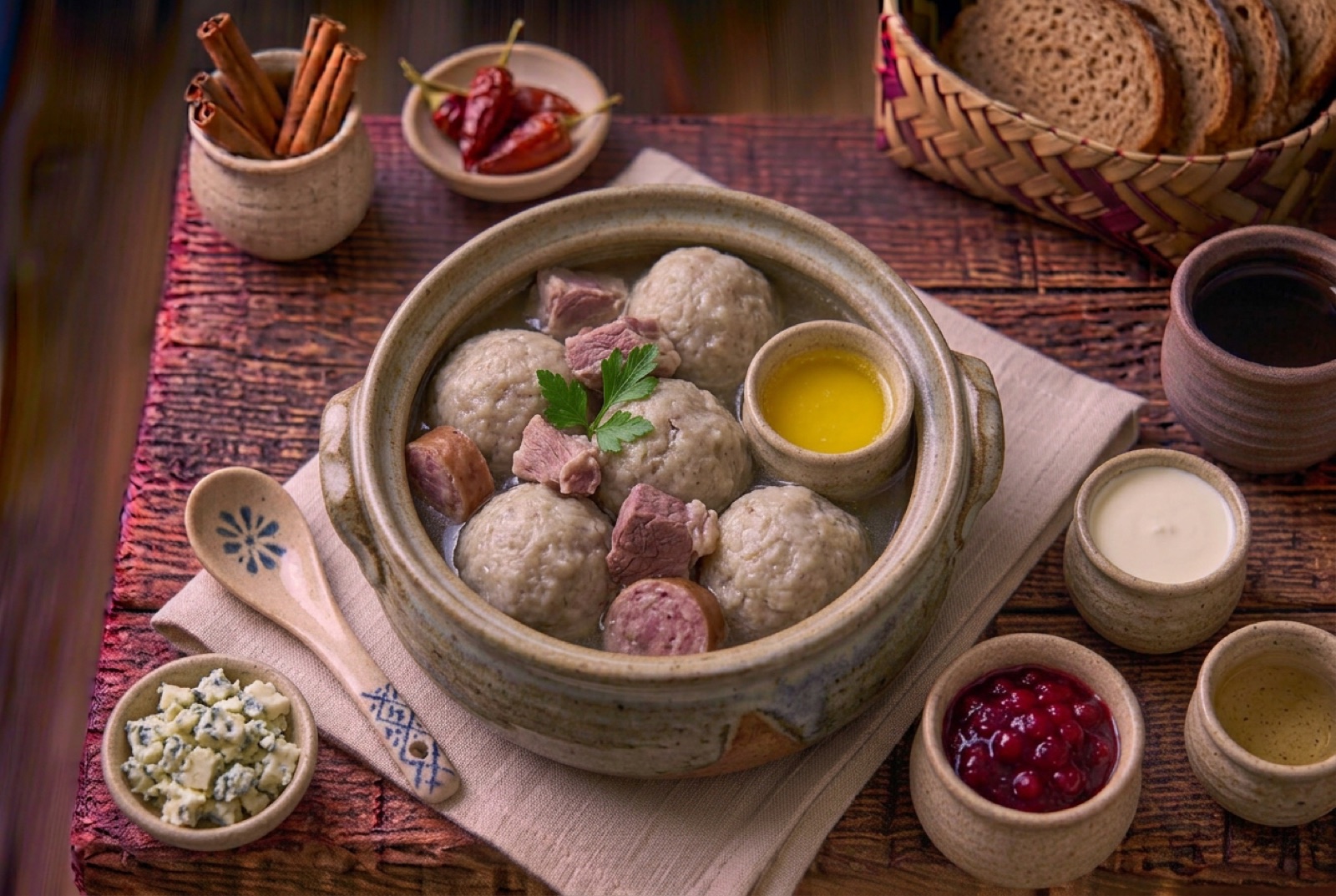
Norway has 9 more dishes in the atlas — Bergensk Fiskesuppe and Fårikål, and 7 more.
Recipe by The DishRoute Kitchen · published August 19, 2026 · updated August 19, 2026