Lefse.
Soft Norwegian Potato Flatbread
Potetlefse · say it: LEFF-seh
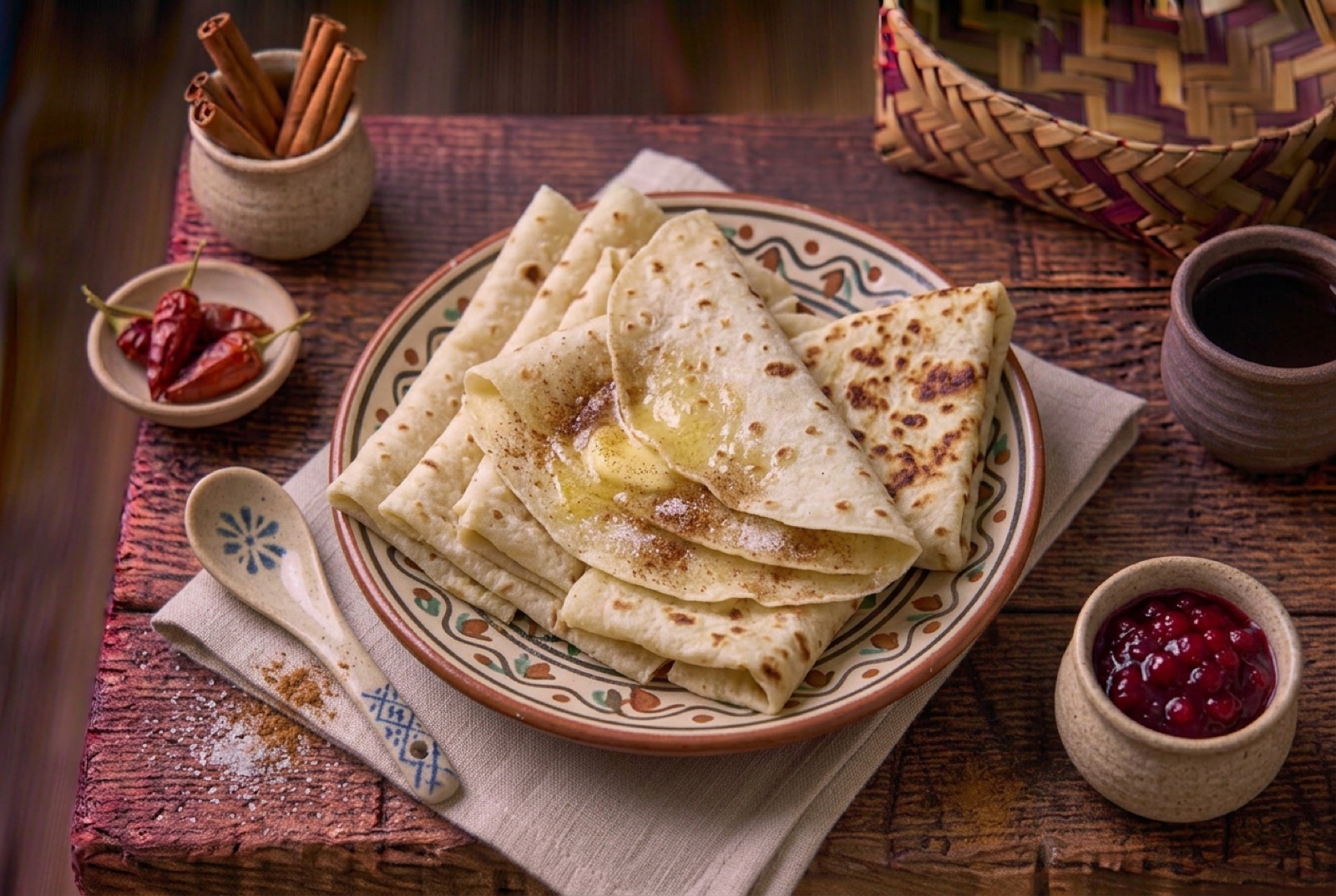
Lefse is a soft, pliable flatbread made mostly of potato — riced floury potatoes enriched with butter and cream, chilled overnight, then cut with just enough flour to roll out almost transparently thin and baked on a dry griddle. It cooks in under a minute a side and comes off flexible and slightly steamy, dotted with brown freckles, tasting faintly of potato and butter and not much else. That neutrality is the point: lefse is a wrapper and a base. The classic treatment is butter, sugar and cinnamon, spread while the bread is warm, rolled or folded into quarters and eaten with coffee.

- Gate
- Norway
- Prep
- 40 min
- Cook
- 30 min
- Total time
- 9 hr 10 min incl. 8 hr rest
- Serves
- 4
- Status
- Medium
- Nutrition / serving · estimated
- Calories 470 kcal
- Protein 9 g
- Carbs 72 g
- Fat 17 g
- Fiber 5 g
- Sugar 14 g
Why this recipe works.
- Chills the potato dough overnight, which is the difference between a dough you can roll thin and one that tears and sticks.
- Adds the flour only at the last moment and in the smallest workable amount, so the bread stays tender instead of turning tough.
- Bakes on a dry surface with real visual cues — the brown freckles and the moment the surface stops looking wet.
- Explains the cloth trick that keeps finished lefse soft, without which they stiffen on the counter within minutes.
Ingredients.
9 itemsFor the dough
To serve
Equipment
- Potato ricer
- Rolling pin (grooved if you have one)
- Large dry griddle or cast-iron pan
- Long thin spatula or lefse stick
- Two clean tea towels
Instructions.
Boil and rice the potatoes
Boil 1 kg of potatoes in salted water for 20–25 minutes until a knife slides in with no resistance. Drain thoroughly and let them steam dry in the colander for 5 minutes, then press them through a ricer while still hot into a wide bowl.
Tip Never mash with a masher or a blender. Both develop the starch and make the dough gluey.
Enrich and chill overnight
Stir the soft butter, cream, salt and sugar into the hot riced potato until smooth. Spread the mixture out in a wide dish so it cools quickly, cover once cold and refrigerate for at least 8 hours or overnight.
Tip This is not an optional resting step. Cold dough is the only kind you can roll thin.
Work in the flour, in batches
Take a quarter of the cold potato mixture and knead in a quarter of the flour with your hands, just until it comes together into a smooth, firm dough that no longer sticks to your palm. Keep the rest of the potato in the fridge until you get to it.
Tip Flouring the whole batch at once guarantees the last rounds will be tough.
Divide and roll
Divide the floured portion into 4 balls. On a well-floured board, roll one out into a round about 30 cm across and 1–2 mm thick — thin enough to see the grain of the board through it. Sweep excess flour off the surface with a dry pastry brush.
Bake on a dry griddle
Heat a large griddle or cast-iron pan until a drop of water skitters across it, with no fat at all. Slide the long spatula under the round, lift it onto the griddle and cook 30–45 seconds, until the top loses its wet sheen and pale brown freckles appear underneath. Flip and give it another 30 seconds.
Tip If the freckles turn dark brown in under 20 seconds the griddle is too hot; if the round dries out before it colours, it is too cool.
Stack under cloths
Move each finished lefse straight onto a plate between two clean tea towels and stack them as you go. The trapped steam keeps them soft and pliable — left uncovered on the counter they stiffen within a few minutes.
Fill and fold
Repeat with the remaining potato mixture, flouring each batch just before rolling. To serve, spread a warm lefse with soft butter, scatter over sugar and cinnamon, then fold in half and in half again into a quarter round, and cut across into wedges.
Tips from our kitchen.
- Use floury potatoes and rice them while hot, then cool the mash completely. Warm potato plus flour equals gluey dough — this is the number one cause of failure.
- Chill the potato mixture overnight. Cold dough rolls thinner, sticks less and tolerates far more handling.
- Add flour to only as much dough as you are rolling right now. Flour starts working on the potato the moment it goes in, and dough that sits gets tougher by the minute.
- Flour the board generously and keep a brush handy to sweep excess off the rolled round before it hits the griddle — loose flour burns and tastes acrid.
- The griddle wants to be hot and completely dry, around 230°C. A drop of water should skitter and vanish. Oil or butter on the surface fries the bread instead of baking it.
- Stack the finished lefse between two clean tea towels as they come off the heat. Trapped steam keeps them soft; left in the open they stiffen within minutes.
Substitutions.
- Double cream in the dough → Whole milk, or evaporated milk
- Cream gives the most tender lefse. Milk works but the bread is a little drier and less forgiving to roll, so add an extra 10 g of butter to compensate.
- Grooved lefse rolling pin → A regular rolling pin with a pastry cloth or a sheet of baking paper
- The grooves stop the dough sticking and pressing back. A plain pin works if the dough is properly cold; rolling between two sheets of baking paper is the most reliable workaround.
- Lefse turning stick → A long thin metal spatula, or a flat wooden ruler
- You need something long enough to slide under a 35 cm round and lift it without folding. A large spatula plus a supporting hand does the job with a bit of nerve.
Variations.
- Lompe
- The small, thicker cousin, about 15 cm across, made from the same dough rolled less thin. Wrapped around a hot dog with mustard and crisp onions, it is one of the most-eaten foods in Norway.
- Lefse with brunost
- Spread with butter and thin shavings of brown cheese instead of sugar. The caramel-sweet cheese against plain potato bread is a very Norwegian combination.
- Tynnlefse (dried and revived)
- Rolled larger and thinner and baked until fully dry and brittle, then stored for months. To serve, brush lightly with water, stack between damp cloths for an hour and they turn soft and foldable again.
Storage & reheating.
Soft lefse keep three days at room temperature in a sealed bag or wrapped in a tea towel inside a plastic bag, and they freeze exceptionally well for three months — stack them with baking paper between each round, and thaw at room temperature still wrapped so the moisture stays in. Reheat briefly on a dry pan or wrap a stack in foil and warm at 150°C for ten minutes. If they do dry out, brush lightly with water and press between damp cloths for half an hour, which is the traditional method for reviving stored flatbread.
Serve with
Butter, sugar and cinnamon; brown cheese; or wrapped around cured meat with sour cream. Coffee is not optional.
The story behind Lefse.
Before potatoes, Norwegian bread was mostly flatbrød — thin rounds of barley or oat dough baked until bone dry and stacked in the loft, where they would keep for a year. That was not a stylistic choice; a country with a short season and no reliable wheat needed bread that could be made in big batches at harvest and eaten in March. Lefse belongs to the same family, and its oldest forms follow the same logic: tynnlefse and Hardanger lefse were rolled out enormous and thin, baked hard, stacked and stored, then revived when needed by sprinkling them with water and pressing them between damp cloths for an hour until they softened back into something foldable. Bread you could put away and reconstitute is a preservation technology, and it shaped what Norwegian baking looks like.
The potato version is newer, arriving after potatoes took hold in Norway in the early nineteenth century, and it is meant to be eaten soft and fresh. It is also the version that emigrated. Norwegian settlers took lefse to Minnesota, the Dakotas and Wisconsin in the nineteenth century, and it survives there with a devotion that can exceed the Norwegian original — American Norwegian communities sell dedicated lefse griddles, grooved rolling pins and long flat turning sticks, and family lefse-making sessions before Christmas are a fixed ritual. Some of the specialised equipment is easier to buy in Minneapolis than in Bergen.
In Norway itself lefse is everyday food. The small thick ones, lomper, are wrapped around hot dogs so universally that they are sold beside them; larger soft ones are folded with butter and sugar, or with brown cheese, or used at a coffee table alongside cakes. There are dozens of regional variants — møsbrømlefse from Salten spread with brown cheese sauce, nordlandslefse layered with butter and cream — and they have almost nothing in common but the shape.
Questions, answered.
Why is my lefse dough sticky and impossible to roll?
Almost always because the potato mixture was not cold enough. Warm potato releases moisture and reacts with the flour to produce a slack, gluey dough. Rice the potatoes, mix in the butter and cream, then refrigerate for at least eight hours before adding any flour. Working with a small portion at a time and keeping the rest in the fridge also helps considerably.
What kind of potatoes make the best lefse?
Floury, low-moisture varieties — russet, Maris Piper, King Edward or Norwegian Beate. They rice into a dry, fluffy mash that needs less flour, which is exactly what you want since flour is what makes lefse tough. Waxy potatoes hold too much water, and boiling rather than steaming makes the problem worse. Some cooks bake the potatoes instead of boiling them for an even drier mash.
Do I need a special lefse griddle?
No. A large dry cast-iron pan, a flat electric griddle or a crêpe pan all work, though a wide surface makes handling a 30 cm round easier. What matters is that the surface is dry — no oil or butter — and hot enough that a lefse cooks in 30 to 45 seconds a side. A grooved rolling pin and a long turning stick are more useful purchases than a dedicated griddle.
Why did my lefse turn out tough?
Too much flour, or flour that sat in the dough too long. Add only enough to make the dough rollable, mix it in briefly, and roll immediately. Do not flour the whole batch at once. Overbaking also stiffens them — pull each round as soon as brown freckles appear and the surface loses its wet sheen, and stack them under a tea towel so the residual steam keeps them pliable.
How thin should lefse be rolled?
Thin enough that you can see the pattern of the board or your hand through it — roughly 1 to 2 mm, and about 30 cm across. That thinness is what gives lefse its characteristic softness and flexibility. If the dough resists and springs back, it is too warm or has too much flour; chill it and try again rather than forcing it.
You might also like.
All recipes →


Keep exploring Norway.
Norway has 9 more dishes in the atlas — Bergensk Fiskesuppe and Fårikål, and 7 more.
Recipe by The DishRoute Kitchen · published August 19, 2026 · updated August 19, 2026