Pinnekjøtt.
Steamed Salt-Cured Lamb Ribs
Pinnekjøtt · say it: PIN-neh-shut
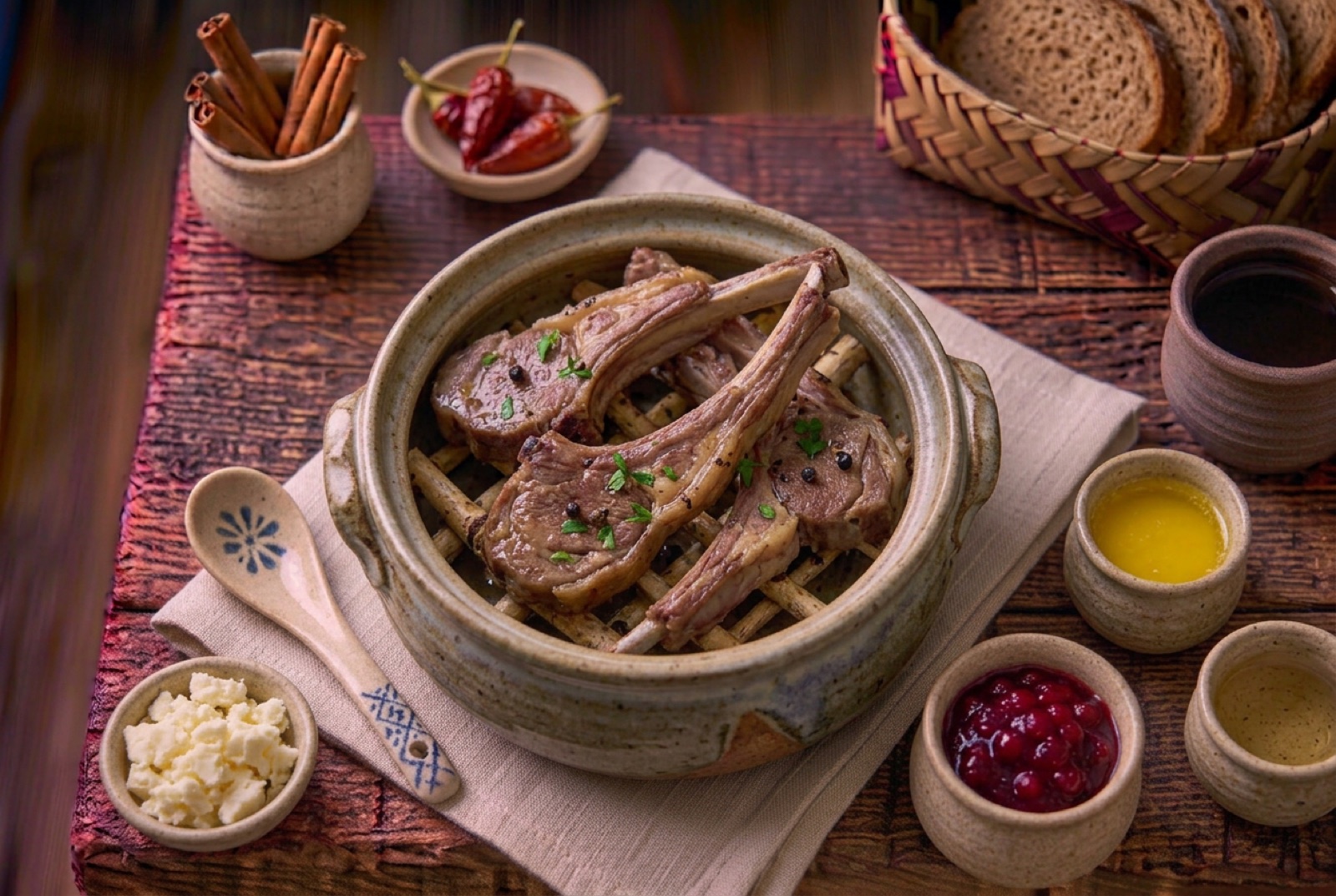
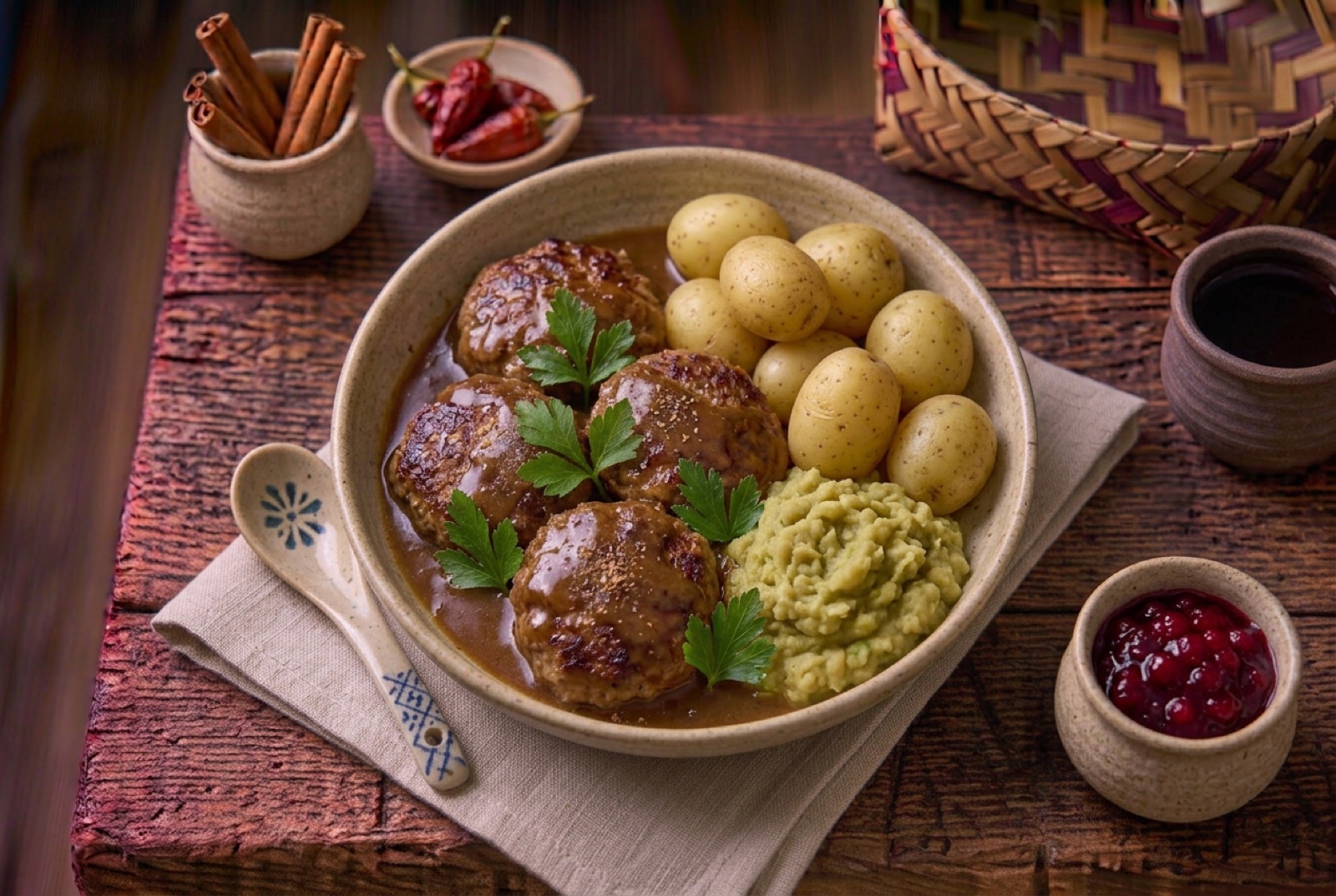
Pinnekjøtt is lamb ribs that have been salted, dried and sometimes smoked for months, then brought back to life by a long soak in cold water and three hours of steaming. The result is meat that falls off the bone in one motion, intensely savoury and salty in the way a good ham is, with the fat rendered to near-transparency and the surface faintly sticky from its own juices. It is served with kålrabistappe — mashed swede and potato — and the salty steaming liquid poured over as sauce. The name means "stick meat", after the peeled birch sticks laid in the bottom of the pot to hold the ribs above the water, and those sticks are not decoration: they perfume the steam.

- Gate
- NorwayVestlandet
- Prep
- 30 min
- Cook
- 3 hr
- Total time
- 33 hr 30 min incl. 30 hr rest
- Serves
- 4
- Status
- Takes skill
- Nutrition / serving · estimated
- Calories 880 kcal
- Protein 52 g
- Carbs 46 g
- Fat 54 g
- Fiber 7 g
- Sodium 2400 mg
Why this recipe works.
- Gives real soaking times for the three different products sold as pinnekjøtt — dried, salted-only and smoked — instead of one number that fits none of them.
- Uses the birch-stick method properly, explaining what it does and what to substitute when you have no birch.
- Includes the correct swede mash made with the meat stock, which is where half the flavour of the plate lives.
- Honest about salt: it tells you to taste the soaking water and how to fix ribs that are still too salty after a day.
Ingredients.
10 itemsFor the ribs
For the swede mash
To serve
Equipment
- Very large pot with a tight lid
- Peeled birch sticks or a steamer rack
- Large bowl or clean bucket for soaking
Instructions.
Soak the ribs
Lay 2 kg of ribs in a large bowl or clean bucket and cover completely with cold water. Refrigerate for 30 hours if they are fully dried and hard, or 10 hours if they are salted but still soft, changing the water two or three times.
Tip Weigh the ribs down with a plate so none float above the water line, or the exposed parts stay salty.
Check the salt
Cut a thin sliver from the thickest rib and taste it raw. It should taste like well-seasoned ham — clearly salty but pleasant. If it makes you wince, change the water and soak for another 6 hours.
Build the birch lattice
Lay the peeled birch sticks across the base of a very large pot in a criss-cross layer about 3 cm deep. Pour in water until it comes just below the top of the sticks — the meat must never touch it.
Load and steam
Stack the drained ribs on the sticks, fat side up, packing them in but leaving small gaps for steam. Cover tightly, bring to a boil, then reduce to the lowest heat that keeps steam escaping steadily and cook for 3 hours.
Tip Check the water every 45 minutes and top up with boiling water from the kettle. A pot that boils dry will scorch and ruin the whole batch.
Make the swede mash
After 2 hours, boil the swede and potato in salted water for 25–30 minutes until a knife meets no resistance. Drain, let them steam dry for 2 minutes, then mash with the butter, cream and nutmeg, loosening with a ladle of the salty steaming liquid from the rib pot until thick and spoonable.
Tip Salt the mash last and lightly — the liquid from the ribs brings plenty.
Check the ribs
The ribs are done when the meat has shrunk back from the ends of the bones and a bone twisted gently pulls free of the meat with almost no resistance. If it still grips, cover and steam for another 30 minutes.
Optional crisping
For browned edges, lift the ribs onto a foil-lined tray, fat side up, and grill under a high heat for 4–6 minutes until the surface blisters and darkens. Do not walk away — the rendered fat catches fast.
Serve
Strain the liquid from the bottom of the pot into a jug and skim most of the fat. Pile the ribs onto a warm platter and serve with the swede mash, boiled potatoes and the strained liquid poured over, with aquavit alongside.
Tips from our kitchen.
- Taste a sliver of raw soaked rib before you cook. If it is unpleasantly salty raw, it will be unpleasantly salty cooked — change the water and give it another six hours.
- Never let the pot boil dry. Check the water every 45 minutes and top up with boiling water from the kettle; adding cold water stalls the cooking.
- The water must stay below the sticks. If it touches the meat you are boiling, not steaming, and the ribs turn stringy and lose their flavour into the pot.
- Save the liquid at the bottom. It is intensely savoury and is used both to loosen the swede mash and as the sauce for the plate.
- Allow 400–500 g of bone-in ribs per person. It looks like an absurd quantity on the counter and is roughly correct on the plate.
- If you want crisp edges, finish the drained ribs under a hot grill for 4–6 minutes at the end, watching constantly — the fat catches quickly.
Substitutions.
- Birch sticks → A metal steamer rack, an inverted heatproof plate, or a bed of thick carrot batons
- Any of these keeps the meat above the water. You lose the faint birch aroma, which matters less than most Norwegians will admit — the salt curing is doing the heavy lifting.
- Commercial pinnekjøtt → Home-cured lamb ribs: rub racks of lamb ribs heavily with coarse salt, refrigerate 3 days turning daily, rinse, then air-dry uncovered on a rack in the fridge for 7–10 days
- This gets you a salted, lightly dried rib rather than the fully hardened traditional product. Soak it only 4–6 hours. It is a genuine approximation, not the real thing, and it should be treated as fresh meat throughout.
- Swede (rutabaga) for the mash → Equal parts carrot and celeriac, or turnip
- Swede's mustardy sweetness is the traditional counterweight to the salt. Carrot alone is too sweet; add celeriac or turnip to bring back some bitterness.
Variations.
- Smoked pinnekjøtt (røkt pinnekjøtt)
- Cured ribs that are cold-smoked as well as dried, common in Rogaland. Much stronger and slightly bacony; soak these longer, up to 36 hours, and expect a darker sauce.
- Oven-steamed pinnekjøtt
- Ribs laid on a rack in a deep roasting tin with 2 cm of water underneath, sealed tightly with two layers of foil and cooked at 160°C for 3 hours. Easier to manage than a stovetop pot for large quantities.
- Pinnekjøtt with sausage
- Many west-coast families add a length of coarse lamb or pork sausage to the steamer for the last 30 minutes, served sliced alongside the ribs.
Storage & reheating.
Steamed pinnekjøtt keeps four days refrigerated and reheats better than most roasted meat: lay the ribs in a covered dish with a few tablespoons of the reserved steaming liquid and warm at 150°C for 25 minutes. It freezes cooked for three months, though the fat texture suffers slightly. Uncooked cured ribs need no refrigeration in their traditional dried state and keep for months in a cool, airy place — that was the entire point of curing them — but modern vacuum-packed pinnekjøtt is only partly dried and must be kept chilled and used by its date.
Serve with
Kålrabistappe (swede and potato mash), boiled almond potatoes, the salty steaming liquid as sauce, and cold aquavit or dark beer.
The story behind Pinnekjøtt.
Pinnekjøtt exists because a west-coast Norwegian farm in November had more sheep than winter feed. Autumn slaughter produced meat that had to survive until spring, and salting followed by air-drying in the cold, dry mountain air was the method that worked without any equipment at all. The ribs were rubbed hard with salt for a few days, then hung to dry in an airy shed until they were rigid and dark. That is a preservation technique, not a flavour choice — but the flavour it produces, concentrated and faintly funky and deeply salty, is now the whole point, and modern producers cure ribs specifically for it rather than out of necessity.
The reconstruction is as important as the curing. Dried ribs are inedible as they are: too hard to cut and far too salty. Soaking in several changes of cold water for a day or more pulls the salt back out and returns water to the muscle, and steaming — never boiling — cooks them without leaching away what is left. The birch sticks that give the dish its name were the practical solution to keeping meat out of the water on a farm that had no steamer basket, and they release a mild resinous sweetness into the steam that a metal rack does not.
Pinnekjøtt was a regional Christmas dish of Vestlandet, the western fjord country, and it stayed regional for a long time. Over the last several decades it has spread across the whole of Norway, and it now competes directly with ribbe, the roasted pork belly of eastern Norway, for the title of the country's main Christmas Eve dinner — a rivalry that gets a fresh round of newspaper coverage every December. What has not changed is the accompaniment: swede mash, boiled potatoes, aquavit, and in many families a bowl of the rendered fat and salty juices to spoon over everything.
Questions, answered.
How long do I need to soak pinnekjøtt?
It depends on the product. Fully dried ribs need 30 to 36 hours in cold water with the water changed two or three times. Ribs that are salted but not dried — the most common supermarket format outside Norway — need only 8 to 12 hours. Smoked versions sit at the long end. Taste a raw sliver before cooking: it should taste seasoned, like ham, not harshly salty.
Why steam pinnekjøtt instead of boiling it?
Boiling leaches the concentrated flavour built up during months of curing straight into the water and leaves the meat stringy. Steaming cooks the ribs gently in a saturated environment so they stay moist, the fat renders slowly, and the flavour stays in the meat. The small amount of liquid that collects underneath becomes intensely savoury and is used as the sauce.
What can I use instead of birch sticks?
A metal steamer insert, a wire rack cut to fit, an upturned heatproof plate, or a thick bed of carrot and swede batons all keep the ribs clear of the water. Peeled birch branches contribute a faint resinous sweetness to the steam and are the reason the dish is called "stick meat", but the technique works without them. Do not substitute pine or spruce, which are far too resinous.
My pinnekjøtt came out too salty — can I fix it?
Partly. Once cooked, you can drain the ribs, discard the salty steaming liquid, and serve them with an unsalted swede mash and plenty of potatoes to dilute the effect. For the future, extend the soak and change the water more often — three changes over 30 hours is not excessive. Always taste the raw soaked meat before committing to the cook.
Is pinnekjøtt or ribbe the real Norwegian Christmas dinner?
Both, depending on where you are. Pinnekjøtt is the traditional Christmas Eve dish of western Norway and has spread nationally over recent decades; ribbe, slow-roasted pork belly with crackling, dominates in the east and around Oslo. Nationally the two are close rivals and the debate resurfaces in the Norwegian press every December, so there is no single correct answer.
You might also like.
All recipes →
Keep exploring Norway.
Norway has 9 more dishes in the atlas — Bergensk Fiskesuppe and Fårikål, and 7 more.
Recipe by The DishRoute Kitchen · published August 19, 2026 · updated August 19, 2026