Ghormeh Sabzi.
Persian Herb and Dried Lime Stew
قورمه سبزی · say it: ghor-MEH sab-ZEE
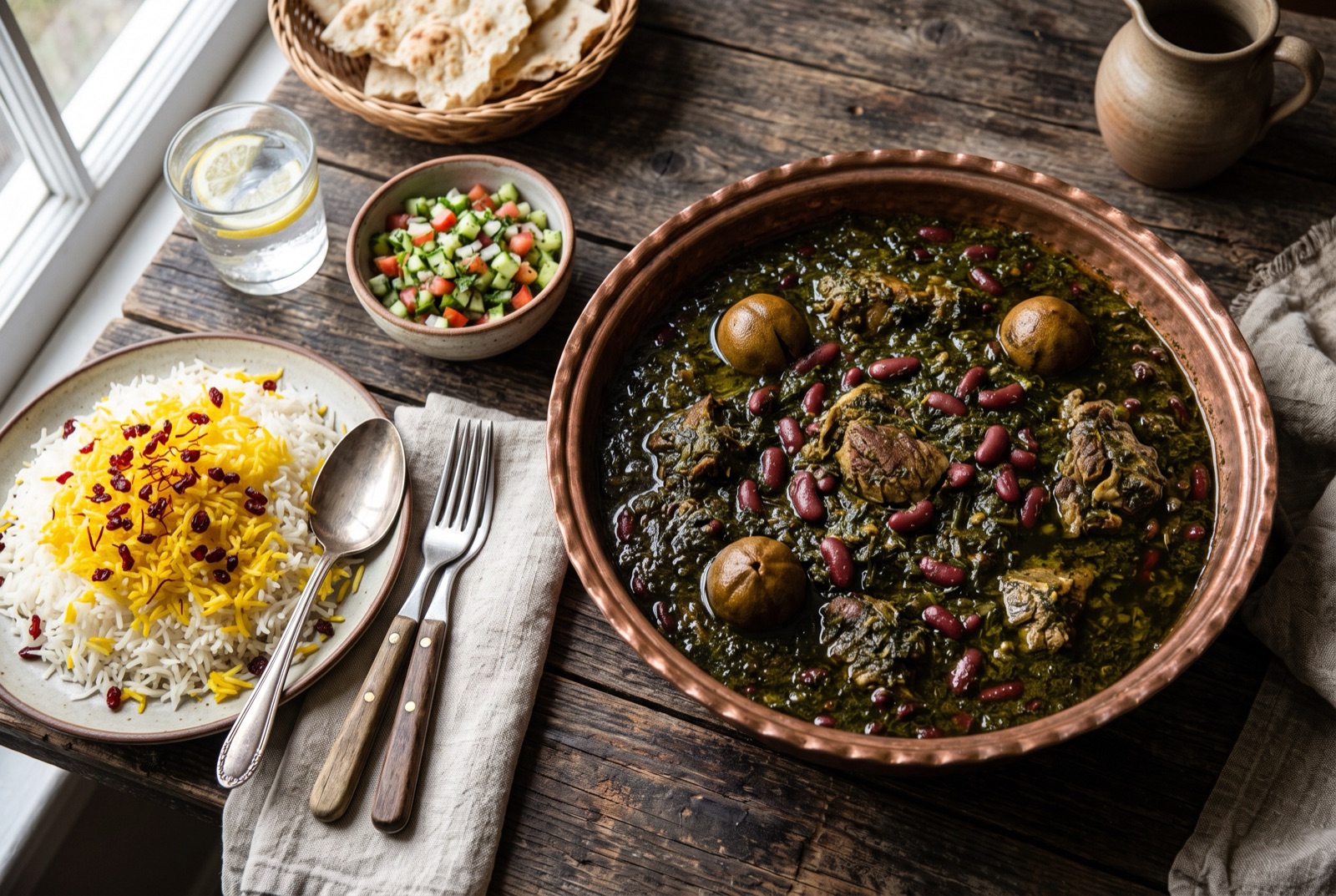
Ghormeh sabzi is the stew most Iranians will name if you ask for the national dish, and it tastes like nothing else in the region: dark, sour, and so herbal it reads almost as a vegetable dish that happens to contain lamb. Enormous quantities of parsley, coriander and chives are chopped fine and fried in oil until they collapse, darken and start smelling nutty rather than green — that frying is the entire recipe, and raw herbs simply will not get you there. Dried fenugreek leaves add the medicinal, slightly bitter top note that makes the dish recognisable, and pierced dried limes give a sourness with a musty, almost fermented edge that fresh citrus cannot imitate. It is served over steamed rice with a wedge of tahdig, and it is better on the second day.

- Gate
- Iran
- Prep
- 30 min
- Cook
- 2 hr 45 min
- Total time
- 3 hr 15 min
- Serves
- 4
- Status
- Medium
- Nutrition / serving · estimated
- Calories 540 kcal
- Protein 39 g
- Carbs 24 g
- Fat 32 g
- Fiber 8 g
- Sodium 820 mg
Why this recipe works.
- Fries the herbs properly — 25 minutes, not 5 — because that darkening is the difference between ghormeh sabzi and green soup.
- Gives the real doneness signal cooks use: the stew is ready when a layer of green-brown oil rises to the surface.
- Handles dried limes honestly, including how to stop them turning the pot bitter.
- Works with supermarket herb bunches and a tin of kidney beans, without pretending that is a compromise on flavour.
Ingredients.
14 itemsFor the herbs
For the stew
To finish
Equipment
- Large heavy pot or Dutch oven with a lid
- Wide frying pan for the herbs
- Sharp knife or food processor for chopping herbs
Instructions.
Wash and dry the herbs thoroughly
Wash the parsley, coriander and chives, then spin or pat them properly dry — any water left clinging will steam in the pan and add fifteen minutes to the frying. Chop everything as finely as you can manage, stems included.
Tip A food processor works, but pulse in short bursts. Blitzed to a paste, the herbs release water and turn to sludge instead of frying.
Fry the herbs until they darken
Heat 4 tablespoons of the oil in a wide pan over medium-low heat and add all the fresh herbs. Fry for 20 to 30 minutes, stirring often, until the volume drops by more than half and the colour goes from bright green through dark olive to almost black. Stir in the fenugreek leaves for the last 2 minutes.
Tip The smell is the checkpoint: cut grass means keep going, toasted and nutty means stop. If anything catches on the bottom, pull the pan off the heat immediately.
Brown the onions
In a large heavy pot, heat the remaining tablespoon of oil and fry 2 of chopped onions over medium heat for about 10 minutes, until soft and properly golden at the edges rather than merely translucent. Stir in the turmeric and cook for 30 seconds until it smells earthy.
Seal the lamb
Add the lamb cubes and turn them in the turmeric-stained onions over medium-high heat for 5 to 6 minutes, until every piece has lost its raw pink colour and the pot smells of browned meat. Season with the salt and pepper.
Add the herbs and liquid
Scrape the fried herbs into the pot with the meat, pour in the stock, and add the drained kidney beans. Bring to a simmer, then drop in the pierced dried limes, pushing them under the surface so they start to soften.
Tip Dried limes float at first. Weigh them down with the beans or they will only flavour the top of the pot.
Simmer low and long
Cover with the lid slightly ajar and simmer over low heat for 2 to 2 and a half hours, stirring every 30 minutes or so, until the lamb pulls apart under a spoon and the liquid has thickened. Top up with a little hot water if it reduces faster than the meat softens.
Check for the oil, then rest
The stew is ready when a distinct layer of dark green-brown oil rises to the surface and the sauce coats a spoon instead of running off it. Taste for salt and sourness, adding the dried lime powder if it needs a sharper edge, then let it sit off the heat for 10 minutes before serving over steamed rice.
Tip If no oil has risen, uncover and simmer harder for 15 more minutes — it is a sign of reduction, not of adding more fat.
Tips from our kitchen.
- Chop the herbs as finely as you have patience for, and dry them well after washing — wet herbs steam instead of frying, and you will wait twice as long for the colour to turn.
- Fry the herbs in a wide pan over medium-low heat, not high. You want them to darken slowly and evenly; scorched herbs make the whole stew bitter and there is no rescuing it.
- Pierce each dried lime two or three times with a knife tip so the sourness leaches out. Never crush them in the pot — the seeds and pith inside are aggressively bitter.
- Taste at the 90-minute mark. If it is too sour, lift out a lime or two; if it is flat, add half a teaspoon of dried lime powder rather than fresh lemon, which tastes wrong here.
- Make it a day ahead if you can. The herbs, lamb and lime need overnight to stop tasting like three separate things.
- Do not skip the fenugreek, but do not overdo it either — more than about two tablespoons of dried leaves and the stew turns bitter and medicinal.
Substitutions.
- Dried limes (limoo amani) → 2 tbsp dried lime powder, or the juice of 2 lemons plus 1 tsp lime zest added at the end
- Middle Eastern grocers and most online spice shops stock whole dried limes cheaply and they keep for years. The lemon version tastes bright rather than musty, so it is a different stew — good, but not the same one.
- Lamb shoulder → Beef chuck or stewing beef, cut the same size
- Very common in Iranian homes. Beef needs roughly 30 minutes longer to reach the same falling-apart tenderness.
- Fresh chives → The green tops of a bunch of scallions, or a small leek, finely sliced
- Iranian recipes use tareh, a garlic chive that sits between the two. Either substitute is closer than leaving them out.
- Fresh herbs → Frozen chopped Persian herb mix (sabzi ghormeh), sold in blocks at Iranian grocers
- Genuinely good and used by Iranian cooks themselves. Thaw and squeeze out water first, then fry as normal — it will need slightly less time.
Variations.
- Ghormeh sabzi with beef shank
- Made with bone-in shank instead of shoulder for a richer, more gelatinous stew. Needs about three hours but produces a body that cubed meat never quite matches.
- Vegetarian ghormeh sabzi
- Skip the meat, double the kidney beans and add a handful of dried mushrooms for depth. Widely made in Iran during religious fasting periods and genuinely satisfying rather than a compromise.
- With black-eyed peas
- Some households, particularly in the north, use black-eyed peas instead of red kidney beans. Softer texture, slightly earthier, and it cooks faster.
Storage & reheating.
Ghormeh sabzi keeps 4 days refrigerated and genuinely improves for the first two — the sourness settles and the herbs stop tasting separate from the meat. Reheat gently over low heat with a splash of water, since it thickens considerably when cold. It freezes very well for up to 3 months; freeze it without the dried limes if you can, as they keep leaching sourness even in the freezer and a thawed portion can come back sharper than you left it.
Serve with
Steamed long-grain rice with a wedge of tahdig, a bowl of plain yogurt, and torshi pickles on the side.
The story behind Ghormeh Sabzi.
Nobody can date ghormeh sabzi precisely, and the honest answer is that stews of meat cooked with mountains of herbs are old enough in the Iranian plateau that a founding story would be invented rather than recorded. What is clear is the logic behind it. Herbs grow fast, cheap and in bulk across northern Iran, and drying or frying them was how a household turned a glut of greens into something that kept. Meat, by contrast, was expensive, so a few hundred grams of lamb flavours a pot that feeds six. The dish that resulted follows the standard Persian khoresh grammar — onions browned in turmeric, meat sealed, long low simmer, a souring agent — but pushes one ingredient to an extreme that outsiders find startling the first time they see the quantities written down.
The souring agent is the other half of the identity. Limoo amani are limes that have been boiled in brine and dried whole until they rattle, going hard, hollow and dark brown. They are pierced and dropped into the pot to slowly leach out a sourness quite unlike fresh lime: dustier, more bitter, with a faintly fermented depth. Cooks argue endlessly about how many to use and when to fish them out, because a dried lime left too long, or squashed against the side of the pot, turns the whole stew bitter. Some households also stir in a spoonful of powdered dried lime at the end for a sharper hit.
In practice ghormeh sabzi is a benchmark dish. It appears at family lunches, at Nowruz, at weddings and at every Iranian restaurant abroad, and it is the dish by which home cooks are quietly measured — not on ingredients, which are fixed, but on whether the herbs were fried long enough and whether the oil eventually rose to the surface. Iranians in the diaspora also treat it as a marker of home, to the point that arguments about the correct ratio of parsley to coriander, or whether chives or leek greens belong, are a recognised national pastime rather than a genuine disagreement.
Questions, answered.
Why is my ghormeh sabzi bitter?
Almost always one of three things: the herbs were fried over too high a heat and caught, you used too much dried fenugreek, or a dried lime was crushed and released the bitter pith and seeds inside. Fenugreek should be around two tablespoons of dried leaves for a stew serving four, the herbs should darken slowly over 20 to 30 minutes, and dried limes should only be pierced, never pressed against the pot.
Can I use dried herbs instead of fresh?
Only as a last resort, and never for all of them. Dried parsley and coriander lose the volatile oils that frying is meant to concentrate, so the stew ends up flat and dusty. Frozen chopped Persian herb mix, sold in blocks at Iranian and Middle Eastern grocers, is a far better shortcut and is what many Iranian households actually use on a weeknight.
What are dried limes and can I leave them out?
Limoo amani are whole limes boiled in salt water and dried until they are hard, hollow and dark brown. They give a musty, deep sourness that is central to the dish rather than decorative. You can leave them out and finish with lemon juice, but the result tastes noticeably brighter and simpler — recognisably a herb stew, but not really ghormeh sabzi.
Why has my stew not turned dark green?
The colour comes entirely from frying the herbs long enough. If they are still bright green when they go into the pot, the finished stew will be khaki and taste grassy. Keep frying — over medium-low heat the herbs will collapse, lose their water, then slowly go from bright green to dark olive to almost black, and the smell shifts from fresh-cut grass to something nutty and toasted.
How do I know when it is actually done?
Iranian cooks look for the oil, not the clock. When the stew is finished, a layer of dark green-brown oil separates and floats on the surface, and the liquid underneath is thick enough to coat rice rather than run off it. If it still looks like herbs suspended in water after two hours, uncover the pot and simmer harder until it reduces.
You might also like.
All recipes →
Keep exploring Iran.
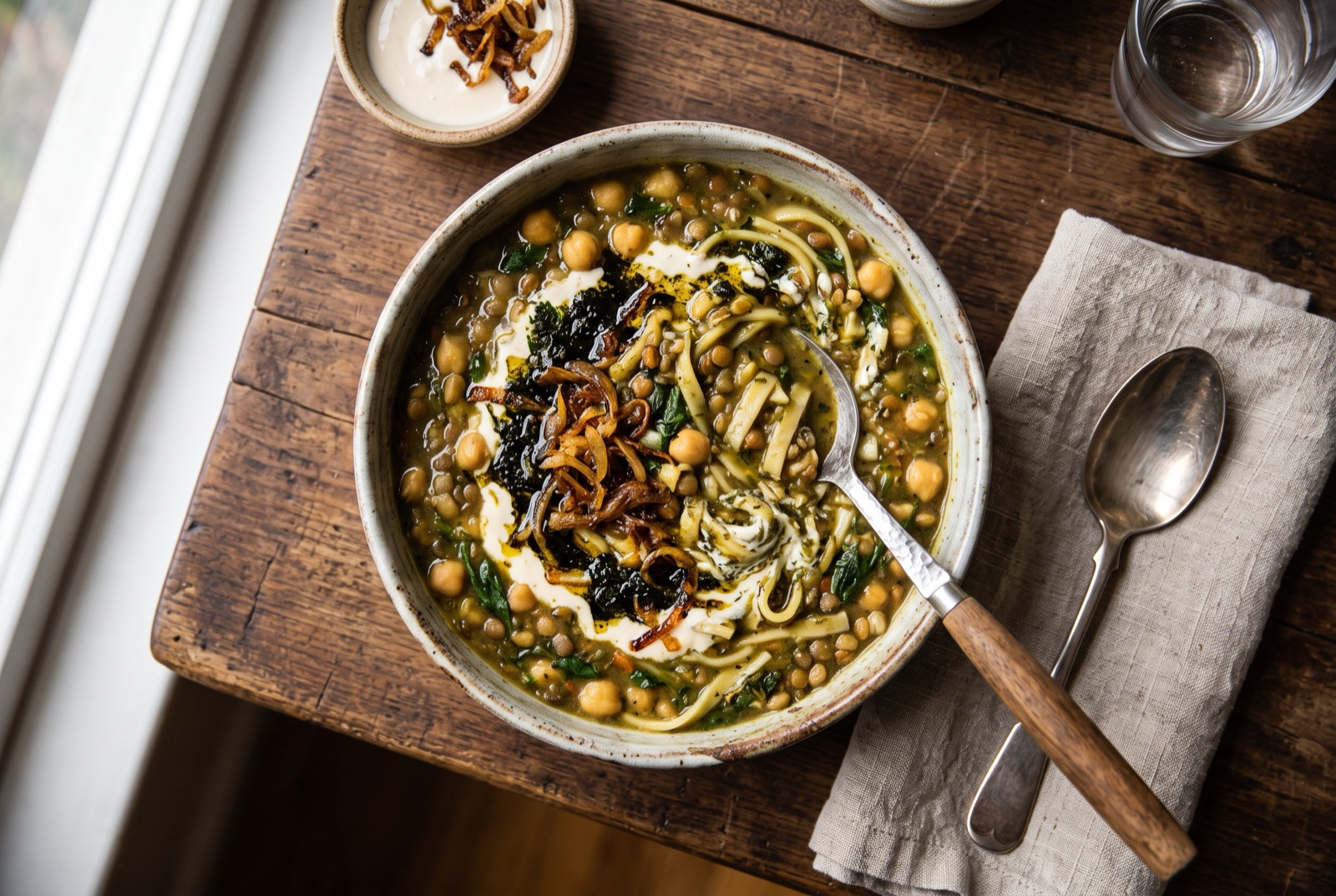
Iran has 9 more dishes in the atlas — Ash-e Reshteh and Faloodeh, and 7 more.
All Iran recipes Lamb recipes Parsley recipes Cilantro recipes maindairy freegluten freehalal friendlyRecipe by The DishRoute Kitchen · published August 20, 2026 · updated August 20, 2026