Halim.
Persian Wheat and Lamb Breakfast Porridge
حلیم · Halim · say it: hah-LEEM
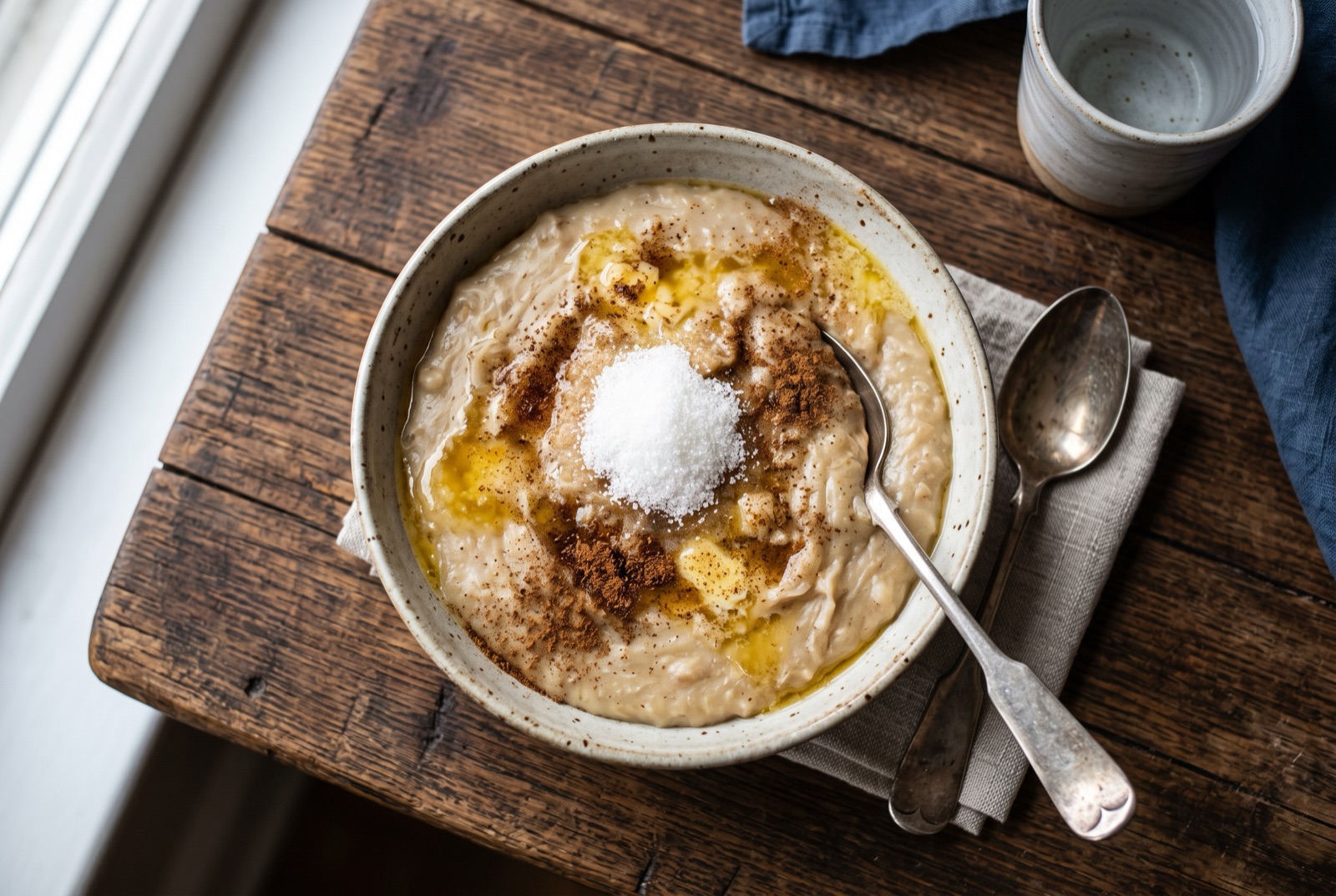
Persian halim is a thick, pale porridge of hulled wheat and lamb cooked until neither ingredient is identifiable, then whipped until it pulls in long strands off the spoon. Unlike the heavily spiced South Asian version, the Iranian one contains almost no spice at all — the pot holds wheat, meat, onion, salt and water, and that restraint is deliberate, because everything else is added at the table. What arrives in the bowl is a smooth grey-white cream topped with melted butter or sheep's-tail fat, a thick dusting of cinnamon and enough sugar to make the whole thing sweet-savoury. It is eaten hot at breakfast, standing up or wrapped to take away, and in Tehran it is winter food bought before dawn rather than cooked at home.

- Gate
- IranNationwide, sold at dawn in Tehran
- Prep
- 25 min
- Cook
- 4 hr
- Total time
- 16 hr 25 min incl. 12 hr rest
- Serves
- 6
- Status
- Medium
- Nutrition / serving · estimated
- Calories 610 kcal
- Protein 33 g
- Carbs 65 g
- Fat 24 g
- Fiber 8 g
- Sugar 14 g
- Sodium 690 mg
Why this recipe works.
- Keeps the Iranian version genuinely Iranian — no lentils, no garam masala, no fried onion garnish.
- Soaks the wheat overnight and explains what to look for, since undersoaked wheat never breaks down properly.
- Gives a workable home method for the beating stage using a stand mixer, with the hand method alongside.
- Sets out the sweet-savoury topping ratios that Iranians actually order at the counter.
Ingredients.
9 itemsFor the pot
To finish
Equipment
- Large heavy pot with a lid
- Wooden paddle or sturdy spoon
- Stand mixer with paddle attachment (optional)
- Two forks for shredding
Instructions.
Soak the wheat
Rinse the wheat berries in several changes of cold water until the water runs clear, then cover them by a good 5 cm and leave overnight. By morning the grains should have swollen, softened at the edges and roughly doubled in volume.
Tip A grain squeezed between thumb and finger should give slightly. If it is still stone hard, soak longer.
Start the pot
Drain the wheat into a large heavy pot, add the lamb, the halved onion, the turmeric, the salt and the water. Bring to a boil and skim off the grey foam that rises in the first ten minutes until the surface stays clear.
Simmer until everything collapses
Lower the heat to the barest simmer, set the lid ajar and cook for 3 to 4 hours, stirring every half hour and scraping the bottom. It is ready when the wheat has burst and lost all shape and the lamb falls off the bone at the touch of a spoon.
Tip Keep the level topped up with boiling water so the pot never drops below a loose porridge consistency.
Shred the meat
Lift out the lamb and the onion. Discard the onion and the bones, then pull the meat apart with two forks into the finest threads you can manage — the strands should look like frayed rope, not like pulled pork.
Beat it into a cream
Return the shredded meat to the pot and beat hard with a wooden paddle against the side, or transfer it to a stand mixer and paddle on low. Keep going for 15 to 20 minutes until the mixture turns pale, glossy and elastic and lifts from the spoon in a slow, unbroken ribbon.
Tip This is the whole dish. Stop early and you have wheat porridge with meat in it.
Adjust and season
Loosen with boiling water until the halim just falls slowly from a tilted ladle, then taste and add salt. It should be mildly savoury and slightly under-seasoned, because the sugar on top does the rest of the work.
Build the bowl
Spoon into warm bowls and smooth the surface flat. Pour melted butter into a shallow pool in the centre, dust the whole surface heavily with cinnamon and scatter a tablespoon of sugar over each portion. Serve immediately, while the butter is still liquid.
Tips from our kitchen.
- Buy hulled or pearled wheat berries, sometimes labelled gandom, and soak them for at least 12 hours. Skipping the soak adds two hours of cooking and still leaves gritty cores.
- Cook the lamb and the wheat in the same pot from the start. The wheat needs the fat and gelatine from the meat to turn creamy, and cooking them separately gives you two things that never fully merge.
- Keep the pot at the barest simmer with the lid ajar. A rolling boil drives off water fast and scorches the starch on the bottom, and burnt halim cannot be rescued.
- Shred the meat while it is hot, pulling it along the grain into hair-fine threads. Chunks left in the pot will still be chunks after an hour of beating.
- If the mixture stiffens while you beat it, add boiling water a ladle at a time. Cold water shocks the starch and gives a slack, grainy texture.
- Salt lightly during cooking and correct at the end. The sugar and cinnamon go on top afterwards, and a pot that is already fully salted leaves no room for that balance.
Substitutions.
- Hulled wheat berries → Pearl barley, or half wheat and half barley
- Barley breaks down faster and gives a slightly slippery texture. It is used in some Iranian households and is a fair substitute, though the finished halim is less stringy.
- Lamb shank → Turkey thigh or breast, or beef shin
- Turkey is the standard in modern Tehran shops — leaner, cheaper and paler, giving a whiter halim. Beef shin works but takes longer and tastes noticeably heavier.
- Melted butter on top → Roghan-e donbeh (rendered sheep's-tail fat), or a good olive oil
- Sheep's-tail fat is the traditional finish and gives a distinctly mutton-rich aroma. Butter is what most people use now; oil works but adds nothing.
Variations.
- Halim-e bademjan
- A completely different dish sharing the name: aubergine cooked down with kashk and meat until smooth, served as a starter rather than a breakfast. Ordering the wrong one is a common mistake.
- Savoury halim
- Skip the sugar and cinnamon and finish with salt, black pepper and extra butter. Less common in Iran but preferred by people who find the sweet version strange.
- Halim for sahari
- Made looser with extra water for the pre-dawn Ramadan meal, so it drinks more easily and keeps thirst down through the day.
Storage & reheating.
Halim keeps three days refrigerated and sets to a solid block that you can slice with a knife. Reheat it in a pan with a generous splash of water over low heat, breaking it up and stirring constantly until it loosens back into a cream — a microwave heats it unevenly and leaves rubbery patches. It freezes well for two months in portions, and the texture survives thawing better than most porridges because the beaten gluten holds it together. Always add the butter, cinnamon and sugar fresh at the moment of serving.
Serve with
Hot sweet tea and fresh barbari or sangak bread torn straight into the bowl.
The story behind Halim.
Halim in Iran is a shop food with its own trade. Halim-forushi open in the small hours, sell out by mid-morning and shut, and their whole business is one product cooked in a single enormous pot that has been going since the previous evening. Queues form in the cold outside them from around six, people bring their own containers, and the seller ladles from the pot and then builds the top: a pool of melted butter, a snowdrift of cinnamon, sugar shaken over from a jar. Ordering is a matter of ratios — more butter, less sugar — rather than choosing a dish.
The technique that defines it has a name, hal kardan, and it means beating the pot contents until the wheat and the meat fibres are indistinguishable and the mass turns elastic. This is not blending. The wheat must be cooked past softness so its starch and gluten are released, the meat must be shredded to threads, and then the two are worked together with a heavy wooden paddle against the side of the pot until the whole thing lifts as a sheet. Correctly beaten halim is stretchy enough to pull a spoon out slowly; underbeaten halim tastes almost the same and looks like lumpy oatmeal, which is why the good shops are known for their arms rather than their recipes.
The dish belongs to a much wider family that runs from Arabian harees through Turkish keşkek to the lentil-loaded haleem of Hyderabad and Karachi, all built on the same idea of wheat and meat pounded to a paste. The Iranian branch is the plainest of them and probably the closest to the medieval original. Turkey is normally used in Tehran now, being cheaper and leaner than lamb; lamb shank gives a richer result and is the older choice. It also has a strong Ramadan association, cooked for sahari, the meal before dawn, because slow wheat starch and meat fat carry a person through a long fasting day better than almost anything else.
Questions, answered.
How is Persian halim different from Pakistani or Indian haleem?
The Iranian version contains no lentils, almost no spice and no chile — just wheat, meat, onion and salt — and it is eaten at breakfast, sweetened with sugar and cinnamon and topped with butter. South Asian haleem adds several kinds of lentil, ginger, garam masala and green chile, is served in the evening, and is finished with fried onion, lemon and coriander. Same ancestor, opposite flavour profile.
Why is my halim lumpy instead of stringy?
Either the wheat was not cooked long enough or the mixture was not beaten hard enough. The grains have to collapse completely before beating will do anything, which usually means three to four hours of simmering after an overnight soak. Once they are soft, sustained beating develops the wheat gluten and that is what produces the stretchy pull.
Can I use a blender or food processor?
A blender turns halim into wallpaper paste — it cuts the strands rather than stretching them, and the result is smooth but dead. A stand mixer with the paddle attachment on low is the best home shortcut, since it works the mixture the same way a wooden paddle does. An immersion blender used in short bursts is an acceptable last resort.
Is halim sweet or savoury?
Both at once, and the balance is set by the eater. The pot itself is savoury and lightly salted, and sugar and cinnamon go on top in the bowl, usually a heaped teaspoon or more per portion. Iranians who dislike the sweet version simply order it with butter and salt only, which is a normal request rather than a modification.
Can I make halim in a pressure cooker?
Yes, and it cuts the cooking time to about 50 minutes at pressure after soaking. Release the pressure, check the wheat has fully collapsed, then do the beating in the open pot as usual. The one thing a pressure cooker cannot shorten is the beating, which is where the texture comes from.
You might also like.
All recipes →
Keep exploring Iran.
Iran has 9 more dishes in the atlas — Ash-e Reshteh and Faloodeh, and 7 more.
Recipe by The DishRoute Kitchen · published August 20, 2026 · updated August 20, 2026