Tahdig.
Persian Crisp Saffron Rice Crust
ته دیگ · say it: tah-DEEG
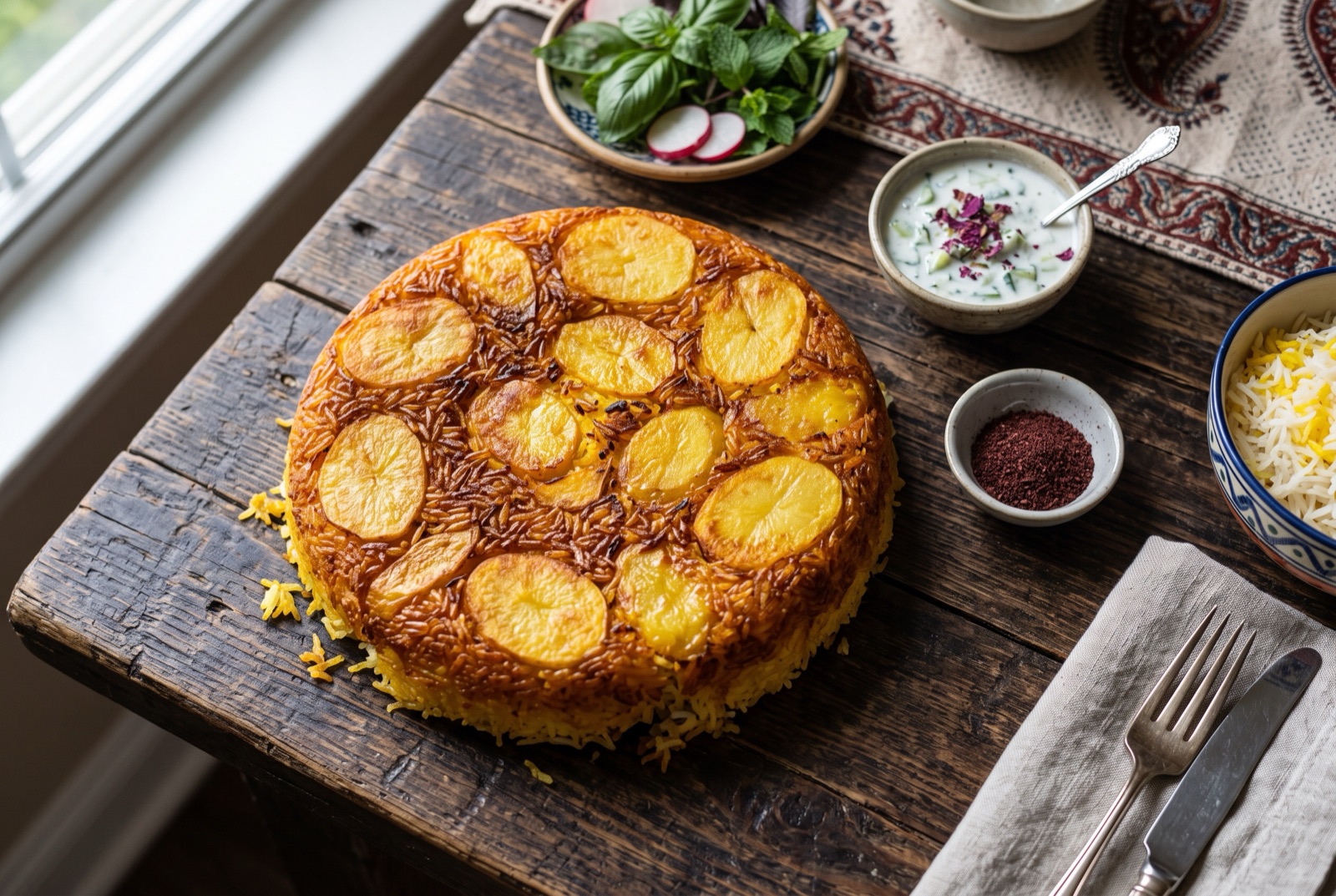
Tahdig is the layer of rice that fries against the bottom of the pot while everything above it steams — shatteringly crisp, deep gold from saffron, and the part of the meal Iranian families genuinely compete over. Getting it right is a two-stage process: rice is parboiled in salted water until the grains bend but still have a hard core, then rebuilt in a pot over hot fat and steamed for around an hour under a lid wrapped in a tea towel, which absorbs condensation so no water drips back down. The crust can be plain rice, sliced potato or a sheet of flatbread. Turned out whole, it should crack like a biscuit under the serving spoon.

- Gate
- Iran
- Prep
- 15 min
- Cook
- 1 hr 15 min
- Total time
- 3 hr 30 min incl. 2 hr rest
- Serves
- 6
- Status
- Medium
- Nutrition / serving · estimated
- Calories 420 kcal
- Protein 7 g
- Carbs 68 g
- Fat 14 g
- Fiber 2 g
Why this recipe works.
- Nails the parboil timing that everything else depends on: bendable outside, hard white core inside.
- Uses the towel-wrapped lid rather than hoping for the best, which is the actual reason Persian rice comes out dry and separate.
- Covers all three crust styles — plain rice, potato and flatbread — and says which one to pick if this is your first attempt.
- Tells you what a finished tahdig sounds and smells like, since you cannot see it until the moment you flip the pot.
Ingredients.
8 itemsFor the rice
For the crust
Equipment
- Heavy-based or non-stick pot with a tight lid, about 24 cm
- Large pot for parboiling
- Fine sieve or colander
- Clean tea towel for the lid
Instructions.
Rinse and soak the rice
Rinse the rice in cold water five or six times, swirling with your hand, until the water runs clear rather than milky. Cover with cold water, stir in 2 tablespoons of salt, and leave to soak for at least 2 hours so the grains hydrate and lengthen.
Tip Skipping the soak gives shorter grains that break during parboiling. Overnight is fine.
Parboil to the bending stage
Bring 3 litres of water to a hard rolling boil with the remaining salt. Drain the soaked rice and tip it in. Boil for 5 to 6 minutes, testing from minute four: a grain should bend between your fingers without snapping and still have a firm white core when bitten. Drain immediately in a sieve and rinse briefly with lukewarm water.
Heat the fat and lay the crust
Melt the butter with the oil in the pot over medium heat until it shimmers and a grain of rice dropped in sizzles at once. Toss the potato slices in half the saffron water and arrange them in a single overlapping layer across the base, pressing them flat.
Tip Using bread instead? Lay the lavash straight into the hot fat, letting it come slightly up the sides, and skip the potato entirely.
Mound the rice and make steam holes
If using the yogurt, fold it through a cupful of the rice and spread that over the potatoes first. Add the rest of the rice a spatula at a time, building it into a loose pyramid rather than packing it down. Poke five or six holes right through to the base with the handle of a wooden spoon.
Tip Never press the rice down. Compacted rice steams into a solid block.
Steam under a wrapped lid
Cook uncovered on medium heat for 5 minutes until you can hear the base start to sizzle, then drizzle over the remaining saffron water, wrap the lid in a clean tea towel with the corners tied on top, clamp it on and turn the heat to its lowest setting. Steam for 50 to 60 minutes.
Tip At around 45 minutes you should hear a steady faint crackle and smell toasted rice and butter. A sharp hiss with any burnt note means turn the heat down immediately.
Shock the base and rest
Take the pot off the heat and stand it on a damp folded cloth or in a shallow tray of cold water for 3 to 4 minutes. The sudden contraction pulls the crust away from the metal and makes a clean release far more likely.
Turn out the crust
Spoon the loose fluffy rice into a serving dish first, leaving the crust behind. Lay a large plate over the pot and invert it in one movement, then lift the pot away to reveal the golden disc. Crack it into pieces at the table.
Tip If parts stay stuck, lever them out with a spatula and lay them on top of the rice. Every Iranian cook has done this and nobody at the table cares.
Tips from our kitchen.
- Rinse the rice until the water runs genuinely clear, five or six changes. Surface starch makes the grains stick together and a sticky bed will never crisp.
- Salt the parboiling water like pasta water. This is the only chance the rice gets to be seasoned from the inside.
- Get the fat properly hot before the crust layer goes in — it should shimmer and sizzle audibly the moment the first rice touches it. Cold fat means a stuck, pale crust.
- Poke five or six holes through the rice pyramid down to the base with the handle of a wooden spoon. These are steam chimneys and without them the top stays hard.
- Wrap the lid in a clean tea towel and tie the corners on top. It catches condensation that would otherwise rain down and turn the rice gluey.
- Listen at the 45-minute mark. A steady faint crackle means the crust is forming; silence means the heat is too low, and a sharp sizzle with a toasted smell means turn it down now.
Substitutions.
- Potato tahdig → A sheet of lavash or a split pita bread laid across the base
- Bread tahdig is the most reliable of all and releases almost every time, which makes it the sensible choice for a first attempt.
- Butter → Ghee, or all sunflower oil
- Ghee browns beautifully and will not burn at the temperatures involved. All-oil versions are common and make the dish dairy-free, at some cost in flavour.
- Saffron → A pinch of turmeric for colour
- It gives you gold but none of the aroma. Saffron is genuinely central to the dish, so if you only have a little, put it all in the crust layer where it shows.
Variations.
- Yogurt tahdig
- A few spoons of thick yogurt and an egg yolk mixed into the bottom layer of rice. The crust browns deeper and tastes richer, and it is the same principle that underpins tahchin.
- Bread tahdig
- Lavash or split pita pressed into the hot fat before the rice goes in. The result is closer to a savoury cracker than a rice crust and it almost never sticks to the pot.
- Sabzi polo
- The same pot method with chopped dill, coriander, parsley and chives folded through the rice layers. The Nowruz classic, served with fish, and it makes an excellent tahdig underneath.
Storage & reheating.
Finished rice keeps 3 days refrigerated, but the crust does not — it softens within hours and never fully returns. Reheat the fluffy rice with a splash of water in a covered pan or in the microwave. Pieces of tahdig can be revived in a dry frying pan over medium heat for a few minutes, or in a hot oven for five, which restores most of the crunch. Do not freeze the crust; the texture collapses completely on thawing and you are left with greasy rice.
Serve with
Any Persian stew ladled over the plain rice, with the crust broken into pieces and passed around separately.
The story behind Tahdig.
The word means bottom of the pot, and it describes an accident that Persian cooking turned into an institution. Any rice cooked long enough in fat over direct heat will brown underneath; what Iranian cooks did was formalise the conditions — the right fat, the right parboil, the towel-wrapped lid, the low steady heat — so that the accident happens reliably and evenly across the whole base. The result is treated as the prize of the meal. It is served to guests first, argued over between siblings, and a cook who consistently produces an unbroken golden disc has a reputation that precedes them.
The method depends entirely on the two-stage cooking of Persian rice. Long-grain rice is rinsed until the water runs clear and soaked for hours, which lets the grains hydrate slowly so they elongate rather than break. Then it is boiled hard in a large volume of heavily salted water for only five or six minutes and drained the moment it reaches the bending-but-not-snapping stage. That partially cooked rice is what gets mounded back into the pot in a pyramid, with holes poked through so steam can travel up and finish the cooking without ever waterlogging the grains. This is why properly made Persian rice is separate and dry rather than sticky, and it is what allows the base to crisp instead of steaming.
What goes on the bottom is a matter of household preference and not much doctrine. Plain saffron rice gives the most delicate crust and is the hardest to release. Sliced potato is the most forgiving and the most popular with children, since the potato acts as a barrier and comes out as golden discs. Flatbread — lavash or a split pita — gives a crust like a savoury cracker and almost never sticks. Yogurt mixed into the bottom layer of rice makes a richer, deeper-browning crust closer to tahchin. All of them are traditional, and the arguments about which is best are the low-stakes kind that families enjoy repeating.
Questions, answered.
Why did my tahdig stick to the pot?
Usually the fat was not hot enough when the rice went in, or you used a pot with a thin base that has hot spots. Heat the oil and butter until it shimmers and sizzles the instant rice touches it, use a heavy or non-stick pot, and let the finished pot sit on a damp cloth or in a shallow tray of cold water for a couple of minutes before flipping — the sudden contraction helps the crust release in one piece.
What kind of rice do I need?
Long-grain rice, ideally aged basmati or Iranian varieties like domsiah or sadri. The grains need to be long and firm enough to survive parboiling and an hour of steaming without breaking. Do not use short-grain, arborio, jasmine or any parboiled or easy-cook rice, all of which are either too sticky or already too soft to give you separate grains and a crisp base.
How long should I parboil the rice?
Five to six minutes in hard-boiling salted water, and you should test rather than trust the clock. Fish out a grain and bite it or press it between your fingers: it should bend without breaking and still show a firm white core in the centre. Rice that is already tender at this stage will be mush after an hour of steaming, and rice that is still brittle will stay hard in the middle.
Which tahdig is easiest for a beginner?
Bread. Lay a sheet of lavash or a split pita over the hot fat before adding the rice — it acts as a barrier, browns evenly, and lifts out cleanly almost every time. Potato slices are the next most forgiving. Plain rice tahdig gives the most delicate crust but is the most likely to stick, so it is worth leaving until you have the timing and heat under control.
Do I really need to wrap the lid in a towel?
Yes, if you want dry, separate grains. During an hour of steaming a lot of condensation collects on the underside of the lid and drips back onto the rice, making it gluey and preventing the base from crisping. A tea towel wrapped over the lid and tied on top absorbs that water. Keep the corners well away from the burner.
You might also like.
All recipes →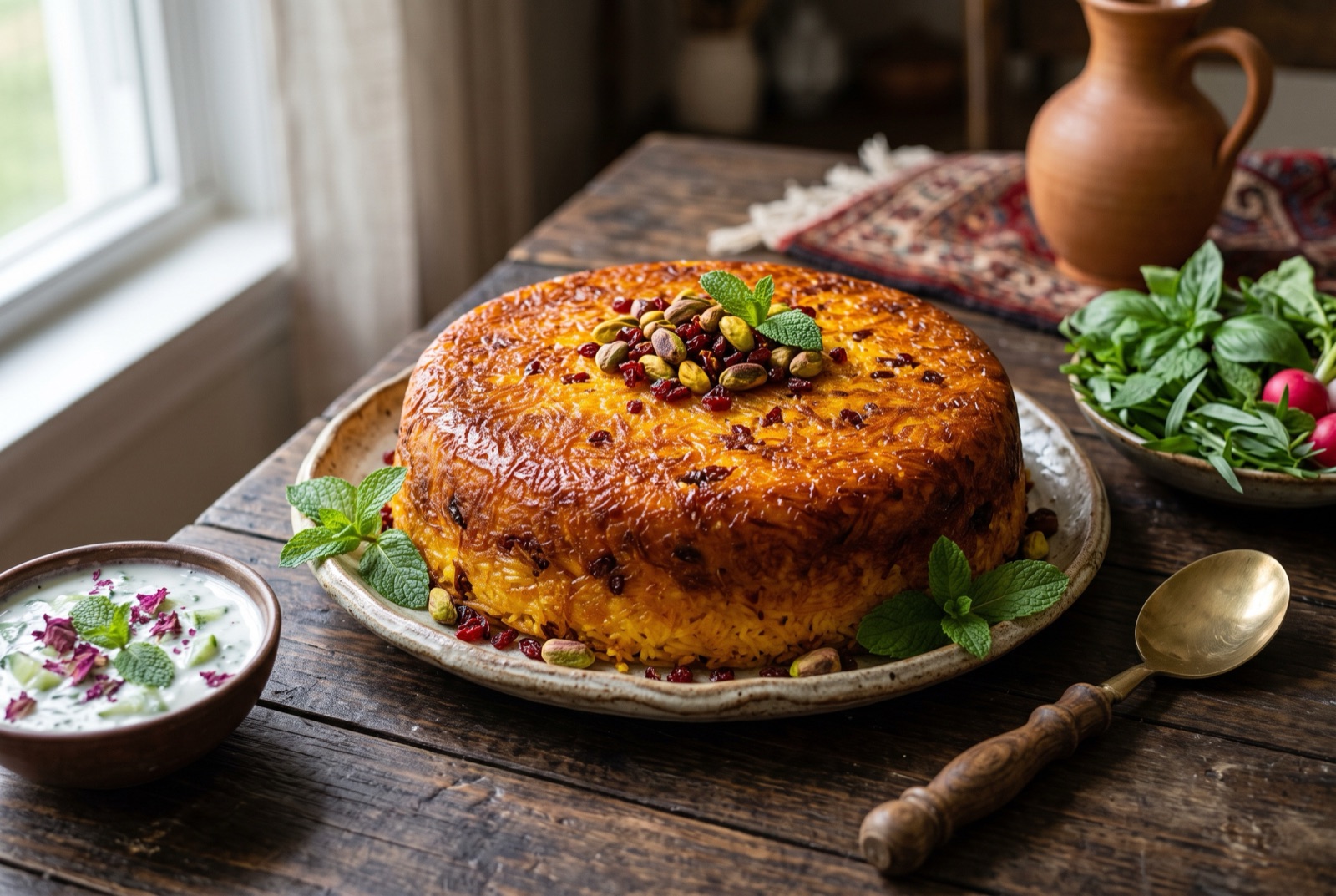
Keep exploring Iran.
Iran has 9 more dishes in the atlas — Ash-e Reshteh and Faloodeh, and 7 more.
Recipe by The DishRoute Kitchen · published August 20, 2026 · updated August 20, 2026