Tahchin.
Persian Saffron Yogurt Rice Cake
ته چین · say it: tah-CHEEN
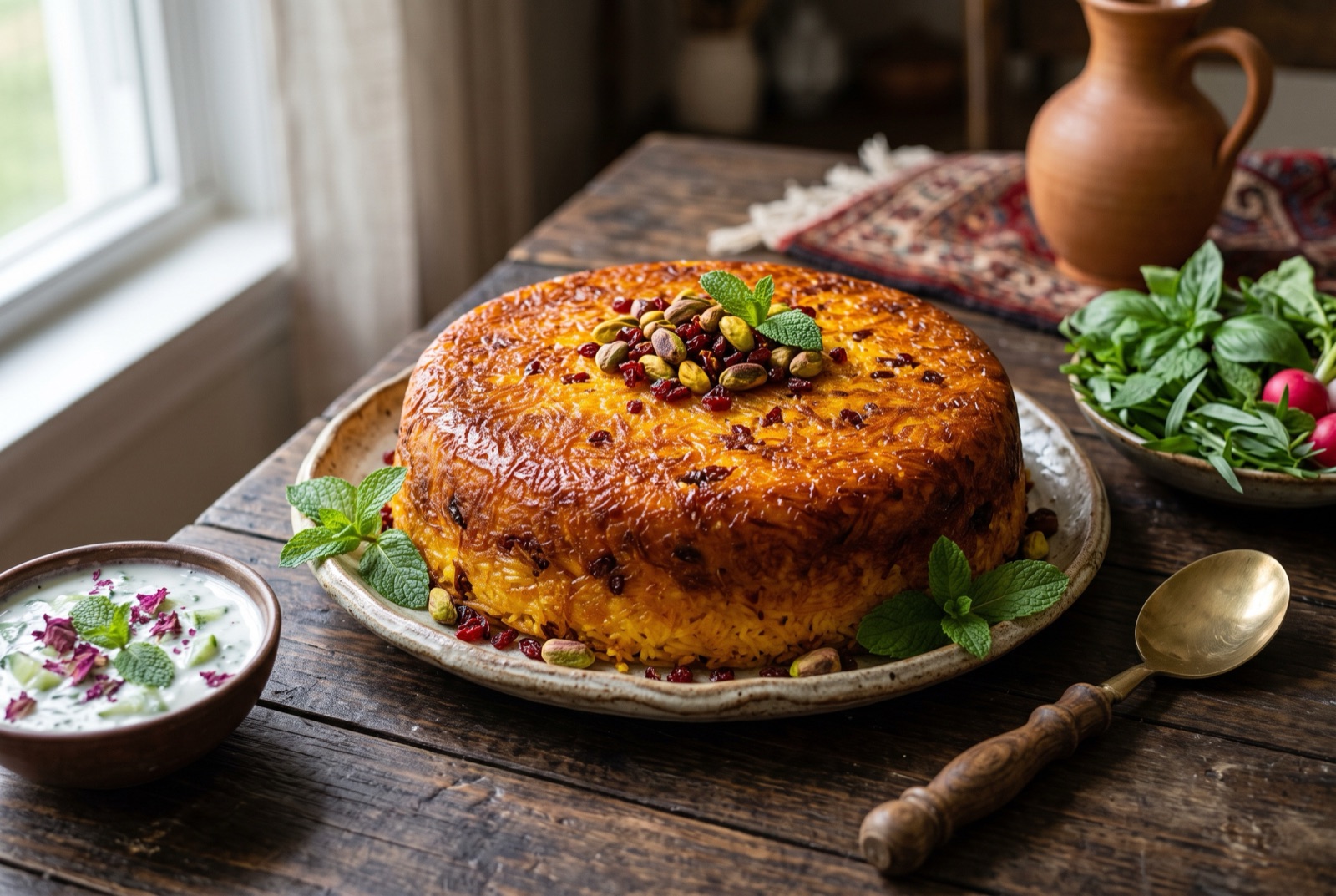
Tahchin is what happens when a Persian cook decides that tahdig — the crisp crust at the bottom of the rice pot — should not be a bonus layer but the entire dish. Parboiled long-grain rice is folded through a mixture of thick yogurt, egg yolks and bloomed saffron, packed over shredded poached chicken, and baked slowly until the outside sets into a burnished orange shell while the inside stays soft, tangy and fragrant. Turned out whole and cut in wedges, it looks like a savoury cake and eats like one: crunchy edge, creamy middle, saffron running through everything. It is the dish Iranian families bring out when they want to impress, and it is genuinely difficult to get perfect.

- Gate
- Iran
- Prep
- 40 min
- Cook
- 1 hr 30 min
- Total time
- 2 hr 25 min incl. 15 min rest
- Serves
- 6
- Status
- Takes skill
- Nutrition / serving · estimated
- Calories 620 kcal
- Protein 33 g
- Carbs 70 g
- Fat 23 g
- Fiber 2 g
Why this recipe works.
- Parboils the rice to the exact stage it needs — bendable but still hard in the middle — so it does not turn to paste during a long bake.
- Uses egg yolks only, not whole eggs, which is what gives the crust its rich colour and stops the cake tasting like an omelette.
- Preheats the fat in the dish before the rice goes in, the trick that makes the cake release cleanly.
- Gives you the rescue plan for a stuck crust, because even experienced cooks lose one occasionally.
Ingredients.
13 itemsFor the rice
For the filling
For the binding mixture
To finish
Equipment
- Ovenproof round dish or springform tin, about 24 cm
- Large pot for parboiling rice
- Sieve or colander
- Mortar and pestle for the saffron
Instructions.
Soak the rice
Rinse the rice in several changes of cold water until it runs clear, then cover with cold water, add a tablespoon of salt and leave to soak for at least 2 hours. Soaked grains stay long and separate instead of breaking during the parboil.
Poach and shred the chicken
Simmer the chicken thighs with the halved onion, turmeric and a teaspoon of salt in just enough water to cover for 25 minutes, until cooked through. Lift out, cool slightly, and pull the meat into thick shreds. Keep a ladle of the poaching liquid.
Parboil the rice to the bendable stage
Bring a large pot of well-salted water to a hard boil, drain the soaked rice and tip it in. Boil for 5 to 6 minutes, then test a grain: it should bend without snapping but still show a firm white core when you bite it. Drain immediately and rinse briefly with lukewarm water to stop the cooking.
Tip This is the step that decides the texture. Thirty seconds too long and the finished cake will be stodgy.
Make the saffron yogurt mixture
Whisk the yogurt, egg yolks, most of the saffron water, half the melted butter and the salt in a large bowl until smooth and a strong orange colour. Fold in about a third of the drained rice, turning gently with a spatula so the grains stay whole and get evenly coated.
Heat the dish and build the layers
Pour the oil and remaining butter into the baking dish and put it in a 180C oven for 5 minutes until the fat is hot and shimmering. Spread the saffron-coated rice evenly across the base and press it down firmly, then scatter over the shredded chicken with a spoonful of its poaching liquid, and cover with the remaining plain rice, mounded loosely and not pressed.
Tip Press only the bottom layer. Packing the top makes a dense cake instead of a crisp shell over fluffy rice.
Bake covered, then uncover
Cover the dish tightly with foil and bake at 180C for 60 minutes, then remove the foil and bake for a further 20 to 30 minutes, until the edges have pulled away from the dish and you can hear a faint sizzle from the fat underneath. The visible top should be set and pale gold.
Rest, then turn out
Take the dish out and leave it to stand for 10 to 15 minutes — the crust firms as it cools slightly and releases much more willingly. Run a thin knife around the edge, lay a large plate over the top and invert in one confident movement.
Tip If patches of crust stay behind, lift them out with a spatula and lay them back on top. Nobody in Iran considers this a failure.
Finish and serve
Fry the rinsed barberries in a knob of butter for 30 seconds until they plump and turn glossy, then scatter them over the orange dome with the pistachios. Cut into wedges at the table so everyone sees the steam come out of the first cut.
Tips from our kitchen.
- Use thick, strained yogurt. Runny yogurt adds water, and water is the enemy of a crisp crust — if yours is thin, drain it in a sieve for an hour first.
- Parboil the rice for 5 to 6 minutes only. Bite a grain: it should bend without snapping but still have a firm white core. It will finish cooking in the oven.
- Grind the saffron with a pinch of sugar in a mortar before steeping it. Whole threads dropped into liquid release maybe half their colour.
- Get the oil or butter genuinely hot in the dish before adding the rice. Cold fat under cold rice is how crusts stick.
- Cover tightly with foil for the first hour so the rice steams, then uncover only if the top needs colour. Steam is what cooks the middle.
- Rest the baked tahchin for 10 to 15 minutes before turning it out. Straight from the oven the crust is still fragile and will tear.
Substitutions.
- Poached chicken → Slow-cooked shredded lamb shoulder, or roasted aubergine slices for a vegetarian version
- All three are traditional. Aubergine tahchin is common in Iranian homes and needs the slices salted and roasted first so they do not water down the rice.
- Barberries (zereshk) → Dried sour cherries, or dried cranberries roughly chopped
- Barberries are sharper and less sweet than either substitute, so use a little less if you swap in cranberries. Rinse and fry them briefly in butter before scattering.
- Thick strained yogurt → Full-fat Greek yogurt, or plain yogurt drained in a sieve for an hour
- Do not use low-fat yogurt — the fat contributes to the crust and the reduced version is more likely to weep water into the rice.
Variations.
- Tahchin-e bademjan
- Layered with roasted aubergine instead of meat. Vegetarian, slightly smokier, and a standard household version rather than an adaptation.
- Stovetop tahchin
- The older method: the same mixture packed into a heavy non-stick pot and cooked on the lowest heat for around 90 minutes with a cloth-wrapped lid. Harder to judge but many cooks insist the crust is superior.
- Tahchin with lamb
- Made with lamb shoulder braised until it shreds, often with a little cinnamon in the poaching liquid. Richer and better suited to winter than the chicken version.
Storage & reheating.
Tahchin keeps 3 days refrigerated and is one of the few rice dishes that reheats genuinely well, because the yogurt and egg hold the structure. Reheat wedges in a moderate oven for 15 minutes rather than in the microwave, which softens the crust into something limp. It can be assembled in its dish up to a day ahead and baked from cold, adding about 15 minutes to the time. Freezing is possible but the crust never fully recovers its crispness on thawing.
Serve with
Wedges cut at the table with a bowl of yogurt and cucumber, torshi pickles, and a green salad to cut the richness.
The story behind Tahchin.
The name is literal — tah means bottom, chin means arranged — and it describes a technique of deliberately building a layered rice dish from the bottom of the pot upwards. Historically tahchin was cooked in a heavy pot on the stovetop over the lowest possible heat for well over an hour, which demanded both patience and a cook who could judge the crust by smell and by the sound of the fat underneath. The modern oven version, baked in a tin or a glass dish, is easier to control and is now the standard for home cooks, though stovetop purists will tell you the crust is never quite as good.
What separates tahchin from every other Persian rice dish is the binder. Yogurt and egg yolks coat the parboiled grains, and in the oven that coating sets into something between a custard and a crust, holding the whole thing together firmly enough to invert. Saffron does the colouring, and this is one of the few dishes where the quantity really matters: too little and the cake comes out pale yellow and bland, and there is nothing else in the recipe to hide behind. Chicken is the classic filling, poached with onion and saffron and then shredded, but lamb, aubergine and even spinach versions all exist and are equally traditional in different households.
Tahchin has a reputation as a showpiece, and it earns it because the failure modes are visible. If the rice is boiled a minute too long it turns to paste in the mould; if the dish is not greased and heated properly the crust sticks and the cake tears when you turn it out; if the oven is too hot the top browns before the centre sets. Iranians serve it at parties, at Nowruz and at weddings precisely because a perfect turnout — one clean flip, an unbroken orange dome, steam rising from the crack when you cut it — is understood by everyone at the table as a display of skill.
Questions, answered.
Why did my tahchin stick to the dish?
Usually the fat was not hot enough when the rice went in, or the dish was not greased right up the sides. Heat the oil or butter in the baking dish in the oven for a few minutes first, so the rice hits hot fat and starts crisping immediately. If it does stick, let it sit for ten minutes, run a thin knife around the edge, and turn it out — any crust left behind can be lifted off in pieces and laid back on top, which is what Iranian cooks do without any embarrassment.
Why is my tahchin mushy inside?
The rice was parboiled too long before baking. It should come out of the boiling water after five or six minutes, at the point where a grain bends between your fingers but still has a hard white core in the middle. It absorbs more moisture from the yogurt and steams for an hour in the oven, so any rice that is already tender at the parboil stage will collapse.
Can I make tahchin without saffron?
Not really, or at least not as tahchin. Saffron supplies both the colour and most of the aroma in a dish that otherwise contains only rice, yogurt, egg and chicken. Turmeric will give you a yellow cake but a completely different flavour. If saffron is out of reach, a Persian rice dish with barberries or dill is a better use of your ingredients.
Do I have to use a springform tin?
No. Any ovenproof dish that you can turn out from works — a heavy round cake tin, a glass baking dish, or a non-stick ovenproof pan. A springform tin makes release easier but can leak butter into the oven, so put a tray underneath it. What matters much more is that the dish is well greased and preheated.
Can I prepare tahchin in advance?
Yes, and it is the usual approach for a dinner party. Assemble it completely in its dish, cover, and refrigerate for up to 24 hours, then bake straight from the fridge with about 15 minutes added to the cooking time. Baked tahchin also reheats well in the oven, unlike almost every other Persian rice dish.
You might also like.
All recipes →
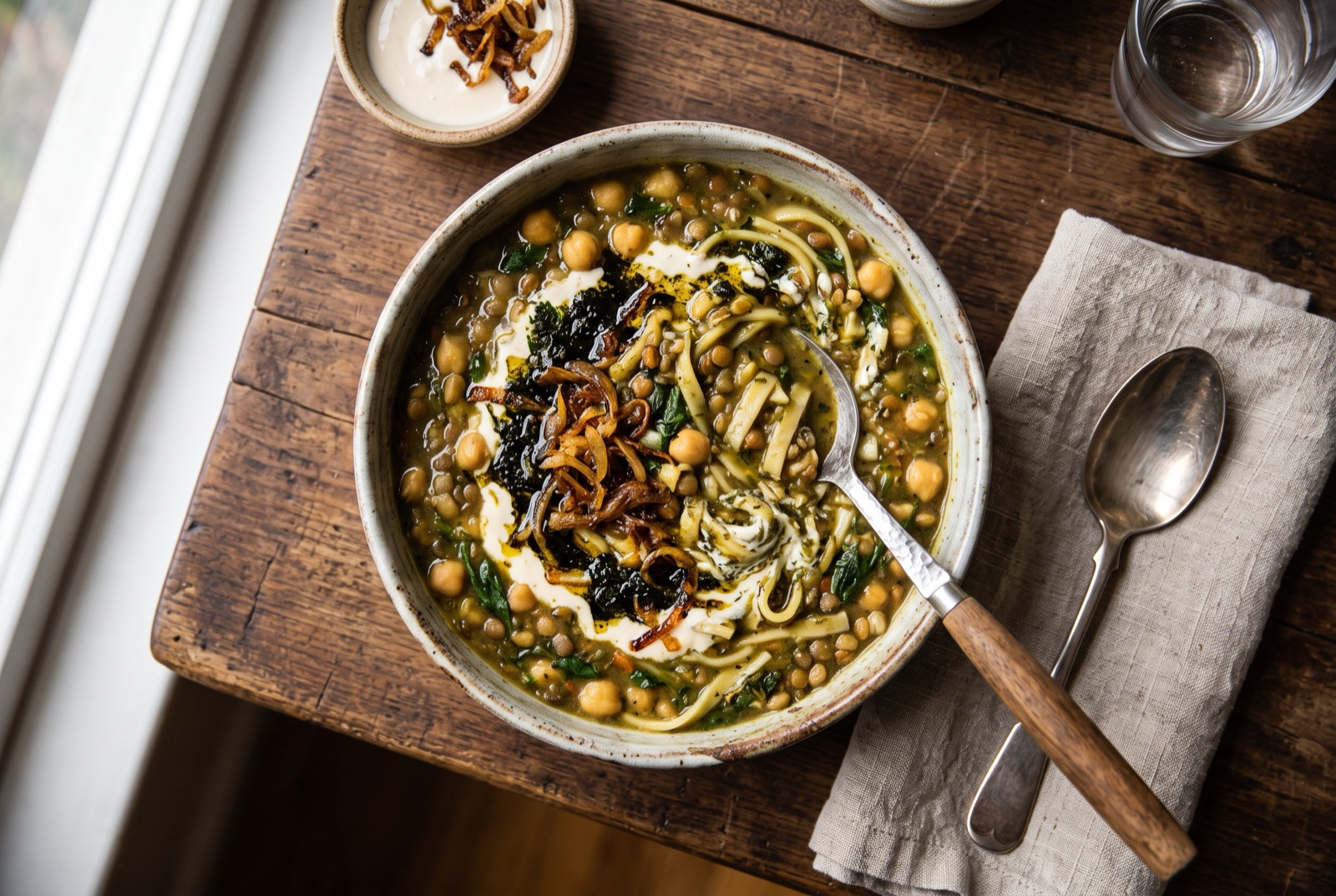
Keep exploring Iran.
Iran has 9 more dishes in the atlas — Ash-e Reshteh and Faloodeh, and 7 more.
Recipe by The DishRoute Kitchen · published August 20, 2026 · updated August 20, 2026