Kabab Koobideh.
Persian Minced Lamb Skewers
کباب کوبیده · say it: kah-BAAB koo-bee-DEH
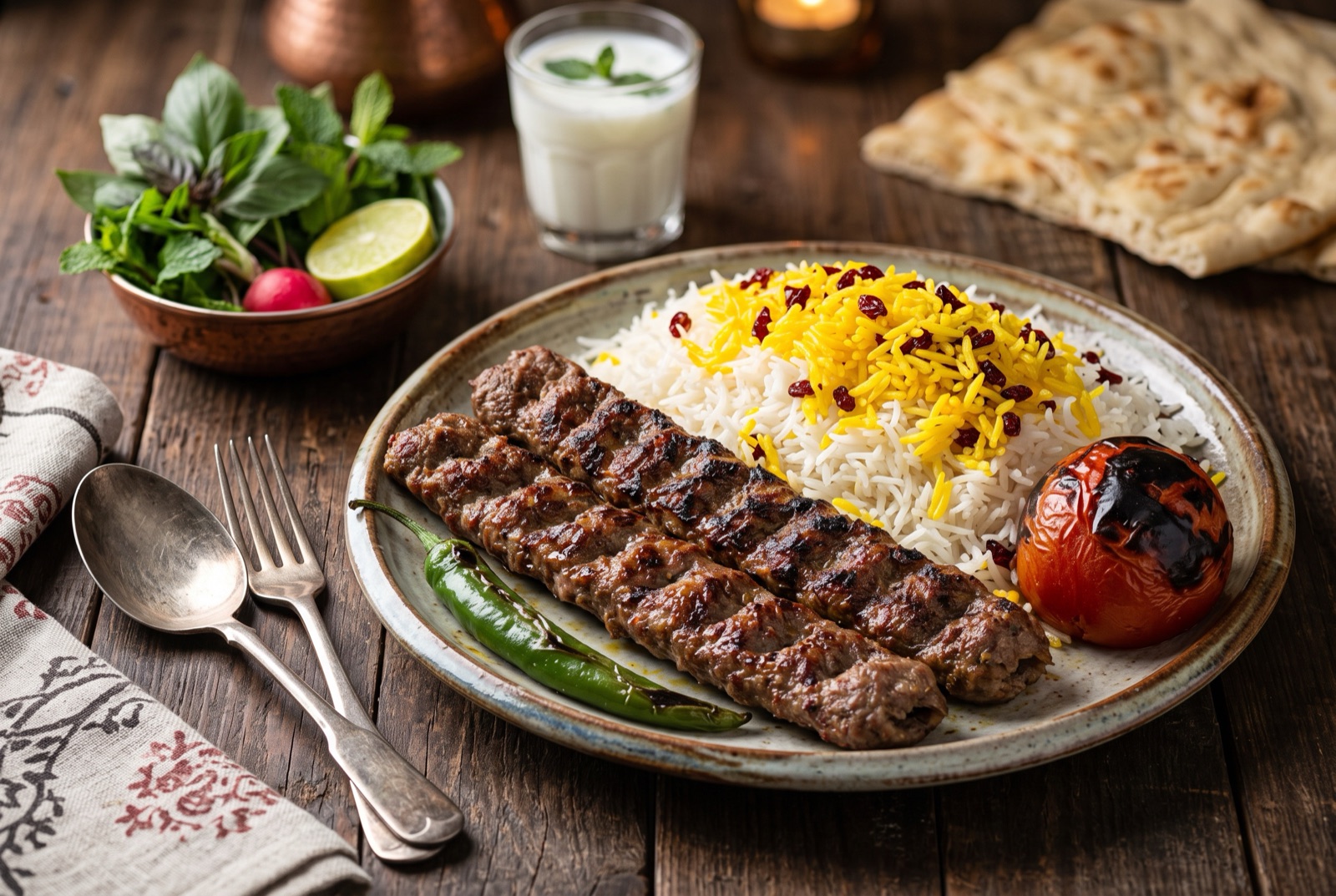
Kabab koobideh is minced lamb and grated onion, salt and pepper — and almost nothing else. What turns those four things into the most eaten dish in Iran is the working: the meat is kneaded and slapped until the protein tightens and the mixture becomes tacky enough to grip a wide flat skewer without falling into the fire. Grilled fast over charcoal it develops a dark, slightly charred crust while the inside stays loose and juicy, tasting sweet from the onion and faintly smoky from the fat dripping onto the coals. It arrives on saffron-buttered rice with a blackened tomato and a shaker of sumac, and the whole thing is eaten with flatbread and raw onion.

- Gate
- Iran
- Prep
- 30 min
- Cook
- 15 min
- Total time
- 1 hr 45 min incl. 1 hr rest
- Serves
- 4
- Status
- Medium
- Nutrition / serving · estimated
- Calories 610 kcal
- Protein 40 g
- Carbs 42 g
- Fat 31 g
- Fiber 3 g
- Sodium 1100 mg
Why this recipe works.
- Squeezes the grated onion dry, which is the single fix that stops koobideh sliding off the skewer.
- Specifies fat content rather than just saying minced lamb, because anything leaner than 20 percent fat will crumble.
- Includes a rest in the fridge, the step home cooks skip and kababis never do.
- Gives a proper method for cooking it without flat skewers or charcoal, instead of pretending you have both.
Ingredients.
10 itemsFor the kababs
To baste and finish
To serve
Equipment
- Wide flat metal skewers, or a ridged grill pan
- Box grater
- Clean tea towel or muslin for squeezing the onion
- Charcoal barbecue if you have one
Instructions.
Grate and drain the onion
Grate 2 of onions on the fine side of a box grater, then tip the pulp into a clean tea towel and wring it out hard over the sink. Keep squeezing until barely any juice comes out — the pulp should look almost dry and shredded.
Tip This is the step that decides whether the kabab stays on the skewer. Do not rush it.
Knead the meat until it turns sticky
Combine the minced lamb, squeezed onion, salt, pepper and turmeric in a wide bowl and knead with your hand for a full 10 minutes, pressing and slapping the mixture against the side. It should change from crumbly to noticeably tacky and start lifting away from the bowl as one mass.
Tip A stand mixer with the paddle attachment does this in about 5 minutes on medium speed.
Chill the mixture
Cover the bowl and refrigerate for at least an hour, or up to overnight. The fat firms up and the salt continues to tighten the protein, both of which help the kabab hold its shape over the heat.
Get the fire properly hot
Light the charcoal and wait until the coals are covered in grey ash with no flames left, then spread them into an even bed. If you are using a ridged grill pan, heat it over high heat for a full 5 minutes until a drop of water skitters and evaporates instantly.
Mould the meat onto the skewers
Divide the mixture into eight. With cold, wet hands, take a portion and press it around a flat skewer, working it outwards into a strip about 20 cm long and 2 cm thick. Pinch ridges along the length with your thumb and finger every 3 cm so the meat grips the metal.
Tip No flat skewers? Shape the same portions into flattened logs on a tray lined with baking paper and cook them directly on the grill pan.
Grill fast and turn once
Lay the skewers across the coals so the meat hangs clear of the bed and grill for 3 to 4 minutes without touching them, until the underside has set into a dark crust and releases cleanly. Turn the whole skewer over and cook another 3 to 4 minutes, basting with the saffron butter. Grill the whole tomatoes alongside until the skins blister and split.
Tip Turning too early tears the kabab. Wait for the surface to firm up and lift away from the metal on its own.
Slide off and serve immediately
Lay a piece of flatbread over the kabab, grip through it and pull the skewer out so the meat slides free in one piece. Serve straight away on saffron rice with a blistered tomato, raw onion wedges and sumac to sprinkle at the table.
Tips from our kitchen.
- Use lamb with at least 20 percent fat, or ask the butcher to mince shoulder rather than leg. Lean mince makes a dry kabab that falls apart on the skewer.
- Grate the onion on the fine side of a box grater, then squeeze it hard in a clean cloth. You want the onion flavour and none of the juice, which is the main cause of skewer failure.
- Knead for a full ten minutes, or five in a stand mixer with the paddle. The mixture should go from crumbly to distinctly sticky and start pulling away from the bowl in one mass.
- Chill the mixture for at least an hour before shaping. Cold fat holds the shape while the surface sets over the heat.
- Wet your hands with cold water before moulding the meat onto skewers, and press in ridges with your fingers along the length — they help the kabab grip and give it the classic wavy look.
- Cook it hard and fast, turning after the surface has set. Koobideh takes around eight minutes total, and anything longer dries it out.
Substitutions.
- Minced lamb → Half lamb, half beef mince, or all beef with 20 percent fat
- The half-and-half mix is standard in many kababis and slightly less strongly flavoured. Pure beef koobideh is common too but needs the fat content watched closely.
- Flat metal skewers → Shape into flattened logs and cook on a ridged grill pan or under a hot oven grill
- You lose the charcoal smoke, which is a genuine difference, but the meat itself cooks the same. Do not try to use thin round skewers — the kabab will spin and drop.
- Sumac → A squeeze of lemon over the finished kabab
- Sumac is the traditional table seasoning and worth buying, but lemon supplies the same sour lift against the fat.
Variations.
- Kabab barg
- The other half of a mixed grill plate: whole strips of lamb fillet or beef tenderloin marinated in onion juice and saffron, skewered flat and grilled. Firmer, leaner and considered the more expensive order.
- Joojeh kabab
- Chicken pieces marinated for hours in saffron, yogurt, lemon and onion, then grilled until the edges blacken. The usual choice for people who find koobideh too rich.
- Kabab tabei
- The pan version made openly as a pan version: the same mixture pressed flat into a frying pan, scored into strips and fried in its own fat. A normal weeknight dish in Iranian homes.
Storage & reheating.
Raw kabab mixture keeps 24 hours refrigerated and actually improves after a few hours of resting, so making it the morning of a barbecue is sensible. It freezes well raw for up to 2 months, either as a block or already shaped into logs on baking paper. Cooked koobideh keeps 2 days but suffers on reheating — the loose texture that makes it good tightens up. Reheat wrapped in foil in a moderate oven rather than in a microwave, or chop the leftovers into flatbread with tomato and herbs for a sandwich.
Serve with
Saffron-buttered rice with a blistered tomato, warm flatbread, raw onion wedges and a shaker of sumac at the table.
The story behind Kabab Koobideh.
Koobideh means pounded, and the name describes the technique rather than the ingredient: meat worked by hand until it changes texture. Grilling meat on skewers over fire is ancient across the Iranian plateau and Central Asia, but koobideh as it exists now is essentially a nineteenth and twentieth century urban dish, tied to the rise of the kababi — the specialist grill house with a long charcoal trough, wide flat skewers, and a cook who does nothing but turn them. That specialisation matters. In Iran, koobideh is overwhelmingly food you buy rather than food you make, and many excellent home cooks have never shaped a skewer in their lives.
The flat skewer is not a stylistic choice. Round skewers spin inside the meat and the kabab slides off; the wide flat blade grips the mixture and lets you turn the whole length at once. Traditional kababi skewers are around three centimetres wide and long enough to span the trough, and they are laid directly across the rails with no grill bars underneath, so the fat drips straight onto the coals and the smoke comes back up through the meat. Everything about the setup is designed around a mixture that is deliberately soft and barely bound.
That softness is also why koobideh has a reputation for being difficult. There is no egg, no breadcrumb and no flour in a proper one — binding comes only from working the meat, from the fat content, and from getting as much water as possible out of the grated onion. Too wet and it drops into the fire; too lean and it crumbles; too little kneading and it never grips at all. A home cook without a charcoal trough and flat skewers is honestly at a disadvantage, and the sensible answer is not to fake the equipment but to shape the mixture into flattened logs and cook them on a very hot ridged pan or under a grill. You lose the charcoal smoke, which is a real loss, but the texture and flavour of the meat itself survive intact.
Questions, answered.
Why does my koobideh fall off the skewer?
Almost always excess moisture from the onion, or not enough kneading. Grate the onion finely and then squeeze it out in a cloth until it is nearly dry, knead the meat for a full ten minutes until it becomes visibly sticky, and chill the mixture for at least an hour before shaping. Skewer width matters too — wide flat skewers grip, thin round ones let the meat spin loose.
Can I add egg or breadcrumbs as a binder?
You can, and many home recipes do, but it is not how koobideh is made in Iran and it changes the texture towards a meatball or kofta. The binding is supposed to come from working the meat and controlling moisture. If you are cooking on a pan rather than skewers you do not need a binder at all, since nothing has to hang over a fire.
What meat should I use for koobideh?
Lamb shoulder minced with around 20 percent fat is the benchmark, though a fifty-fifty mix of lamb and beef is extremely common in kababis. Avoid anything sold as lean or extra-lean mince — the fat is what keeps the kabab juicy through fast, high-heat grilling and what holds the loose mixture together while it cooks.
Can I make koobideh without a barbecue?
Yes. Shape the mixture into flattened logs about two centimetres thick and cook them on a very hot ridged grill pan, or on a foil-lined tray under a preheated oven grill set as high as it goes. You will not get charcoal smoke, which is a real part of the flavour, but the meat itself cooks identically and the dish is still worth making.
Why is the tomato served blackened?
Grilled tomatoes go on the skewers alongside the meat in every kababi, and the blistered, half-collapsed flesh is mashed into the saffron rice at the table to moisten and season it. The char is deliberate — it adds smoke and concentrates the sweetness, and the loose skin is meant to be slipped off before eating.
You might also like.
All recipes →
Keep exploring Iran.
Iran has 9 more dishes in the atlas — Ash-e Reshteh and Faloodeh, and 7 more.
Recipe by The DishRoute Kitchen · published August 20, 2026 · updated August 20, 2026