Petulla.
Albanian Breakfast Fried Dough
Petulla · say it: PEH-too-lah
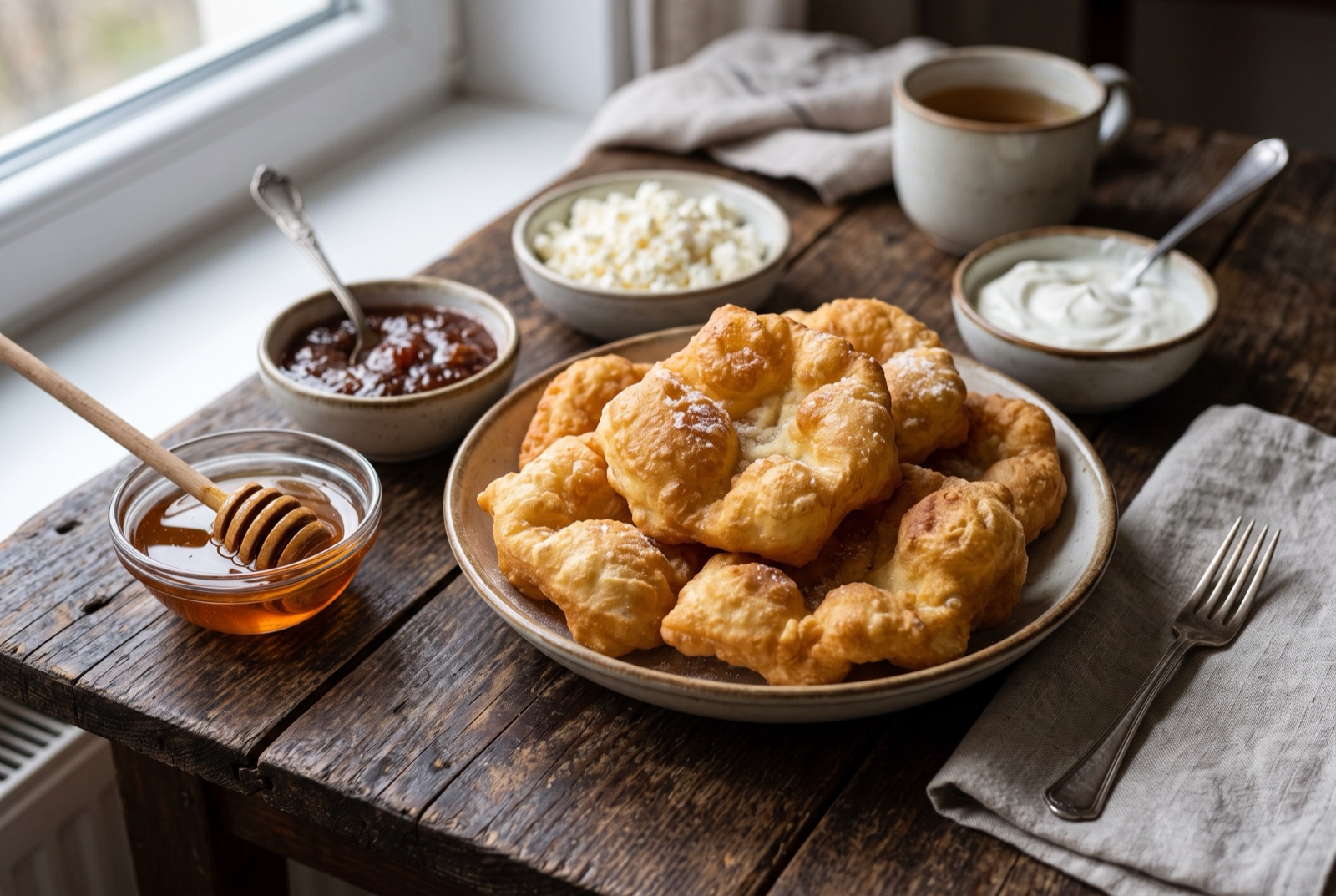
Petulla are what an Albanian weekend morning smells like. A slack, wet yeasted dough is left to rise until it is full of bubbles, then torn into rough pieces with oiled hands and dropped into hot oil, where each piece balloons, browns unevenly and comes out crisp outside and almost hollow inside. They are not sweet in themselves — the dough is barely seasoned — which is the whole point, because they arrive at the table surrounded by things to put on them: runny honey, fruit jam, crumbled salty white cheese and a bowl of thick sour cream. You tear, dip, alternate salty and sweet, and eat far more than you meant to.

- Gate
- AlbaniaNationwide
- Prep
- 15 min
- Cook
- 25 min
- Total time
- 1 hr 55 min incl. 1 hr 15 min rest
- Serves
- 6
- Status
- Easy
- Nutrition / serving · estimated
- Calories 590 kcal
- Protein 15 g
- Carbs 78 g
- Fat 24 g
- Fiber 3 g
- Sugar 22 g
- Sodium 810 mg
Why this recipe works.
- Keeps the dough deliberately slack and wet, which is what produces the hollow, airy interior rather than heavy doughnuts.
- Tears the dough with oiled hands instead of rolling and cutting, the way it is actually done in Albanian kitchens.
- Gives clear oil-temperature cues, so the petulla puff instead of soaking up fat and going leaden.
- Serves them the proper Albanian way, with sweet and salty on the table at the same time.
Ingredients.
11 itemsFor the dough
To fry
To serve
Equipment
- Large mixing bowl
- Deep heavy pan or wok for frying
- Slotted spoon
- Paper towels
Instructions.
Wake the yeast
Stir the yeast and sugar into 100 ml of the lukewarm water and leave for 8–10 minutes, until the surface is foamy and smells clearly of bread. If nothing happens, the yeast is dead and there is no point continuing.
Mix a slack dough
Combine the flour and salt in a large bowl, pour in the yeast mixture, the remaining water and the yoghurt, and beat hard with a wooden spoon for two minutes. The dough should be sticky and loose, closer to a very thick batter than a bread dough.
Tip Resist adding flour. Wet dough is what makes petulla hollow.
Let it rise
Cover the bowl with a cloth and leave somewhere warm for 60–75 minutes, until the dough has roughly doubled, domed on top and is visibly pocked with bubbles when you look at the side of the bowl.
Heat the oil
Pour the frying oil into a deep heavy pan to a depth of about 5 cm and heat to 175°C. Test with a small scrap of dough: it should surface within two seconds and bubble steadily around its edges without browning instantly.
Tear and fry
Oil your hands, pull off pieces of dough about the size of a plum without knocking the air out, stretch each one slightly and lower it into the oil. Fry four or five at a time for 2–3 minutes a side, until puffed, hollow-sounding and deep gold in patches.
Tip They will look uneven and blistered — that is correct. Perfectly smooth petulla mean the dough was too tight.
Drain and serve immediately
Lift the petulla onto paper towels for a few seconds only, then pile them onto a warm plate. Bring them to the table with honey, jam, crumbled white cheese and sour cream in separate bowls and let everyone build their own.
Tips from our kitchen.
- The dough should be too wet to knead and should stick to your fingers. If it holds a ball, add water — a stiff dough gives dense petulla.
- Let it rise until the surface is domed and full of visible bubbles, then use it straight away; a collapsed second rise loses the airiness.
- Oil your hands rather than flouring them when tearing pieces, since loose flour burns black in the oil and taints the whole batch.
- Test the oil with a scrap of dough: it should sink briefly, then surface within two seconds and start bubbling steadily around the edges.
- Fry four or five at a time at most. A crowded pan drops the oil temperature and the petulla go greasy instead of crisp.
- Eat them within minutes. Petulla are wonderful hot and merely acceptable twenty minutes later, and no reheating fully fixes that.
Substitutions.
- Fresh or dried yeast → 250 g plain yoghurt plus 2 tsp baking powder, with the water reduced accordingly
- The no-yeast version is a common shortcut and can be fried immediately, but the texture is more scone-like and less hollow.
- Sunflower oil for frying → Any neutral oil with a high smoke point, or olive oil for a heavier, more southern flavour
- Avoid extra-virgin olive oil for deep frying, as it smokes and turns bitter at the temperature needed here.
- White brined cheese → Feta, or fresh curd cheese
- The salty element is essential to the Albanian way of eating these. Skipping it turns breakfast into dessert.
Variations.
- Petulla me gjizë
- Curd cheese worked into the dough before frying, giving richer, slightly tangy petulla that need no cheese on the side.
- Sugared petulla
- Tossed in caster sugar or dusted with icing sugar straight out of the oil — the children's version, sold hot at street stalls.
- Northern style with tëlyen
- Served with the clarified butter of the highlands instead of sour cream, poured warm over the hot dough.
Storage & reheating.
Petulla are a same-hour food and go leathery once cold. If you have leftovers, keep them uncovered at room temperature and refresh them in a 190°C oven for 5 minutes, which restores some crispness but not the puff. The raw dough can be refrigerated overnight after mixing and fried straight from the fridge the next morning, which actually improves the flavour.
Serve with
Honey, fruit jam, crumbled white cheese, thick sour cream and strong coffee — all on the table at once.
The story behind Petulla.
Fried dough is universal, and every country around Albania has its own: uštipci in Bosnia, mekike in Bulgaria, lokma in Turkey, langoš in Hungary. What makes petulla Albanian is less the dough than the spread around it. The standard breakfast presentation puts sweet and salty on the table simultaneously and expects you to move between them — honey on one piece, white cheese on the next — and Albanians find it strange that other cultures pick a side. Sour cream or thick kos usually sits in the middle as the bridge between the two.
The dough itself has no secrets and no fat in it. Flour, water, yeast, salt, sometimes a spoonful of yoghurt, mixed to a batter far too wet to knead and left to rise until it is visibly aerated. That wetness is deliberate: a slack dough traps large irregular bubbles and creates the hollow interior, which is why petulla shaped neatly from a stiffer dough come out heavy and doughnut-like instead. Shapes are deliberately irregular — torn, stretched, sometimes with a hole poked through so the middle cooks — and no two are the same.
They belong to unhurried mornings: weekends, holidays, the day a relative visits, snow days when nobody is going anywhere. In some households they are also made in the evening as a quick supper with cheese, and in the north they are eaten with tëlyen, the clarified butter of the highlands. Street stalls and small bakeries sell them by the bag, hot and greasy in paper, and children eat them on the way to school with sugar shaken over the top. There is no version of petulla that anyone considers fancy, and that is precisely why they persist.
Questions, answered.
Why did my petulla come out heavy and greasy?
Almost always the oil was too cool. Below about 170°C the dough absorbs oil before the outside can seal, so it soaks rather than puffs. Test with a scrap: it should surface within two seconds and bubble steadily. The other cause is a dough that was too stiff or that had over-risen and collapsed, both of which stop the pieces ballooning.
Can I make the dough the night before?
Yes, and it is worth doing. Mix the dough, cover it and refrigerate overnight — the slow cold fermentation gives a better flavour and the dough is easier to handle cold. Take it out about 30 minutes before frying so it comes back to room temperature, and do not knock it down; tear pieces straight from the risen mass.
What is the difference between petulla and doughnuts?
Petulla dough contains no sugar, no egg and no fat, and is much wetter than doughnut dough, so it puffs into irregular hollow shapes rather than neat rings and stays savoury. Doughnuts are enriched and sweetened before frying. Petulla get their sweetness only from whatever you put on them at the table, which is why they work equally well with cheese.
How do Albanians actually eat petulla?
For breakfast, with several things at once. The table carries honey, fruit jam, crumbled white brined cheese and sour cream or thick yoghurt, and people alternate between sweet and salty across the same plate. They are torn rather than cut, eaten with the hands, and usually accompanied by strong coffee. They also appear as a quick evening meal, in which case cheese tends to win over honey.
Can I fry them in less oil?
Shallow frying in about two centimetres of oil works and is what most home kitchens do, though you will need to turn each piece once and the shapes come out flatter. Air fryers do not work well here: without hot oil the wet dough dries out rather than puffing, and you end up with something closer to a small chewy bread roll than a petulla.
You might also like.
All recipes →
Keep exploring Albania.
Albania has 9 more dishes in the atlas — Byrek me Spinaq and Fërgesë Tirane, and 7 more.
Recipe by The DishRoute Kitchen · published August 20, 2026 · updated August 20, 2026