Trileçe.
Albanian Three-Milk Caramel Cake
Trileçe · say it: tree-LEH-cheh
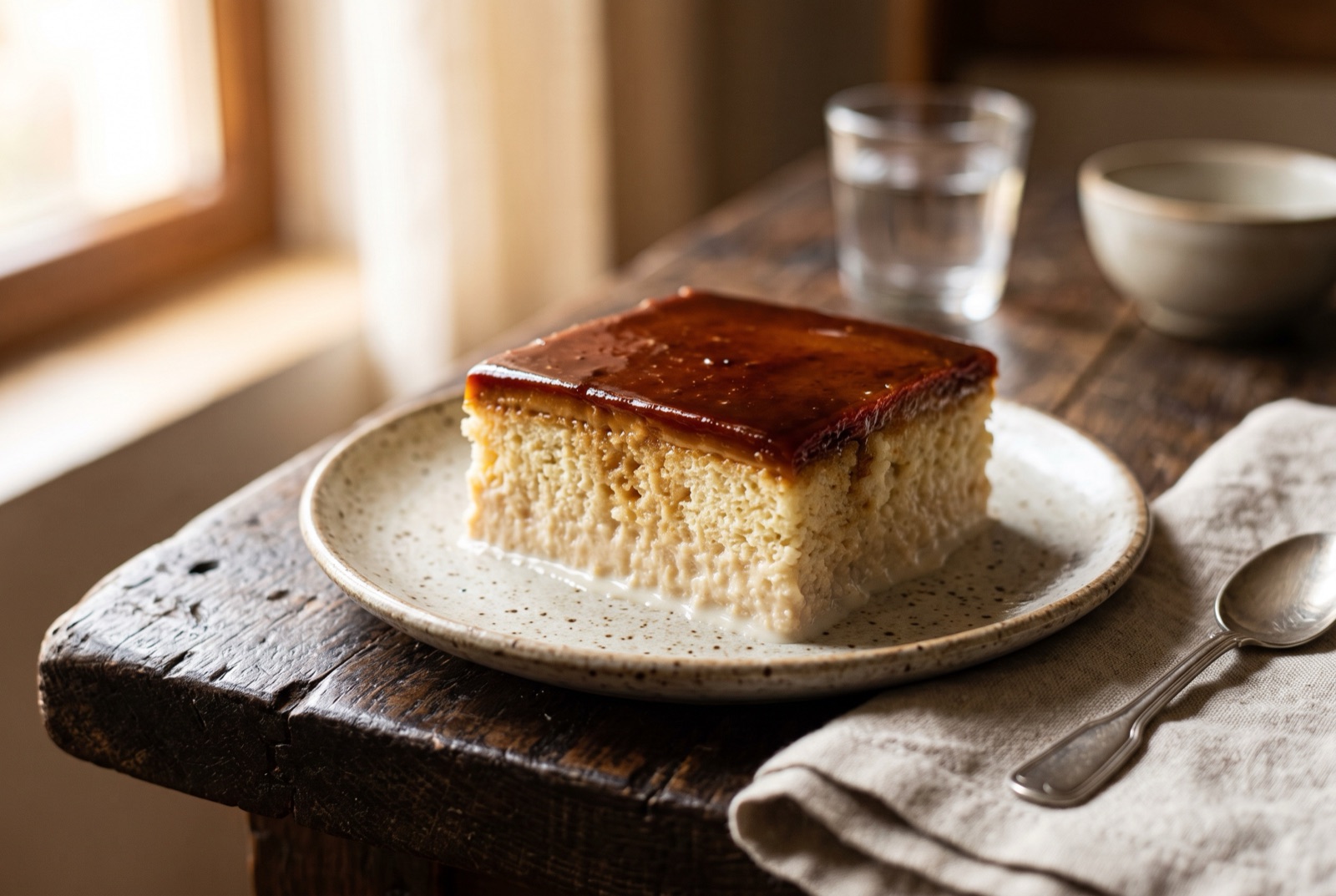
Trileçe is a milk-soaked sponge under caramel. A whisked, fat-free sponge is baked until dry and thirsty, pricked all over and drenched in a mixture of three milks — evaporated, condensed and fresh — then chilled until the crumb has drunk every drop and turned into something between cake and set custard. Over the top goes a thin layer of caramel cooked to a genuinely dark, slightly bitter stage, which is what stops the whole thing being cloying. It is cold, wet, sweet and faintly burnt at the same time, cut into squares and eaten with a spoon rather than a fork, and it has become the default dessert order across Albania.

- Gate
- AlbaniaTirana and the cities
- Prep
- 30 min
- Cook
- 30 min
- Total time
- 9 hr incl. 8 hr rest
- Serves
- 12
- Status
- Medium
- Nutrition / serving · estimated
- Calories 410 kcal
- Protein 8 g
- Carbs 58 g
- Fat 16 g
- Sugar 46 g
- Sodium 140 mg
Why this recipe works.
- A properly whisked fatless sponge, which is the only kind that can absorb this much liquid without collapsing.
- Gives the three-milk ratio by weight so the cake ends up saturated but never sitting in a pool.
- Cooks the caramel to a genuinely dark stage and explains how to stop it splitting when the cream goes in.
- Made a day ahead by design — the overnight soak is what turns it from wet cake into trileçe.
Ingredients.
13 itemsFor the sponge
For the three-milk soak
For the caramel
Equipment
- Electric whisk or stand mixer
- Rectangular baking tin, about 30 x 20 cm
- Skewer
- Heavy-based saucepan for caramel
Instructions.
Whisk the sponge base
Whisk the eggs, sugar, vanilla and salt on high speed for 8–10 minutes, until the mixture has tripled in volume, turned pale and holds a ribbon on the surface for three seconds before sinking back.
Tip Undermixing here is fatal — the eggs are the only leavening that matters, and there is no fat to help.
Fold in the flour
Sift the flour and baking powder over the eggs in three additions, folding each in with a large spatula using slow figure-of-eight strokes until no dry streaks remain. Stop the moment it is combined.
Bake until dry
Pour into a lined 30 x 20 cm tin and bake at 180°C for 25–30 minutes, until the top is golden brown, springs back firmly when pressed and a skewer comes out completely clean. A slightly overbaked sponge soaks better than an underbaked one.
Prick and cool
Leave the sponge in its tin and, while it is still warm, prick it all over at 2 cm intervals with a skewer, pushing right down to the base. Let it cool to room temperature.
Soak in three milks
Whisk the evaporated milk, condensed milk and whole milk together. Pour a third over the cooled sponge, wait five minutes for it to disappear, then repeat twice more until all the liquid is in. Cover and refrigerate for at least 6 hours, ideally overnight.
Tip The surface should look damp but there should be no standing liquid at the edges.
Make the dark caramel
Melt the sugar in a dry heavy pan over medium heat without stirring, swirling the pan occasionally, until it is fully liquid and a deep amber that smells faintly toasted. Take it off the heat, whisk in the warm cream slowly — it will bubble violently — then the butter and the salt.
Tip Warm cream, off the heat, poured slowly. Cold cream straight into hot sugar seizes it into a lump.
Top and chill again
Let the caramel cool for 15 minutes until it thickens slightly but still pours, then spread it in a thin even layer over the chilled cake. Return to the fridge for at least an hour before cutting into squares and serving cold.
Tips from our kitchen.
- Whisk the eggs and sugar until the mixture holds a visible ribbon on the surface for three seconds. That air is the entire structure of the sponge.
- Fold the flour in by hand in three additions. A machine will knock out the air and give you a flat, rubbery base.
- Bake the sponge until it is dry and lightly coloured, even slightly overdone — a moist sponge cannot absorb the milk.
- Pour the milk mixture slowly in three stages, letting each one sink in before adding the next, or it will run off the top and pool.
- For the caramel, do not stir the sugar as it melts; swirl the pan instead. Stirring makes it crystallise into grit.
- Take the caramel to a proper amber, just to the point where it smells slightly toasted. Pale caramel makes the whole dessert sickly.
Substitutions.
- Evaporated milk → An extra 250 ml of whole milk plus 50 ml single cream
- Evaporated milk gives a slightly cooked, concentrated dairy flavour, so the substitute is a little cleaner and less caramelised.
- Caramel topping → Whipped cream, dusted with cinnamon
- This turns it back into a Latin American style tres leches. Lighter, but no longer the version Albanians would recognise.
- Plain flour → A 1:1 gluten-free flour blend
- Works reasonably here because the sponge relies on whisked eggs rather than gluten for structure, though the crumb is a touch more fragile.
Variations.
- Coffee trileçe
- A shot of strong espresso stirred into the milk mixture, which cuts the sweetness sharply and is popular in Tirana cafés.
- Chocolate trileçe
- Cocoa whisked into the sponge and a chocolate ganache in place of caramel — sold widely, though purists consider it a different cake.
- Kajmak-topped
- Finished with lightly whipped double cream under the caramel drizzle, giving a layered top rather than a single caramel sheet.
Storage & reheating.
Trileçe must be refrigerated and keeps 4 days covered, improving on days two and three as the soak evens out. Serve it cold, straight from the fridge, cut into squares with a knife wiped between cuts. It does not freeze: the soaked crumb turns to slush on thawing and the caramel weeps water. Do not leave it at room temperature for more than an hour, since it is essentially a dairy custard.
Serve with
Strong Turkish coffee or espresso — the bitterness is the natural counterweight to all that sweetened milk.
The story behind Trileçe.
Trileçe is not an old Albanian recipe and nobody in Albania pretends otherwise. It is the Balkan and Turkish adaptation of Latin American tres leches — the name is a straight phonetic borrowing of the Spanish for three milks — and it arrived in Albania in the 2000s, largely through Turkey, where trileçe had already become a pastry-shop standard. Within about a decade it went from novelty to the dessert most likely to appear on an Albanian menu, and it now sits alongside baklava and revani in the standard restaurant lineup without anyone finding that strange.
What the Balkan version changed is the top. Latin American tres leches is usually crowned with whipped cream or meringue, light and pale. Trileçe replaces that with caramel, cooked dark enough to carry a real bitter edge, poured thin so it sets into a glossy sheet rather than a sauce. That single substitution changes the balance of the dessert completely: the caramel cuts through the sweetened condensed milk and gives the whole thing a burnt-sugar backbone. Some versions use a lighter butterscotch, and a debate exists between people who want the caramel almost black and people who do not.
The reason it took hold so fast is worth noting. Albanian dessert tradition leaned heavily on Ottoman syrup pastries — baklava, revani, kadaif — all of which are sweet, dense and served in small pieces. Trileçe fits the same appetite for very sweet things but is cold, soft and spoonable, which suits a hot Mediterranean summer far better than a tray of syrup-soaked filo. Bakeries sell it by the slice in plastic tubs, cafés keep it in the fridge case, and it is one of the few desserts Albanians will order after a full meal without hesitating.
Questions, answered.
Why is my trileçe soggy at the bottom and dry on top?
The milk was poured too fast. Pour it in three stages, waiting a few minutes between each so the sponge draws it upward, and prick the cake thoroughly with a skewer first. It also helps to soak the cake in the tin it was baked in and to leave it overnight, which lets the liquid distribute evenly through the crumb rather than sinking straight to the base.
Is trileçe the same as tres leches?
They are the same idea with a different finish. Both are sponges soaked in three kinds of milk, and the name is a direct borrowing from Spanish. Latin American tres leches is normally topped with whipped cream or meringue, while trileçe as made in Albania and Turkey is topped with dark caramel. That caramel gives a bitter edge that changes the balance of the dessert considerably.
How dark should the caramel be?
Amber to deep copper, just at the point where it smells toasted rather than merely sweet. Sugar goes from pale gold to burnt in under a minute at the end, so watch it constantly and pull the pan off the heat a shade earlier than you think, since it keeps cooking. Pale caramel leaves the dessert flat and cloying; slightly bitter caramel is what makes it work.
Can I make trileçe ahead?
You should. Bake and soak the cake a day before serving and keep it covered in the fridge overnight, which is when the crumb finishes absorbing the milk and the texture settles. Add the caramel a few hours before serving rather than the night before, since it slowly softens and thins as it sits on the wet surface.
My caramel seized when I added the cream. What happened?
Cold cream hitting very hot sugar makes it clump instantly. Warm the cream first, take the caramel off the heat for a few seconds, and pour the cream in slowly while whisking. If it does seize, put the pan back over low heat and keep stirring — the hardened sugar will usually melt back into the cream within a minute or two.
You might also like.
All recipes →
Keep exploring Albania.
Albania has 9 more dishes in the atlas — Byrek me Spinaq and Fërgesë Tirane, and 7 more.
Recipe by The DishRoute Kitchen · published August 20, 2026 · updated August 20, 2026