Poronkäristys.
Lapland Sautéed Reindeer with Mash
Poronkäristys · say it: POH-rohn-KAH-riss-tewss
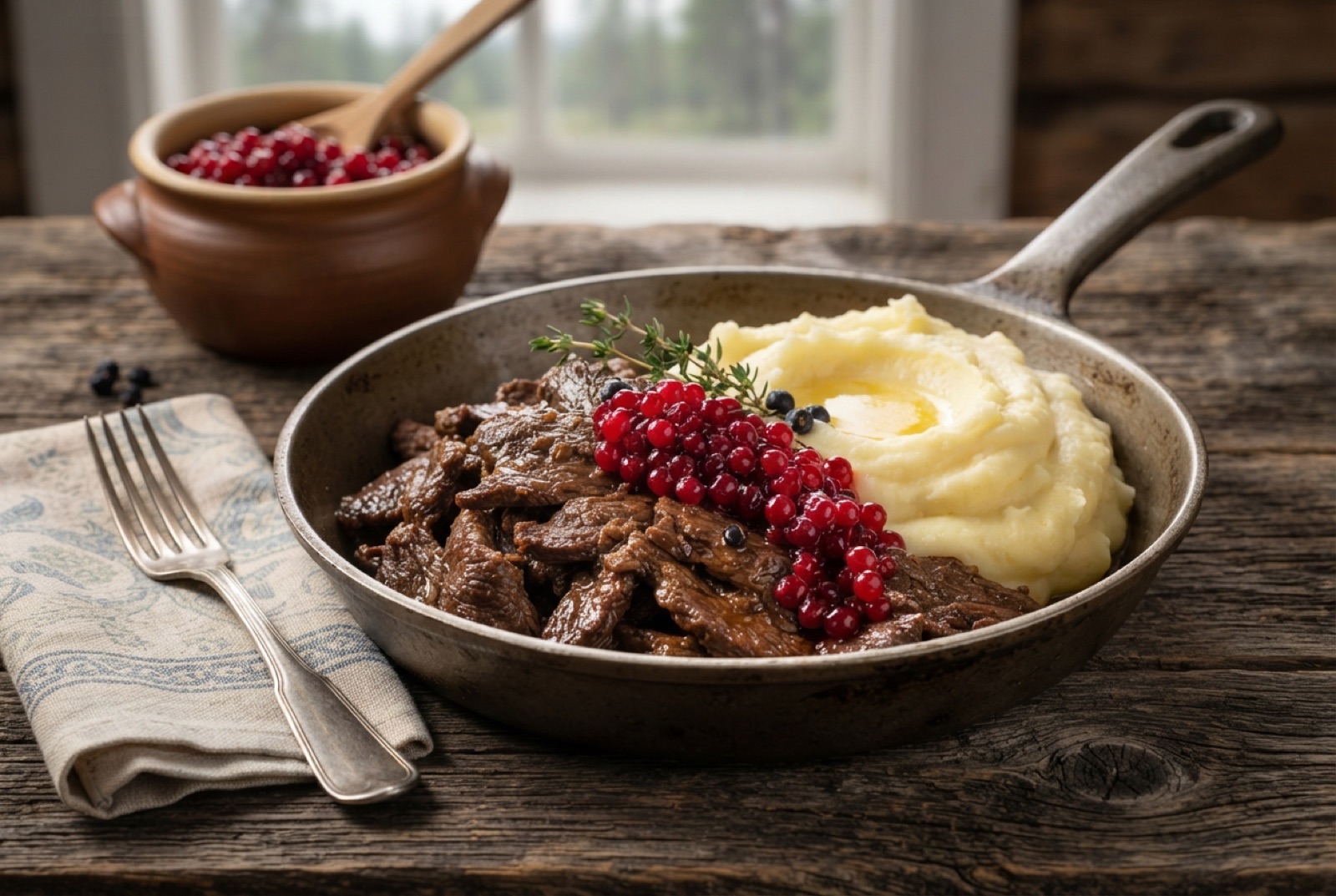
Poronkäristys is shaved reindeer, fried hard in its own fat and then briefly braised until the shavings soften into something between a sauté and a very loose stew. The meat is lean, dark and faintly sweet — closer to venison than to beef, with none of the muskiness people expect — and the seasoning is deliberately almost nothing: fat, salt, pepper, a splash of liquid. What makes the plate work is the contrast around it. Mashed potato absorbs the pan juices, lingonberries cut straight through the richness with raw tartness, and a pickled cucumber adds the third sour note. It is the standard hot lunch across Finnish Lapland and takes well under an hour.

- Gate
- FinlandLapland
- Prep
- 20 min
- Cook
- 35 min
- Total time
- 55 min
- Serves
- 4
- Status
- Medium
- Nutrition / serving · estimated
- Calories 610 kcal
- Protein 45 g
- Carbs 48 g
- Fat 26 g
- Fiber 5 g
- Sugar 11 g
Why this recipe works.
- Explains the frozen-meat shaving trick properly, so you can reproduce the texture even with venison or beef.
- Keeps the seasoning as spare as the original instead of dressing it up with cream and juniper it never had.
- The mash is built the Finnish way — hot milk, plenty of butter, no cream — so it soaks up the pan juices rather than sitting apart from them.
- Whole plate in about 45 minutes, including the potatoes.
Ingredients.
12 itemsFor the käristys
For the mash
To serve
Equipment
- Large heavy frying pan or sauté pan with a lid
- Sharp knife or meat plane
- Potato masher
Instructions.
Boil the potatoes
Put 1 kg of peeled, quartered potatoes into cold salted water, bring to the boil and simmer for 18–20 minutes until a knife slides in with no resistance. Drain and leave them in the hot dry pan for a minute so the surface steam escapes.
Shave the meat
While the potatoes cook, take the meat straight from the freezer and shave it into thin curls with a sharp knife held almost flat against the block, or with a meat plane. Keep the shavings in the freezer bowl until the pan is hot — they must go in still frozen.
Tip If the block softens and starts slicing rather than curling, put it back in the freezer for ten minutes.
Fry hard, in batches
Melt half the butter in a wide pan over high heat until it stops foaming and just begins to smell nutty. Add a third of the shavings in a single layer and let them sit untouched for a minute until the edges brown and the pan hisses sharply, then toss and tip them into a bowl. Repeat with the rest, adding fat as needed.
Tip Grey, watery meat means the pan was too cool or too full. Pour off any released liquid and reheat before the next batch.
Braise until tender
Return all the meat to the pan with the onion if using, season with the salt and pepper, and pour in the beer or water. Bring to a simmer, cover, and cook gently for 15–20 minutes until the shavings are completely soft and the liquid has reduced to a glossy few tablespoons clinging to the meat.
Mash the potatoes
Mash the drained potatoes while still hot, then beat in the butter and enough hot milk to give a soft, spoonable mash — not stiff, since it has to take up the pan juices. Season with salt and a scrape of nutmeg.
Tip Hot milk keeps the mash light; cold milk makes it dense and gluey.
Plate the Lapland trio
Spoon the mash onto warm plates, pile the käristys beside it with all the pan juices poured over, and add a generous spoon of cold lingonberries and a few slices of pickled cucumber. Serve immediately, while the berries are still cold against the hot meat.
Tips from our kitchen.
- Shave the meat while it is still frozen solid, not thawed. Half an hour out of the freezer is already too long — the block should resist the knife and give up curls, not slices.
- Get the pan properly hot before the meat goes in and work in two or three batches. Crowding drops the temperature and the shavings release water and stew grey instead of catching colour.
- Reindeer is very lean, so use more fat than feels right — the finished pan should look glossy, and any fat left behind goes over the potatoes.
- Do not season with salt until after the first hard fry; salting frozen shavings pulls water out immediately and you lose the sizzle.
- Lingonberries should be barely sweetened and served cold and raw-tasting. A sugary jam turns the plate into dessert and kills the contrast the dish depends on.
Substitutions.
- Reindeer shavings → Venison, elk or lean beef sirloin, half-frozen and shaved against the grain
- Venison is closest. Beef works but is heavier and less sweet — slice it thinner than you think and cook it a shade less.
- Reindeer fat → Butter, or half butter and half neutral oil
- Butter alone can catch at the high heat needed, so add oil for the first hard fry and finish with butter.
- Dark beer → Water, beef stock, or a splash of strong black coffee
- Water is entirely traditional. Coffee sounds odd but appears in some northern kitchens and deepens the colour nicely.
- Lingonberries → Cranberries cooked briefly with a little sugar, or redcurrant
- You are after sharp and barely sweet. Cranberry is the closest supermarket match; avoid anything jelly-like.
Variations.
- Poronkäristys with cream
- A restaurant flourish: a splash of cream stirred in at the end for a rounder, more sauce-like pan. Divisive in Lapland, common further south.
- Käristys on flatbread
- Served on rieska, the soft barley flatbread of the north, with lingonberries on top — the way it is often eaten at markets and round-ups rather than at a table.
- Smoked reindeer version
- A handful of cold-smoked reindeer added with the fresh shavings in the last minutes, which pushes the whole pan toward the smoky end without turning it into bacon.
Storage & reheating.
Cooked käristys keeps 2 days refrigerated and reheats well in a covered pan over low heat with a spoonful of water, since the shavings are already fully braised. Do not microwave it uncovered — the lean meat dries out fast. It freezes acceptably for a month but loses some tenderness. Mashed potato is best made fresh; if you must reheat it, do so with extra hot milk beaten in.
Serve with
Buttery mashed potato, cold lingonberry compote and pickled cucumber — the fixed Lapland trio, in that order on the plate.
The story behind Poronkäristys.
Reindeer herding in Lapland is Sámi in origin and still largely Sámi and northern Finnish in practice, run as a semi-wild system where animals graze freely across enormous territory and are gathered for round-ups in autumn and winter. That grazing — lichen, sedge, birch leaves, mushrooms — is why the meat tastes the way it does, and why it is exceptionally lean. It is also why the dish exists in this particular form: käristys means, roughly, something fried or sizzled, and the technique came out of the practical reality of a frozen carcass. A block of frozen meat can be shaved with a knife or plane into curls thinner than any cook could slice fresh, and those shavings cook almost instantly, which matters when the fuel is a fire and the kitchen is cold.
The traditional fat is reindeer fat, saved and rendered, and the traditional liquid is water, beer or a little stock — beer is common in restaurant versions and adds a faint malty bitterness that suits the meat. Beyond that the dish resists elaboration. There is no browning of onions in most versions, no cream, no juniper, no red wine reduction. The plate is fixed: käristys, potato mash, lingonberries, and pickled cucumber, sometimes with a little melted butter over the potato.
Outside Lapland, poronkäristys is the dish Finns order to remind themselves the north exists, and abroad it is often the only Finnish savoury dish people can name. The honest home-cook caveat is that shaved reindeer is hard to buy outside the Nordics, though vacuum-packed frozen shavings do ship internationally. Venison, elk or a lean piece of beef sliced against the grain while half-frozen gives you a plate that is genuinely close in spirit, if not identical in flavour — reindeer is sweeter and finer-grained than any of them.
Questions, answered.
Where can I buy reindeer meat?
Nordic and specialist game suppliers sell vacuum-packed frozen reindeer shavings, and they ship to much of Europe and to parts of North America. Fresh reindeer outside the Nordics is rare. If none is available, venison or elk from a game butcher gives a very close result using the same method.
Why does the meat have to be frozen?
Because the dish depends on shavings far thinner than anyone can cut from fresh meat. Frozen muscle holds its shape against the blade, so you can plane off curls a millimetre or two thick, and those curls cook through in seconds and then braise into tenderness rather than toughening.
Does reindeer taste gamey?
Much less than most people expect. It is dark and lean like venison but noticeably sweeter and finer in texture, with a clean flavour rather than the strong muskiness associated with older game. The lichen-heavy diet of free-grazing herds is usually credited for it.
Can I make it without beer?
Yes, and water is the more traditional choice in home kitchens. Beer adds a faint malt bitterness that suits the meat and is common in restaurants; stock adds savoury weight. All three produce a legitimate poronkäristys, so use whichever you have open.
Why is my käristys tough?
Almost always because the shavings were too thick or the braise was too short. Thin curls need only 15–20 minutes of gentle covered simmering to turn tender; thicker slices behave like a stew and need closer to an hour with more liquid. Overly high heat during the braise also tightens the lean muscle.
You might also like.
All recipes →
Keep exploring Finland.
Finland has 9 more dishes in the atlas — Kalakukko and Karjalanpaisti, and 7 more.
Recipe by The DishRoute Kitchen · published August 19, 2026 · updated August 19, 2026