Salata od Hobotnice.
Dalmatian Octopus and Potato Salad
Salata od hobotnice · say it: SAH-lah-tah od hoh-BOT-nee-tseh
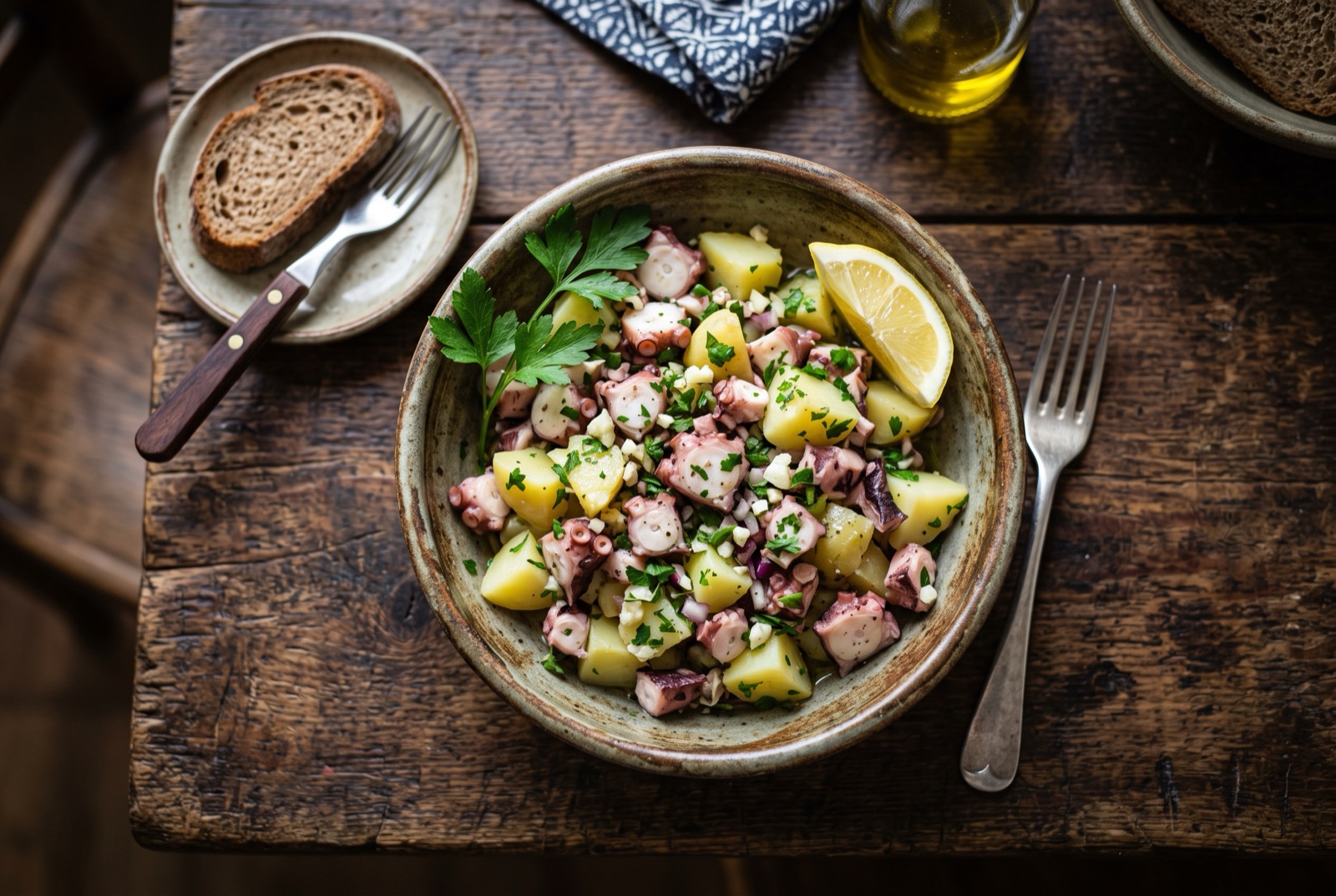
This is the cold plate that arrives first at almost every tavern along the Croatian coast: chunks of tender octopus tossed with waxy potato, raw onion, garlic and a great deal of parsley, dressed simply with good olive oil and red wine vinegar. What makes the Dalmatian version distinct is timing — the octopus and potato are dressed while still warm, so they absorb the vinegar and oil instead of just wearing them, and then the salad is left to sit for at least an hour before it goes anywhere near a table. The result is clean and sharp, with tender octopus that has taken on the dressing all the way through. The only difficult part is cooking the octopus properly, and that comes down to leaving it alone.

- Gate
- CroatiaDalmatia
- Prep
- 25 min
- Cook
- 1 hr
- Total time
- 2 hr 25 min incl. 1 hr rest
- Serves
- 4
- Status
- Easy
- Nutrition / serving · estimated
- Calories 390 kcal
- Protein 33 g
- Carbs 26 g
- Fat 18 g
- Fiber 3 g
- Sodium 720 mg
Why this recipe works.
- Dresses the octopus and potato while warm, which is how the flavour gets inside rather than sitting on the surface.
- Cools the octopus in its cooking liquid — the step that separates tender from rubbery more than any tenderising trick.
- Cuts the potato to match the octopus so every forkful has both, the way Dalmatian konobas serve it.
- Says plainly which tenderising folklore works and which does not, instead of repeating the cork myth.
Ingredients.
13 itemsFor the octopus
For the salad
For the dressing
To serve
Equipment
- Large lidded pot
- Thin-bladed knife for testing
- Large mixing bowl
Instructions.
Start the octopus
Put the octopus in a large pot with the bay, halved onion and peppercorns, add cold water to cover by 5 cm, and add no salt. Bring it slowly to the point where bubbles just break the surface, then drop the heat immediately.
Tip Salt now tightens the flesh. The salad gets seasoned at the end instead.
Simmer gently
Cover and cook for 45–60 minutes at a bare tremble, checking from 40 minutes onwards. Push a thin knife into the thickest part of a tentacle where it meets the head — when it slides in and back out with no grip at all, the octopus is done.
Cool it in the liquid
Turn off the heat and leave the octopus in the covered pot to cool in its own cooking water for at least 30 minutes. Lifting it out hot lets the flesh contract and undoes the tenderising you just spent an hour on.
Boil the potatoes
While the octopus cools, boil the potatoes whole in salted water for 20–25 minutes, until a skewer meets no resistance in the centre but the skins have not split. Drain them and let them steam dry in the colander for a couple of minutes.
Cut everything to size
Lift the octopus out, pull away any large loose flaps of skin, and cut the tentacles into 2 cm pieces, chopping the head into similar chunks. Cut the still-warm potatoes into pieces of roughly the same size so each forkful gets both.
Dress while warm
Tip the warm octopus and potato into a large bowl with the red onion, garlic, parsley and capers. Pour over the olive oil and vinegar, season with salt and pepper, and fold everything together gently with a spoon until it glistens.
Tip Warm ingredients drink the dressing; cold ones only wear it. This is the step that makes the salad taste seasoned all the way through.
Rest in the fridge
Cover and refrigerate for at least an hour, and up to a day, stirring once halfway through. The onion will soften, the vinegar will penetrate the potato, and the whole thing will settle into something noticeably more cohesive than it was.
Season again and serve
Take the bowl out 20 minutes before serving so the olive oil loosens, then taste and correct with salt, another splash of vinegar or more oil as needed. Serve at cool room temperature with lemon wedges and bread.
Tips from our kitchen.
- Frozen octopus is genuinely better than fresh here. Freezing ruptures the muscle fibres and does the tenderising work for you, so buy it frozen or freeze fresh octopus for 48 hours first.
- Do not salt the cooking water. Salt at this stage tightens the flesh; season the salad at the end instead.
- Test doneness with a thin knife into the thickest part of a tentacle, near the head. It should slide in and out with no grip at all.
- Let the octopus cool in the pot with the lid on. Draining it hot lets the flesh contract and toughen just as you have finished tenderising it.
- Choose a waxy potato that holds its shape — anything floury turns the salad into a paste as you stir it.
- Give the finished salad at least an hour in the fridge, and taste it again before serving. It nearly always wants another pinch of salt after resting.
Substitutions.
- Whole octopus → Pre-cooked octopus tentacles, or squid simmered for 25 minutes
- Vacuum-packed cooked octopus is sold in most fishmongers and saves an hour. Squid is a fair budget stand-in but sweeter and softer, so cut it slightly larger.
- Red wine vinegar → Lemon juice, or half vinegar and half lemon
- Lemon gives a fresher, less assertive salad. Vinegar is the Dalmatian default and stands up better to the sitting time in the fridge.
- Waxy potato → Omit, and add a handful of white beans instead
- Bean and octopus salad is common along the coast too. Purists who reject the potato usually accept the beans, for reasons nobody can fully explain.
Variations.
- With capers and olives
- A spoon of capers and a handful of chopped green olives folded through, adding salt and bite — common on the islands.
- Summer tomato version
- Ripe tomato cut into chunks and added just before serving, which loosens the dressing and makes the salad juicier and lighter.
- Grilled finish
- The cooked tentacles brushed with oil and charred briefly on a hot grill before being chopped into the salad, adding smoke and crisp edges.
Storage & reheating.
Keeps 3 days refrigerated in a sealed container and is at its best on day one or two, once the dressing has had time to work through. Take it out of the fridge 20 minutes before serving — the olive oil solidifies when cold and the salad tastes flat straight from the fridge. Do not freeze the finished salad; the potato goes grainy and the octopus turns spongy. Cooked octopus on its own, however, freezes well in its cooking liquid for up to 3 months.
Serve with
Crusty bread, a plate of pršut and hard sheep cheese, and a cold glass of Pošip or Malvazija.
The story behind Salata od Hobotnice.
Octopus salad is a coastal staple across the Mediterranean, and the Croatian version is defined less by unusual ingredients than by restraint and by the potato. In a Dalmatian konoba — the informal stone-walled taverns that serve wine from the barrel and food from a very short list — this salad is the default cold starter, sitting alongside marinated anchovies and a plate of pršut and cheese. It is made in quantity in the morning, left in the fridge in a large bowl, and spooned out through lunch and dinner, which is precisely how the dish is designed to work: it needs the sitting time.
The potato is the local signature. Plenty of Mediterranean octopus salads skip it, but on the Croatian coast a waxy boiled potato is standard, cut into pieces roughly the size of the octopus chunks so that each forkful gets both. It softens the acidity, bulks out an expensive ingredient, and takes on the dressing beautifully. Some households add capers, some add a chopped tomato in summer, and some insist on nothing but octopus, oil, vinegar, garlic and parsley — that last group considers everything else an adulteration, and they are usually the older relatives.
Cooking the octopus is where beginners lose their nerve. There is a great deal of folklore about tenderising it — beating it against rocks, freezing it, adding a wine cork to the pot — and while freezing genuinely helps by breaking down muscle fibres, the cork does nothing at all. What actually works is a long, gentle simmer with the lid on and the heat low, followed by letting the octopus cool in its own cooking liquid rather than draining it hot. Fishermen along the coast will tell you the same thing in fewer words: do not boil it hard and do not rush it.
Questions, answered.
How do I make sure the octopus comes out tender?
Freeze it before cooking — this ruptures the muscle fibres and does most of the tenderising — then simmer it gently, covered, with the water barely trembling rather than boiling. Test with a thin knife into the thickest part of a tentacle; it should slide in with no resistance. Finally, let the octopus cool in its own cooking liquid rather than draining it hot, which prevents the flesh from contracting and toughening.
Does the wine cork trick actually work?
No. Adding a cork to the cooking water is a widespread Mediterranean superstition with no mechanism behind it and no observable effect on the texture. What genuinely tenderises octopus is freezing it beforehand, cooking it slowly at a bare simmer, and letting it cool in its liquid. Beating fresh octopus against a hard surface also works, which is probably where the folklore started.
Should I peel the skin off the tentacles?
Not for this salad. The purple skin holds a lot of flavour and gelatin, and it looks right in a Dalmatian octopus salad. It may loosen and slip in places during cooking, which is normal — just pull off any large flapping pieces before chopping. Some cooks rub off the outer film for a neater appearance, but it is not traditional here.
Can I use pre-cooked octopus from the supermarket?
Yes, and it is a perfectly good shortcut that plenty of Croatian home cooks use when they are short on time. Warm the tentacles briefly in hot water before dressing them so they still absorb the oil and vinegar, since the warm-dressing step is what gets the flavour into the flesh. Check the packaging for added salt and season the salad accordingly.
How long should the salad rest before serving?
At least an hour in the fridge, and it is better after two or three. The vinegar and olive oil need time to penetrate the octopus and potato, and the raw onion and garlic mellow as they sit. Konobas along the Croatian coast make it in the morning for lunch and dinner service for exactly this reason. Taste and adjust the salt again after resting.
You might also like.
All recipes →
Keep exploring Croatia.
Croatia has 9 more dishes in the atlas — Brudet and Crni Rižot, and 7 more.
All Croatia recipes Potato recipes Olive oil recipes Parsley recipes appetizerpescatariangluten freedairy freeRecipe by The DishRoute Kitchen · published August 20, 2026 · updated August 20, 2026