Sanwin Makin.
Burmese Semolina and Coconut Cake
ဆနွင်းမကင်း · say it: sah-NWIN mah-GIN
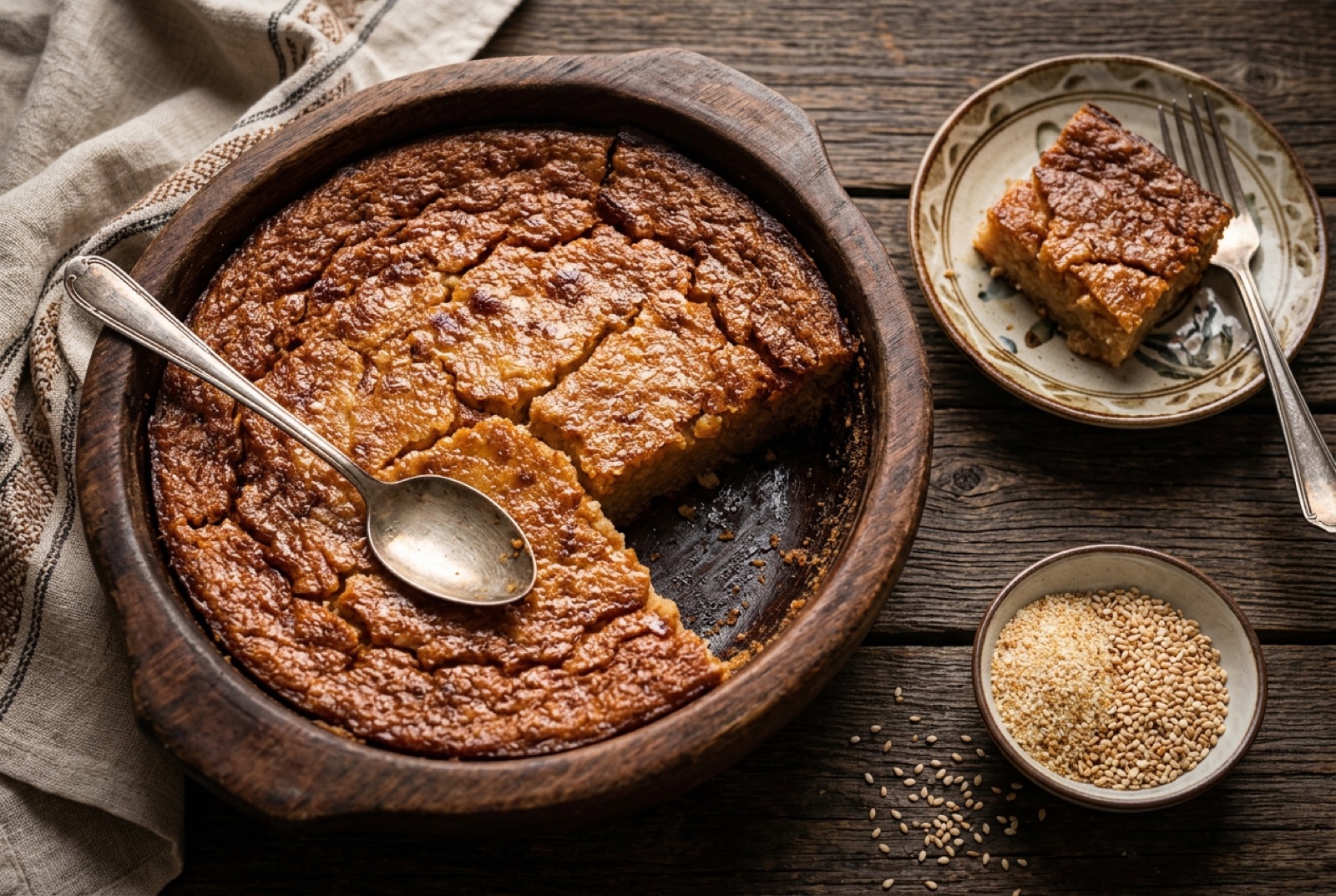
Sanwin makin is the cake Burmese tea shops sell by the diamond-shaped slice: fine semolina toasted until it smells of biscuits, simmered with coconut milk, sugar and a great deal of ghee until it thickens into a paste stiff enough to stand a spoon in, then set in a shallow pan and baked until the top browns and splits. The inside stays dense and slightly custardy rather than crumbly, closer to a set halwa than to a sponge, and it is sweet without being cloying because the coconut fat carries most of the flavour.

- Gate
- MyanmarYangon and Mandalay
- Prep
- 15 min
- Cook
- 50 min
- Total time
- 1 hr 35 min incl. 30 min rest
- Serves
- 12
- Status
- Medium
- Nutrition / serving · estimated
- Calories 385 kcal
- Protein 5 g
- Carbs 42 g
- Fat 22 g
- Fiber 2 g
- Sugar 24 g
- Sodium 130 mg
Why this recipe works.
- Toasts the semolina first, which is the difference between a nutty cake and one that tastes of raw flour paste.
- Cooks the mixture to a specific visual cue — pulling cleanly from the pan — rather than to a fixed time.
- Finishes under the grill to reproduce the coals-on-the-lid crust that defines the cake in Myanmar.
- Uses coconut milk as the only liquid, so the cake stays moist for days without refrigeration.
Ingredients.
9 itemsFor the cake
For the top
Equipment
- Heavy-based saucepan or wok
- Wooden spoon or sturdy spatula
- 20 cm square baking tin
- Oven with a grill element
Instructions.
Toast the semolina
Put the semolina in a dry heavy pan over medium-low heat and stir constantly for 8 to 10 minutes, until it turns sandy beige and smells of toasted biscuits. Tip it into a bowl so it stops cooking.
Tip Stop as soon as the smell changes. Semolina goes from nutty to bitter in under a minute at this stage.
Whisk in the coconut milk
Off the heat, pour the coconut milk into the toasted semolina in a steady stream while whisking hard, until the mixture is completely smooth with no dry pockets. Whisk in the sugar and salt.
Cook the paste
Return everything to the pan over medium-low heat and stir steadily for 20 to 25 minutes as it thickens. Add the ghee in three additions, letting each one be absorbed before the next goes in.
Tip Do not stop stirring once it thickens — the base catches fast and scorched semolina flavours the whole cake.
Judge the doneness
The paste is ready when it pulls away from the sides of the pan in one glossy mass, a spoon dragged through the middle leaves a channel that holds its shape, and ghee starts to bead at the edges.
Add the egg
Take the pan off the heat and stir a few spoonfuls of the hot paste into the beaten eggs to temper them, then stir the eggs back into the pan quickly and thoroughly, along with the raisins if using.
Press into the tin
Scrape the mixture into a greased 20 cm tin and press it flat with a spatula or an oiled palm, right into the corners. Smooth the surface hard, because whatever texture it has now is what browns.
Bake, then grill the top
Bake at 180C for 15 minutes to set the cake through, then move it directly under a hot grill for 4 to 6 minutes until the top is deep brown, blistered and beginning to crack. Watch it continuously at this stage.
Seed, cool and cut
Scatter the poppy and sesame seeds over the hot surface so they stick, then leave the cake in the tin for at least 30 minutes. Cut into diamonds by slicing straight lines one way and diagonals the other.
Tips from our kitchen.
- Toast the semolina dry before any fat goes in, stirring constantly until it smells of biscuits and turns sandy beige — this takes longer than expected and cannot be rushed at high heat.
- Add the coconut milk to the toasted semolina off the heat and whisk hard. Pouring it into a hot dry pan sets instant lumps that never smooth out.
- Keep the ghee generous. Cutting it back gives a cake that sets hard and dry by the next morning instead of staying sliceable.
- Cook until the paste pulls away from the sides in one mass and a spoon dragged through leaves a channel that holds. Underdone paste sinks into a wet layer at the base.
- Temper the beaten egg with a few spoons of the hot paste before stirring it in, or it scrambles into visible threads.
- Let the cake cool for at least half an hour before cutting. Hot, it tears; cold, it slices into clean diamonds.
Substitutions.
- Ghee → Unsalted butter, or coconut oil for a dairy-free version
- Butter works with a slightly milkier flavour. Coconut oil makes the cake vegan-friendly alongside the egg omission and pushes the coconut note further forward.
- Eggs → Leave them out entirely
- A great many Burmese households make it eggless. The cake sets softer and more halwa-like, and needs an extra five minutes of cooking on the stove to compensate.
- Poppy seeds → White or black sesame seeds
- Sesame is the northern habit and toasts more visibly under the grill, so scatter it on slightly later to stop it scorching.
Variations.
- Raisin sanwin makin
- A handful of raisins is folded in with the egg, softening in the residual heat and giving pockets of sharper sweetness against the coconut.
- Grated coconut version
- Fresh or frozen grated coconut is stirred into the paste at the end, giving a chewier texture and a much shorter shelf life of about two days.
- Ahlu tray
- The ceremonial format — a huge shallow tray baked for donation offerings and cut into small diamonds so that a single cake feeds a whole gathering.
Storage & reheating.
Keeps 3 days at room temperature under a cloth or loosely covered, and the texture is arguably best on day two once the ghee has fully set. Refrigeration makes it hard and waxy; if you do chill it, bring slices back to room temperature or warm them briefly in a dry pan. It freezes for 2 months wrapped in slices. Do not seal it airtight while warm, as trapped steam softens the caramelised top.
Serve with
Strong sweet milky tea, or plain green tea, in the mid-morning tea-shop manner rather than as a dessert after dinner.
The story behind Sanwin Makin.
Semolina is not an indigenous Burmese grain, and sanwin makin is one of the clearest pieces of evidence for how much Indian cooking entered the country during the colonial period, when Burma was administered as a province of British India and Rangoon held one of the largest Indian populations of any city in Asia. The technique — toast a coarse wheat flour in fat, cook it out with liquid and sugar until it pulls away from the pan — is the semolina halwa method found from Karachi to Cairo. What Myanmar changed was the liquid and the finish: coconut milk instead of milk or water, and a spell under fierce top heat that gives the cake a caramelised, fissured crust no halwa has.
That crust came from a specific piece of equipment rather than an oven. Burmese cooks set the pan over coals and then piled more coals on the metal lid, so the heat arrived from above as well as below. Even now the surface is the part people judge — a good sanwin makin is deep brown and cracked on top, pale gold at the edges, and never uniformly beige. Home ovens with a grill element reproduce this closely; a fan oven alone tends to dry the cake before the top ever colours.
The cake belongs to the mont family, the whole Burmese category of sweet and savoury snacks eaten outside meals rather than after them. Burmese meals do not really have a dessert course; sweetness turns up at the tea shop mid-morning, or at the end of a meal in the form of bitter fermented tea rather than sugar. Sanwin makin also has a strong ceremonial life. It is made in enormous trays for ahlu, the merit-making donation ceremonies where food is offered to monks and then to everyone present, and it appears at novitiation ceremonies, funerals and housewarmings — partly because it is cheap and scales easily, and partly because it keeps for days in a hot climate without refrigeration, which sponge cakes do not.
Regional habits vary in small ways. Poppy seeds scattered on top are the Yangon standard; sesame is common further north; some households fold in raisins or grated coconut, and a few enrich the batter with egg for a firmer, more custard-like set. The proportions of ghee and sugar are where cooks argue, since both are what separate a cake that stays moist on day three from one that sets hard.
Questions, answered.
What kind of semolina should I use?
Fine semolina, sold as fine sooji or shwegyi, gives the smooth custardy set this cake is known for. Coarse semolina works but produces a noticeably grainier crumb and needs a few more minutes of cooking and slightly more coconut milk to hydrate fully.
Why is my sanwin makin dry and crumbly?
Usually too little fat or too much oven time. The ghee is what keeps the cake sliceable rather than sandy, so it should not be reduced, and the cake only needs enough time under heat to colour the top — around 20 to 25 minutes total, not a full hour of baking.
Can I make it without an oven?
Yes, and that is the traditional method. Cook the paste fully on the stove, press it into a heavy pan, cover with a lid and cook on very low heat for about 20 minutes, then brown the top with a blowtorch or by holding the pan under a hot grill for a few minutes.
Is sanwin makin served as a dessert?
Not usually in Myanmar. Burmese meals rarely end with something sweet, and this cake belongs to the mont category of snacks eaten between meals, most often at a tea shop mid-morning or handed out at ceremonies and donation gatherings.
Can I halve the sugar?
You can reduce it by about a quarter without hurting the structure, since the set comes from the semolina and fat rather than from sugar. Cutting it much further makes the cake taste flat and browns the top far less, because the caramelised crust depends on sugar on the surface.
You might also like.
All recipes →
Keep exploring Myanmar.
Myanmar has 9 more dishes in the atlas — Balachaung and Danbauk, and 7 more.
All Myanmar recipes Semolina recipes Coconut milk recipes Ghee recipes dessertsnackvegetariannut freeRecipe by The DishRoute Kitchen · published August 21, 2026 · updated August 21, 2026