Tam Mak Hoong.
Lao Green Papaya Salad with Padaek
ຕໍາໝາກຫຸ່ງ · Tam mak hoong · say it: tam mahk hoong
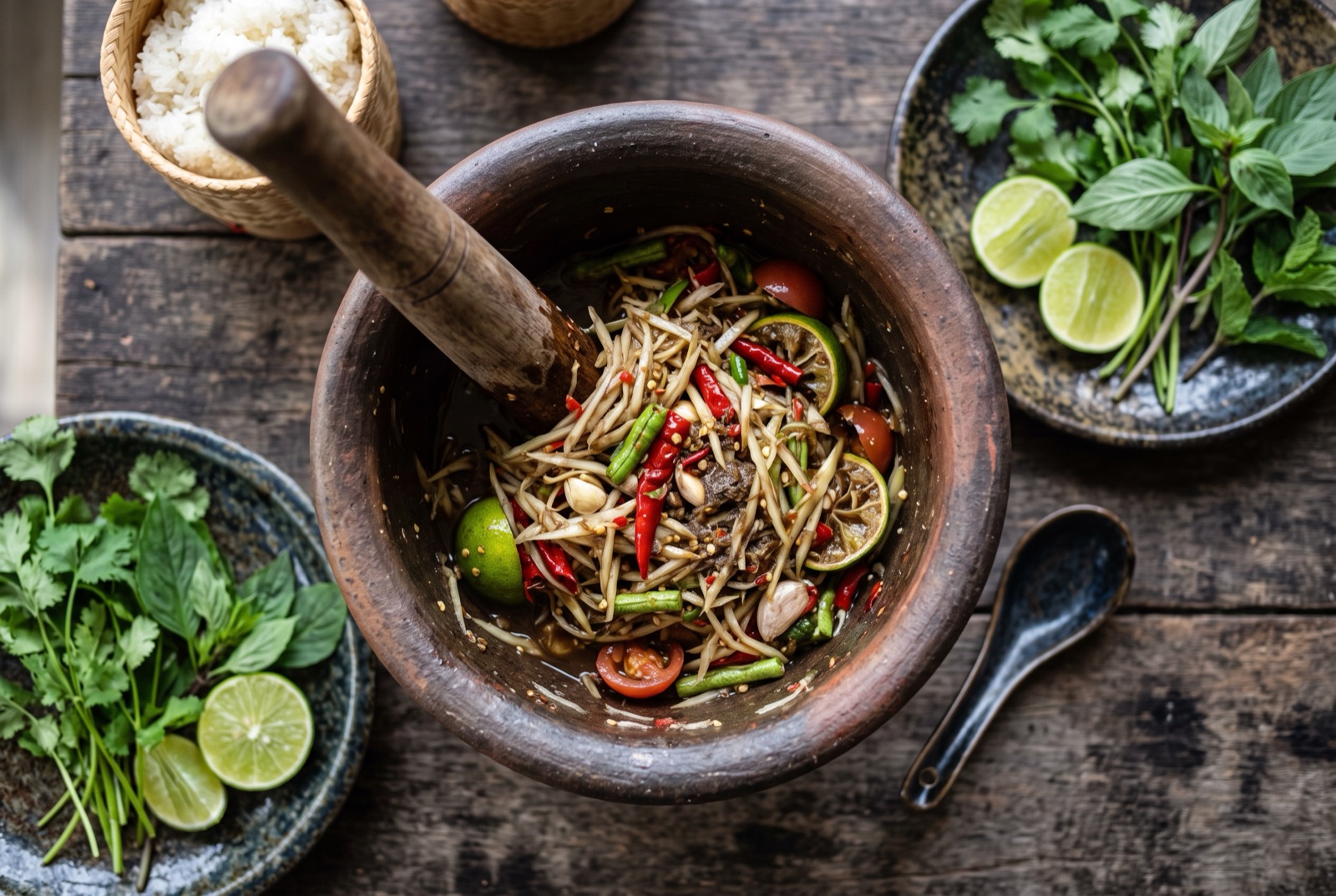
Tam mak hoong is unripe papaya, shredded into long threads and pounded — not chopped, not tossed — in a tall mortar with garlic, bird's eye chiles, tomato, lime and padaek, the thick fermented fish sauce that gives Lao food its bass note. The pounding is the technique: a bruising rhythm that splits the papaya fibres so they drink the dressing instead of sitting in it. The result is crunchy, sour, salty, savoury and hot, with almost no sweetness. If you know the Thai som tam with its palm sugar and peanuts, this is the same idea run in a different key — darker, funkier, more aggressive, and to many Lao eaters the original.

- Gate
- LaosNationwide
- Prep
- 20 min
- Cook
- 0 min
- Total time
- 20 min
- Serves
- 4
- Status
- Easy
- Nutrition / serving · estimated
- Calories 110 kcal
- Protein 4 g
- Carbs 22 g
- Fat 1 g
- Fiber 5 g
- Sugar 12 g
- Sodium 1500 mg
Why this recipe works.
- Uses padaek as the primary seasoning rather than an optional extra, which is exactly what makes this Lao rather than Thai.
- No palm sugar anywhere, because Lao papaya salad is not a sweet dish and adding it changes the balance completely.
- Explains the bruising technique and gives a workable method for cooks without a clay papaya mortar.
- Shreds by hand-chopping into the fruit, the traditional way that gives ragged edges the dressing clings to.
Ingredients.
11 itemsFor the salad
For the dressing
To serve
Equipment
- Tall clay papaya mortar with wooden pestle, or any mortar plus a wide bowl
- Heavy knife or julienne peeler
- Large spoon for turning
Instructions.
Shred the papaya
Peel the papaya, halve it and scrape out the seeds. Chop repeatedly into the flesh at a shallow angle with a heavy knife, then shave down across the cuts to release ragged threads. Keep them in cold water until you are ready, then drain thoroughly.
Tip Ragged, hand-cut edges hold dressing far better than the smooth threads a grater makes.
Pound the base
Put the garlic, chiles and salt in a tall mortar and pound until broken down into a coarse, wet paste with no whole pieces of garlic left — about a minute of firm strokes.
Add the long beans
Drop in the long beans and pound with light strokes until they are bruised, split along their length and starting to darken, roughly 20 seconds. They should stay in recognisable pieces.
Season the mortar
Pour in the padaek, fish sauce and lime juice, and drop the squeezed lime halves in too — their oils and bitterness are part of the flavour. Stir and pound a few times to combine.
Bruise the papaya
Add the papaya in two batches. Pound with light, quick strokes while turning the mixture up from the bottom with a spoon, about 30 strokes per batch, until the shreds soften slightly, glisten and bend rather than snap.
Tip Light taps, not heavy blows. The pestle bruises; it should not crush.
Finish with tomato
Add the tomato quarters and eggplant slices and give them only five or six gentle taps, just enough for the tomatoes to release juice while holding their shape.
Taste and serve at once
Taste directly from the mortar and adjust: lime for sourness, padaek for depth, chile for heat. Tip everything with its dressing onto a plate and serve immediately with sticky rice and raw cabbage.
Tips from our kitchen.
- Choose a papaya that is rock hard and dark green, with white flesh and pale seeds. Any orange blush means it has started to ripen and will turn to mush under the pestle.
- Pound the garlic and chiles first with a pinch of salt, and only then add the softer ingredients — reverse the order and the garlic never breaks down.
- Bruise the papaya with a light pestle and a spoon turning underneath, about thirty strokes. You want the shreds bent and glossy, not crushed.
- Add the tomato near the end and give it only a few taps; it should release juice without disintegrating into pulp.
- Taste and adjust in the mortar, not on the plate. It should punch sour and salty in that order, with heat arriving a beat later.
- Serve it within twenty minutes of pounding. Salt keeps drawing water out of the papaya and the crunch fades fast.
Substitutions.
- Padaek → Fish sauce plus a mashed anchovy fillet and a teaspoon of the brine from pickled fish
- Padaek is available at Lao, Thai and Vietnamese grocers, usually as pla ra. Nothing else replicates its murk, but this approximates the salinity and depth.
- Green papaya → Shredded green mango, kohlrabi, or a mix of cucumber and carrot
- Green mango is more sour and needs less lime; kohlrabi is the closest match for texture and near-neutral in flavour.
- Clay papaya mortar → Any mortar for the aromatics, then a wide bowl and the pestle for the papaya
- A granite mortar will pulverise the shreds if you pound papaya in it directly, so pound the hard ingredients first and switch vessels.
Variations.
- Tam mak hoong sai pu
- With small salted or fermented field crabs pounded in whole. Intensely savoury and one of the most popular versions in Laos and Isan.
- Tam sua
- The same dressing with khao poon rice vermicelli pounded through, turning the salad into something closer to a light noodle dish.
- Tam mak thang
- Made with shredded cucumber instead of papaya. Softer, more watery and faster, common when papaya is out of season.
Storage & reheating.
Eat it the day it is made, ideally within an hour. Salt draws water out of the papaya continuously, so within a few hours the shreds go limp and a pool of liquid collects at the bottom. If you need to prepare ahead, shred the papaya and keep it in cold water in the fridge for up to a day, then drain it thoroughly and pound the salad just before serving. Leftovers are still edible the next day but the texture is gone, and freezing is not an option.
Serve with
Sticky rice and grilled chicken — the classic Lao trio, eaten together with fingers Raw cabbage wedges and long beans on the side for scooping up the dressing
The story behind Tam Mak Hoong.
Papaya is not native to Southeast Asia. It came from Mesoamerica with Portuguese and Spanish ships, spread through the region during the colonial centuries, and was absorbed so completely into Lao and Isan cooking that the salad now reads as ancient. Chiles arrived by the same route, which means the most iconic dish of the Mekong is built on two ingredients that reached it from across the Pacific. That is a common story in Southeast Asian food and worth remembering before anyone claims a dish has been made unchanged for a thousand years.
The Lao and Thai versions are genuinely different, and the difference is instructive. Thai som tam Thai leans sweet: palm sugar, dried shrimp, roasted peanuts, a clear dressing. The Lao tam mak hoong leans fermented: a heavy pour of padaek, often with pieces of the fermented fish itself, plus more chile, sometimes crab or eggplant, and no sugar to round the edges. Isan in northeastern Thailand, where most people are ethnically Lao, makes the padaek version too and calls it som tam pu pla ra. The dishes are relatives, not copies, and the argument over whose it is tends to end wherever the border is drawn.
The mortar matters more than most equipment claims. A Lao or Thai papaya mortar is tall, deep and made of unglazed clay with a long wooden pestle, and its softness is the point: it bruises without smashing. A heavy granite spice mortar will pulverise papaya into wet pulp within a few strokes. If clay is not an option, the workable home method is to pound the garlic, chile and tomato in whatever mortar you own, then transfer everything to a bowl and use the pestle to press and turn the papaya against the sides — awkward, but it preserves the shred. Everything else is negotiable. Padaek is not: without it you have made a papaya salad, not tam mak hoong.
Questions, answered.
What is the difference between tam mak hoong and som tam?
Tam mak hoong is the Lao version and is seasoned with padaek, the thick fermented fish sauce, with more chile and no sugar. Thai som tam Thai is sweeter, using palm sugar, dried shrimp and roasted peanuts, with a lighter and clearer dressing. Northeastern Thailand, which is ethnically Lao, makes the padaek version too.
What is padaek and is there a substitute?
Padaek is Lao fermented fish sauce, made by curing freshwater fish with salt and rice bran for months. It is thicker, cloudier and far more pungent than the clear fish sauce sold as nam pla, and often contains pieces of fish. If you cannot find it, use regular fish sauce with a mashed anchovy, though the result will be cleaner and less complex.
How do I shred green papaya without a special tool?
Peel it, then hold it in one hand and chop repeatedly into the surface with a heavy knife at a shallow angle, making close parallel cuts about 2 mm apart. Then slice down across the cuts to shave off ragged threads. A julienne peeler or the large holes of a box grater also work, though the edges are smoother and hold less dressing.
Why is my papaya salad watery?
Either the papaya was too ripe, or it sat too long after pounding. Salt and padaek draw moisture out of the fruit continuously, so pooling starts within about twenty minutes. Use a rock-hard green papaya, drain it well if you soaked it, and pound the salad immediately before it goes to the table.
Can I make it vegetarian?
You can make a good salad, though it will not be tam mak hoong in the strict sense, since padaek is the defining ingredient. Use light soy sauce with a little miso or fermented bean paste for savoury depth, plus extra lime and a pinch of salt. Add roasted peanuts for body if you like, which pushes it closer to the Thai style.
You might also like.
All recipes →
Keep exploring Laos.
Laos has 9 more dishes in the atlas — Jeow Mak Len and Khao Piak Sen, and 7 more.
Recipe by The DishRoute Kitchen · published August 20, 2026 · updated August 20, 2026