Nam Khao.
Lao Crispy Rice Salad with Fermented Pork
ແໜມເຂົ້າ · Naem khao · say it: nam kow
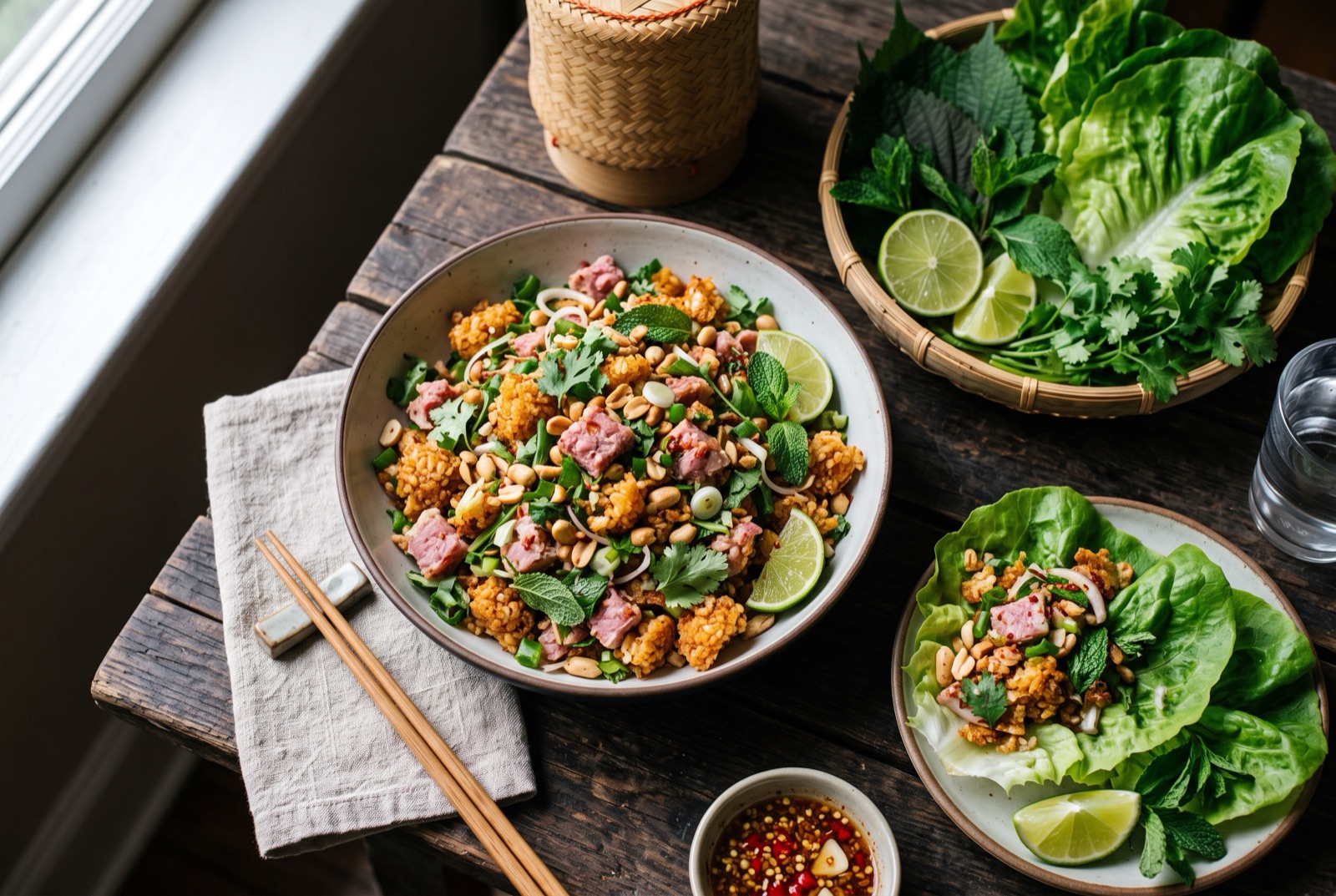
Nam khao is a salad built out of broken deep-fried rice. Cooked jasmine rice is bound with red curry paste, egg and coconut, rolled into balls and fried until the outside is blistered and hard, then smashed apart while still hot and tossed with shredded sour fermented pork, peanuts, spring onion, coriander, mint, chile and a lot of lime. You eat it wrapped in lettuce or cabbage leaves, by hand, immediately — the whole dish is a race between the crunch and the dressing. It tastes sour, salty, faintly funky from the cured pork, and crackles in a way no other rice dish does.

- Gate
- LaosVientiane
- Prep
- 30 min
- Cook
- 25 min
- Total time
- 1 hr 15 min incl. 20 min rest
- Serves
- 4
- Status
- Medium
- Nutrition / serving · estimated
- Calories 590 kcal
- Protein 24 g
- Carbs 57 g
- Fat 30 g
- Fiber 4 g
- Sodium 1250 mg
Why this recipe works.
- Fries the rice in balls and crushes them hot, which is the only way to get shards rather than uniform crumbs.
- Uses dry, day-old rice so the balls hold their shape and the interior does not steam into paste.
- Gets the dressing ratio right for a salad that is meant to be eaten within minutes, not sit and soften.
- Straightforward about fermented pork: where to buy it, and what you lose if you substitute.
Ingredients.
16 itemsFor the rice balls
For the salad
For the dressing
To serve
Equipment
- Deep pan or wok for frying
- Thermometer or a wooden chopstick for testing oil
- Slotted spoon
- Wide mixing bowl
Instructions.
Mix the curried rice
Break up the cold rice with your fingers so there are no clumps, then work in the curry paste, salt and coconut until every grain is evenly orange. Add the beaten egg a little at a time until the mixture just holds together when squeezed in your palm.
Tip Stop adding egg the moment it holds — too much and the balls turn dense and greasy.
Shape and chill
Roll the mixture into balls a little smaller than a tennis ball, wetting your hands with salted water between each one. Chill them for 20 minutes on a tray so they firm up before they meet the oil.
Fry until hard-shelled
Heat the oil to 170°C and fry the balls in batches of three or four for 6–8 minutes, turning, until deep golden and hard when tapped with a spoon. Drain on a rack, not on paper, so the undersides stay crisp.
Tip A wooden chopstick dipped in should throw a steady stream of small bubbles.
Prepare the salad base
While the rice fries, shred the fermented pork into loose strands and combine it in a wide bowl with the peanuts, shallots and spring onions. Mix the lime juice, fish sauce and sliced chile in a small cup and set it aside.
Crush the rice while hot
Tip the hot fried balls into the bowl and crush them with the back of a heavy spoon into irregular shards the size of a thumbnail. Leave some pieces larger — uniform crumbs give you a dull, sandy texture.
Dress at the last second
Pour over the dressing, add the coriander and mint, and toss quickly with your hands or two spoons, no more than a few turns. Taste and add lime if it is not sharp enough.
Serve immediately
Pile the salad onto a platter with the chilled lettuce leaves around it and take it to the table straight away. Everyone spoons a little into a leaf, folds it and eats it by hand while the rice is still audibly crisp.
Tips from our kitchen.
- Use rice cooked the day before and spread out to dry. Fresh hot rice carries too much moisture and the balls fall apart in the oil.
- Wet your hands with salted water between rolling each ball, or the sticky curried rice welds itself to your palms.
- Fry at a steady 170°C for a full 6–8 minutes. Too hot and the shell darkens before the inside sets; too cool and the balls drink oil.
- Crush the balls while they are still hot, using the back of a spoon, so they break into irregular shards rather than crumbs.
- Dress at the very last second and carry the bowl straight to the table — lime juice starts softening the crisp rice within minutes.
- Keep the lettuce leaves in iced water until serving so they stay stiff enough to hold a spoonful without folding.
Substitutions.
- Som moo / naem (fermented pork) → Cooked minced pork with 2 tbsp rice vinegar and extra lime
- This gives sourness but not the fermented depth. Do not attempt a fast home ferment with raw pork — proper naem needs days and controlled conditions.
- Red curry paste → A pounded paste of dried chile, lemongrass, galangal, garlic and shallot
- Homemade paste is better but shop-bought Thai red curry paste is entirely acceptable here, since it is thinned through a large volume of rice.
- Deep frying → Shallow-fry flattened patties in 1 cm of oil, turning once
- Less oil and easier to manage, and many Lao-American kitchens do it this way. You get more crisp surface but less contrast with the soft interior.
Variations.
- Nam khao tod patties
- The diaspora shortcut: the curried rice is shaped into flat discs and shallow-fried, giving a higher crust-to-interior ratio and faster cooking.
- With crisp pork skin
- Some cooks add crushed fried pork rind alongside the peanuts for a second, airier kind of crunch that lasts longer against the dressing.
- Vegetarian nam khao
- Crisp curried rice with fried tofu, extra peanuts and a soy-and-lime dressing sharpened with rice vinegar in place of the fermented pork.
Storage & reheating.
Assembled nam khao does not keep at all — it is soft within half an hour and unpleasant by the next day. The components store well separately: fried rice balls hold 2 days in an airtight container and re-crisp in a hot oven for 8 minutes, and the herbs and peanuts can be prepped hours ahead. Uncooked curried rice balls can be refrigerated overnight before frying. Fermented pork should be kept refrigerated and used by its date, since it is a live-fermented product.
Serve with
A platter of cold lettuce leaves, cabbage and mint for wrapping Sticky rice on the side, and a chili dip for anyone who wants more heat
The story behind Nam Khao.
Nam khao belongs to Vientiane and to the Lao diaspora, and it is the dish that most often converts sceptics. The fermented pork at its centre, som moo or naem, is a preserved sausage made by curing raw pork with garlic, salt and cooked rice, letting lactic fermentation do its work over a few days until it turns pink, tangy and slightly effervescent. That technique is shared with Thailand and northern Vietnam, and the resulting sourness is what the crisp rice is there to balance.
The fried rice balls are the part that requires nerve. The rice must be cooked, cooled and quite dry, then bound with just enough egg and curry paste to hold, and the balls must be fried long enough to build a hard shell without the inside turning to paste. Cooks in Laos often make a big batch of balls, fry them ahead, and crush them into the salad at the last possible moment, which is why nam khao at a party is assembled in front of everyone rather than brought out ready-made. Once dressed, the clock starts: within ten minutes the lime has softened the crunch, and within thirty it has gone.
Outside Laos the dish travelled with refugee communities after 1975, and it became a fixture of Lao gatherings in France, Australia and especially the United States, where it is often the first thing a Lao restaurant is known for. Many of those kitchens fry the rice as flat patties rather than balls because it is faster and gives more crisp surface per gram, which is a sensible adaptation rather than a corruption. If you cannot find som moo, the honest answer is that a home-cured substitute does not work — fermentation takes days and carries real safety considerations with raw pork. Cooked pork with extra lime and a little rice vinegar gives you a good salad that is simply missing the sour note at its centre.
Questions, answered.
What is som moo or naem?
It is a fermented raw pork sausage from Laos and Thailand, cured with garlic, salt and cooked rice and left to ferment for a few days until it turns pink and sour. It is sold vacuum-packed at Thai, Lao and Vietnamese grocers, usually as naem or nem chua. In nam khao it provides the sour, funky counterweight to the fried rice.
Why did my rice balls fall apart in the oil?
Usually too much moisture in the rice, or not enough binder. Use rice cooked the day before and spread out to dry, add the beaten egg gradually until the mixture just holds when squeezed, and chill the shaped balls for twenty minutes before frying so they firm up. Overcrowding the pan also drops the oil temperature and causes them to break.
Can I make nam khao ahead for a party?
Only in parts. Fry the rice balls up to two days ahead and re-crisp them in a hot oven, prep the herbs and peanuts in the morning, and keep everything separate. Crush the rice and dress the salad in front of your guests, which is how it is done at Lao gatherings, because the crunch is gone within about ten minutes of the lime hitting it.
Is nam khao very spicy?
It is moderately hot rather than fierce. Most of the heat comes from the curry paste worked through the rice, which spreads it thin, plus whatever fresh chile goes into the dressing. You control the second part entirely, and the peanuts and lettuce wrapping soften the impact considerably.
What do I eat nam khao with?
It is finger food. Scoop a spoonful into a cold lettuce or cabbage leaf with a mint sprig, fold it and eat it in one bite. Lao tables also put out sticky rice, raw long beans and a chili dip alongside, and the salad is shared from a single platter in the middle of the table.
You might also like.
All recipes →
Keep exploring Laos.
Laos has 9 more dishes in the atlas — Jeow Mak Len and Khao Piak Sen, and 7 more.
Recipe by The DishRoute Kitchen · published August 20, 2026 · updated August 20, 2026