Khao Piak Sen.
Lao Hand-Cut Rice Noodle Chicken Soup
ເຂົ້າປຽກເສັ້ນ · Khao piak sen · say it: kow pee-ak sen
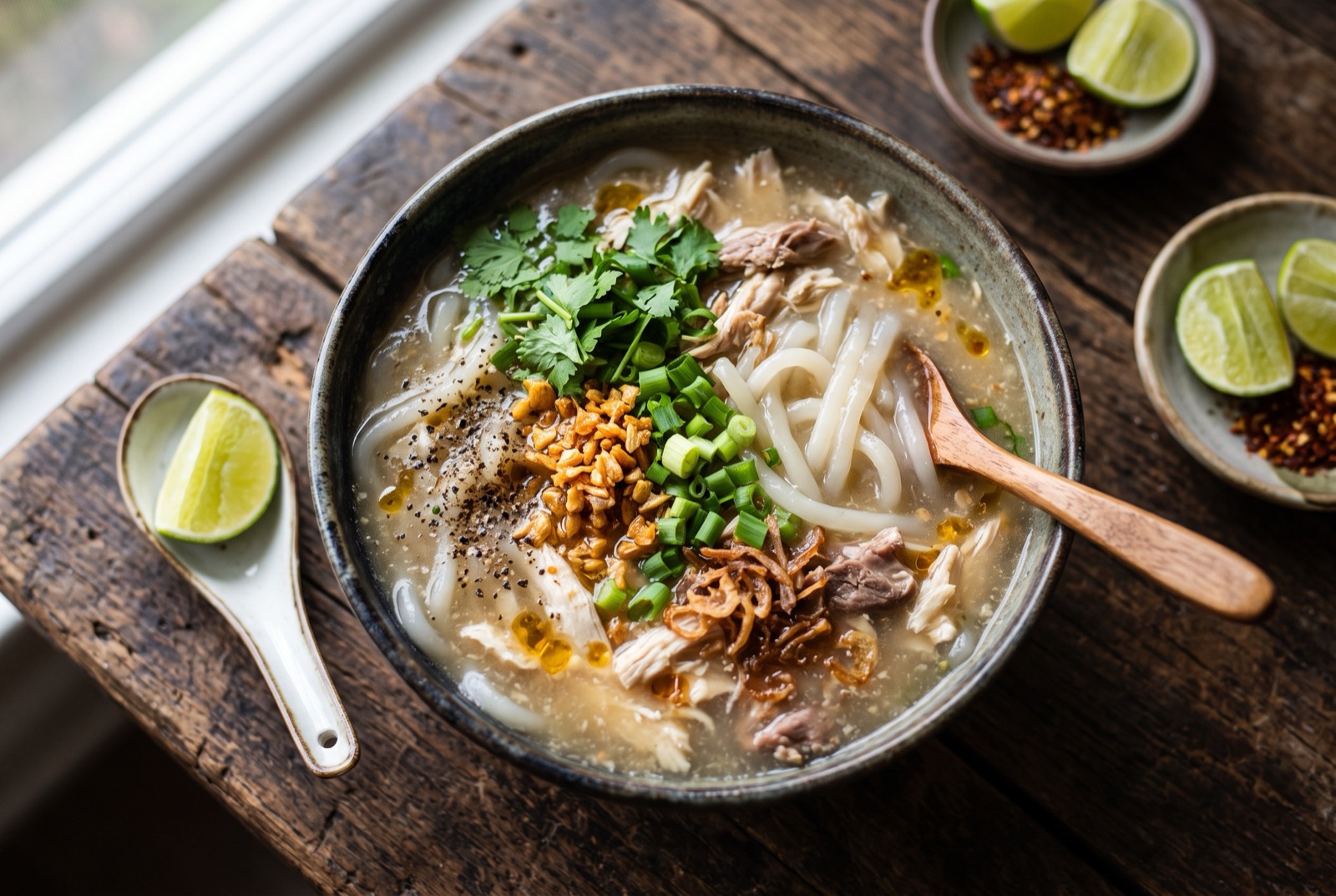
Khao piak sen is the Lao breakfast soup: fat, slippery, slightly chewy noodles in a chicken broth that has been deliberately allowed to go cloudy. The dough is rice flour and tapioca starch scalded with boiling water, kneaded warm, rolled and sliced by hand — and crucially the noodles go into the pot unrinsed, so the loose starch clinging to them thickens the broth into something between soup and gravy. Over the top go crisp fried garlic and its oil, spring onion, coriander, black pepper and a lot of lime. It is comfort food that eats like a bowl of noodles and a bowl of congee at the same time, and it is best made and eaten within the hour.

- Gate
- LaosVientiane
- Prep
- 45 min
- Cook
- 1 hr 15 min
- Total time
- 2 hr 15 min incl. 15 min rest
- Serves
- 4
- Status
- Takes skill
- Nutrition / serving · estimated
- Calories 560 kcal
- Protein 35 g
- Carbs 72 g
- Fat 14 g
- Fiber 2 g
- Sodium 1300 mg
Why this recipe works.
- Scalds the flour with genuinely boiling water, which is the only way the starch gelatinises enough to hold a noodle together.
- Cooks the noodles directly in the broth so their starch thickens it — rinsing them is the single most common mistake.
- Builds the fried garlic oil separately so the garlic stays crisp instead of dissolving into the soup.
- Sets out realistic timing for a dough that has to be handled hot and worked fast.
Ingredients.
16 itemsFor the broth
For the noodles
To finish
Equipment
- Large mixing bowl
- Rolling pin
- Sharp knife or bench scraper
- Large stockpot
- Small pan for the garlic oil
Instructions.
Simmer the broth
Put the chicken in a stockpot with the cold water, bring slowly to a simmer and skim off the grey foam that rises in the first ten minutes. Add the charred onion, ginger and lemongrass and simmer gently, uncovered, for 60 minutes.
Tip Never let it boil hard — a rolling boil emulsifies the fat and turns the broth muddy rather than clean.
Shred the chicken
Lift the chicken out after about 35 minutes, when the meat pulls easily from the bone. Strip the meat, shred it coarsely and set aside, then return the bones to the pot for the remaining simmering time.
Scald the noodle dough
Mix the rice flour, tapioca starch and salt in a heatproof bowl. Pour in the boiling water all at once and stir hard with a wooden spoon until it forms a shaggy, sticky mass with no dry pockets. Let it sit 5 minutes, until cool enough to touch but still hot.
Tip Straight off a rolling boil — anything cooler and the dough will not hold.
Knead while hot
Turn the dough onto a surface dusted with tapioca starch and knead for 5–6 minutes, until it is smooth, elastic and slightly tacky like fresh play dough. Add a teaspoon of starch at a time if it sticks to your palms.
Roll and cut
Roll the dough out to about 5 mm thick, dusting heavily underneath. Cut it into 5 mm wide strips with a sharp knife, tossing them in more tapioca starch as you go so they stay separate. Work quickly before the surface dries.
Cook the noodles in the broth
Strain the broth, return it to a strong simmer and season with the fish sauce. Shake the excess starch off the noodles and drop them straight in. Cook for 5–7 minutes, until they float and turn translucent at the edges and the broth visibly thickens and turns cloudy.
Tip Stir gently but often for the first minute so they do not settle and stick to the base.
Fry the garlic
While the noodles cook, fry the sliced garlic in the oil over medium-low heat for 3–4 minutes, until pale gold. Pull it off the heat the moment it turns straw-coloured — it keeps browning in the hot oil and goes bitter if left dark.
Build the bowls
Ladle noodles and thick broth into bowls, top with the shredded chicken, then spoon over the garlic and its oil. Finish with spring onion, coriander, plenty of black pepper and a lime wedge, and eat immediately while the noodles still have bite.
Tips from our kitchen.
- Use water at a full rolling boil, not merely hot. Below boiling the starch will not gelatinise and the dough falls apart under the rolling pin.
- Knead the dough while it is still uncomfortably warm, using a folded towel to protect your hands — it stiffens and cracks as it cools.
- Dust generously with tapioca starch, not flour, when rolling and cutting, so the strands do not weld together in the pot.
- Cut the noodles thick, roughly 5 mm square in section. Thin strands lose their chew and dissolve into the broth.
- Cook the noodles in the broth itself, unrinsed. That cloudy starch is what turns the soup thick and glossy.
- Make only as much as you will eat now. These noodles are at their best within minutes of cutting and turn heavy overnight.
Substitutions.
- Hand-cut fresh noodles → Frozen bánh canh noodles from a Vietnamese grocer
- A genuinely decent shortcut with a similar chew. Add a tablespoon of tapioca starch slurry to the broth, since frozen noodles are rinsed and will not thicken it themselves.
- Whole chicken for the broth → Chicken thighs plus wings or backs
- You need bones and collagen for the body of the broth, so boneless breast alone will produce something thin and disappointing.
- Fried garlic oil → Fried shallot oil, or a mix of both
- Shallot oil is sweeter and less sharp. Many Vientiane stalls use both, and there is no wrong answer.
Variations.
- Khao piak sen sai kai
- The standard: topped with shredded poached chicken from the broth, plus a piece of skin for whoever wants it.
- With pork blood cake and offal
- A common street version with cubes of set pork blood and simmered offal added to the bowl, giving a deeper and more mineral flavour.
- Khao piak khao
- The rice porridge cousin made without noodles at all, where broken rice is simmered until it collapses. Same seasonings, same garlic oil, different starch.
Storage & reheating.
This dish does not keep well assembled — the noodles keep absorbing broth and by the next day you have a solid mass. The broth alone refrigerates for 3 days and freezes for 3 months. Uncut dough can be wrapped tightly and held at room temperature for about an hour, no longer, before it dries and cracks. Cut noodles can be dusted heavily with tapioca starch and frozen flat on a tray for up to a month, then dropped into boiling broth straight from frozen.
Serve with
Lime wedges, chile paste and a shaker of coarse black pepper on the table A Lao baguette (khao jee) for tearing and dipping, a Vientiane breakfast habit
The story behind Khao Piak Sen.
The name is descriptive rather than poetic: khao piak means wet rice, sen means strand. It belongs to a family of thick, starch-clouded rice noodle soups found across the region, and its closest relative is Vietnamese bánh canh, which uses almost the same dough. The overlap is not a coincidence — Laos and Vietnam share a long border, a long history of movement across it, and a French colonial period that put both cuisines in the same administrative unit for sixty years. Which direction the noodle travelled is not something anyone can settle, and Lao and Vietnamese cooks each treat it as their own.
What makes the Lao bowl distinct is the finish. The broth is chicken, simmered with lemongrass, ginger and a whole onion, and it is served hot with an aggressive load of fried garlic in its oil, chopped coriander, spring onion, coarse black pepper and lime — plus, at street stalls, a spoon of chile paste and often a piece of the boiled chicken shredded on top. In Vientiane it is a morning dish, sold from carts and small shops from around six, and the noodles are cut fresh through the whole service rather than made in advance.
This is the hardest recipe in the Lao repertoire to get right at home, and the reason is the dough. Rice flour has no gluten, so the structure comes entirely from gelatinising some of the starch with boiling water — get the water temperature or the ratio wrong and the dough either crumbles or turns to glue. It also has to be kneaded and rolled while genuinely hot, which is uncomfortable, and worked quickly before it dries. The payoff is a texture no dried noodle reproduces: bouncy, faintly slippery, with a soft chew that holds up in hot broth for exactly as long as it takes to eat the bowl. Get it wrong once and you will understand the technique; get it right and you will stop buying the frozen kind.
Questions, answered.
Why does my rice noodle dough crumble?
Almost always because the water was not at a full boil when it went in. Rice flour has no gluten, so the dough holds together only when the boiling water gelatinises part of the starch. Use water straight off a rolling boil, mix immediately, and knead while the dough is still hot — a cooled dough will crack no matter how much you work it.
Should I rinse the noodles before adding them to the broth?
No. The loose starch on the surface of freshly cut noodles is what thickens khao piak sen and gives it its characteristic cloudy, glossy body. Cook them straight in the broth. If you are using rinsed frozen noodles, whisk a tablespoon of tapioca starch slurry into the soup to compensate.
What is the difference between khao piak sen and Vietnamese bánh canh?
The noodles are nearly the same — rice flour and tapioca starch, thick and chewy, cooked in their own starch. The difference is in the bowl: the Lao version is chicken-based and finished with fried garlic oil, coriander, spring onion, black pepper and lime, while bánh canh is often built on pork or crab broth with different garnishes.
Can I make the noodles ahead of time?
Only with care. Freshly cut noodles are best within an hour. To hold them longer, dust them heavily with tapioca starch, spread them on a tray without touching and freeze until firm, then bag them for up to a month and cook from frozen. Refrigerating them raw makes them dry out and crack.
Is khao piak sen gluten-free?
Yes, if made as written. The noodles use rice flour and tapioca starch, neither of which contains gluten, and the broth is seasoned with fish sauce and salt. Check your fish sauce label, since a small number of brands include wheat, and skip any soy sauce garnish unless it is a gluten-free variety.
You might also like.
All recipes →
Keep exploring Laos.
Laos has 9 more dishes in the atlas — Jeow Mak Len and Khao Poon, and 7 more.
Recipe by The DishRoute Kitchen · published August 20, 2026 · updated August 20, 2026