Khao Poon.
Lao Coconut Curry Rice Vermicelli
ເຂົ້າປຸ້ນ · Khao poun · say it: kow poon
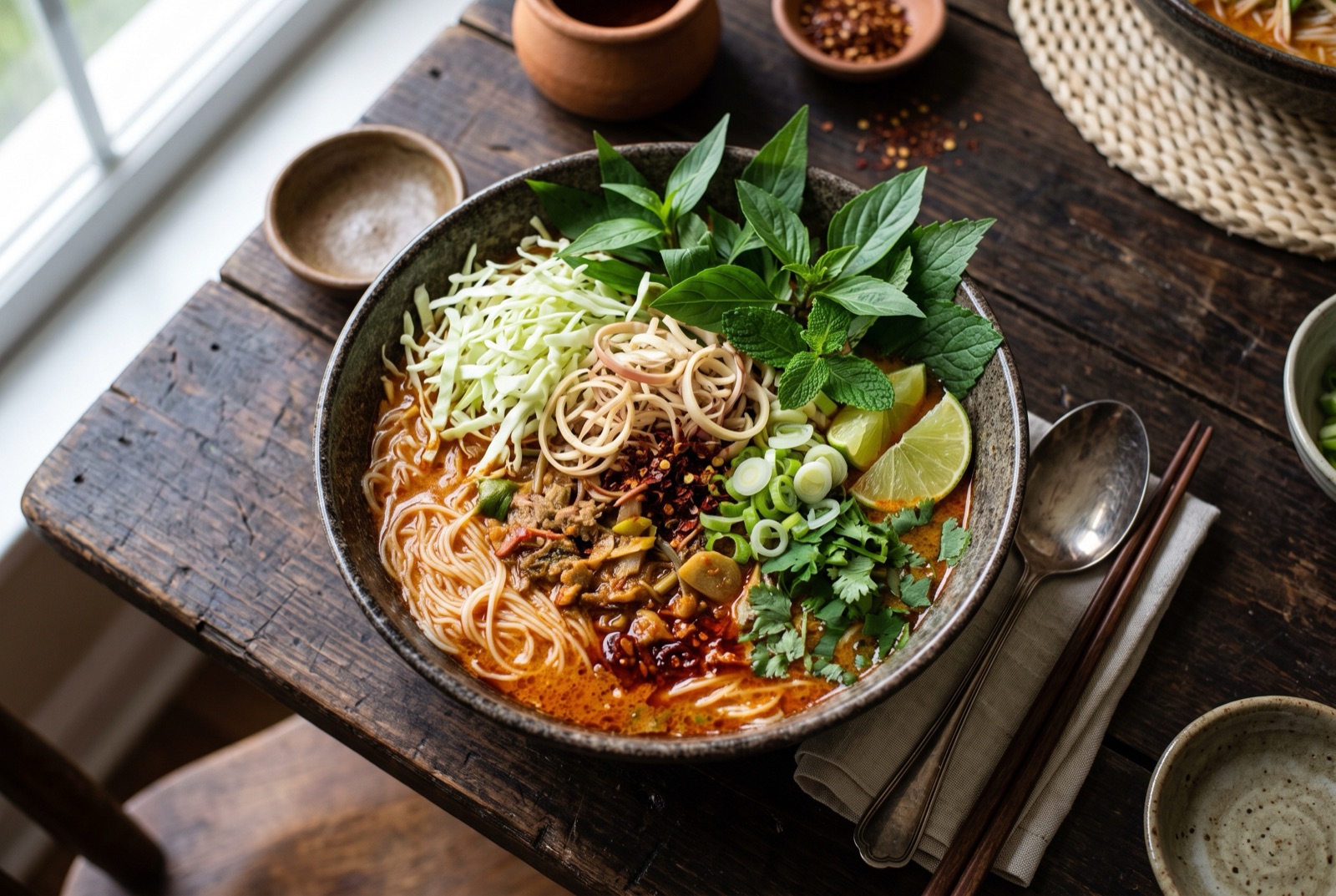
Khao poon is a noodle bowl assembled in three layers. At the bottom go nests of very fine rice vermicelli, cold and already cooked. On top goes a raw vegetable pile — shredded cabbage, bean sprouts, banana flower, sliced long beans, mint and coriander. Over all of it comes a ladle of hot red broth: coconut milk cooked with a pounded paste of galangal, lemongrass, garlic, shallot and dried chile, loosened with stock and made savoury with fish sauce and a little padaek. The broth wilts the vegetables just enough. What you get is warm and cool at once, creamy but sharp with lime, and each mouthful is roughly half salad.

- Gate
- LaosVientiane
- Prep
- 35 min
- Cook
- 40 min
- Total time
- 1 hr 15 min
- Serves
- 4
- Status
- Medium
- Nutrition / serving · estimated
- Calories 620 kcal
- Protein 34 g
- Carbs 58 g
- Fat 29 g
- Fiber 6 g
- Sodium 1400 mg
Why this recipe works.
- Builds the paste from scratch in a mortar, which gives a broth with real perfume rather than the flat heat of a jarred curry paste.
- Cracks the coconut milk first and fries the paste in its own oil — the step that decides whether the broth tastes finished or raw.
- Treats the raw vegetable pile as an ingredient, not a garnish, with the right ratio for the bowl.
- Gives a workable plan for dried vermicelli, including how to stop it going mushy in hot broth.
Ingredients.
20 itemsFor the paste
For the broth
To serve
Equipment
- Mortar and pestle or small food processor
- Large pot for the broth
- Colander
- Bowl of acidulated water for the banana flower
Instructions.
Pound the paste
Drain the soaked chiles and pound them in a mortar with a pinch of salt, then work in the lemongrass, galangal, shallots and garlic one at a time until smooth. Stir in the turmeric and shrimp paste. Expect about 15 minutes of pounding, or use a small processor with a splash of water.
Tip Add each ingredient only once the previous one has broken down, or nothing gets smooth.
Poach the chicken
Simmer the chicken thighs in the stock for 20 minutes, until cooked through. Lift them out, let them cool enough to handle, then strip the meat from the bones and shred it coarsely. Keep the poaching stock.
Crack the coconut cream
Spoon the thick cream from the top of the coconut milk tins into a wide pot and simmer over medium heat for 5–8 minutes, stirring, until it splits and clear oil pools at the edges.
Tip If your coconut milk is homogenised and will not split, add a tablespoon of neutral oil and carry on.
Fry the paste
Add the paste to the cracked cream and fry for 3–4 minutes, stirring constantly, until it darkens to brick red and smells sweet and toasted rather than sharply raw.
Build the broth
Pour in the remaining coconut milk and the reserved poaching stock, add the lime leaves and shredded chicken, and bring to a bare simmer. Cook uncovered for 15 minutes, then season with the fish sauce and padaek. It should taste salty and rich, since the raw vegetables will dilute it in the bowl.
Tip Bubbles at the edge only. A rolling boil splits the coconut milk.
Cook the noodles
Soak the vermicelli in warm water for 15 minutes, then dip it into boiling water for 30 seconds and rinse immediately under cold water. Drain thoroughly and shake it out into loose nests.
Assemble at the table
Put a nest of noodles in each bowl, pile a generous handful of cabbage, bean sprouts, banana flower and long beans on top, then ladle the hot broth over so the vegetables wilt slightly. Finish with mint, coriander and a hard squeeze of lime.
Tips from our kitchen.
- Soak dried vermicelli in warm water rather than boiling it, then finish with a 30 second dip in boiling water — it stays springy under hot broth instead of collapsing.
- Crack the coconut cream before adding the paste: simmer it hard until it splits and oil pools at the edges, then fry the paste in that oil for a couple of minutes.
- Keep banana flower in acidulated water after slicing or it browns within minutes, the way an apple does.
- Do not boil the broth once all the coconut milk is in. A hard boil splits it into grainy curds and thin liquid.
- Rinse cooked noodles under cold water and drain them well; residual starch turns the broth cloudy and gluey in the bowl.
- Serve the vegetables raw and separate so each person builds their own bowl — pre-mixing them into the pot wastes their crunch.
Substitutions.
- Fresh khao poon noodles → Dried rice vermicelli (bún), soaked and briefly boiled
- The dried version lacks the faint fermented tang of fresh khao poon. A teaspoon of rice vinegar in the soaking water gets you a hint of it.
- Banana flower → Shredded white cabbage plus a handful of bean sprouts
- Banana flower has a slightly astringent, artichoke-like edge that cabbage does not replicate, but the crunch and volume are what the bowl mainly needs.
- Padaek → An extra tablespoon of fish sauce with a pinch of shrimp paste
- Padaek gives the broth a murkier, deeper savouriness; shrimp paste is the closest widely available stand-in.
Variations.
- Khao poon nam pa
- Made with poached freshwater fish flaked into the broth instead of chicken, which gives a lighter and slightly sweeter bowl.
- Luang Prabang khao poon
- A northern version with no coconut milk at all — a clear, sour, chile-forward broth that lets the herbs do more of the work.
- Vegetarian khao poon
- Coconut broth built on the same paste with mushroom stock, fried tofu and extra banana flower, seasoned with soy sauce and salt.
Storage & reheating.
Store the broth, noodles and vegetables separately, never assembled — a made-up bowl turns to mush within an hour. The broth keeps 3 days refrigerated and reheats well over low heat; do not let it boil or the coconut milk splits. Cooked noodles keep 2 days and revive with a 20 second dip in boiling water. The raw vegetable platter should be cut the same day. The broth freezes for up to 2 months, though it may look grainy on thawing and needs a gentle whisk while reheating.
Serve with
A platter of lime wedges, extra chile and raw herbs for the table Prawn crackers or crisp fried shallots scattered on top
The story behind Khao Poon.
Khao poon is the party dish of Laos. It appears at weddings, temple festivals, funerals, New Year and any gathering where a large number of people need to be fed from one pot, because the broth scales endlessly and the assembly happens at the table. Guests build their own bowl from a spread of noodles, raw vegetables and condiments, which means one cook can serve fifty people without plating anything.
The name refers to the noodle rather than the soup: khao poon are fermented fresh rice vermicelli, extruded through a press into boiling water, with a faint sourness and a springier bite than the dried kind. Fresh khao poon is a market product in Laos, sold in coiled nests early in the morning, and it is closely related to Vietnamese bún and to Burmese mohinga noodles. Outside Southeast Asia dried rice vermicelli is what most people will use, and it works — you lose the fermented tang, and the noodles want a slightly shorter soak than the packet suggests so they do not go soft under hot broth.
There is more than one khao poon. The red coconut version below, khao poon nam gai or nam pa depending on the protein, is the most familiar. But Luang Prabang makes a clear, coconut-free version, and there is a black khao poon coloured with charred aromatics. The Lao diaspora in France and the United States has kept the dish alive abroad more visibly than almost any other Lao food, which is why it is often the one thing on a Lao restaurant menu that regulars already know how to order — usually with extra banana flower and a wedge of lime on the side.
Questions, answered.
What noodles are used in khao poon?
Fresh fermented rice vermicelli, also called khao poon, which is extruded into boiling water and sold in coiled nests. It is closely related to Vietnamese bún. Outside Southeast Asia, dried rice vermicelli is the standard substitute — soak it in warm water, then dip it briefly in boiling water so it stays springy rather than soft.
Why did my coconut broth turn grainy?
Coconut milk splits when boiled hard or held at a rolling boil for too long, separating into oil and curdled solids. Keep the pot at a bare simmer once all the coconut milk is in. If it has already split, take it off the heat and whisk vigorously, which will bring most emulsions back together.
What is banana flower and how do I prepare it?
It is the purple bud at the end of a banana bunch, sold whole or pre-shredded at Asian grocers. Peel away the tough outer bracts, quarter the pale inner heart, slice it thinly and drop it straight into water with lemon juice, since it oxidises brown within minutes. It tastes faintly astringent, like a cross between artichoke and cabbage.
Is khao poon the same as Thai khanom jeen nam ya?
They are close relatives, both built on fine fermented rice vermicelli under a curry-style broth with a raw vegetable platter. The Lao version leans on padaek and dried chile with a red coconut broth; the Thai southern versions often use more fish and krachai. Similar dishes recur across the region, including Burmese mohinga.
Can I make khao poon in advance for a crowd?
Yes, and it is designed for exactly that. Make the broth up to three days ahead and reheat gently, cook the noodles the morning of, and cut the vegetables a few hours before. Set everything out separately and let people assemble their own bowls, which is how it is served at Lao gatherings anyway.
You might also like.
All recipes →
Keep exploring Laos.
Laos has 9 more dishes in the atlas — Jeow Mak Len and Khao Piak Sen, and 7 more.
All Laos recipes Rice noodles recipes Coconut milk recipes Chicken recipes maindairy freegluten freeRecipe by The DishRoute Kitchen · published August 20, 2026 · updated August 20, 2026