Mok Pa.
Lao Steamed Fish in Banana Leaf
ໝົກປາ · Mok pa · say it: mohk pah
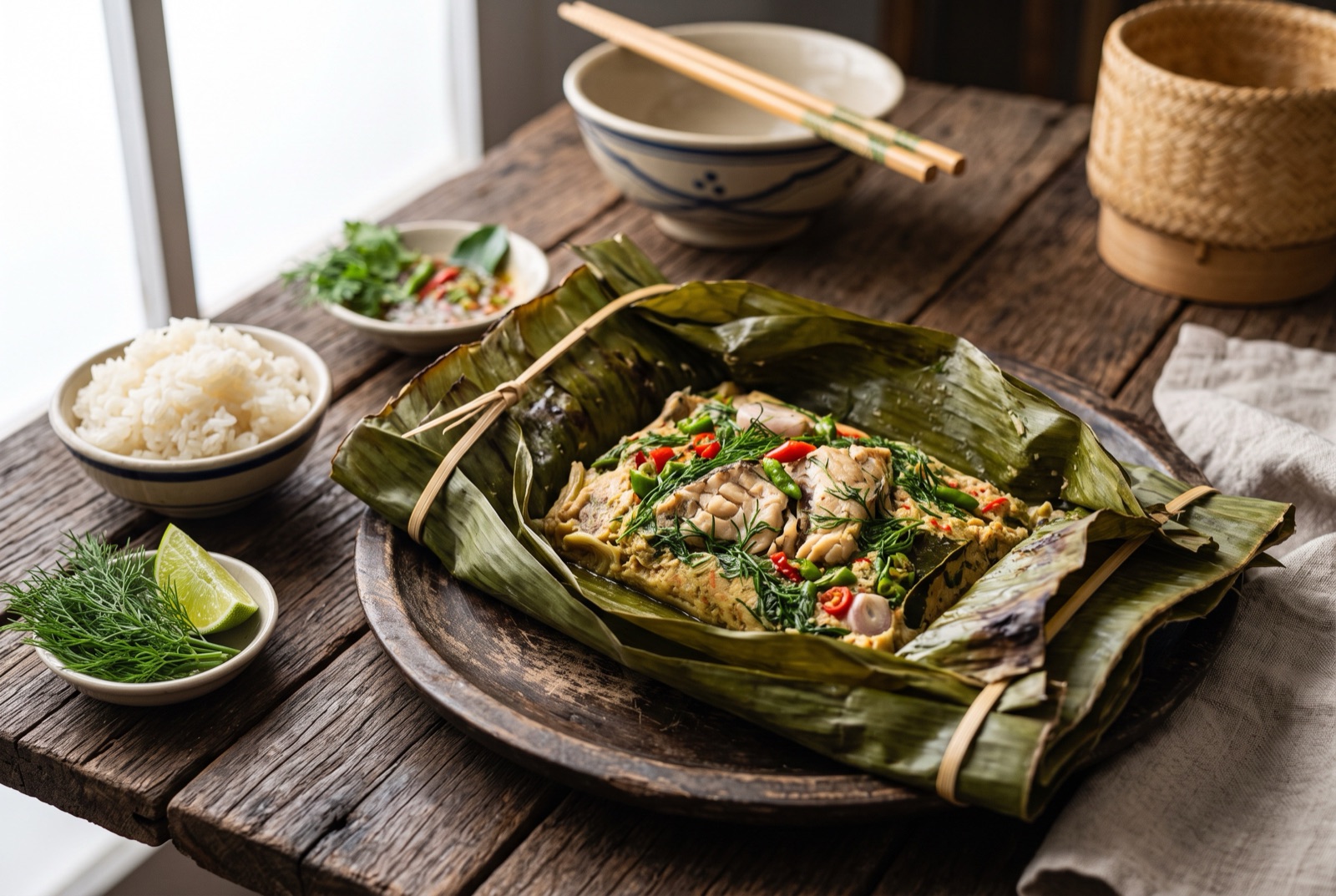
Mok pa is a steamed parcel, not a stew: chunks of freshwater fish are mixed raw with pounded lemongrass, galangal, shallot and chile, then loaded with fresh dill and spring onion, bound lightly with toasted sticky rice powder and egg, wrapped in banana leaf and steamed for around half an hour. What comes out is soft and slightly custardy, intensely aromatic from the leaf, and cleanly savoury rather than rich — there is no coconut milk and no oil in the traditional version. The dill is the giveaway. No Thai steamed fish uses it in this quantity, and its grassy, faintly aniseed note against river fish is one of the most recognisably Lao flavour combinations there is.

- Gate
- LaosMekong river provinces
- Prep
- 30 min
- Cook
- 30 min
- Total time
- 1 hr
- Serves
- 4
- Status
- Medium
- Nutrition / serving · estimated
- Calories 250 kcal
- Protein 32 g
- Carbs 9 g
- Fat 8 g
- Fiber 2 g
- Sodium 950 mg
Why this recipe works.
- Keeps the traditional Lao ratio — no coconut milk, so the dill and river fish stay in the foreground.
- Pounds the aromatics into a rough paste rather than blitzing them, which keeps the lemongrass fibrous and fragrant instead of bitter.
- Uses egg and toasted rice powder together, so the parcel sets softly instead of weeping liquid.
- Gives a workable foil method with an honest account of what you give up.
Ingredients.
14 itemsFor the paste
For the filling
For wrapping
Equipment
- Mortar and pestle
- Steamer with a lid
- Kitchen string or bamboo skewers
- Tongs for softening the leaves over a flame
Instructions.
Pound the aromatic paste
Pound the lemongrass, galangal, shallots, garlic, chiles and salt in a mortar, working in that order and adding each ingredient once the last has broken down. Stop when you have a rough, fibrous paste rather than a smooth purée — about 5 minutes of steady work.
Tip Salt at the start gives the pestle grip and speeds the whole job up.
Soften the leaves
Wipe the banana leaf squares and pass each one briefly over a gas flame or dip it in boiling water until it darkens, turns glossy and goes limp. Pat dry — a stiff leaf splits the moment you fold it.
Mix the filling
Toss the fish chunks with the paste and fish sauce until evenly coated, then fold in the toasted rice powder and beaten egg. Add the dill, spring onion and lime leaf last and mix gently so the fish stays in pieces.
Wrap the parcels
Lay two leaf squares crosswise, spoon a quarter of the filling into the centre, then fold the sides over the top and the ends underneath to make a tight rectangular packet. Secure with string or a skewer pushed through the seam. Repeat to make four parcels.
Tip Double-leafing prevents leaks; if one sheet tears, the second still holds.
Steam
Stack the parcels seam-side up in a steamer over a gentle, steady boil, cover and steam for 30 minutes, until the packets smell strongly of scorched leaf and dill and the filling feels set when pressed through the leaf.
Tip Top up the steamer water halfway so it never runs dry.
Rest, then open at the table
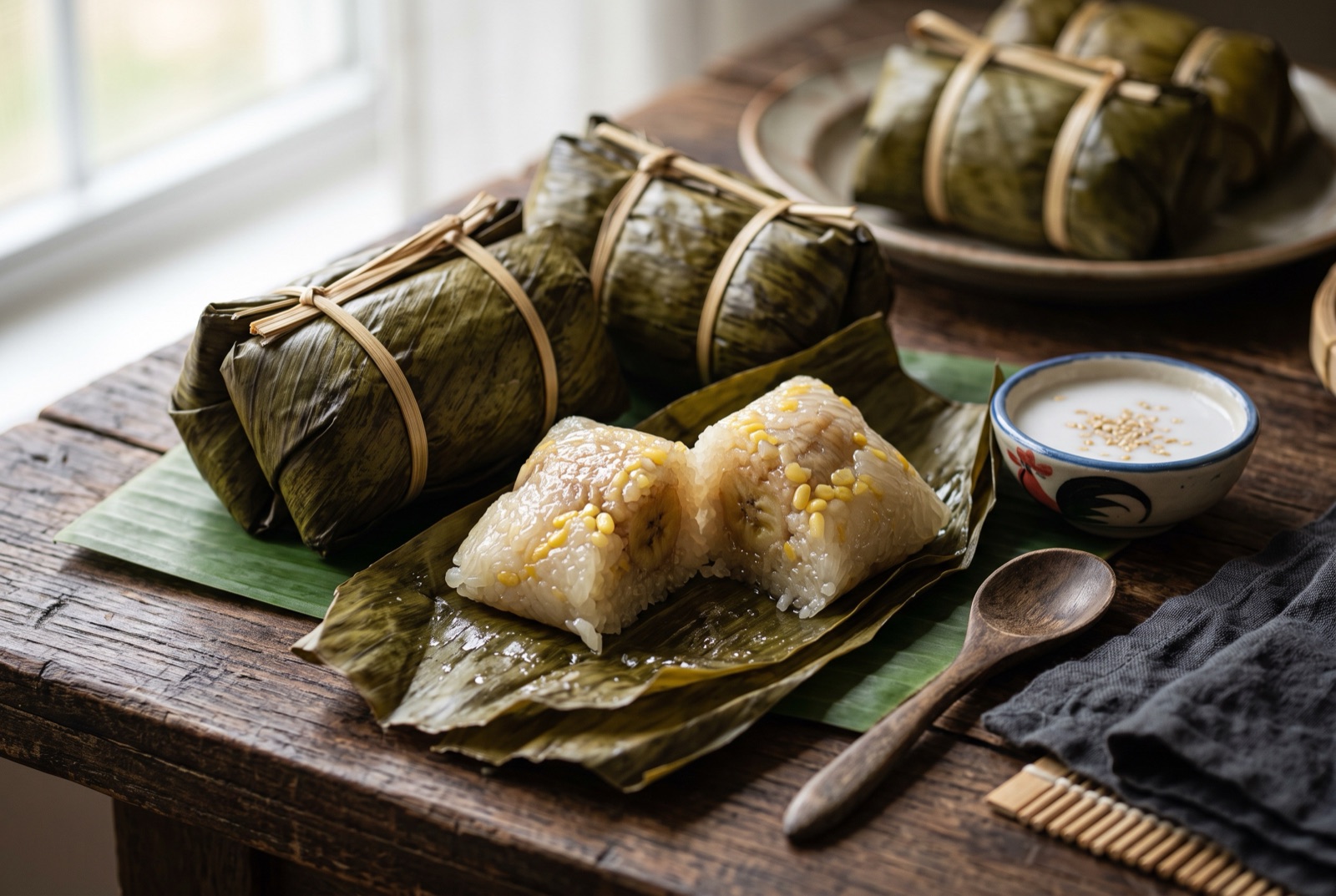
Let the parcels sit for 5 minutes off the heat so the filling firms up. Bring them out closed and cut them open in front of whoever is eating — the burst of trapped steam is part of the dish. Serve with sticky rice.
Tips from our kitchen.
- Soften banana leaves before folding: pass them over a flame or dip in boiling water for a few seconds until they turn glossy and pliable, or they will split at every crease.
- Cut the fish into 3 cm chunks rather than mincing it. Chunks keep some bite and stop the filling turning into a paste.
- Chop the dill roughly and use far more than feels sensible — a full large bunch for 600 g of fish is correct, not a typo.
- Pound lemongrass and galangal in a mortar until fibrous and fragrant; a blender chops them into gritty splinters that stay sharp in the finished parcel.
- Steam over a steady, gentle boil. A violent boil forces water into the parcel and the filling ends up soupy.
- Let the parcels sit five minutes after steaming before opening, so the filling firms up and holds together when spooned out.
Substitutions.
- Banana leaf → Aluminium foil, or foil lined with baking paper
- The parcel works mechanically but loses the leaf aroma, which is a genuine part of the dish. Frozen banana leaves from Asian grocers thaw in minutes and cost very little.
- Freshwater fish (snakehead, catfish, tilapia) → Cod, haddock, pollock or any firm white sea fish
- Sea fish is cleaner tasting and needs slightly less lemongrass; reduce the galangal a little so it does not overwhelm.
- Galangal → Fresh ginger plus a strip of lime zest
- Not identical — galangal is sharper and more piney — but the combination gets you closer than ginger alone.
Variations.
- Mok gai
- The same paste and wrapping method with chicken thigh instead of fish, steamed a little longer since chicken needs more time to cook through.
- Mok khai pa
- Made with fish roe rather than fillet, which sets firmer and richer inside the parcel. Prized in Mekong towns during the season.
- Mok het
- A vegetarian parcel of mixed mushrooms, dill and egg. Use soy sauce and a pinch of salt in place of fish sauce for a fully meat-free version.
Storage & reheating.
Steamed parcels keep 2 days in the fridge still wrapped, and reheat well: return them to the steamer for 6–8 minutes, or microwave in the leaf for about 90 seconds. The uncooked filling can be mixed and refrigerated for a few hours before wrapping, but no longer, because the salt in the fish sauce starts to cure the fish and the texture goes firm and slightly rubbery. Freezing raw parcels works better than freezing cooked ones — steam from frozen, adding around 10 minutes.
Serve with
A basket of sticky rice — the parcel is a dipping dish as much as a main A charred chili dip and a plate of raw cucumber and lettuce
The story behind Mok Pa.
Laos is landlocked, so its fish come from the Mekong and its tributaries — snakehead, catfish, carp, tilapia — and the cooking reflects that. River fish are muddier and bonier than sea fish, and steaming them tightly with strong aromatics is a practical answer to both problems: the lemongrass and galangal scrub the muddiness, and the parcel holds everything together so small bones can be picked out as you eat rather than hunted for on a plate.
The technique is older than any national cuisine. Wrapping food in leaves and cooking it in embers or steam is one of the oldest methods in mainland Southeast Asia, requiring no pot, no oil and almost no fuel, and it survives across the region under different names — mok in Laos, ho mok in Thailand, amok in Cambodia, pepes in Indonesia. The Lao version stayed the leanest of the group. Where Thai ho mok is thickened with coconut cream into something close to a savoury custard and Cambodian amok is richer still, mok pa keeps the coconut out and lets dill, spring onion and fermented fish sauce carry it. Whether that is conservatism or confidence depends on who you ask.
At home the parcels are made in batches, tied with strips of the leaf itself or with bamboo skewers, and stacked in a bamboo steamer over the same pot that is cooking the sticky rice — one fire, two dishes. They are opened at the table, which is half the point: the trapped steam carries the smell of scorched leaf and dill across the room. Mok is also made with chicken, with river weed, with eggs, with mushrooms and, in a version some Lao cooks consider the best of all, with fish eggs. If you cannot find banana leaf, foil works and nobody starves, but you lose the faint tea-like perfume the leaf gives up as it heats, which is a real loss rather than a purist quibble.
Questions, answered.
What fish should I use for mok pa?
In Laos it is river fish such as snakehead, catfish or tilapia. Outside Southeast Asia, any firm white fish that holds its shape works well: cod, haddock, pollock, hake or basa. Avoid thin, delicate fillets like sole, which disintegrate into the filling during steaming, and avoid oily fish like mackerel, whose flavour fights the dill.
Can I make mok pa without banana leaves?
Yes. Foil parcels or small heatproof bowls covered tightly with foil both work, and the fish cooks identically. What you lose is the aroma the leaf releases as it heats, a faint smoky, tea-like perfume that scents the filling. Frozen banana leaves are cheap at Asian grocers and worth buying if you can.
Why does my mok pa come out watery?
Usually one of three causes: the steamer was boiling too hard and forced condensation into the parcel, the fish released liquid because it was previously frozen and not patted dry, or there was not enough toasted rice powder and egg to bind it. Keep the water at a gentle boil, dry the fish well, and let the parcels rest before opening.
What is the difference between mok pa and Thai ho mok?
Both are steamed fish parcels from the same regional tradition, but Thai ho mok is built on coconut cream and red curry paste, setting into a rich savoury custard. Lao mok pa uses no coconut at all and leans on dill, spring onion, lemongrass and fermented fish sauce, so it tastes lighter, greener and considerably more herbal.
Is dill really traditional in Lao cooking?
Yes, and it is one of the clearest markers of Lao food. Fresh dill, known as phak sii, is used generously in steamed fish, stews and soups across Laos, in quantities closer to a leafy vegetable than a herb garnish. Neighbouring Thai cooking uses it far more sparingly outside the Lao-speaking northeast.
You might also like.
All recipes →
Keep exploring Laos.
Laos has 9 more dishes in the atlas — Jeow Mak Len and Khao Piak Sen, and 7 more.
All Laos recipes White fish recipes Dill recipes Lemongrass recipes maindairy freegluten freepescatarianRecipe by The DishRoute Kitchen · published August 20, 2026 · updated August 20, 2026