Khao Tom Mat.
Lao Banana Sticky Rice Parcels
ເຂົ້າຕົ້ມມັດ · Khao tom mat · say it: kow tom maht
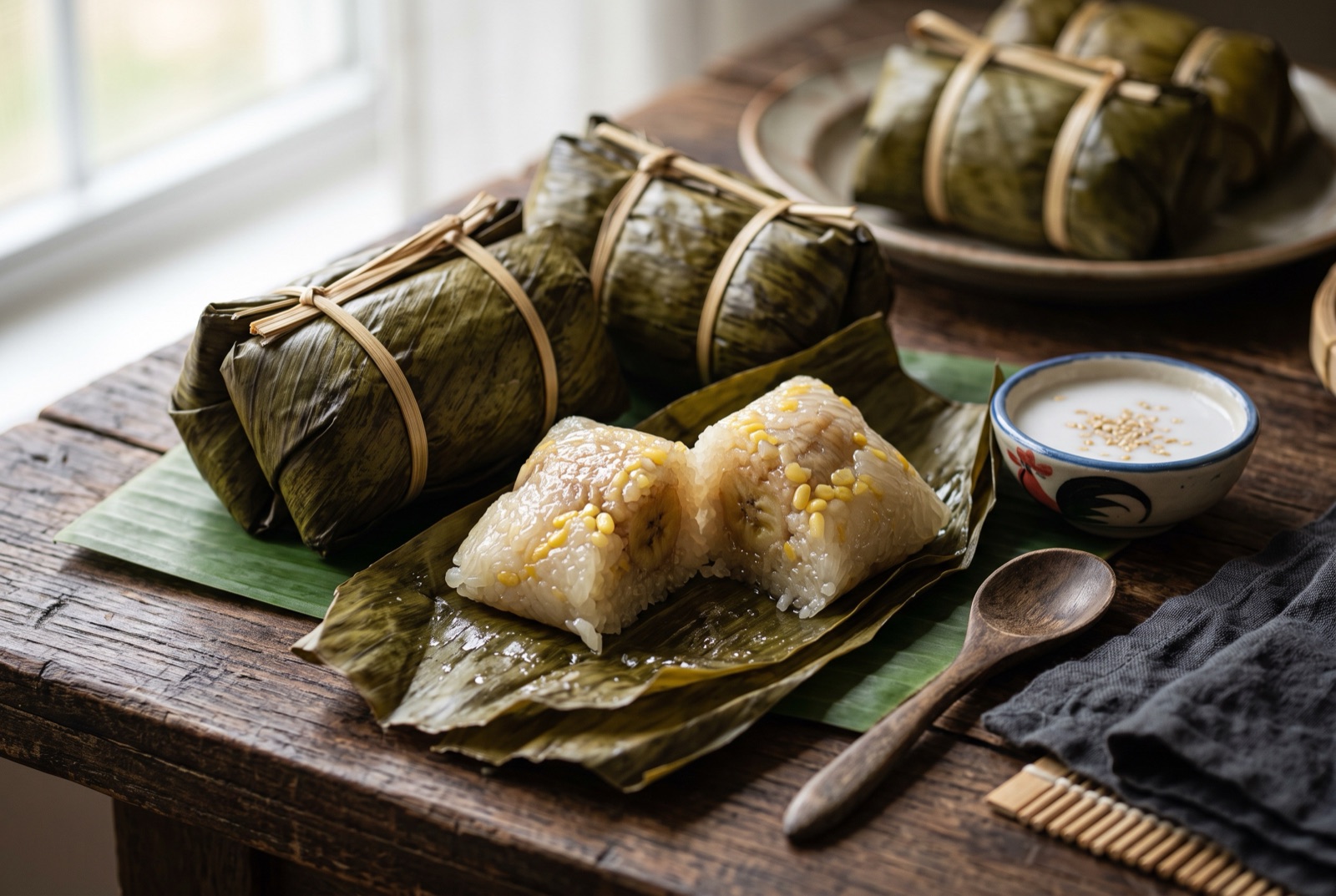
Khao tom mat is a steamed sweet parcel: sticky rice simmered briefly in sweetened coconut milk until it drinks most of it, then packed around a piece of banana in a banana leaf, tied into a tight bundle and steamed for about an hour. The rice comes out translucent, glossy and just sweet, the banana soft and slightly wine-like, and the leaf gives everything a faint green tea aroma. It is eaten at room temperature with the fingers, unwrapped like a present, and it is more restrained than most sweets — the sugar is background, and the point is texture and the smell of the leaf.

- Gate
- LaosNationwide
- Prep
- 40 min
- Cook
- 1 hr 10 min
- Total time
- 5 hr 50 min incl. 4 hr rest
- Serves
- 8
- Status
- Medium
- Nutrition / serving · estimated
- Calories 390 kcal
- Protein 6 g
- Carbs 68 g
- Fat 11 g
- Fiber 3 g
- Sugar 20 g
Why this recipe works.
- Pre-cooks the rice in coconut milk before wrapping, so it steams evenly instead of leaving a hard core.
- Gives clear folding and tying instructions, which is where most first attempts leak.
- Specifies genuinely ripe bananas and explains why underripe fruit ruins the parcel.
- Naturally vegan and gluten-free without substituting anything away.
Ingredients.
8 itemsFor the rice
For the filling
For wrapping
To serve
Equipment
- Large steamer
- Kitchen string or strips of banana leaf
- Heavy saucepan
- Tongs for softening leaves
Instructions.
Cook the rice in coconut milk
Warm the coconut milk with the sugar and salt in a heavy pan until the sugar dissolves, then add the drained rice. Cook over low heat for 12–15 minutes, stirring often, until the rice has drunk almost all the liquid and clings together in a sticky mass but is still firm at the centre of each grain.
Tip Stir from the bottom throughout — coconut sugar catches and scorches quickly on a thin pan.
Cool the rice
Spread the rice on a tray and let it cool for 15 minutes, until you can handle it comfortably. Wrapping scalding rice softens the leaves too fast and makes them tear.
Soften the leaves
Wipe each banana leaf rectangle and pass it over a gas flame or dip it in boiling water for a few seconds, until it darkens, turns glossy and goes limp. Pat dry and trim off any split edges.
Fill the parcels
Lay two leaf rectangles crosswise, shiny side up. Spread a heaped tablespoon of rice into a rectangle, lay a piece of banana and a spoonful of mung beans down the centre, then cover with more rice so the fruit is fully enclosed.
Tip Fully enclosed matters — exposed banana leaks sugar and glues the parcel to the leaf.
Fold and tie
Fold the long sides of the leaf over the filling to overlap, then fold both ends underneath to make a flat rectangular packet. Tie two parcels together back to back with string or a strip of leaf, snug but with a little give so the rice can swell.
Steam
Stack the tied bundles in a large steamer, cover and steam over a steady boil for 60 minutes, topping up the water halfway. The parcels are done when the rice feels solid and springy through the leaf and the packets smell strongly of banana.
Cool before unwrapping
Lift the parcels out and let them cool for at least 30 minutes. Unwrap one to check: the rice should be glossy, translucent and hold its shape in a clean block that pulls away from the leaf.
Serve
Serve at room temperature, still in the leaf, letting everyone unwrap their own. Scatter toasted sesame seeds over the exposed rice, and offer a little extra coconut cream for spooning if you like.
Tips from our kitchen.
- Soak the sticky rice at least 4 hours, ideally overnight. Unsoaked grains will not soften properly inside a wrapped parcel, however long you steam them.
- Cook the rice in the coconut milk only until it has absorbed most of the liquid and turned sticky but still raw in the centre — it finishes in the steamer.
- Soften the banana leaves over a flame until they turn glossy and dark green, otherwise they crack along every fold.
- Use bananas with brown speckles on the skin. Firm yellow fruit stays starchy and flavourless after an hour of steam.
- Tie the parcels snug but not throttled: the rice needs about a fifth more room to swell as it cooks.
- Let them cool at least 30 minutes before unwrapping. Hot from the steamer the rice is loose and sticks to the leaf; cooled, it firms into a clean block.
Substitutions.
- Banana leaf → Foil, or foil lined with baking paper
- Structurally fine but you lose the leaf aroma, which is a large part of the appeal here. Frozen banana leaves are inexpensive at Asian grocers and thaw in minutes.
- Split mung beans → Omit them, or use a thin layer of black-eyed beans
- The beans add a soft, mealy contrast rather than flavour. Plenty of Lao versions skip them entirely and nobody objects.
- Fresh banana → Ripe plantain, or strips of taro
- Plantain is firmer and less sweet; taro makes a savoury-leaning version that is also traditional in parts of the region.
Variations.
- With black sticky rice
- Made with a mix of black and white glutinous rice, which turns the parcel deep purple and adds a nuttier, chewier bite.
- Khao tom nam yoi
- A savoury cousin filled with pork belly and mung beans rather than banana, seasoned with black pepper and salt instead of sugar.
- Sesame and coconut
- Toasted sesame seeds and shredded fresh coconut worked through the rice before wrapping, for a version with more texture and less sweetness.
Storage & reheating.
The parcels keep 2 days at room temperature and 5 days refrigerated, still wrapped, which is exactly what they were designed for. Cold rice goes hard, so re-steam refrigerated parcels for 10 minutes or microwave them in the leaf for a minute to bring the softness back. They freeze well for up to 2 months: steam from frozen for about 20 minutes. Do not unwrap before storing — the leaf is what stops the rice drying out.
Serve with
Strong Lao coffee with condensed milk, the standard morning pairing A little extra thick coconut cream and toasted sesame for spooning over the unwrapped parcel
The story behind Khao Tom Mat.
This is festival and temple food. Khao tom mat is made in large batches for Buddhist merit-making ceremonies, for Lao New Year in April, and for the boat racing festival, when families need something sweet that travels without a plate and keeps for a day in the heat. The parcel is the packaging: banana leaf costs nothing where bananas grow, needs no washing up, and protects the contents well enough that vendors sell the bundles from baskets by the roadside.
Wrapped steamed rice cakes recur right across Southeast and East Asia — Vietnamese bánh tét, Filipino suman, Thai khao tom mat, Chinese zongzi — and the family resemblance is not accidental. All of them solve the same problem in the same way with the same materials, and each culture has taken the idea somewhere different: savoury and pork-filled in some, sweet and coconut-heavy in others, tetrahedral or cylindrical or flat depending on the local folding habit. Claiming the Lao version as the source of any of the others would be nonsense; they are parallel answers, and the Lao one leans sweet, small and banana-centred.
The practical craft is in the wrapping and the tying. A loose parcel lets water in and you get soggy rice; too tight and the grains have no room to swell, so the centre stays hard. The bundles are traditionally tied in pairs with strips of banana leaf or bamboo, which is partly convenience and partly so they can be hung from a pole and carried. Mung beans are optional and common — soaked and steamed, they add a soft, faintly nutty layer against the banana. Use ripe bananas with brown flecks; underripe fruit stays starchy and tastes of nothing after steaming, which is the most common way this goes wrong.
Questions, answered.
Why is the rice in the middle of my parcel still hard?
Either the rice was not soaked long enough, or the parcel was tied too tightly for the grains to swell. Soak glutinous rice for at least four hours before cooking, pre-cook it in the coconut milk until sticky, and wrap the bundles snugly but with a little slack. Steaming longer will not fix rice that was never soaked.
Can I use regular rice instead of sticky rice?
No. Glutinous rice, also sold as sweet or sticky rice, has a very different starch composition that makes it cohere into a solid, chewy block when steamed. Jasmine or long-grain rice stays as separate grains and the parcel will simply fall apart when you unwrap it.
How do I soften banana leaves without a gas flame?
Dip them in a pan of boiling water for a few seconds until they darken and turn glossy, then pat them dry. Alternatively wipe them with oil and warm them in a dry pan or a low oven for a minute. The aim is pliability — a stiff leaf splits at the first fold and the parcel will leak.
How sweet is khao tom mat?
Much less sweet than most Western desserts. The sugar in the coconut milk is enough to season the rice rather than to make it a confection, and most of the sweetness comes from the ripe banana. If you want it sweeter, increase the sugar in the coconut milk slightly rather than adding anything to the filling.
When is khao tom mat eaten in Laos?
It is festival and temple food, made in large batches for Buddhist merit-making ceremonies, Lao New Year in April and the boat racing festival. Because it keeps without refrigeration and needs no plate or cutlery, it is also everyday market food, sold from baskets in tied pairs as a snack or breakfast.
You might also like.
All recipes →
Keep exploring Laos.
Laos has 9 more dishes in the atlas — Jeow Mak Len and Khao Piak Sen, and 7 more.
All Laos recipes Sticky rice recipes Coconut milk recipes dessertsnackvegetarianvegangluten freedairy freeRecipe by The DishRoute Kitchen · published August 20, 2026 · updated August 20, 2026