Or Lam.
Luang Prabang Herb and Eggplant Stew
ເອາະຫຼາມ · Aw lam · say it: aw lahm
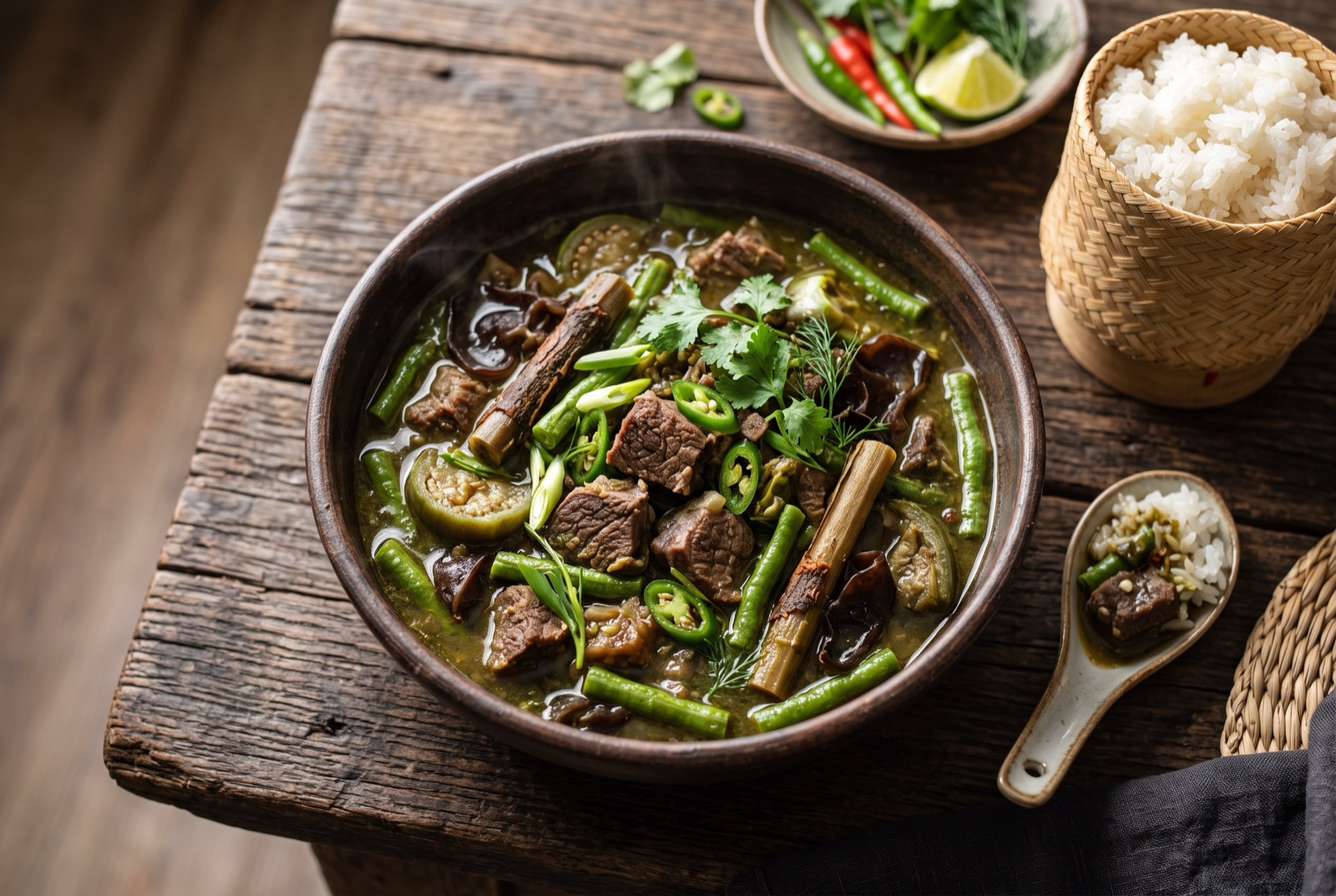
Or lam is a thick, deliberately bitter vegetable-heavy stew from the mountains of northern Laos. Meat is present but not the point — the bulk is long beans, wood ear mushrooms, pea eggplants and greens, cooked down until the broth turns cloudy and clings, thickened with a little pounded sticky rice rather than flour. What makes it unmistakable is sakhan, a woody pepper-vine stem simmered whole in the pot, which leaves a slow tingling numbness on the lips, and a final handful of dill and Lao basil. It tastes green, bitter, peppery and faintly smoky, and it is eaten by hand with sticky rice rather than spooned over anything.

- Gate
- LaosLuang Prabang
- Prep
- 30 min
- Cook
- 1 hr
- Total time
- 1 hr 30 min
- Serves
- 4
- Status
- Medium
- Nutrition / serving · estimated
- Calories 380 kcal
- Protein 33 g
- Carbs 24 g
- Fat 16 g
- Fiber 6 g
- Sodium 1200 mg
Why this recipe works.
- Keeps the vegetable-to-meat ratio the way Luang Prabang cooks it, rather than turning it into a meat stew with garnish.
- Thickens with pounded sticky rice, which is the authentic method and gives a cloudy body no roux imitates.
- Explains what sakhan actually does and offers a substitute that is honest about its limits.
- Chars the aromatics first, which stands in for the smoked buffalo most home cooks cannot buy.
Ingredients.
16 itemsFor the stew
For the aromatics
For the vegetables
To finish
Equipment
- Heavy pot or Dutch oven
- Mortar and pestle
- Dry frying pan for charring aromatics
Instructions.
Char the aromatics
Dry-fry the unpeeled shallots, garlic and dried chiles in a heavy pan over high heat for 6–8 minutes, turning, until the skins are blackened in patches and the kitchen smells of smoke. Peel the shallots and garlic once cool enough to handle.
Tip Blackened patches, not uniform char — burnt through means bitter in the wrong way.
Pound to a rough paste
Pound the charred shallots, garlic and chiles in a mortar with a pinch of salt until you have a coarse, smoky paste with visible flecks. It does not need to be smooth.
Start the broth
Scrape the paste into a heavy pot with the chicken, bruised lemongrass and the bag of Sichuan pepper or sakhan. Pour in the stock, bring to a simmer and cook uncovered for 25 minutes, until the chicken is tender and the broth has taken on colour.
Thicken with pounded rice
Mix the pounded soaked rice with a ladle of hot broth to loosen it, then stir the slurry back into the pot in a slow stream. Simmer for 10 minutes, stirring often, until the liquid turns cloudy and coats the back of a spoon.
Tip Stir the base of the pot regularly from here on — rice starch catches quickly.
Add the vegetables
Add the wood ear, long beans and chayote and simmer for 10 minutes, then add the pea eggplants and cook another 8 minutes, until the beans are soft but the eggplants still pop when bitten.
Season and finish
Remove the lemongrass and the pepper bag. Season with the fish sauce, taste, and adjust — it should be savoury, green and clearly bitter with a slow tingle. Stir in the dill, basil and spring onion off the heat and let them wilt in the residual heat.
Serve with sticky rice
Ladle into a shared bowl and bring it to the table with a basket of sticky rice, so everyone can dip rather than spoon. Let it stand a couple of minutes before eating — the numbing note reads more clearly just below scalding.
Tips from our kitchen.
- Char the shallots, garlic and chiles in a dry pan until blackened in patches before pounding — that smokiness is doing the work of the traditional smoked meat.
- Do not skim the cloudiness. Or lam is meant to look murky and thick; a clear broth means it has not cooked long enough.
- Add the pounded sticky rice as a slurry with a ladle of hot broth, stirring as you pour, or it will drop to the bottom and scorch.
- Pea eggplants are bitter and should stay slightly firm — add them in the last ten minutes so they still pop between the teeth.
- Taste for salt only at the very end. The stew reduces considerably and fish sauce added early can leave it harsh.
- Serve it hot but not boiling; the numbing tingle of sakhan or Sichuan pepper is much easier to feel once the heat drops slightly.
Substitutions.
- Sakhan (Lao pepper vine) → 1 tsp Sichuan peppercorns, lightly crushed, in a tea infuser or muslin bag
- Not the same flavour — sakhan is woodier and less citrusy — but it delivers the numbing sensation that defines the dish. Remove the bag before serving.
- Pea eggplants → Small Thai green eggplants quartered, or halved Brussels sprouts
- You are after bitterness and a firm pop rather than the eggplant itself, which is why sprouts work better here than a soft Mediterranean aubergine.
- Buffalo or dried smoked meat → Chicken thigh plus 1/2 tsp smoked paprika
- Buffalo is genuinely hard to source. The smoked paprika replaces the trace of smokehouse flavour the dried meat would bring.
- Lao basil and dill → Thai basil plus fresh dill, or dill alone
- Dill is the non-negotiable one; if you can only find a single herb, make it dill.
Variations.
- Or lam sin kwai
- Made with buffalo, usually a mix of fresh meat and dried smoked strips, which gives the deepest and most traditional version of the stew.
- Or lam pa
- A river-fish version cooked in far less time, with the fish added only for the last ten minutes so it does not break up.
- Vegetarian or lam
- Built on wood ear, oyster mushrooms and extra long beans, seasoned with salt and soy instead of fish sauce, with a strip of dried mushroom for depth.
Storage & reheating.
Or lam improves on the second day as the bitterness mellows and the body thickens further; keep it up to 3 days refrigerated. Reheat gently with a splash of water, since the rice thickener sets firm when cold and can catch on the pan base. Add the fresh dill and basil after reheating rather than before, because they turn dull and grey on a second boil. It freezes acceptably for a month, though the eggplants soften and lose their pop.
Serve with
Sticky rice, always — or lam is eaten by dipping rice into it rather than with a spoon A small dish of raw greens and cucumber to cut the bitterness
The story behind Or Lam.
Luang Prabang sits in a mountain valley where the Nam Khan meets the Mekong, and for centuries it was the royal capital of Lan Xang, the Lao kingdom whose name means a million elephants. Its kitchen is the most self-contained in the country: cut off from the lowlands by hills, cooks leaned on what the forest and the riverbank produced — bitter greens, wild mushrooms, pea eggplants, river weed, and sakhan, a climbing pepper vine harvested as short lengths of woody stem. Or lam is the dish where all of that arrives at once.
The bitterness is intentional and worth understanding rather than fighting. Lao cooking treats bitter as a fourth pillar alongside sour, salty and hot, and or lam is where it is most visible: pea eggplants pop bitter, the greens are astringent, and in the fully traditional version a smear of buffalo bile is stirred in at the end. Modern home cooks in Luang Prabang often skip the bile, and nobody will accuse you of fraud for doing the same, but they will not sweeten the stew to compensate. There is no sugar in or lam, and adding some turns it into a different dish.
Sakhan is the harder problem outside Laos. Piper ribesioides is sold in Lao markets as dried finger-length sticks, simmered in the pot and pulled out before serving like a bay leaf, and its effect — a mild, spreading numbness closer to Sichuan pepper than to chile — has no clean substitute. A few crushed Sichuan peppercorns in a tea infuser get you a recognisable sensation without pretending to be the same thing. Traditionally the meat was buffalo, often dried and smoked, which is why the stew carries a faint charred note; chicken thigh is the everyday version and the one below, with a piece of charred meat or a spoonful of smoked paprika standing in for the smokehouse.
Questions, answered.
What is sakhan and do I need it?
Sakhan is the woody stem of a Lao pepper vine, simmered whole in stews and removed before eating. It produces a mild spreading numbness on the lips and tongue, similar in effect to Sichuan pepper but woodier in flavour. It is difficult to buy outside Laos, and crushed Sichuan peppercorns in a muslin bag give a close enough sensation for a home version.
Why is or lam bitter, and can I make it less so?
Bitterness is a deliberate flavour pillar in Lao cooking, delivered here by pea eggplants, astringent greens and traditionally a smear of buffalo bile. You can reduce it by using fewer pea eggplants and swapping some greens for long beans, but do not add sugar to balance it — that turns or lam into a different, sweeter stew that Lao cooks would not recognise.
What thickens or lam if there is no flour?
Sticky rice. A small amount of raw glutinous rice is soaked and pounded, then stirred into the simmering broth, where its starch releases and gives the stew a cloudy, clinging body. Some cooks use toasted rice powder instead. Either way the thickening is gentle and the stew stays spoonable rather than gluey.
Can I make or lam without meat?
Yes, and it holds up better than most meat stews do without meat, because vegetables and herbs already make up the bulk. Use wood ear and oyster mushrooms for texture, season with salt and light soy instead of fish sauce, and add a piece of dried mushroom to the broth for savoury depth.
How is or lam eaten in Laos?
With sticky rice, by hand. Diners pinch off a lump of rice, press it into a rough scoop and dip it into the stew, rather than ladling the stew over rice on a plate. It sits in the middle of a shared table alongside grilled meat, a chili dip and raw vegetables, and everyone eats from the same bowl.
You might also like.
All recipes →
Keep exploring Laos.
Laos has 9 more dishes in the atlas — Jeow Mak Len and Khao Piak Sen, and 7 more.
Recipe by The DishRoute Kitchen · published August 20, 2026 · updated August 20, 2026