Alivenci.
Moldovan Cornmeal and Curd Cheese Cake
Alivenci · say it: ah-lee-VEN-chee
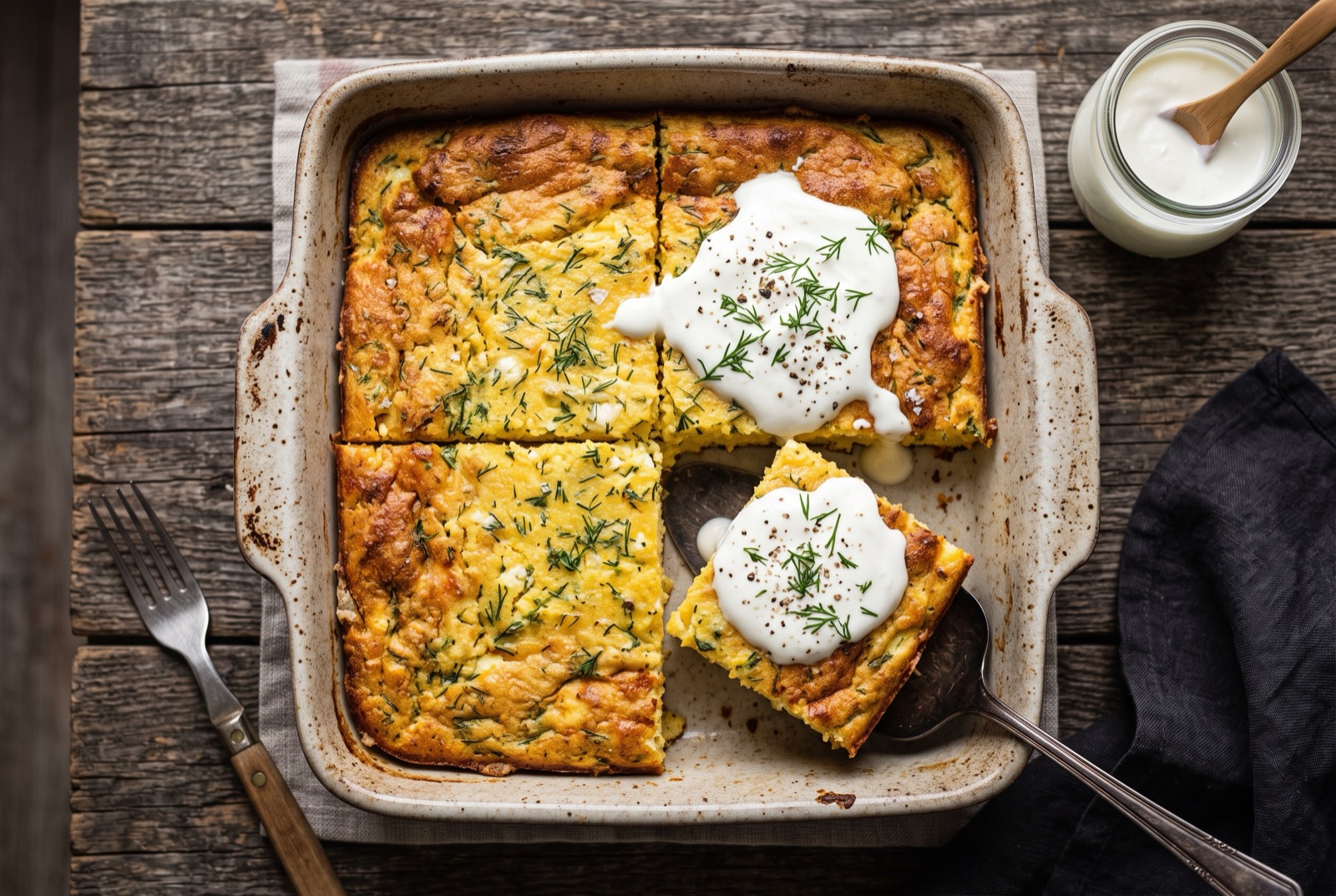
Alivenci is a baked cornmeal and curd cheese cake — soft and almost custardy in the middle, dry and gold on top, somewhere between a cornbread, a soufflé and a savoury cheesecake. The batter is fine cornmeal, fresh curd, eggs, sour cream and a lot of chopped dill, poured into a tray and baked until it puffs and cracks. It is eaten warm with more sour cream spooned over the top, at breakfast or with afternoon tea, and it walks the line between savoury and sweet depending on how much sugar goes in. Simple to make, hard to stop eating.

- Gate
- Moldova
- Prep
- 20 min
- Cook
- 35 min
- Total time
- 1 hr 5 min incl. 10 min rest
- Serves
- 6
- Status
- Easy
- Nutrition / serving · estimated
- Calories 430 kcal
- Protein 20 g
- Carbs 34 g
- Fat 24 g
- Fiber 2 g
- Sodium 610 mg
Why this recipe works.
- Cornmeal soaked in hot milk first, so the finished cake is tender instead of gritty on the tongue.
- Whisked egg whites folded in at the end, which is what makes it rise and stay light rather than dense.
- Works savoury or lightly sweet from one base batter, with the adjustment spelled out.
- One bowl, one tray, and it is out of the oven in under forty minutes.
Ingredients.
11 itemsFor the batter
To serve
Equipment
- 24 cm baking tin or ovenproof dish
- Two mixing bowls
- Electric or hand whisk
Instructions.
Swell the cornmeal
Put 200 g of cornmeal in a large bowl and pour the hot milk over it, stirring at once so no dry pockets remain. Leave it 10 minutes, until it has thickened to a loose porridge and no longer feels gritty between your fingers.
Tip Skip this and the finished cake tastes sandy — there is no fixing it later.
Beat in the curd and yolks
Heat the oven to 190°C and butter a 24 cm tin. Beat the drained curd, egg yolks, sour cream and melted butter into the warm cornmeal until the mixture is smooth and thick enough to fall off the spoon in a slow ribbon.
Season it
Stir in the dill, salt, pepper and baking powder and taste the batter — it should be clearly seasoned, since baking mutes salt. For a sweet version, leave out the dill and pepper and beat in four tablespoons of sugar instead.
Whip and fold the whites
Whisk the egg whites with a pinch of salt to soft peaks, the stage where a lifted peak flops over rather than standing upright. Fold them into the batter in three additions with a spatula, cutting down and lifting until no white streaks remain.
Tip A few large folds beat many small stirs — every extra stroke costs you rise.
Bake until cracked and gold
Pour into the tin, level the top and bake for 35 minutes, until the surface is deep gold, dry to the touch and split with a few cracks, and a skewer in the centre comes out with a few moist crumbs clinging.
Rest, cut and serve
Let the cake sit in its tin for 10 minutes so it firms up and stops steaming, then cut it into squares. Serve warm with a heavy spoonful of cold sour cream on each piece and a little extra dill scattered over.
Tips from our kitchen.
- Use fine cornmeal, not coarse polenta grits. Coarse grain never fully softens in a batter this short and leaves the cake sandy.
- Pour hot milk over the cornmeal and let it stand ten minutes before mixing — this pre-swelling is the single biggest quality difference.
- Drain wet curd well. Excess whey makes the middle sink and stay wet no matter how long you bake it.
- Whisk the whites to soft peaks only, the stage where the peak flops over. Stiff whites break into lumps when folded and leave white streaks.
- Bake until the top is dry and cracked and a skewer comes out with a few moist crumbs — a completely clean skewer means it is already overdone.
- Let it settle in the tin for ten minutes before cutting. Cut straight from the oven it collapses and smears.
Substitutions.
- Brânză de vaci (fresh curd) → Quark, ricotta, or sieved cottage cheese
- Ricotta is sweeter and wetter — drain it and add an extra pinch of salt. Quark is the closest of the three.
- Sour cream in the batter → Full-fat yogurt or buttermilk
- Slightly less rich and the crumb is a little looser, but the tang stays and the cake still works.
- Dill → Chopped green onion, or nothing at all if making the sweet version
- For the sweet version replace the dill with a teaspoon of vanilla and a handful of raisins.
Variations.
- Sweet alivenci
- Four tablespoons of sugar instead of the dill and pepper, with raisins and lemon zest, served dusted with icing sugar and honey.
- Alivenci în foi
- The older northern form: the batter spooned into cabbage or vine leaves and baked in individual parcels rather than a tray.
- With browned butter
- Butter cooked to a nutty brown and poured over the finished cake instead of sour cream — richer, and very good with soup.
Storage & reheating.
Keeps three days covered in the refrigerator, and eats well cold, though warm is better. Reheat squares in a moderate oven for ten minutes rather than the microwave, which turns the cornmeal rubbery. Freezing is possible for a month but the texture loosens noticeably, so eat frozen portions warm with extra sour cream.
Serve with
A generous spoonful of thick sour cream, and hot tea or a glass of cold sour milk.
The story behind Alivenci.
Corn arrived in Moldovan and Romanian cooking relatively late but conquered it completely. By the nineteenth century cornmeal had displaced millet as the everyday grain, and mămăligă — polenta — became the default carbohydrate of the countryside, eaten instead of bread at most meals. Alivenci belongs to that corn culture: it is what happens when the same cornmeal is enriched with the other things a household always had, namely eggs, fresh cow curd and sour cream, and put in the oven rather than stirred in a pot.
The dish is particularly associated with Bukovina and the north of the region, where it is sometimes made in individual portions wrapped in cabbage or vine leaves rather than baked flat in a tray, and where names and shapes shift from one village to the next. What stays constant is the trio of cornmeal, curd and dill, and the sour cream served over the top rather than stirred in. The name has no settled explanation, and honest sources treat the folk etymologies with caution — it is simply an old regional word.
What makes alivenci worth knowing is its position on the table. It is not a dessert and not quite a bread. It is what gets made when there is fresh curd to use up and no time for dumplings, served warm from the tray to whoever is in the house. Sweetened lightly it goes with tea; left savoury with plenty of dill and pepper it becomes a side dish for soup or a meal on its own with a bowl of sour milk. Both versions are correct and both are made in the same kitchens, which is why the sugar quantity in any given family recipe tells you more about that family than about the dish.
Questions, answered.
What kind of cornmeal should I use?
Fine or medium ground yellow cornmeal, the kind sold for polenta but on the finer end. Coarse grits stay hard in a batter that only bakes for thirty minutes. If all you have is coarse, blitz it briefly in a grinder or soak it in the hot milk for a full thirty minutes.
Why did the middle of my alivenci sink?
Almost always too much moisture from undrained curd, or the whites deflating because they were over-whisked or folded in too roughly. Drain the cheese in a sieve, whip the whites only to soft peaks, and fold with a spatula in a few large strokes rather than stirring.
Is alivenci sweet or savoury?
Both versions are traditional. With dill, pepper and salt it is a savoury cake eaten with sour cream at breakfast or alongside soup; with sugar, vanilla and raisins it becomes a tea cake. The base batter is identical, so you can decide at the mixing stage.
Can I make it without eggs?
Not really, or at least not as this dish. The eggs both bind the batter and, whipped, provide the lift that keeps it from being a heavy slab of wet cornmeal. Without them you would be making a different thing closer to a baked polenta.
Can I prepare the batter in advance?
Mix the cornmeal, milk, curd and yolks up to a day ahead and refrigerate, but whisk and fold in the egg whites only immediately before baking. Whites lose their air within minutes, and a batter left standing with them folded in bakes flat and dense.
You might also like.
All recipes →
Keep exploring Moldova.
Moldova has 9 more dishes in the atlas — Chiftele Marinate and Colaci Moldovenești, and 7 more.
All Moldova recipes Cornmeal recipes Quark recipes Eggs recipes breakfastsidevegetariangluten freenut freeRecipe by The DishRoute Kitchen · published August 20, 2026 · updated August 20, 2026