Colaci Moldovenești.
Braided Ring Bread for Feasts
Colaci · say it: ko-LAHCH mol-do-ve-NESHT
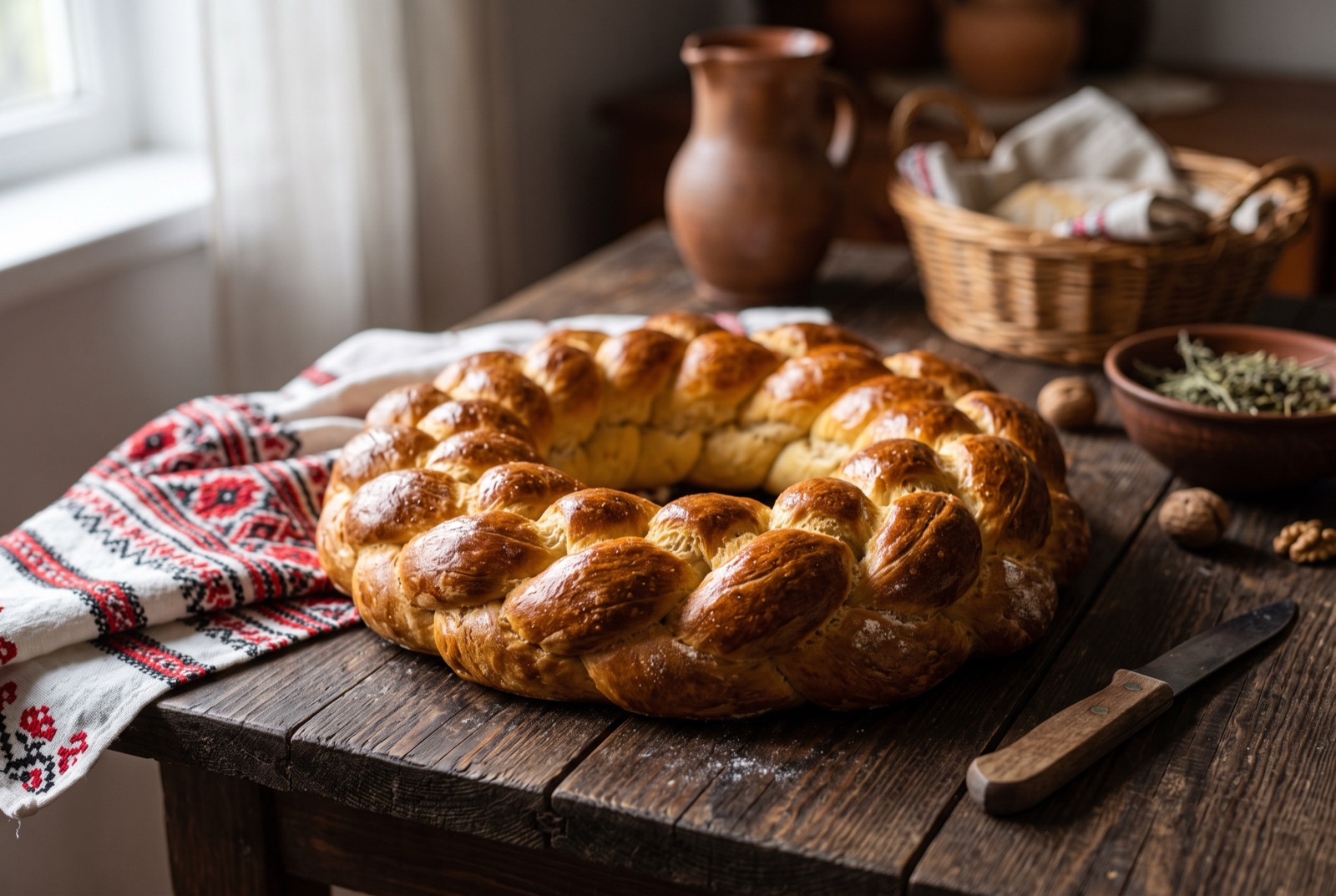
A colac is a ring of braided bread, made from a soft dough enriched with milk, eggs, butter and just enough sugar to help the crust colour. It is not a dessert bread and not a plain loaf either: it sits between the two, sweet enough to eat with tea and neutral enough to hand across a table at a funeral. The dough is worked until it is silky, divided into strands, plaited into a rope and joined into a circle, then proved a second time and glazed with egg before baking. What comes out is glossy, high and slightly stringy when torn.

- Gate
- Moldova
- Prep
- 40 min
- Cook
- 35 min
- Total time
- 3 hr 45 min incl. 2 hr 30 min rest
- Serves
- 12
- Status
- Medium
- Nutrition / serving · estimated
- Calories 295 kcal
- Protein 8 g
- Carbs 48 g
- Fat 8 g
- Fiber 2 g
- Sugar 8 g
- Sodium 330 mg
Why this recipe works.
- A pre-ferment stage that gives the crumb flavour instead of just yeast smell.
- Butter added after the gluten has formed, so the dough stays strong and the braid holds.
- Clear proving markers, since over-proved enriched dough collapses the moment it hits the oven.
- One dough that works for the glossy feast version and the plain memorial one.
Ingredients.
11 itemsFor the dough
To glaze
Equipment
- Large mixing bowl or stand mixer
- Baking tray and parchment
- Pastry brush
- Clean cloth for covering
Instructions.
Start the maia
Crumble the yeast into the warm milk with a tablespoon of the sugar and three tablespoons of the flour. Whisk smooth and leave it 15 minutes, until the surface is foamy and domed — if nothing moves, the yeast or the milk temperature is at fault.
Mix and knead the dough
Add the remaining flour and sugar, the eggs, the salt and the zest, and work to a shaggy dough. Knead for 10 minutes, until it is smooth and elastic and a stretched piece goes thin enough to see light through before tearing.
Work in the butter
Add the softened butter a spoonful at a time, kneading each addition in fully before the next. The dough will slacken and look broken at first, then come back together glossy and slightly tacky after about 5 minutes.
Tip Resist adding extra flour here — the stickiness disappears as the butter is absorbed.
First rise
Cover the bowl with a cloth and leave it somewhere warm for about 90 minutes, until doubled and visibly domed. Enriched dough rises slowly, so give it the full time rather than judging by the clock alone.
Plait the ring
Knock the dough back, divide it into three equal pieces and roll each into a rope about 60 cm long. Plait them loosely, then bring the ends round into a circle on a lined tray, tucking one end under the other and pinching the join closed underneath.
Tip Pinch the three strands together firmly at the top before you start plaiting or the braid unravels as you work.
Prove and glaze
Brush the ring with the egg glaze, cover loosely and prove for 45 minutes, until it has grown by about half and a fingertip dent fills back in slowly. Brush a second coat of glaze just before it goes in the oven.
Bake and cool
Bake at 180°C for 30 to 35 minutes, tenting with foil once the top is deep gold, until the base sounds hollow when tapped. Cool completely on a rack before tearing — cut warm, the crumb compresses and turns gummy.
Tips from our kitchen.
- Warm the milk to blood heat only. Anything hotter than about 40°C weakens the yeast and the second rise never arrives.
- Knead the dough to a smooth window before adding the butter — fat added too early coats the flour and the strands tear when you plait.
- Roll each strand from the centre outward so it thickens evenly. Uneven strands bake into a lopsided ring with a raw thick spot.
- Plait loosely, not tightly. A tight braid has nowhere to expand and splits along the seams in the oven.
- Prove the shaped ring only until it is about half again its size and a fingertip dent springs back slowly. Fully doubled enriched dough sinks as it bakes.
- Glaze twice — once before proving and once just before baking — and tent with foil once the top is gold, or the braid darkens before the middle is set.
Substitutions.
- Fresh yeast → Instant dried yeast, one third of the weight
- Mix instant yeast straight into the flour rather than dissolving it, and expect a slightly faster rise.
- Butter → Sunflower oil, the traditional fat in fasting households
- Use about 80 ml. The crumb is softer and keeps better, though the flavour is plainer.
- Milk → Water, with the eggs left in
- This is what is used for memorial colaci in fasting periods. The crust is paler and the crumb chewier.
Variations.
- Wedding colac
- Double the dough, plait two ropes and lay one over the other, decorating the top with dough leaves, birds and a spiral centre.
- Colac de pomană
- The memorial version: smaller, plain three-strand ring, no sugar in the glaze and often no egg wash at all.
- With poppy seed and orange
- Orange zest worked into the dough and poppy seeds scattered over the glaze, common at Christmas and at hram.
Storage & reheating.
Best on the day it is baked and good for two more, kept wrapped in a cloth rather than plastic, which softens the crust to leather. After that it toasts well or goes into a bread pudding. It freezes properly for a month if wrapped tightly while still slightly warm from cooling, and revives in a 160°C oven for ten minutes straight from frozen.
Serve with
Torn rather than sliced, with fresh curd, honey or plum jam, and hot tea.
The story behind Colaci Moldovenești.
Bread in Moldova has two lives. One is everyday — pâine, or more often mămăligă standing in for it entirely at the family table. The other is ritual, and that is where colaci belong. Almost every rite of passage in a Moldovan village involves a ring of plaited bread changing hands: godparents receive one at a baptism, the bride and groom carry them at a wedding, mourners are given one at a pomană alongside a candle, and at the hram, the annual feast of the village church, they are stacked on the table before anyone sits down. The bread is not really eaten so much as given, and the giving is the point.
The name is Slavic in root — kolo, a circle or wheel — and the same word travels the region as the Ukrainian and Russian kalach and the Romanian colac, with shapes that change every fifty kilometres. Moldova claims no exclusive ownership here and never has; what varies is the occasion and the decoration rather than the dough. Wedding colaci are the largest and the most heavily plaited, sometimes with a second braid laid over the first and dough birds or leaves pressed on top. Memorial colaci are plainer, smaller and often unglazed, because gloss is for celebration.
The economics behind that split are simple. This is wheat country — the plains of the south and the Prut valley grow it well — but white flour, eggs, butter and sugar together were once an expensive combination for a household, and putting all four into one bread marked the day as extraordinary. The village oven fired for a feast baked dozens of colaci in a morning, and families sent their own dough to it rather than heat a stove for a single loaf.
The ring shape has practical logic on top of the symbolic. A ring bakes evenly with no dense middle, it stacks, it can be carried on an arm or hung on a stick, and it can be broken and shared without a knife — useful for a bread whose job is to be handed to fifty people in a churchyard.
Questions, answered.
What is a colac and when is it eaten?
A colac is a ring of plaited enriched bread from Moldova and Romania, baked for occasions rather than for everyday meals. It is given at weddings, baptisms, memorial meals and the village patron feast, and is usually torn and shared rather than sliced.
Why is my braid splitting open in the oven?
The braid was plaited too tightly, or the shaped ring was under-proved, so all the expansion happened at once in the oven heat. Plait with a little slack between strands and let the ring rise until it is roughly half again its size before baking.
Can I make the dough the night before?
Yes. After the first rise, knock the dough back, cover it well and refrigerate overnight. Bring it to room temperature for about an hour before shaping, since cold enriched dough is stiff to plait and proves very slowly.
How do I know when it is properly baked?
The crust should be deep glossy brown and the base should sound hollow when tapped. If you use a thermometer, the centre of the braid reaches about 92°C. Enriched dough browns early, so colour alone is not a reliable test.
Is a colac sweet?
Only mildly. It carries far less sugar than a cozonac and no filling, which is why it works both as a celebration bread eaten with jam and as a plain memorial bread handed out at a graveside. Some households leave the sugar out entirely.
You might also like.
All recipes →
Keep exploring Moldova.
Moldova has 9 more dishes in the atlas — Alivenci and Chiftele Marinate, and 7 more.
Recipe by The DishRoute Kitchen · published August 21, 2026 · updated August 21, 2026