Plăcinte cu Brânză.
Moldovan Pan-Fried Cheese Pastries
Plăcinte cu brânză · say it: pluh-CHEEN-teh koo BRUHN-zuh
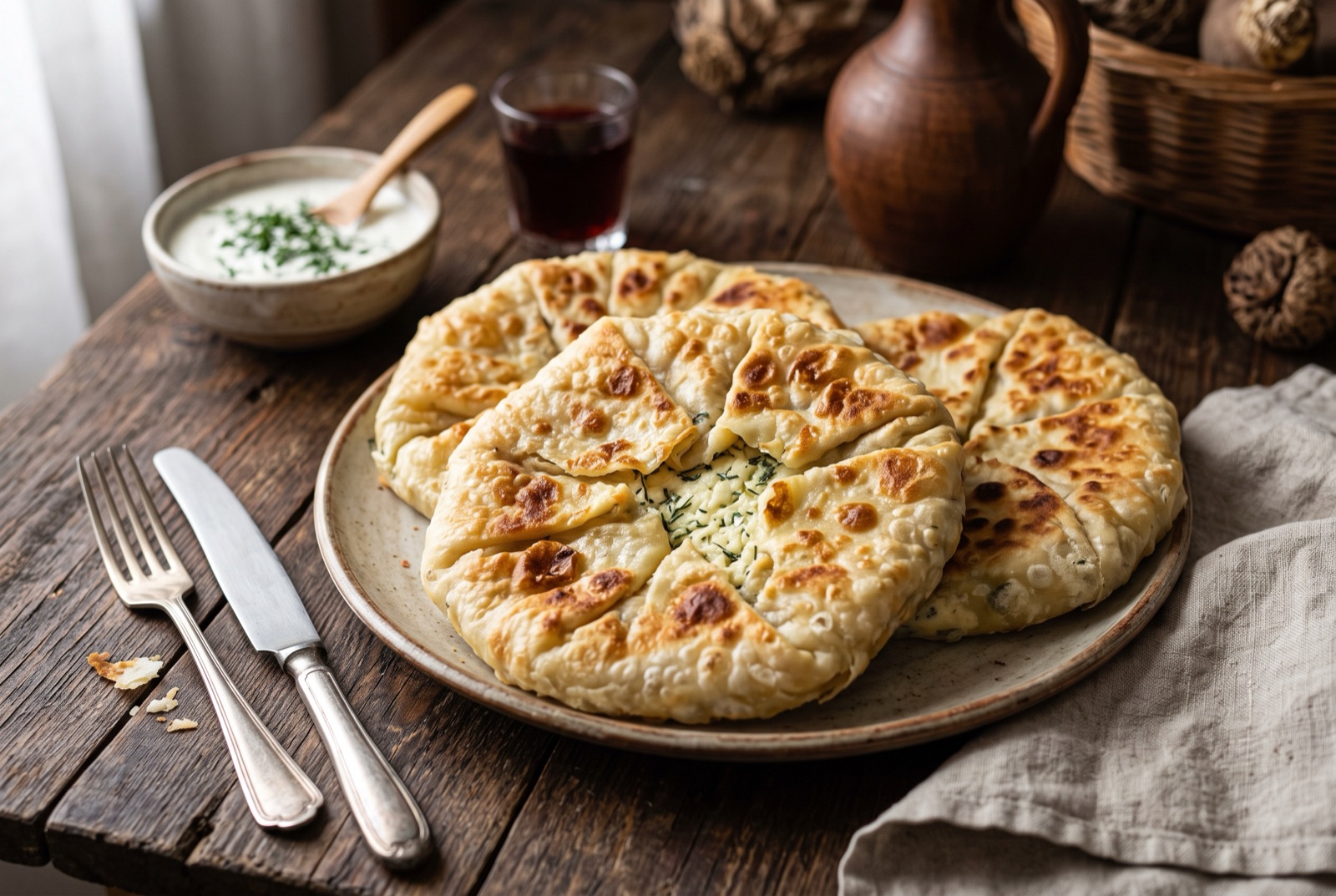
Plăcinte cu brânză are flat, palm-stretched pastries filled with salty white cheese and a lot of chopped dill, cooked in a dry or barely oiled pan until the surface blisters into dark freckles. They are chewy at the folds, crisp where the dough thinned out, and salty enough that one is never enough. The dough is nothing but flour, water, oil and salt — the whole craft is in resting it long enough that it stretches translucent without tearing. Moldovans eat them standing up at bus stations, wrapped in paper, and sitting down at home with a glass of cold buttermilk.

- Gate
- Moldova
- Prep
- 35 min
- Cook
- 25 min
- Total time
- 2 hr incl. 1 hr rest
- Serves
- 4
- Status
- Medium
- Nutrition / serving · estimated
- Calories 470 kcal
- Protein 18 g
- Carbs 52 g
- Fat 21 g
- Fiber 2 g
- Sodium 890 mg
Why this recipe works.
- A slack, oil-enriched dough that genuinely stretches thin at home without a pasta machine or special flour.
- Cooked dry in a pan the traditional way, so the pastry blisters instead of frying greasy.
- Honest cheese guidance: what brânză de oi actually is and which supermarket cheeses behave the same way.
- Makes eight pastries from one bowl of dough, and they reheat properly rather than going leathery.
Ingredients.
10 itemsFor the dough
For the filling
To finish
Equipment
- Large heavy frying pan or cast-iron skillet
- Mixing bowl
- Clean cloth for resting and stacking
Instructions.
Mix and knead the dough
Stir 400 g of flour with the salt, then work in the warm water and oil until a soft, slightly sticky dough comes together. Knead on an oiled surface for five minutes until it is smooth and elastic and stops sticking to your palms.
Rest until slack
Rub the dough with a little oil, cover the bowl with a cloth and leave it at room temperature for a full hour. It is ready when a poked finger leaves a dent that fills back in slowly rather than springing straight out.
Tip This rest is what makes the dough stretchable. Skipping it guarantees tearing.
Make the filling
Crush the crumbled cheese with the fresh curd, beaten egg, dill and a good grind of pepper until it holds together in a rough paste. Taste it — if the cheese is very salty, add a spoonful more curd rather than salting further.
Stretch each portion
Divide the dough into eight balls, oil them and rest ten more minutes. Flatten one on an oiled surface, then pull it outward from the centre with the backs of your hands until it is thin enough to see the surface through, about 30 cm across.
Tip Thick edges are fine — they end up in the folds and give you the chewy bite.
Fill and fold
Spoon an eighth of the filling into the middle of the sheet and fold the four sides over it like an envelope, overlapping well so no cheese can escape. Press the parcel gently flat with your palm to a rough square about 12 cm wide.
Cook in a dry pan
Heat a heavy pan over medium heat and wipe it with the barest film of oil. Cook each pastry for about 3 minutes a side, until it puffs in patches and the surface freckles dark brown, pressing lightly with a spatula so the middle makes contact.
Tip If the pastries brown before three minutes, drop the heat — the dough inside the folds needs the time.
Brush and stack
Brush each hot pastry with melted butter and stack them on a plate under a clean cloth while you cook the rest. Cut into squares and serve warm, when the cheese is still soft and the dough still pliant.
Tips from our kitchen.
- Rest the dough at least an hour. Under-rested dough springs back and tears the moment you stretch it — the wait does more than kneading.
- Oil your hands and the work surface instead of flouring them; flour makes the dough grip and rip, oil lets it slide out thin.
- Squeeze wet cheese in a clean cloth before mixing. A wet filling steams inside the pastry and bursts the seams in the pan.
- Cook over medium heat, not high. You want ten minutes of freckling and puffing, not a scorched outside over raw dough.
- Brush the finished pastries with butter while hot and stack them under a cloth — they soften into each other and stay pliable.
- If the dough tears while stretching, patch it with a scrap and fold that side inward. Nobody will find the repair.
Substitutions.
- Brânză de oi (salty sheep cheese) → Feta, drained and crumbled, mixed with a little quark or ricotta
- Feta alone can be too sharp and dry; a third of soft fresh curd brings it closer to the creamy-salty balance of the original.
- Fresh dill → Chopped green onion tops, or a mix of parsley and a pinch of dried dill
- Dill is the signature, but the pastry survives without it — dried dill is weak, so use twice as much as you would think.
- Sunflower oil in the dough → Any neutral oil, or melted lard for a richer, flakier result
- Sunflower is the Moldovan default and the country grows huge quantities of it.
Variations.
- Plăcinte cu cartofi
- The fasting version: filled with mashed potato fried with plenty of onion and black pepper, completely dairy-free and just as common.
- Plăcinte cu varză
- Shredded cabbage slowly cooked down with onion until sweet and deep gold, then folded in — the autumn filling.
- Plăcinte cu mere
- A sweet version with grated apple, sugar and cinnamon, dusted with icing sugar after cooking and eaten with tea.
Storage & reheating.
Best within hours of cooking. Keep leftovers stacked under a cloth at room temperature for a day, then refresh in a dry pan for a minute per side — the microwave turns them rubbery. They freeze well cooked: cool completely, layer with parchment, freeze up to two months, then reheat from frozen in a covered pan over low heat until the cheese is hot again.
Serve with
Cold buttermilk or kefir, or a bowl of zeamă — the classic pairing of sour soup and salty pastry.
The story behind Plăcinte cu Brânză.
Plăcinta is the oldest word in the Moldovan kitchen, and its ancestry is not in dispute: it descends from the Latin placenta, the flat cake of the Roman world, and the same root survives in Romanian, where plăcintă covers everything from these folded pan pastries to sweet baked pies. Moldova and Romanian Moldavia share the dish and argue only about shape and technique. Here the classic form is the square or round folded envelope, cooked on the stovetop rather than in an oven, which made it a dish any household could produce without a bread oven fired up.
The filling follows the calendar. Brânză de oi — salty, crumbly sheep cheese pressed and kept in brine — is the classic; in spring it shares the pan with young dill and green onion, in summer with fresh cow curd, in autumn with pumpkin or cabbage, and on fasting days with potato and onion so the pastry stays free of dairy. In villages where sheep were kept for milk rather than meat, brânză was the household protein, and folding it into dough was how a small quantity fed a whole table.
What makes the Moldovan version distinct is the stretching. The dough is rested until slack, then pulled by hand over the back of the knuckles until you can see the shadow of your fingers through it — the same instinct that produces strudel or yufka further west and south. It tears sometimes, and that is normal; you patch it, fold it, and the seam disappears in the pan. At markets in Chișinău women make them in a continuous production line, stretching, filling and flipping without pause, and the smell of scorched flour and hot cheese is the smell of a Moldovan street corner.
Questions, answered.
What is brânză de oi and where do I find it?
It is a salty white sheep cheese, pressed and stored in brine, made across Romania and Moldova and sold loose at markets. Eastern European delis carry it; if yours does not, drained feta blended with a little fresh curd or ricotta gives a very close result in both salt level and texture.
Why does my dough tear when I stretch it?
Almost always because it has not rested long enough for the gluten to relax, or because you floured the surface instead of oiling it. Give the dough a full hour covered at room temperature, work with oiled hands, and pull from the centre outward rather than yanking at the edges.
Do I fry these in oil?
No. Traditional plăcinte are cooked in a dry or very lightly oiled pan so the dough blisters and freckles rather than deep-fries. A thin film of oil on the pan is enough; too much fat makes the layers greasy and heavy instead of crisp.
Can I make the dough in advance?
Yes. It keeps refrigerated for up to two days in an oiled bowl under cling film, and it actually stretches better on day two. Bring it back to room temperature for about thirty minutes before shaping, or it will be stiff and fight you.
Can I bake them instead of using a pan?
You can, at 200°C for around 20 minutes brushed with oil, and they will be good — but they become a different pastry, drier and more bread-like. The stovetop method is what gives the chewy folds and the dark blistered patches that define the dish.
You might also like.
All recipes →
Keep exploring Moldova.
Moldova has 9 more dishes in the atlas — Alivenci and Chiftele Marinate, and 7 more.
Recipe by The DishRoute Kitchen · published August 20, 2026 · updated August 20, 2026