Aloo Paratha.
Punjabi Potato-Stuffed Flatbread
ਆਲੂ ਪਰੌਂਠਾ · Aloo paranthaa · say it: AH-loo puh-RAHN-thah
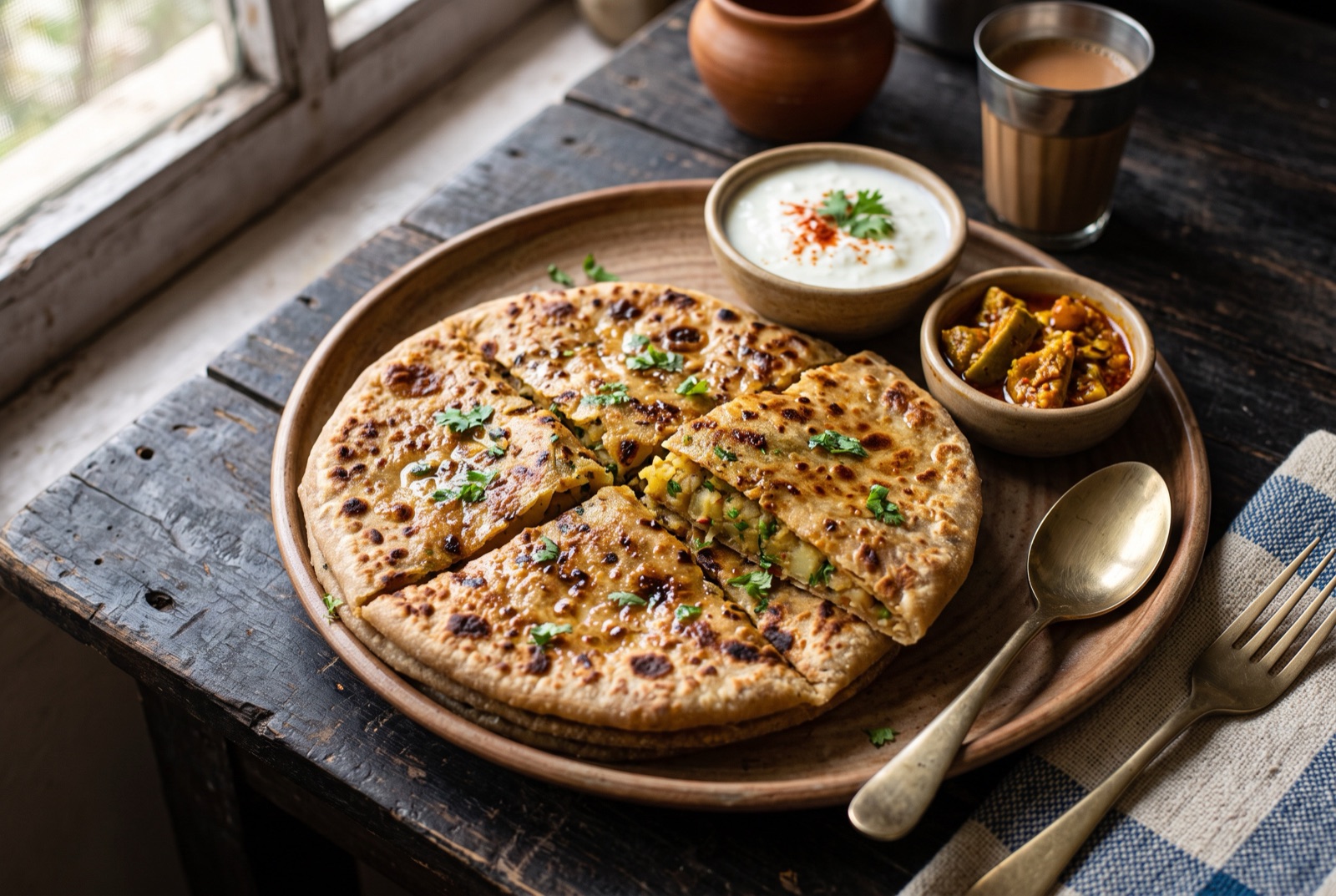
Aloo paratha is a whole-wheat flatbread with a seasoned potato filling sealed inside it, rolled out into a single thin round and cooked on a dry griddle with ghee brushed on as it puffs. Done well it has a soft, chewy crust freckled with dark blisters, and a filling that stays distinctly potato — warm, salty, sour with dried mango powder, prickly with green chile and carom seed — rather than dissolving into the bread. It is the standard Punjabi winter breakfast, eaten straight off the tava with a spoonful of cold yogurt, a knob of white butter melting on top, and a piece of mango pickle. Nothing about it is delicate, and that is the point.

- Gate
- IndiaPunjab
- Prep
- 35 min
- Cook
- 30 min
- Total time
- 1 hr 35 min incl. 30 min rest
- Serves
- 4
- Status
- Medium
- Nutrition / serving · estimated
- Calories 520 kcal
- Protein 13 g
- Carbs 72 g
- Fat 20 g
- Fiber 8 g
- Sodium 960 mg
Why this recipe works.
- A dry-filling method — potatoes boiled in their skins, cooled, no raw onion — so the paratha does not split as you roll it.
- Two sealing techniques explained, the pouch and the sandwich, with an honest verdict on which is easier for a beginner.
- Ghee added after the first flip, not before, which is what gets blisters instead of a greasy, pale bread.
- Dough hydration and rest times that give a soft paratha still edible an hour later, not a leathery one.
Ingredients.
19 itemsFor the dough
For the filling
To cook and serve
Equipment
- Flat cast-iron tava or heavy frying pan
- Rolling pin
- Potato masher
- Mixing bowls
Instructions.
Make and rest the dough
Mix the flour and salt in a bowl, rub in the melted ghee, then add the water a little at a time, gathering the flour into a shaggy mass. Knead for 5 minutes until it is smooth and noticeably soft — softer than bread dough, tacky enough to just cling to your palm. Cover with a damp cloth and rest 30 minutes.
Tip If the dough springs back hard when you press it, it needs more rest, not more flour.
Mash the potatoes dry
Peel the cooled boiled potatoes and mash them with a masher until no lumps remain — it should look like coarse dry crumbs holding together, not a wet purée. Spread the mash out on a plate for a few minutes if it feels at all damp.
Tip Do not use a blender or food processor. Potato starch turns gluey the moment it is whipped.
Season the filling
Fold in the ginger, green chiles, cilantro leaves, crushed cumin, ajwain, amchur, garam masala, chili powder and salt. Taste it — it should be assertively salty and sour on its own, because the plain dough around it will mute everything. Divide into 8 balls the size of a golf ball.
Stuff the dough
Divide the dough into 8 equal balls too. Roll one into a 10 cm disc, press the edges thinner than the centre, sit a filling ball in the middle, then draw the edges up and over it like a purse and pinch the top firmly shut. Flatten the sealed ball gently with your palm, seam side down.
Tip Thinner edges are the whole trick — pleating thick dough at the top gives you a lump of raw dough in the finished bread.
Roll it out
Dust the stuffed ball with dry flour and roll it out to about 20 cm, working from the centre outward with light pressure and turning it a quarter turn every few passes. If the filling breaks through, pinch the hole shut, dust that spot with flour and carry on — it will still cook fine.
Griddle dry, then add ghee
Set a tava or heavy pan over medium heat. Lay on the paratha dry and cook about 45 seconds, until the surface loses its raw sheen and small bubbles rise. Flip, brush the cooked side with half a teaspoon of ghee, and cook another minute until the underside shows dark brown blisters.
Tip Ghee goes on after the first flip, never before. Fat on a raw surface fries the dough pale and greasy instead of blistering it.
Press and finish
Flip once more, brush the second side with ghee, and press the paratha down gently with a folded cloth or spatula, moving around the surface — it should balloon in places and the seam should feel firm rather than soft. Cook a final 30–45 seconds, then stack the finished parathas in a cloth-lined bowl to keep them soft while you make the rest.
Serve immediately
Serve each paratha hot, with a spoonful of cold yogurt, a small knob of white butter melting on top and a piece of pickle on the side. They are meant to be eaten as they come off the pan, not assembled into a plated meal.
Tips from our kitchen.
- Boil the potatoes whole with the skin on, then peel them warm and let them cool completely before mashing. Cubed boiled potatoes take on water and make a filling that tears every dough you wrap it in.
- Never put raw onion or tomato in the filling. Salt draws water out of them within minutes and you will be rolling out a leaking parcel.
- Mash with a masher or grate the cold potatoes — never use a food processor, which turns them gluey.
- Rest the dough at least 20 minutes. Unrested dough springs back as you roll and forces you to press harder, which is exactly how the filling breaks through.
- Roll from the centre outward with light, even pressure and rotate the disc a quarter turn between passes. Bearing down on one spot is what makes a thin patch that bursts.
- Cook on medium, not high. High heat browns the outside before the dough inside the seam is cooked, and you get a raw doughy line through the middle.
Substitutions.
- Atta (Indian whole-wheat flour) → Regular whole-wheat flour, or half whole-wheat and half plain flour
- Atta is milled very finely from a soft wheat and gives a notably softer bread. Western whole-wheat is coarser — add an extra tablespoon or two of water and rest the dough longer.
- Amchur (dried mango powder) → 1 tsp lemon juice added at the end, or 1 tsp pomegranate seed powder
- Amchur is the sour note that keeps the filling from tasting flat. Lemon works but adds moisture, so mash the potatoes a little drier.
- Ghee → Neutral oil or vegan butter
- Makes the paratha vegan when served with a plant yogurt. Ghee browns better and is the traditional fat, but oil gives a perfectly good bread.
- Ajwain (carom seeds) → A pinch of dried thyme, or omit
- Ajwain has a sharp thyme-oregano note and is traditionally added because it is thought to help digest heavy potato. It is not essential to the flavour balance.
Variations.
- Mooli paratha
- Grated white radish instead of potato — squeeze it hard in a cloth first, since radish holds enormous amounts of water. Sharper and more peppery, and a Punjabi winter favourite.
- Paneer paratha
- Crumbled fresh paneer with green chile, ginger and cilantro. Richer, faster than boiling potatoes, and the filling is naturally dry enough to be forgiving.
- Sandwich method
- Roll two small discs, spread filling on one, cover with the second and press the edges together. It holds far more filling with far less risk of tearing, and it is how many cooks make them for a crowd.
Storage & reheating.
Parathas are best straight off the tava, but they keep well for a packed lunch: stack them, wrap the stack in a clean cloth and then in foil, and they stay soft for about 6 hours. Refrigerate up to 3 days and reheat on a dry hot pan for a minute a side — never in a microwave, which steams them soft and rubbery. You can also freeze uncooked stuffed parathas between sheets of parchment for 2 months and cook them straight from frozen over lower heat. The filling on its own keeps 2 days refrigerated.
Serve with
Cold plain yogurt or a thin salted chaas, and a knob of white butter placed on the hot bread so it melts in. Mango or lime pickle — the sour-salty kick is doing real work against a rich, starchy bread. Masala chai. This is a breakfast, and the tea is part of the dish as far as Punjab is concerned.
The story behind Aloo Paratha.
Parathas belong to the wheat belt. Punjab, Haryana and western Uttar Pradesh grow and eat wheat as their staple grain, and the paratha — a roti enriched with fat, folded and rolled so it cooks in layers — is the everyday breakfast bread of that region. Stuffing it turns a side dish into a meal, and there is a whole family of them: mooli paratha with grated radish, gobi with cauliflower, methi with fenugreek leaves, paneer, and in winter a version made with fresh green peas. Aloo is the most common of all, because potatoes are cheap, filling, and leftovers from last night are already boiled.
The cultural setting is as much roadside as domestic. Along the Grand Trunk Road, dhabas — truckers' roadside kitchens — serve stacks of parathas cooked to order on huge tavas, swimming in ghee, with a slab of white butter and a glass of lassi, and that image of Punjabi hospitality travelled with Punjabi migration across India and abroad. There is even a village in Punjab, and a lane in Old Delhi called Paranthe Wali Gali, where the entire business is frying parathas. Meanwhile the home version stays quieter: made in the morning, one at a time, eaten by whoever is at the table as it comes off the pan.
The technique has one genuine difficulty and everyone who cooks it has fought with it. Wet filling tears the dough. Punjabi cooks manage this by boiling the potatoes whole in their skins so they absorb no water, cooling them completely before mashing, and never adding fresh onion or tomato to the stuffing — both release liquid the moment they hit salt. Understand that one constraint and the rest is just rolling. A tear or two is normal even for someone who has made thousands; you patch it with a pinch of dry flour and keep going.
Questions, answered.
Why does my aloo paratha keep tearing when I roll it?
Nearly always a wet filling. Boil the potatoes whole in their skins so they do not soak up water, cool them completely before mashing, and leave out anything that releases liquid — raw onion, tomato, fresh coriander stems. The other two causes are overfilling and uneven rolling. Use a filling ball roughly the same size as the dough ball, no bigger, and roll with light even pressure, turning the disc as you go rather than flattening one area.
Can I make the filling and dough ahead of time?
Yes, and it makes a weekday breakfast realistic. The filling keeps 2 days in the fridge; bring it to room temperature before using, since fridge-cold mash is stiff and tears the dough. Dough can be made a day ahead, wrapped tightly and refrigerated, and it actually rolls better after a long rest. You can also stuff and roll the parathas fully, stack them between parchment, and freeze — cook from frozen on medium-low heat.
Why is my paratha hard instead of soft?
Three usual suspects: a dough that was too stiff, not enough resting, or too much heat. The dough should be noticeably softer than pasta or bread dough — tacky enough to just cling to your fingers — and it needs at least 20 minutes to relax. Cook on medium heat and take the bread off as soon as both sides are blistered; every extra minute on the pan drives out moisture and turns it into a cracker.
Do I need a tava or will a normal frying pan work?
A normal heavy frying pan works fine. A tava is simply a flat, uncoated cast-iron disc with no sides, which makes flipping easier and gives a more even surface heat. Cast iron of any shape is ideal; non-stick works but never gets the surface hot enough for really dark blisters. What matters most is that the pan is heavy enough to hold steady heat through six or eight parathas in a row.
Is this the same as a plain paratha or a laccha paratha?
No. A plain paratha is dough folded with ghee between the layers and rolled out, giving a flaky bread with no filling. Laccha paratha takes that further, pleating the dough into a coil so it cooks into many visible layers. Aloo paratha is a stuffed paratha: a single sealed pocket of dough around a filling, rolled flat. Different techniques, different textures, all Punjabi.
You might also like.
All recipes →
Keep exploring India.
India has 9 more dishes in the atlas — Butter Chicken and Chana Masala, and 7 more.
Recipe by The DishRoute Kitchen · published August 19, 2026 · updated August 19, 2026