Barbecued Prawns.
Garlic Butter King Prawns
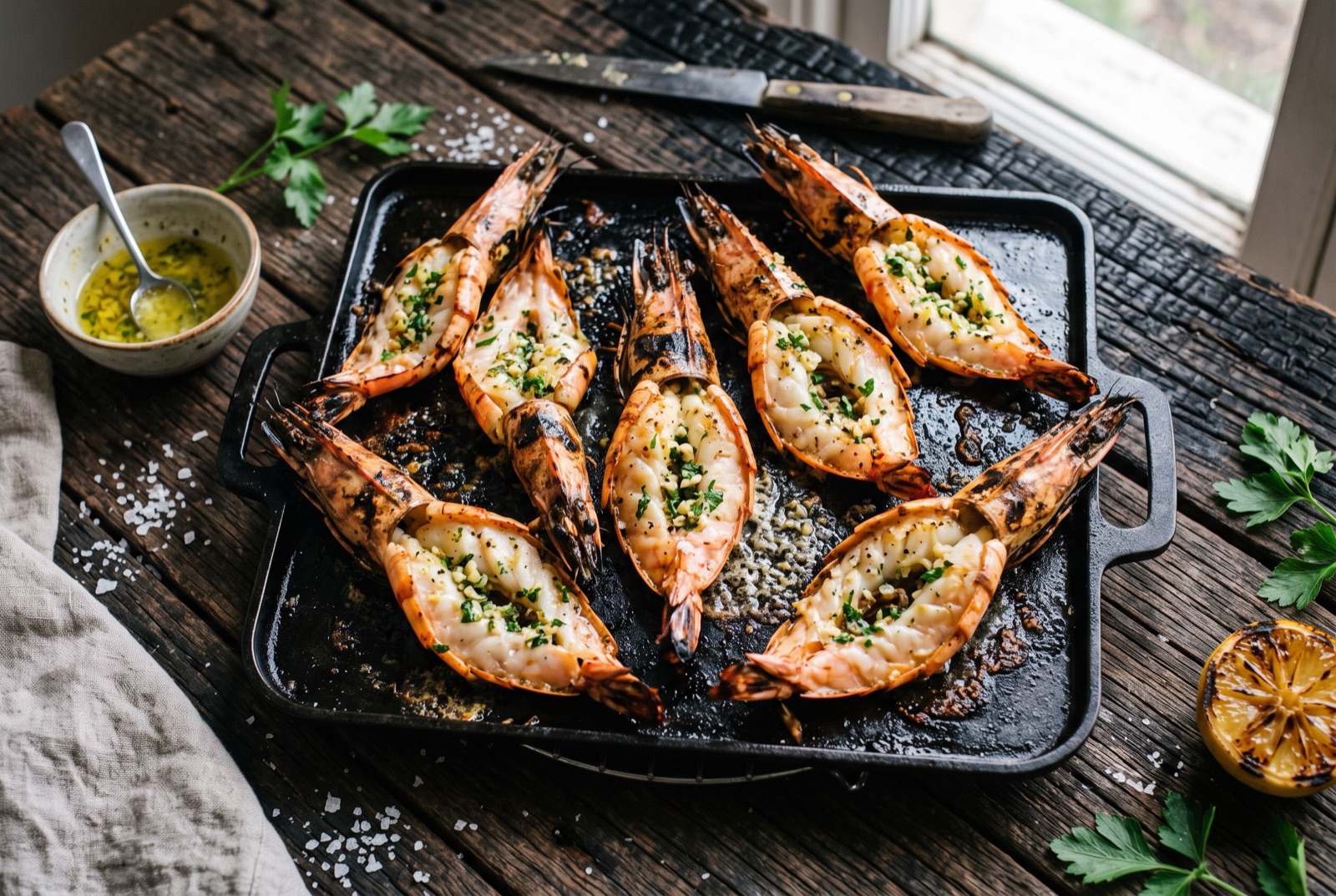
These are whole king prawns split along the back, shells left on, cooked flat on a barbecue until the flesh turns opaque and the shells char at the edges. The shell is doing real work — it shields the meat from the direct heat and traps the garlic butter against it, so the prawns steam in their own juices while the outside picks up smoke and colour. The result is sweet, briny, faintly smoky flesh that comes away from the shell in one piece, drenched in butter and lemon. Australians cook them like this all summer and especially at Christmas, when a tray of green prawns costs less than a roast and takes six minutes.

- Gate
- Australia
- Prep
- 20 min
- Cook
- 8 min
- Total time
- 28 min
- Serves
- 4
- Status
- Easy
- Nutrition / serving · estimated
- Calories 390 kcal
- Protein 42 g
- Carbs 3 g
- Fat 24 g
- Fiber 1 g
- Sodium 1100 mg
Why this recipe works.
- Butterflies the prawns in the shell, so the garlic butter reaches the flesh while the shell still protects it from scorching.
- Cooks shell-side down for most of the time — the shell acts as a heat shield and the meat gently steams instead of drying out.
- Gives a visual doneness cue (the C-versus-O test) rather than a minute count that changes with every prawn size.
- Six minutes of cooking, one bowl, and it scales straight from two people to a Christmas table.
Ingredients.
8 itemsFor the prawns
For the garlic butter
Equipment
- Kitchen scissors
- Barbecue flat plate or heavy grill pan
- Pastry brush
- Tongs
Instructions.
Split and devein the prawns
Working with one prawn at a time, run kitchen scissors along the back of the shell from head to tail, cutting about halfway into the flesh. Open the shell slightly and lift out the dark vein with the tip of a knife. Leave the heads and shells on and pat everything dry.
Tip Dry prawns colour; wet prawns steam. Give them a proper pat with paper towel.
Make the garlic butter
Beat the softened butter with the garlic, lemon zest, half the parsley, the chilli flakes if using and a good pinch of salt until completely smooth. Set half aside in a large serving bowl for tossing at the end and keep half for brushing.
Butter the prawns
Brush the brushing half of the garlic butter down the split backs of the prawns, pushing it into the cut so it sits directly against the flesh rather than on the shell. Let them sit at room temperature for 10 minutes.
Heat the barbecue properly
Bring a barbecue flat plate to high heat until a bead of oil shimmers and slides instantly across the surface. Wipe it with the olive oil on a folded paper towel held in tongs — it should smoke faintly.
Cook shell-side down
Lay the prawns split-side up, shell down, in a single layer and leave them undisturbed for 3–4 minutes, until the shells turn orange-pink and the butter pools and bubbles in the split. Do not move them before the shells have coloured.
Flip briefly and pull them off
Turn the prawns flesh-side down for 60–90 seconds only, just long enough to pick up a little colour, then lift them off while the flesh is opaque but the very centre still looks slightly glassy and each prawn has curled into a loose C, not a tight O.
Toss in the reserved butter
Tip the hot prawns straight into the bowl of reserved garlic butter, add the lemon juice and remaining parsley, and toss until everything is coated and the butter has melted into the pan juices. Serve immediately with lemon wedges and bread.
Tips from our kitchen.
- Buy green (raw) prawns, not pre-cooked. Cooked prawns reheated on a barbecue turn stringy and there is nothing to be done about it.
- Split the shell down the back with kitchen scissors, then cut into the flesh and pull the dark vein out — the split lets the butter in and helps them cook flat.
- Get the plate genuinely hot before the prawns land. A lukewarm barbecue poaches them in their own liquid and they never take colour.
- Cook shell-side down for about two-thirds of the total time and flesh-side down only briefly at the end.
- Pull them off when the flesh is opaque but the very centre still looks faintly glassy — carryover heat finishes the job on the platter.
- Keep a second bowl of the garlic butter aside, unheated, to toss the cooked prawns through before serving.
Substitutions.
- King prawns → Tiger prawns, banana prawns or large shell-on shrimp
- Anything from about 20 g up works. Below that the prawns overcook before the shells colour, so cook small ones on skewers instead.
- Barbecue plate → Ridged cast-iron grill pan over the highest burner you have
- Get it smoking before the prawns go on. You will lose the outdoor smoke but keep the char and the timing.
- Butter → Olive oil with an extra clove of garlic
- A dairy-free version that Mediterranean-Australian households often prefer. Olive oil also handles the high heat with less burning.
Variations.
- Chilli and lime prawns
- Swap the lemon for lime and add a finely chopped red chilli to the butter — the version most common on tropical Queensland barbecues.
- Cold Christmas prawns
- Not barbecued at all: the same prawns bought cooked, chilled, peeled at the table and eaten with lemon and seafood sauce. Half of every Australian Christmas prawn haul ends up this way.
- Garlic prawn skewers
- Peeled prawns threaded onto soaked bamboo skewers, which is easier for a crowd but loses the protection and flavour of the shell.
Storage & reheating.
Eat these within the hour. Cooked prawns keep 2 days refrigerated and are good cold in a salad or a prawn roll, but reheating makes them tough and there is no way around it. Raw green prawns should be cooked the day you buy them, or frozen immediately in their shells and thawed slowly in the fridge overnight — never under running water, which waterlogs the flesh.
Serve with
Crusty bread for the butter, lemon wedges, and a green salad — the bread is not optional if you want the pan juices.
The story behind Barbecued Prawns.
Prawns are the Australian celebration food, and the reason is the calendar. Christmas falls in high summer, nobody wants an oven going, and the seafood markets of every capital run around the clock through the last days of December — the Sydney Fish Market famously trades for thirty-six hours straight. Families queue for kilos of green king prawns, banana prawns and tiger prawns, half destined to be eaten cold with lemon and the rest headed for the barbecue.
A note on language, because it causes confusion abroad. In Australia they are prawns, not shrimp. Green does not mean unripe or herbed; it means raw. And no Australian has ever said "throw another shrimp on the barbie" outside of a 1984 tourism advertisement aimed at Americans, which the country has never entirely lived down.
The cooking is barely a recipe, which is the point. Australian barbecuing is done on a flat steel plate rather than an open grill, heated hard and wiped with oil, and the whole discipline is heat management plus knowing when to stop. Prawns give you a very narrow window: perfectly cooked and slightly translucent at the very centre one moment, chalky and squeaking the next. The old rule is that a prawn is done when it forms a loose C — a tight O means it has gone too far. Split the shells first so the butter reaches the meat, keep the barbecue hot, and stand there watching, because turning your back for two minutes is the only real way to ruin them.
Questions, answered.
How do I know when a prawn is cooked?
Watch the shape and the colour together. Raw prawns are straight and translucent; as they cook they curl and turn opaque white with orange-pink shells. A prawn curled into a loose C is done. If it has curled into a tight O it has gone too far and will be rubbery. Pull them off the heat a fraction early, because they keep cooking on the plate.
Should I peel them before or after cooking?
After. The shell shields the flesh from direct heat, keeps the garlic butter pressed against the meat, and adds a lot of flavour as it toasts. Splitting the back before cooking gives you the best of both — the seasoning gets in, and the peeled shell lifts away in one piece at the table. Provide finger bowls and paper napkins.
Can I use frozen prawns?
Yes, and most prawns sold in Australia have been frozen at some point anyway. Thaw them slowly in the fridge overnight in a colander set over a bowl so they drain, then pat them very dry. Prawns thawed in water or in a microwave release liquid onto the barbecue and steam rather than sear, which costs you all the colour.
Why are my prawns sticking to the barbecue?
The plate was not hot enough, or was not oiled. Protein grips metal until a crust forms, then releases on its own. Heat the plate until oil shimmers and moves quickly across it, oil it with a folded paper towel held in tongs, and do not try to move the prawns for the first ninety seconds — they will let go when they are ready.
What does "green prawns" mean?
It is the Australian term for raw, uncooked prawns, and has nothing to do with colour — green king prawns are grey-brown until they hit heat. Fishmongers sell green prawns alongside already-cooked ones, and for barbecuing you want green every time. Asking for green prawns in an Australian fish shop is completely standard.
You might also like.
All recipes →
Keep exploring Australia.
Australia has 9 more dishes in the atlas — ANZAC Biscuits and Aussie Meat Pie, and 7 more.
Recipe by The DishRoute Kitchen · published August 20, 2026 · updated August 20, 2026