Carpetbag Steak.
Oyster-Stuffed Grilled Sirloin
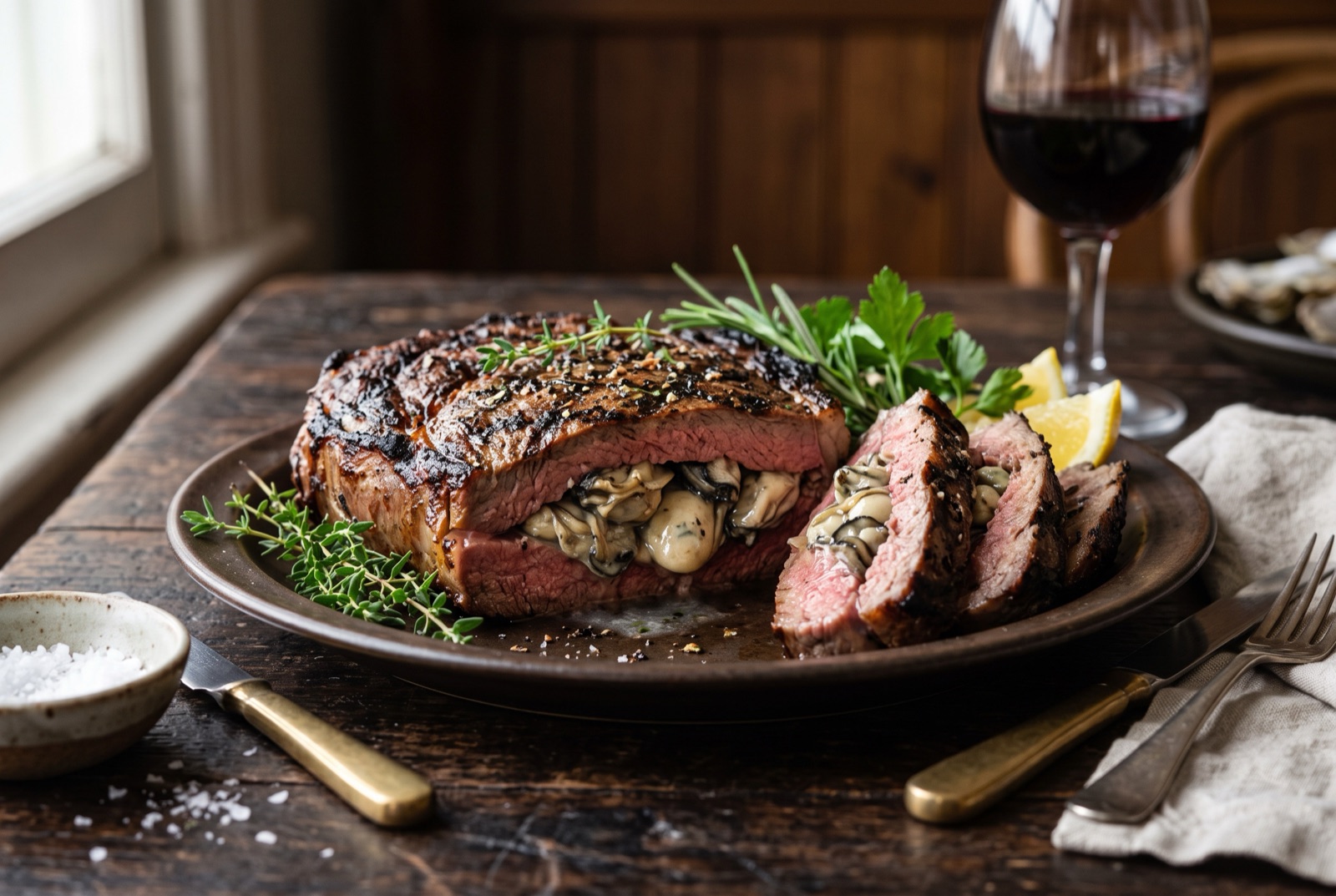
Carpetbag steak is a thick beef sirloin slit open along one side, stuffed with raw oysters, tied or skewered shut and cooked over fierce heat. What happens inside is the whole point: the oysters release their brine as the beef heats, and that liquor steams and bastes the meat from within, so the centre of the steak ends up saltier, wetter and more mineral than any beef gets on its own. Cut into it and the oysters have gone plump and just-set rather than shrivelled. It is a rich, faintly briny, slightly theatrical dish, and it needs a hot grill and a sharp knife more than it needs technique.

- Gate
- AustraliaNew South Wales
- Prep
- 25 min
- Cook
- 15 min
- Total time
- 48 min incl. 8 min rest
- Serves
- 2
- Status
- Takes skill
- Nutrition / serving · estimated
- Calories 780 kcal
- Protein 62 g
- Carbs 4 g
- Fat 57 g
- Fiber 1 g
- Sodium 1250 mg
Why this recipe works.
- Sears the sealed steak hard first, then finishes it gently, so the oysters poach rather than boil dry.
- Specifies a genuinely thick cut and explains why thinner steak cannot work for this dish.
- Uses the oyster liquor deliberately, folding it into the pan butter instead of pouring it away.
- Gives a clear internal-temperature target, since you cannot judge doneness by pressing a stuffed steak.
Ingredients.
10 itemsFor the steak
For the pan butter
Equipment
- Small sharp boning knife
- Wooden toothpicks or butcher's twine
- Cast-iron pan or charcoal barbecue
- Probe thermometer
Instructions.
Temper the beef
Take the steaks out of the fridge a full 45 minutes before cooking and leave them uncovered on a rack. A cold centre is the main reason stuffed steaks end up overcooked outside and raw inside.
Cut the pocket
Lay a steak flat and insert a small sharp knife horizontally into one long side, about halfway up. Work the blade side to side inside the meat to open a wide cavity while keeping the entry slit no more than 5 cm across. Repeat with the second steak.
Tip Keep the knife tip away from the far edge — piercing through the other side means the filling escapes.
Stuff and seal
Pat the shucked oysters dry, reserving every drop of liquor. Slide six oysters into each pocket, distributing them evenly rather than stacking them at the opening, then close the slit with soaked toothpicks or tie the steak with twine. Season the outside heavily with salt and cracked pepper.
Sear hard on both sides
Heat a cast-iron pan or barbecue plate until a drop of water vanishes instantly. Add the oil and sear each steak for 3 minutes a side without moving it, until a dark, dry crust forms and the meat lifts cleanly from the pan. Sear the fat edge for another minute, holding the steak upright with tongs.
Finish gently to temperature
Drop the heat to medium-low, add the butter, garlic and thyme, and baste the steaks with the foaming butter for 4–6 minutes, turning every minute. Probe through the side into the beef, avoiding the stuffing, and pull the steaks at 50°C for medium-rare.
Tip The pocket will feel firm and slightly swollen when the oysters have set — a spongy, loose feel means it needs another minute.
Rest, then build the pan butter
Move the steaks to a warm board and rest for 8 minutes. Meanwhile pour the reserved oyster liquor and the lemon juice into the hot pan, swirl it into the butter until it looks glossy and slightly thickened, then stir in the parsley.
Slice and serve
Remove the toothpicks or twine and slice each steak thickly across the grain so every slice shows beef and oyster. Spoon the pan butter over the cut faces and serve at once with lemon wedges.
Tips from our kitchen.
- The steak must be at least 4 cm thick. Anything thinner has no pocket depth and the oysters cook to rubber before the beef colours.
- Cut the pocket with a small, thin knife from one side only, keeping the opening narrow and the cavity wide, so nothing escapes during cooking.
- Pat the oysters dry before they go in but keep their liquor — it goes into the pan butter at the end.
- Bring the steak fully to room temperature, a good 45 minutes out of the fridge, or the middle stays cold while the outside overcooks.
- Use a probe thermometer through the side of the steak into the beef, not into the stuffing, and pull it at 50°C for medium-rare.
- Rest the steak 8 minutes before slicing so the juices redistribute and the oysters settle instead of flooding the board.
Substitutions.
- Fresh oysters → Fresh scallops or large prawns, halved
- Not traditional, but they behave similarly in the pocket. Scallops in particular stay sweet and just-set at the same doneness as medium-rare beef.
- Sirloin → Thick-cut rump, scotch fillet or eye fillet
- Eye fillet gives the neatest pocket but the least beef flavour. Rump is cheaper and works if it is well aged and cut thick.
- Charcoal barbecue → Heavy cast-iron pan finished in a 200°C oven
- You lose smoke but gain temperature control, which matters more here than char does.
Variations.
- Carpetbag with bacon
- A rasher of bacon wrapped around the steak before grilling, holding the pocket closed and adding smoke. Common in 1970s pub versions.
- Bearnaise finish
- Served with bearnaise instead of pan butter — the classic steakhouse pairing, and the tarragon works well against the oyster brine.
- Oyster-topped instead of stuffed
- For cooks who do not want to cut a pocket: grill the steak plain and lay lightly warmed oysters and browned butter over the rested meat.
Storage & reheating.
This is a cook-and-eat-now dish. Stuffed raw steaks can be prepared up to 4 hours ahead and kept covered in the fridge, but no longer — the oyster liquor starts to cure the beef around it. Leftover cooked steak keeps 2 days refrigerated and is best eaten cold, sliced thin into a salad, since reheating destroys the oysters entirely. Do not freeze at any stage.
Serve with
Chips or a baked potato, and something sharp — watercress, a lemon-dressed salad — to cut the richness.
The story behind Carpetbag Steak.
Carpetbag steak belongs to a particular era of Australian restaurant dining — roughly the 1950s through the 1970s — when Sydney had abundant cheap oysters, a growing steakhouse culture, and an appetite for dishes that arrived at the table looking like an event. The name comes from the bulging shape of the stuffed steak, likened to a carpet bag. Versions of the surf-and-turf idea existed elsewhere, but the oyster-stuffed steak became strongly associated with Australia and New Zealand, where Sydney rock oysters and Bluff oysters were plentiful enough to be treated as a stuffing rather than a luxury.
It then went out of fashion almost completely. Oysters got more expensive, mid-century restaurant food became a punchline, and a whole generation of Australian cooks knew carpetbag steak only as something their parents ordered on anniversaries. Its recent return is partly nostalgia and partly the discovery that the original logic is sound: oysters cooked briefly inside meat are a genuinely good idea, and the combination of hot beef fat and cold oyster liquor produces something neither ingredient does alone.
The honest warning is that this dish punishes carelessness at both ends. Overcook the steak and the oysters turn to grey rubber and weep their liquid away; undercook it and the pocket is cold and unpleasant. The steak also has to be genuinely thick — four centimetres minimum — or there is nowhere to put the oysters and no thermal buffer between the grill and the filling. Buy good beef, buy oysters that smell of clean seawater, and accept that this is a dish for two or four people, not a crowd.
Questions, answered.
Do the oysters actually cook inside the steak?
Yes — they poach in their own liquor and the beef juices, which is why the pocket must be sealed. At medium-rare the oysters come out plump and just set, roughly like a lightly poached egg white. If the steak reaches well-done the oysters overshoot badly and turn firm and grey, so the doneness of the beef and the quality of the filling are locked together.
How thick does the steak need to be?
At least 4 cm, and 5 cm is better. The thickness does two jobs: it gives a cavity deep enough to hold six oysters without bulging open, and it puts enough beef between the grill and the stuffing that the outside can char while the centre only reaches medium-rare. A 2 cm steak simply cannot do this dish.
Can I use tinned or smoked oysters?
Smoked oysters were used in some 1970s versions and give a much stronger, sweeter, distinctly retro result — usable, but a different dish. Tinned plain oysters are not recommended: they are already cooked, so they only toughen further inside the steak and contribute little liquor, which is the whole mechanism this recipe relies on.
How do I keep the pocket closed?
Cut a narrow opening and a wide cavity, so the meat naturally wants to close. Then secure it with two or three wooden toothpicks soaked in water, or tie the steak around its circumference with butcher's twine. Do not overfill — the pocket should close without tension, or it will gape open on the grill and the oysters will spill.
Why is it called carpetbag steak?
The name refers to the shape: a steak stuffed until it bulges resembles an old-fashioned carpet bag, the soft-sided travelling bag made from carpet fabric. The dish is strongly associated with mid-twentieth-century Australian and New Zealand restaurant menus, when local oysters were cheap enough to use as a filling rather than served on their own.
You might also like.
All recipes →
Keep exploring Australia.
Australia has 9 more dishes in the atlas — ANZAC Biscuits and Aussie Meat Pie, and 7 more.
Recipe by The DishRoute Kitchen · published August 20, 2026 · updated August 20, 2026