Bazin.
Libyan Barley Dough Dome with Lamb Sauce
بازين · say it: bah-ZEEN
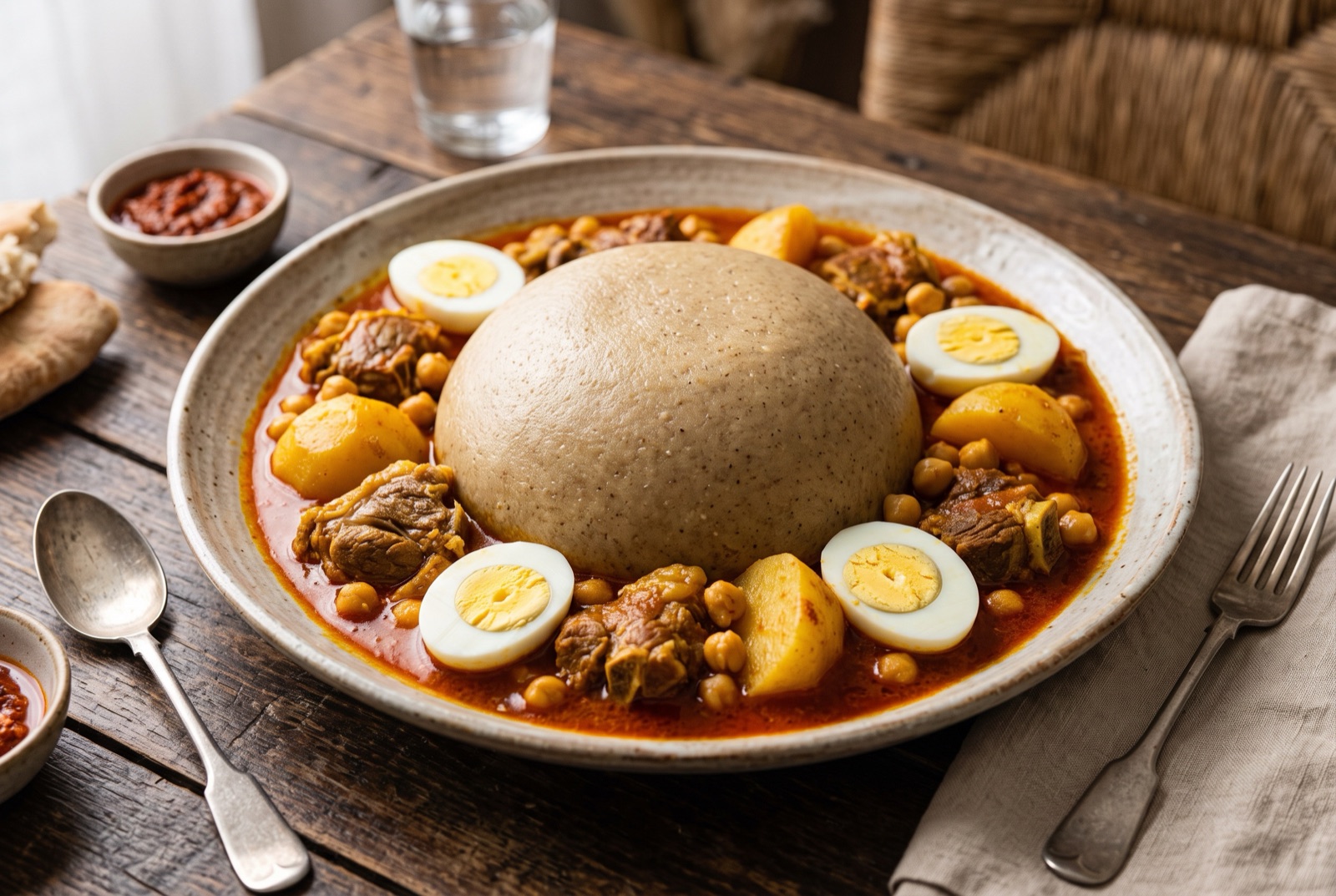
Bazin is unsalted barley dough, cooked stiff and beaten smooth, that sits like a small hill in the centre of a wide platter while a dark lamb-and-tomato sauce is poured around its base. The dough itself tastes of almost nothing — faintly nutty, faintly bitter from the barley — and that is the point: it is the neutral, filling thing that carries a sauce heavy with turmeric, cinnamon-warm hararat and fried tomato paste. Everyone at the table works from their own wedge, pinching off a piece, pressing a dent into it with the thumb, and dragging it through the sauce. Potatoes, chickpeas and hard-boiled eggs sit in the liquid as the rest of the meal. It is celebration food and it is deeply everyday food at once.

- Gate
- LibyaTripolitania and the Nafusa Mountains
- Prep
- 25 min
- Cook
- 1 hr 35 min
- Total time
- 2 hr
- Serves
- 6
- Status
- Takes skill
- Nutrition / serving · estimated
- Calories 690 kcal
- Protein 36 g
- Carbs 74 g
- Fat 26 g
- Fiber 10 g
- Sodium 820 mg
Why this recipe works.
- Uses the real two-stage method — steam the flour undisturbed first, then beat — instead of stirring it into lumps from the start.
- A sauce built on properly fried tomato paste, so it tastes round and sweet rather than sharp and tinned.
- Explains how to get a smooth dome without a magraf stick, using equipment an ordinary kitchen already has.
- Cuts the barley with a little plain flour, which makes a first attempt far more forgiving without changing the flavour much.
Ingredients.
18 itemsFor the sauce
For the dough
Equipment
- Heavy pot for the dough with a tight lid
- Sturdy wooden spoon or rolling pin for beating
- Wide serving tray or shallow bowl
- Large casserole for the sauce
Instructions.
Brown the lamb
Heat the olive oil in a large casserole over medium-high heat and brown the lamb in two batches, turning only when each side has taken real colour and releases from the pan without tearing. Lift the meat out and set it aside.
Fry the tomato paste
Lower the heat, soften the onion in the same fat for 8 minutes until translucent, then add the garlic and the tomato paste. Keep frying and scraping for 3 to 4 minutes, until the paste turns brick-dark and the oil around it runs bright orange rather than red.
Tip This is the step that decides the sauce. Underfried paste tastes metallic and stays sharp no matter how long you simmer it.
Build and simmer the sauce
Stir in the turmeric, hararat, paprika and chilli flakes for 30 seconds, return the lamb, pour in the 1.4 litres of water and season with salt. Bring to a simmer, cover loosely and cook for 50 minutes, until the meat gives easily under a spoon.
Add potatoes, chickpeas and eggs
Slide in the halved potatoes, the chickpeas and the whole eggs in their shells. Simmer uncovered for 20 minutes more, until the potatoes are tender to a knife tip and the sauce has reduced to the consistency of thin gravy. Lift the eggs out, peel them and set aside.
Steam the barley flour
While the sauce finishes, bring the 900 ml of water and 1 teaspoon of salt to a rolling boil in a heavy pot. Mix the barley and plain flours, then rain them in from a height in a steady stream without stirring. Cover tightly, drop the heat to its lowest setting and leave completely undisturbed for 15 minutes.
Tip Resist stirring here. The flour needs to sit and hydrate as a mound; any early poking is what creates lumps.
Beat the dough smooth
Uncover and start working the mass hard against the side of the pot with a thick wooden spoon, folding and pressing rather than stirring. After 3 to 5 minutes it should stop looking like wet porridge and come together as one dense, elastic dough that pulls away from the pot in a single lump and no longer smells of raw flour.
Tip If it fights you, add a splash of the hot cooking water — never cold water, which seizes the dough.
Shape the dome
Wet your hands in cold water, tip the dough into a bowl and press and turn it into a smooth, rounded dome, re-wetting your palms whenever it starts to grab. Invert the bowl onto the centre of a wide serving tray so the dome sits proud in the middle with its surface glossy and crack-free.
Assemble and serve
Ladle the sauce and its meat, potatoes and chickpeas around the base of the dome until the liquid reaches roughly a third of the way up, and never over the top. Halve the peeled eggs and arrange them around the rim, then bring the tray to the table and eat straight from it by hand.
Tips from our kitchen.
- Buy barley flour, not pearl barley — grinding your own rarely gets fine enough, and coarse flour makes a gritty dome.
- Keep a bowl of cold water beside you when shaping. Wet hands and a wet spoon are the only way the dough will not stick to everything.
- Beat the dough while it is still very hot. Once it cools it stiffens fast and you will never work the lumps out.
- Taste the sauce for salt before the dome goes in — the dough is unsalted, so the sauce has to season the whole plate.
- Pour the sauce around the dome, not over it. A drowned bazin turns slack and slides apart when people tear at it.
- If the dough seems too stiff to beat, splash in a few tablespoons of the boiling cooking water rather than cold water.
Substitutions.
- Barley flour → Half wholemeal wheat flour, half plain flour
- The texture works and the dome holds, but you lose the faint bitterness that makes bazin taste like bazin. Middle Eastern and health-food shops carry barley flour cheaply.
- Lamb shoulder → Bone-in goat, or beef chuck cut into 4 cm pieces
- Goat is common in Libya and needs the same timing. Beef needs about 30 minutes longer before it gives way.
- Hararat → 1 tsp cinnamon plus ½ tsp each black pepper, nutmeg and ground cloves
- Hararat blends vary between households anyway, so a home mix is genuinely close rather than a compromise.
Variations.
- Bazin with dried okra
- Stir a handful of dried okra into the sauce with the chickpeas. It thickens the liquid and adds a slight ropiness that many Libyan cooks consider the better version.
- Meatless bazin
- Skip the lamb and build the sauce on chickpeas, potato and plenty of fried tomato paste. Common in lean weeks and during fasting, and it works because the dough was never the meaty part.
- Bazin with lamb shanks
- Use two whole shanks instead of diced shoulder and simmer for two and a half hours, so the meat is pulled apart at the table rather than served in cubes.
Storage & reheating.
The sauce keeps 3 days refrigerated and improves overnight, so make it ahead if you are cooking for a crowd. The dough does not keep well — it hardens into a dense brick within hours and never fully softens again — so cook it fresh on the day. Leftover dome can be broken into a bowl, covered with hot sauce and microwaved briefly; it will be edible but noticeably heavier. Freeze the sauce alone for up to 2 months.
Serve with
A bowl of harissa or crushed dried chilli in oil, a plain chopped salad of tomato, cucumber and onion, and green tea afterwards.
The story behind Bazin.
Barley is the older grain of North Africa, sown where wheat struggles and harvested by communities who could not count on rain. Bazin belongs to that economy — flour, water, salt and fuel, plus whatever sauce the household could afford to build around it — and it survives today as the dish Libyans name first when asked what their country eats. It appears at weddings and circumcisions, at Eid tables, on the Friday platter after prayers, and in the middle of an ordinary week when a big pot of lamb sauce needs something to sit in.
Making it properly is a physical job. The flour is rained into boiling water and left to steam undisturbed, then worked with a wooden stick — the magraf — against the side of the pot until the dough stops being lumpy porridge and becomes one elastic mass that pulls away cleanly. Libyan cooks judge it by sound and resistance rather than by the clock, and the beating is hard enough that it is often the household task nobody volunteers for. The dome is then shaped with wet hands, always smooth, always centred; a lopsided bazin gets commented on.
Related barley doughs exist across the Maghreb — Tunisia and Algeria have their own versions under close variants of the same name, and versions turn up in parts of the Arabian Peninsula too — so this is a shared regional idea rather than an exclusively Libyan invention. What Libya has made distinctly its own is the surrounding sauce and the etiquette: sauce poured to a level, never over the dome; eggs halved and placed around the rim; and each diner keeping strictly to the sector of the tray in front of them. Eating across someone else's territory is the one rule everyone learns young.
Questions, answered.
Why is my bazin dough full of lumps?
Almost always because the flour was stirred in too early or too fast. Barley flour must be sprinkled into boiling water and then left completely alone under a lid for around 15 minutes to hydrate and steam. Only then does the beating start, and it needs to be vigorous — pressing and folding the mass against the side of the pot for several minutes, not gentle stirring.
Can I make bazin without a magraf stick?
Yes. A sturdy wooden spoon with a thick handle, or a small rolling pin, does the same job as the traditional stick. What matters is that the tool is strong enough not to snap and that you work the dough hard against the pot wall while it is still very hot. A stand mixer with a dough hook can also be used on low speed for about two minutes.
Is bazin supposed to taste bland?
The dough itself is meant to be plain — it is cooked with only water and a pinch of salt, and its job is to soak up sauce rather than compete with it. All the seasoning lives in the surrounding lamb, tomato and hararat sauce, which is why that sauce should be assertively salted and spiced when you taste it on its own.
What is hararat and can I buy it?
Hararat is the standard Libyan warm-spice blend, usually built from cinnamon, turmeric, black pepper, cloves and nutmeg, sometimes with ginger or cardamom. Recipes differ from family to family, so there is no single correct formula. Middle Eastern grocers sell it under hararat or bzaar, and a home mix of those ground spices is perfectly acceptable.
How do Libyans actually eat bazin at the table?
Everyone sits around a single wide tray and eats with the right hand from the wedge of dough directly in front of them, tearing off a piece, pressing a hollow in it and using it to scoop sauce. Reaching across into someone else's section is the main breach of etiquette. The eggs, potatoes and meat in the sauce are shared out towards the end of the meal.
You might also like.
All recipes →
Keep exploring Libya.
Libya has 9 more dishes in the atlas — Bsisa and Couscous bil Bosla, and 7 more.
All Libya recipes Lamb recipes Tomato paste recipes Potato recipes maindairy freehalal friendlynut freeRecipe by The DishRoute Kitchen · published August 20, 2026 · updated August 20, 2026