Usban.
Libyan Herb and Rice Stuffed Sausage
عصبان · say it: oos-BAAN
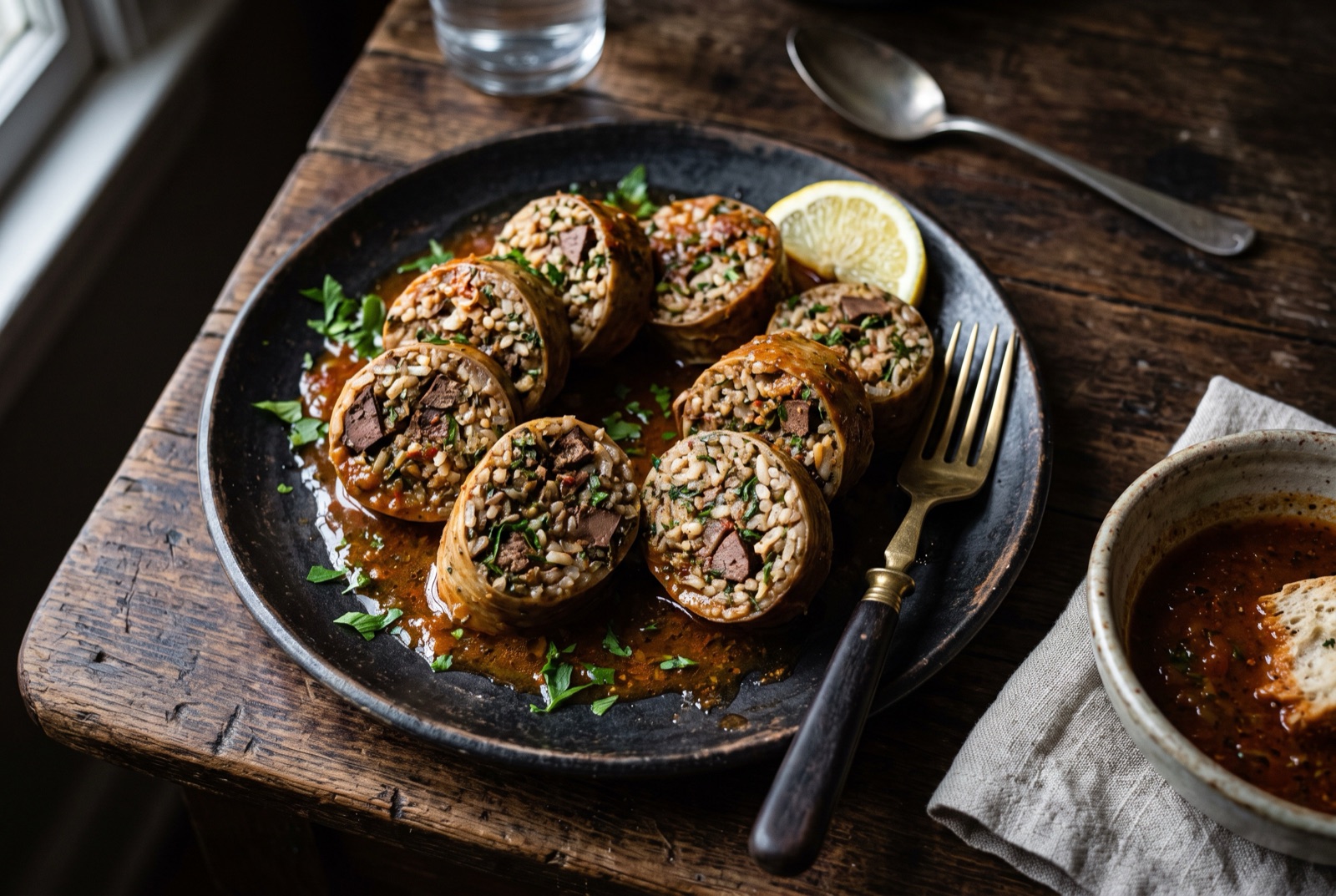
Usban is a stuffed sausage that leans on herbs rather than meat for its character. The filling is mostly rice and finely chopped parsley and mint, bound with minced lamb, chopped liver and a little fat, seasoned with hararat and turmeric, then loosely packed into cleaned tripe or casing and simmered for two hours in a tomato sauce that eventually thickens around it. Cut into coins, each slice is dark green flecked with rice, tender rather than springy, tasting of herbs, warm spice and the sauce it cooked in. It takes a full afternoon and it is the dish Libyan cooks are quietly proudest of.

- Gate
- Libya
- Prep
- 50 min
- Cook
- 2 hr 5 min
- Total time
- 3 hr 10 min incl. 15 min rest
- Serves
- 6
- Status
- Takes skill
- Nutrition / serving · estimated
- Calories 530 kcal
- Protein 28 g
- Carbs 40 g
- Fat 27 g
- Fiber 4 g
- Sodium 880 mg
Why this recipe works.
- Sets the rice-to-herb ratio that keeps the filling green and light instead of dense and stodgy.
- Fills the casing to two-thirds and pricks it during cooking — the two habits that stop usban from bursting.
- Includes a cheesecloth method for cooks whose butcher cannot supply tripe, with an honest note on what changes.
- Cleans the casing properly with salt, flour and vinegar, which is what separates good usban from the version people remember badly.
Ingredients.
20 itemsFor the casing
For the filling
For the sauce
Equipment
- Large heavy pot with a lid
- Kitchen string and a trussing needle
- Funnel or wide spoon for stuffing
- Sharp knife
Instructions.
Clean the casings
Scrub the tripe and casings inside and out with coarse salt and flour, rinsing under cold water between rubs, then soak them for 20 minutes in cold water with the vinegar. Rinse once more; the casing should feel slippery-clean and smell almost neutral.
Mix the filling
Combine the rinsed rice, minced lamb, chopped liver, parsley, mint, spring onion, grated onion, hararat, turmeric and olive oil in a large bowl with a generous teaspoon of salt. Toss with your hands until the mixture is uniformly green and no clumps of rice remain white.
Stuff loosely and tie
Spoon the filling into the casings until each is two-thirds full and still visibly slack, then tie both ends with kitchen string, leaving no tension in the knot. Sew or knot any open seams in the tripe so the filling cannot escape.
Tip If it feels firm in your hand it is already too full — take some out.
Build the sauce
Heat the olive oil in a large pot, soften the chopped onion, then fry the tomato paste with the garlic and chilli for 3 minutes until it darkens and the oil runs orange around the edges. Add the water, season with salt and pepper and bring to a gentle simmer.
Simmer and prick
Lower the stuffed casings into the sauce so they are covered, and keep the pot at the barest simmer with the lid ajar. After 25 minutes, when the sausages have plumped and tightened, prick them in six or seven places with a needle — you should see a thin jet of steam escape each hole.
Cook through
Continue simmering for a further 90 minutes, turning the sausages once or twice, until a skewer pushed into the thickest part meets no resistance and the sauce has reduced to a thick, glossy coat. Top up with hot water if the level drops below the sausages.
Rest and slice
Turn off the heat and let everything sit in the pot for 15 minutes so the filling firms up. Lift the sausages onto a board, cut them into 2 cm coins with a sharp knife, arrange on a platter and spoon the reduced sauce over the top.
Tips from our kitchen.
- Order tripe and casings from a halal butcher a few days ahead; they are rarely on display but almost always available on request.
- Chop the herbs by hand rather than in a processor, which bruises them into a wet paste and dulls the colour.
- Rinse the rice until the water runs clear, otherwise the surface starch glues the filling into a solid plug.
- Leave the filling loose enough to feel slack through the casing — it should sag, not feel firm, before it goes into the pot.
- Keep the sauce at a bare simmer. A rolling boil is the second most reliable way to split a casing.
- Let the cooked usban sit in the sauce for 15 minutes before slicing, so the coins hold together under the knife.
Substitutions.
- Tripe or intestine casing → A double layer of cheesecloth, rolled and tied tightly at both ends
- The filling cooks through and slices fine, and the flavour of the stuffing is unaffected. What you lose is the soft, gelatinous casing itself, which for many people is the point of the dish.
- Lamb liver → Chicken livers, or simply more minced lamb
- Chicken liver is milder and easier to find. Leaving liver out entirely makes a lighter usban that some households prefer anyway.
- Fresh mint → 1 tbsp dried mint
- Add it with the spices rather than the fresh herbs. Dried mint is deeper and less bright, and the filling will be a shade less green.
Variations.
- Usban with chickpeas in the sauce
- Add a cup of cooked chickpeas and a couple of halved potatoes to the tomato sauce for the last 40 minutes, turning the pot into a complete one-dish meal.
- Rice-only filling
- Some cooks skip the minced meat entirely and bulk the filling with more rice, herbs and a little rendered fat. Cheaper, lighter, and closer to how the dish would have been made in leaner years.
- Fried usban slices
- Cook the sausage a day ahead, chill it firm, then slice and pan-fry the coins in a little oil until the edges crisp before returning them to warm sauce.
Storage & reheating.
Usban keeps 3 days refrigerated in its sauce and is arguably better on day two, when it firms up and slices cleanly. Reheat the whole sausage or the sliced coins gently in the sauce over low heat, adding a splash of water if it has tightened. It freezes well for up to 2 months — freeze it whole in sauce rather than sliced, and defrost fully in the fridge before reheating so the casing does not tear.
Serve with
Plain white rice or bread to catch the sauce, and a sharp salad of tomato, onion and lemon to cut the richness.
The story behind Usban.
Every part of a slaughtered animal has a use in traditional Libyan cooking, and usban is what happens to the stomach and intestines. It is at its most common around Eid al-Adha, when households that have sacrificed a sheep suddenly have all the raw material at once, and the offal work happens the same day while everything is still fresh. Older relatives usually take charge of cleaning and stuffing, partly because it is exacting work and partly because it is the kind of knowledge that gets handed down by watching.
The same dish exists next door under a close name — Tunisian osbane is built on the same principle, and versions turn up in Algeria too — so this is a Maghrebi tradition rather than a Libyan exclusive. The Libyan filling is defined by its herb ratio: parsley and mint are used in a volume that looks reckless until they cook down, and the finished slice should read green, not brown. Rice, not breadcrumbs, does the binding, and it must go in undercooked and loosely packed because it swells to nearly double inside the casing.
That swelling is the reason usban has a reputation for going wrong. Overfill the casing and it splits in the pot, spilling the filling into the sauce and turning two hours of work into a rice stew — perfectly edible, and Libyans have a resigned name for that outcome, but not what anybody set out to make. The fix is old and simple: fill to two-thirds, tie the ends without tension, and prick the casing with a needle in a few places once it plumps up in the first half hour of simmering, so steam escapes instead of building.
Questions, answered.
How do I clean tripe and casings properly?
Turn the casing inside out where possible, then rub it hard with coarse salt and plain flour and rinse under cold running water. Repeat two or three times, then soak for twenty minutes in water with a good splash of vinegar or the juice of two lemons. Done properly the casing should smell faintly of nothing much; if it still smells strong, repeat the salt-and-flour scrub.
Why did my usban burst in the pot?
Almost certainly overfilling. Rice roughly doubles in volume as it cooks, so the casing must be filled to no more than two-thirds and tied loosely enough that there is slack. Pricking the casing with a needle in several places once it plumps up during the first half hour lets steam escape. Keeping the sauce at a gentle simmer rather than a boil also matters a great deal.
Can I make usban without tripe?
Yes. Roll the filling tightly in a double layer of cheesecloth, tie both ends and the middle with kitchen string, and simmer it in the sauce for the same length of time. You get the same herb-and-rice interior and the same slices, but not the soft gelatinous casing, which is a real part of the dish for people who grew up with it.
How long does usban actually need to cook?
Around two hours at a bare simmer. The rice inside needs far longer than it would in an open pot because it is cooking in a sealed, crowded environment. Test by pushing a skewer into the thickest part: it should slide in with no grit or resistance, and the casing should feel tender rather than rubbery when pressed.
What do Libyans do when the sausage splits anyway?
They eat it as a rice and herb stew and get on with the meal. The filling is the same food whether or not it stayed inside the casing, so scoop everything back into the sauce, let it simmer another fifteen minutes and serve it in bowls. It is a common enough outcome that nobody treats it as a disaster.
You might also like.
All recipes →
Keep exploring Libya.
Libya has 9 more dishes in the atlas — Bazin and Bsisa, and 7 more.
Recipe by The DishRoute Kitchen · published August 20, 2026 · updated August 20, 2026