Bhuna Khichuri.
Bengali Rice and Lentil Pilaf
ভুনা খিচুড়ি · say it: BHOO-nah khi-choo-REE
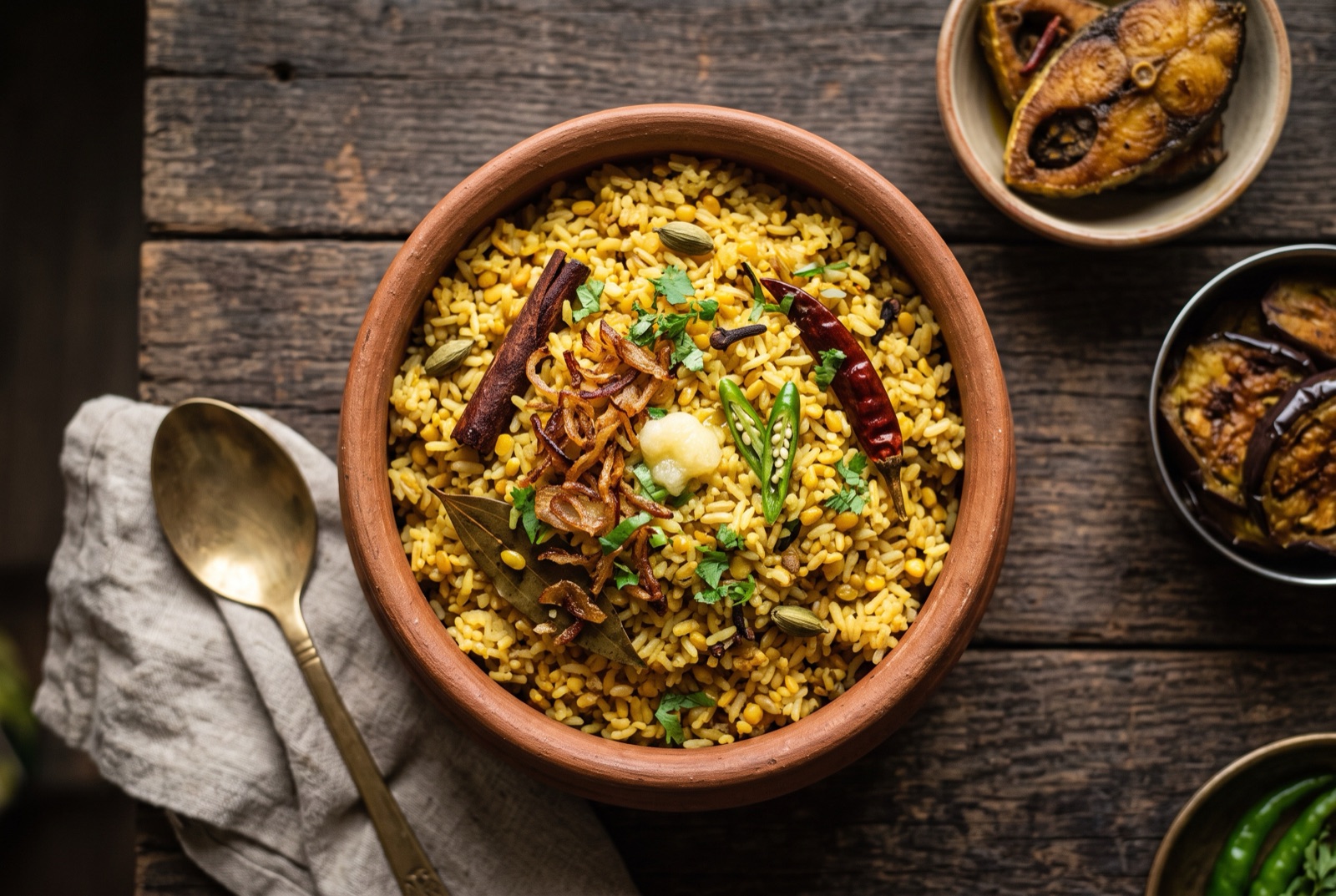
Bhuna khichuri is the dry, fluffy branch of the khichuri family: rice and roasted moong dal fried together in ghee with cardamom, cinnamon and bay leaf until they smell nutty, then cooked with a measured amount of water so the grains steam apart instead of collapsing into porridge. It tastes gently sweet from the toasted dal, warm from whole spice, and rich in a way that has nothing to do with chile — the heat comes from whole green chiles slit and pushed into the surface near the end. In Bangladesh it belongs to rain. The first serious monsoon downpour reliably produces khichuri in a large number of kitchens at once, eaten with fried eggplant, an omelette, or a beef bhuna if the day is special.

- Gate
- BangladeshNationwide
- Prep
- 15 min
- Cook
- 45 min
- Total time
- 1 hr
- Serves
- 4
- Status
- Easy
- Nutrition / serving · estimated
- Calories 520 kcal
- Protein 17 g
- Carbs 82 g
- Fat 14 g
- Fiber 8 g
- Sodium 760 mg
Why this recipe works.
- Roasts the moong dal first, which is the single step that separates real bhuna khichuri from plain rice and lentils.
- A tested liquid ratio that produces separate grains rather than the wet porridge version of khichuri.
- Complete meatless main dish, not a side — a full protein and grain in one pot.
- Ready in under an hour with ingredients that keep in a cupboard indefinitely.
Ingredients.
15 itemsFor the pot
To finish
Equipment
- Heavy lidded pot
- Dry pan for roasting the dal
- Sieve
Instructions.
Roast the dal
Put the moong dal in a dry pan over medium heat and stir for 4–5 minutes, until it darkens by one shade and smells like toasted popcorn. Tip it out immediately onto a plate so the residual pan heat does not take it further.
Tip The smell is the signal, not the colour. As soon as it turns nutty, it is done.
Rinse and drain
Rinse the roasted dal together with 300 g of rice in cold water two or three times until the water runs mostly clear, then leave them in a sieve to drain for 15 minutes. The grains should look damp, not wet, before they hit the fat.
Fry the onions and whole spices
Melt the ghee in a heavy pot, add the cardamom, cinnamon, cloves and bay leaves and let them sizzle for 30 seconds. Add the sliced onions and fry over medium heat for about 8 minutes, until soft and golden with brown edges, then stir in the ginger paste, turmeric and cumin.
Bhuna the rice and dal
Add the drained rice and dal and fry them in the spiced ghee for a full 3 minutes, folding constantly. The grains should turn glassy at the edges, take on the turmeric colour evenly and start smelling toasted rather than raw.
Tip This is the step the dish is named after. Rushing it gives you a plain lentil rice.
Add hot water and steam
Pour in the hot water and the salt, stir once, and bring to a hard boil. Cover tightly, drop to the lowest heat and cook for 18 minutes without lifting the lid, until steam craters appear on the surface and no liquid pools at the base when you tilt the pot.
Finish with chiles and rest
Take the pot off the heat, push the slit green chiles into the surface, scatter over the garam masala and a last teaspoon of ghee, and re-cover. Leave for 10 minutes, then fold gently once with the back of a spoon and serve hot with fried eggplant.
Tips from our kitchen.
- Dry-roast the moong dal in a pan without any fat until it smells toasted and turns one shade darker. Stop before it browns properly or the finished dish tastes scorched.
- Rinse the roasted dal and the rice together, then drain them for 15 minutes. Surplus water on the grains throws off the ratio and makes the khichuri sticky.
- Fry the drained rice and dal in the ghee for a full three minutes before adding liquid, until the grains look glassy at the edges and smell nutty.
- Use hot water, not cold. Cold water drops the pot temperature and the grains start absorbing unevenly from that point on.
- Do not stir once the water is in. If you need to check the base, tilt the pot rather than digging a spoon through the layers.
- Add a final tablespoon of ghee and the slit green chiles after the heat goes off, then cover for ten minutes so the aroma settles into the rice.
Substitutions.
- Roasted moong dal → Red lentils (masoor dal)
- Masoor cooks much faster and breaks down more, so the result will be softer and closer to a wet khichuri. Reduce the water by 100 ml and check at 12 minutes.
- Ghee → Mustard oil or a neutral oil
- This makes the dish fully vegan and gives it a sharper, more everyday character. Ghee is what makes the celebratory version taste celebratory.
- Chinigura or short-grain aromatic rice → Basmati rice
- Basmati needs about 100 ml more water and 4 more minutes. The grains stay longer and more separate, which some people prefer for a bhuna khichuri.
Variations.
- Khichuri with vegetables
- Diced potato, carrot and cauliflower added with the water. Common in home cooking and it makes the pot a complete meal without anything else on the table.
- Bhoger khichuri
- The temple version: wetter, softer, cooked with more water and no onion or garlic, offered during Durga Puja and eaten with fried vegetables.
- Chicken khichuri
- Pieces of marinated chicken fried in the ghee before the rice goes in, then cooked through with it — a one-pot meal common at Bangladeshi picnics.
Storage & reheating.
Bhuna khichuri keeps 3 days refrigerated and firms up considerably as it cools. Reheat covered with a tablespoon of water sprinkled over the surface, in a pan on low heat or a 150°C oven, until steam comes through. It freezes for up to 2 months in portions; thaw in the fridge and reheat covered. Do not reheat it more than once, as the dal continues breaking down each time.
Serve with
Begun bhaja — thick eggplant slices rubbed with turmeric and salt and fried until the edges frill — plus a hard-boiled egg, achar and thin cucumber slices.
The story behind Bhuna Khichuri.
Khichuri, in one form or another, is one of the oldest continuously cooked dishes on the subcontinent — rice and lentils boiled together, mentioned in ancient texts and eaten by everyone from ascetics to emperors, and the direct ancestor of the Anglo-Indian breakfast kedgeree. Bengal split the idea in two. Bhoger khichuri, the temple offering, is soft and wet, closer to a savoury porridge, and is cooked in enormous quantities during Durga Puja. Bhuna khichuri is the other pole: fried first, cooked dry, treated as a pilaf, and served at celebrations and lunches where the wet version would look too plain.
The technique word is the same one used for beef bhuna. Here it refers to frying the rice and dal in fat with the spices before any water is added — a step that coats each grain, drives off surface moisture and stops the dal from breaking down. The roasted moong dal does most of the flavour work. Whole yellow moong is dry-roasted in a pan until it smells like popcorn and turns a shade darker, which is what gives bhuna khichuri its distinct nuttiness. Skip the roasting and the dish is noticeably duller.
The rain connection is not sentimental invention. Bangladesh gets an enormous monsoon and a genuine cultural habit has grown around it: khichuri with begun bhaja, thick slices of eggplant fried in a turmeric-salt coating, plus fried dried fish or a hard-boiled egg. Ask a Bangladeshi what they eat when it pours and this is the answer, close to unanimously. It is also disaster food in a more literal sense, cooked in vast batches and distributed during floods, because the ingredients are cheap, the dish is complete on its own and it holds heat well.
The home version below is the celebratory register — ghee, whole garam masala, plenty of fried onion — but the same method with oil instead of ghee and fewer spices gives you the everyday one.
Questions, answered.
What is the difference between bhuna khichuri and ordinary khichuri?
Bhuna khichuri is dry and fluffy, with separate grains, because the rice and lentils are fried in fat with whole spices before any water is added and the liquid is carefully measured. Ordinary or bhoger khichuri uses much more water and no frying stage, producing a soft, porridge-like dish. Both are traditional Bengali food, but they are eaten in different contexts.
Why should I roast the moong dal first?
Roasting yellow moong dal in a dry pan until it darkens slightly and smells toasted develops a distinctly nutty flavour that raw dal never produces, and it also helps the lentils hold their shape instead of dissolving. It takes about five minutes and it is the main thing separating a memorable bhuna khichuri from a bland one. You can buy pre-roasted moong dal in South Asian shops.
What is the right water ratio for bhuna khichuri?
Roughly 1.5 parts hot water to 1 part combined rice and dal by volume when using short-grain aromatic rice, and about 1.75 parts for basmati. That is noticeably less than for a wet khichuri, which uses three or four parts. Measure rather than eyeballing it — this dish has very little tolerance for extra liquid.
Is khichuri vegan?
It can be. The rice and lentil base is entirely plant-based, and the only animal product in this recipe is the ghee. Substituting mustard oil or a neutral oil gives you a fully vegan dish that is still completely traditional — much everyday khichuri in Bangladesh is cooked in oil rather than ghee.
What do Bangladeshis eat with khichuri?
Fried eggplant (begun bhaja) is the classic pairing, alongside a hard-boiled or fried egg, pickles, and often fried dried fish or a dry meat curry such as beef bhuna. It is considered a rainy-day meal, and the combination of soft khichuri with something crisp and something sharp is the whole point of the plate.
You might also like.
All recipes →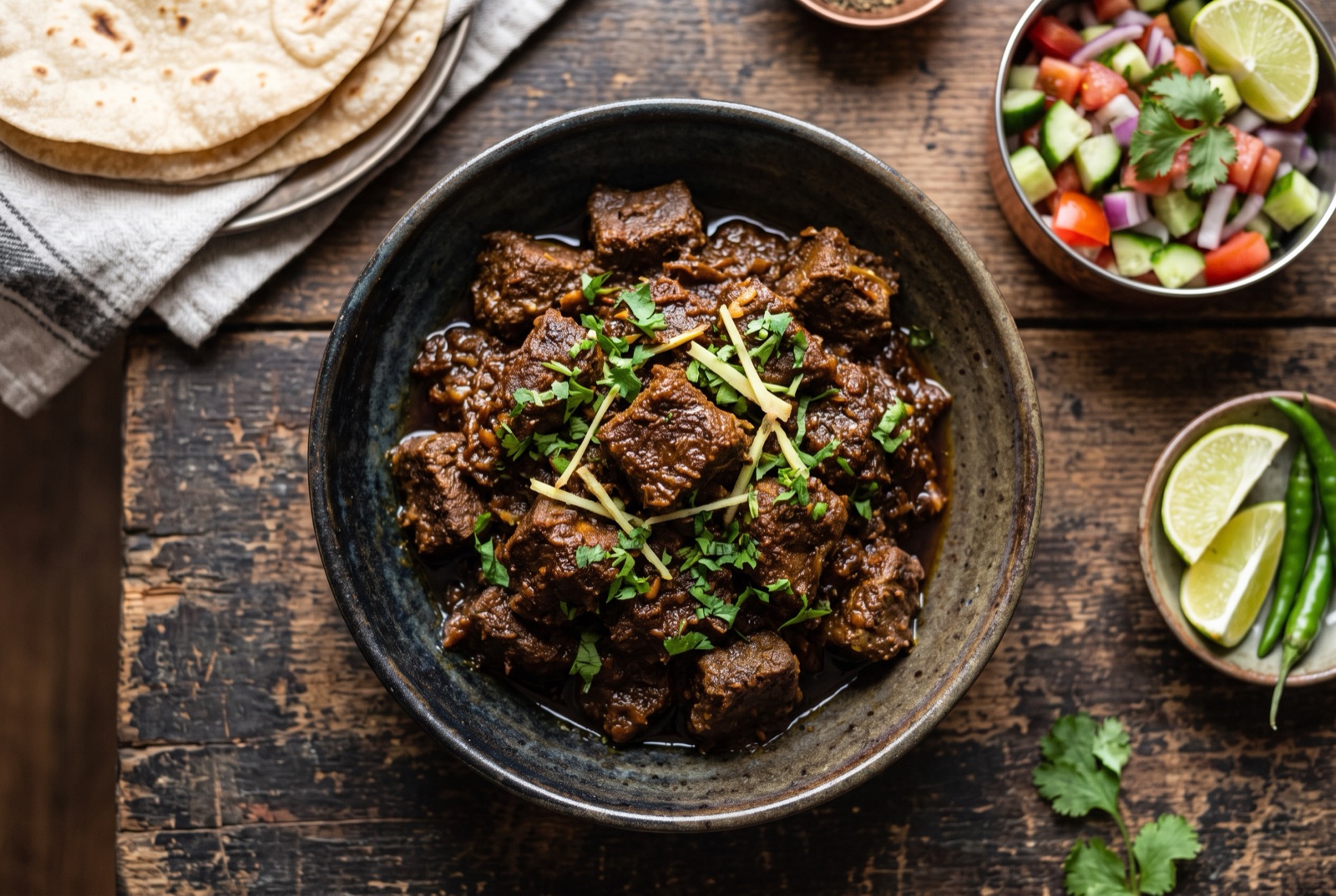
Keep exploring Bangladesh.
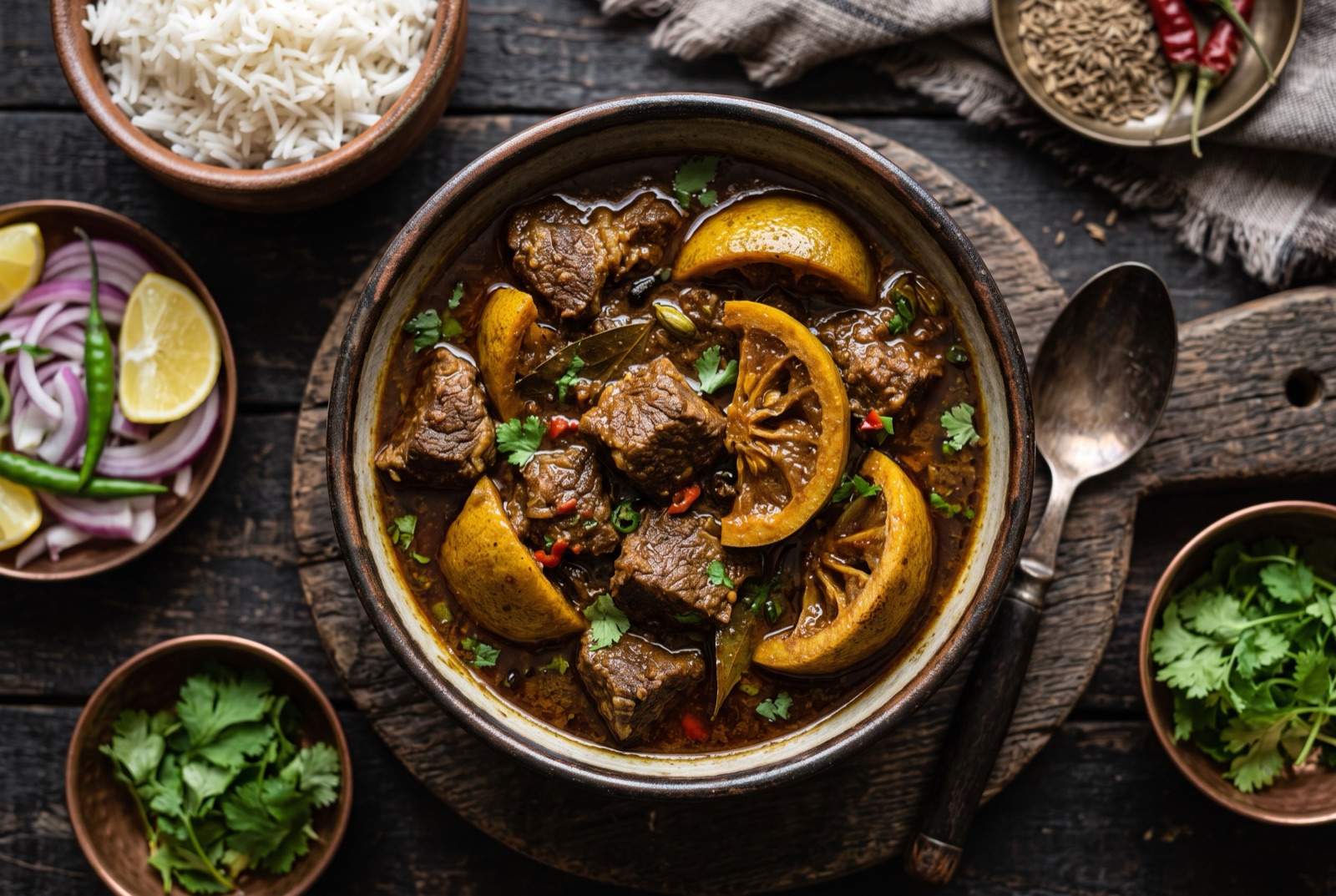
Bangladesh has 9 more dishes in the atlas — Beef Bhuna and Beef Shatkora, and 7 more.
Recipe by The DishRoute Kitchen · published August 20, 2026 · updated August 20, 2026