Sopa de Maní.
Bolivian Peanut and Beef Soup
Sopa de maní · say it: SOH-pah deh mah-NEE
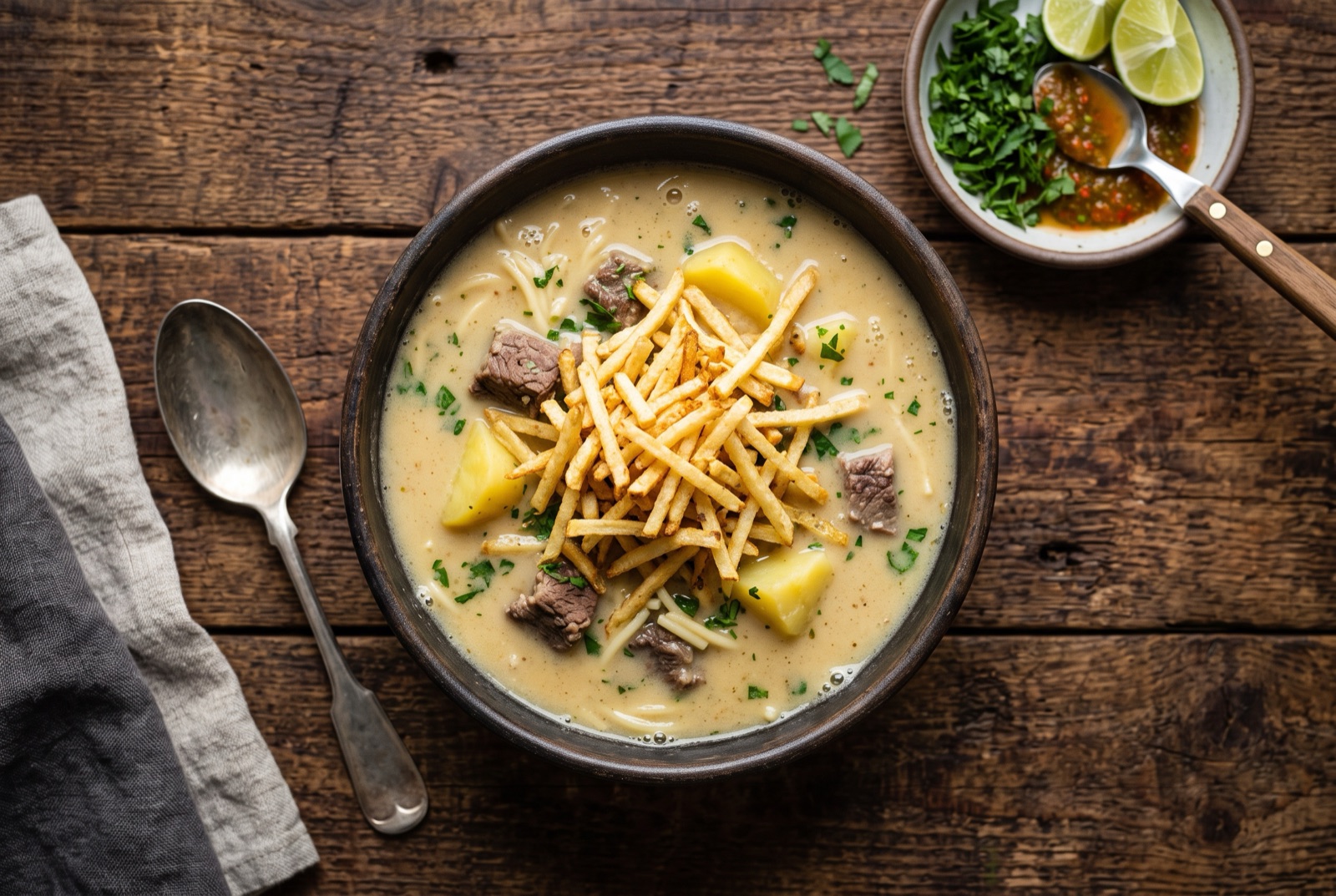
This is the soup Bolivians name first when asked what their country tastes like. Raw peanuts — not roasted, not from a jar — are blended with water into a loose white cream and stirred into a beef broth already carrying onion, cumin, oregano and yellow chilli. As it simmers the cream thickens the soup and turns it a soft gold, with a flavour that is nutty and savoury rather than sweet, closer to a rich stock than to anything resembling peanut butter. Potato, carrot, peas and a little pasta go in for body. What lifts it above every other bowl of soup is what lands on top: a pile of thin fried potato sticks and chopped parsley, added at the table so they crunch for the first few spoonfuls before they soften.

- Gate
- BoliviaCochabamba and the valleys
- Prep
- 25 min
- Cook
- 1 hr 40 min
- Total time
- 2 hr 5 min
- Serves
- 6
- Status
- Medium
- Nutrition / serving · estimated
- Calories 590 kcal
- Protein 33 g
- Carbs 47 g
- Fat 30 g
- Fiber 7 g
- Sodium 720 mg
Why this recipe works.
- Raw peanuts are specified and explained, because roasted peanuts or peanut butter produce a completely different and much sweeter soup.
- The peanut cream is added off a hard boil and stirred through, which is what stops it catching on the base of the pot.
- Meat and broth are built from a bone-in cut, so the soup has body before any thickener touches it.
- The fried potato garnish is treated as part of the recipe rather than a decoration, with timing so it is still crisp when it lands.
Ingredients.
19 itemsFor the broth
For the peanut cream
For the soup
To finish
Equipment
- Heavy stockpot
- Blender
- Fine sieve
- Small pan for frying the potato sticks
Instructions.
Start the broth
Cover the beef shank with the water in a heavy pot, bring slowly to a simmer and skim the grey foam that rises in the first 15 minutes. Leave it to bubble very gently, uncovered, for 1 hour, until the meat is tender enough to pull from the bone.
Blend the peanut cream
Blend 250 g of raw peanuts with the warm water on high for a full 2 minutes, then push the mixture through a fine sieve, working the pulp with a spoon. What passes through should be the colour and consistency of thin single cream, with no grit left between your fingers.
Tip If the peanuts still have their papery red skins, rub them off first — they make the soup dull brown and slightly bitter.
Fry the seasoning base
In a separate pan, cook the onion in the oil over medium heat until soft and golden at the edges, then add the garlic, cumin, oregano, ají paste and grated tomato. Fry until the mixture is jammy and the oil separates around it, about 8 minutes, then stir it into the broth.
Add the peanut cream
Lower the heat so the pot is barely trembling, pour in the peanut cream and stir it through. Cook for 30 minutes, scraping across the base of the pot with a flat wooden spoon every few minutes, until the soup turns pale gold and thickens enough to leave a trail behind the spoon.
Tip A hard boil at this stage will make the peanut catch and burn on the bottom within minutes.
Cook the vegetables and pasta
Add the potato and carrot and simmer 15 minutes, then the peas and pasta for a final 10, until the potato yields to a spoon and the pasta is soft. Taste and season generously with salt and pepper — the peanut flattens seasoning and the soup needs more than you expect.
Fry the potato sticks
Rinse the matchstick potatoes, dry them completely in a cloth, and fry in hot oil in two batches until stiff and pale gold, about 3 minutes. Drain on paper and salt them straight away while the surface is still glistening.
Loosen and serve
Stir in hot water or stock until the soup pours freely from the ladle rather than dropping in clumps. Serve in deep bowls with a piece of meat in each, then heap the fried potato sticks and parsley on top at the last possible moment.
Tips from our kitchen.
- Blend the peanuts with warm water for a full two minutes and then push the cream through a sieve. Any grit that survives will feel like sand in the finished soup.
- Keep the pot at a lazy simmer once the peanut goes in, and stir the bottom with a flat wooden spoon every few minutes. Peanut solids sink and scorch faster than almost anything else.
- Hold back 300 ml of hot stock until the very end. The soup thickens as it stands and almost always needs loosening just before serving.
- Cut the potato sticks thin and dry them thoroughly before frying, then salt them the second they come out of the oil so they season while the surface is still hot.
- Add the pasta in the last ten minutes only. Left in longer it swells, goes soft and absorbs the liquid you need for the broth.
- Taste for salt after the peanut cream has cooked, not before — the peanuts flatten the seasoning and a soup that tasted right earlier will need more.
Substitutions.
- Raw shelled peanuts → 250 g unsweetened, unsalted natural peanut butter thinned with 700 ml water
- This works in an emergency but tastes noticeably roastier and sweeter, and it thickens faster. Raw peanuts are sold cheaply in Latin American, African and Indian grocers, and they freeze well.
- Beef shank → Short ribs, oxtail or bone-in chicken thighs
- Any cut with bone and connective tissue will do. Chicken makes a lighter soup and needs only 45 minutes of simmering instead of 90.
- Short pasta → 80 g long-grain rice, added 20 minutes before the end
- Rice is the equally traditional alternative and thickens the soup slightly more. Some cooks use both, which makes for a very substantial bowl.
Variations.
- Sopa de maní con arroz
- Rice instead of noodles, the more common choice in the highlands, giving a heavier and slightly starchier soup.
- Vegetarian sopa de maní
- Built on a strong vegetable stock with extra potato, carrot and broad beans; the peanut cream carries enough body that the missing meat is less obvious than you would expect.
- Extra picante
- A whole locoto simmered in the pot and removed before serving, which lets a steady heat build through the peanut without any visible chilli in the bowl.
Storage & reheating.
The soup keeps 3 days refrigerated and thickens dramatically overnight — expect to whisk in 200–300 ml of hot stock or water when reheating, and to do it over low heat while stirring so the peanut does not catch. It freezes for 2 months, though the potato pieces go grainy, so some cooks freeze the peanut broth alone and add fresh vegetables on reheating. Fry the potato sticks fresh every time; they lose their crunch within an hour.
Serve with
Bread for the bottom of the bowl, and llajua stirred in by the spoonful for anyone who wants it hot.
The story behind Sopa de Maní.
Peanuts are native to South America and were domesticated in the lowlands of this region long before anyone wrote about them, so cooking them into a savoury liquid is not a borrowing from anywhere. Bolivia grows them in the valleys and the east, sells them raw by the sackful in every market, and turns them into this soup for family lunches, restaurant menus del día and celebrations alike. Ask about a national dish and sopa de maní will be in the first two answers most people give, usually paired with salteñas.
It is not exclusively Bolivian, and pretending otherwise would be dishonest. Peru has its own peanut soups, Ecuador makes sopa de maní and the closely related peanut-thickened stews of the highlands, and versions turn up in northern Argentina. What is specific to Bolivia is the combination of details: the beef broth rather than chicken, the inclusion of pasta or rice as well as potato, and above all the fried potato sticks scattered over the surface, which are not optional and which nobody outside the country seems to do in quite the same way. That garnish is how a Bolivian identifies a properly served bowl at a glance.
The technique deserves respect because it is where the soup goes wrong. Peanut cream will catch and scorch on the bottom of a pot the moment attention wanders, and burnt peanut is unmistakable and unfixable. It also thickens noticeably as it cooks and again as it stands, so a soup that looked correct in the pot can be a paste by the time it reaches the table. Bolivian cooks stir often, keep the heat low and hold back a jug of hot stock to loosen it at the end — three habits worth copying exactly.
Questions, answered.
Can I use peanut butter instead of raw peanuts?
You can, but it changes the soup. Peanut butter is made from roasted nuts, which brings a darker, sweeter, distinctly toasty flavour, and most commercial brands add sugar, salt and stabilisers. Raw peanuts blended with water give a milder, cleaner, more savoury base that tastes like a stock rather than a sauce. If you do use peanut butter, choose an unsweetened natural one and thin it with plenty of water.
Why did my peanut soup burn on the bottom?
Peanut solids are heavy and sink, and once they settle on a hot pot base they scorch within a minute or two. Keep the heat low after the peanut cream goes in, stir right across the bottom with a flat-edged spoon every few minutes, and use the heaviest pot you own. A burnt batch cannot be rescued because the bitter flavour spreads through the whole pot immediately.
Is sopa de maní a Bolivian or Peruvian dish?
Peanut soups exist across the central Andes, including in Peru and Ecuador, and peanuts have been cultivated in the region for thousands of years, so no country can claim the idea. The Bolivian version is identifiable by its beef broth, the pasta or rice cooked in it, and the pile of thin fried potato sticks on top, which is the detail that most reliably marks a bowl as Bolivian.
How thick should the finished soup be?
It should coat a spoon and look like a pale gold cream, but still pour freely — closer to a thin bisque than to a stew. It will thicken as it sits, so aim slightly looser than you want when you take it off the heat, and keep hot stock nearby to adjust at the table.
What are the fried potato sticks on top for?
They are the traditional Bolivian garnish, and they provide the textural contrast the soup otherwise lacks. Thin matchsticks of potato fried until crisp are piled on each bowl just before it is carried out, so the first spoonfuls have crunch against the smooth peanut broth. Adding them early defeats the purpose, since they soften within a few minutes.
You might also like.
All recipes →
Keep exploring Bolivia.
Bolivia has 9 more dishes in the atlas — Api con Pastel and Cuñapé, and 7 more.
Recipe by The DishRoute Kitchen · published August 20, 2026 · updated August 20, 2026