Pique Macho.
Bolivian Beef and Chip Sharing Platter
Pique a lo macho · say it: PEE-keh MAH-cho
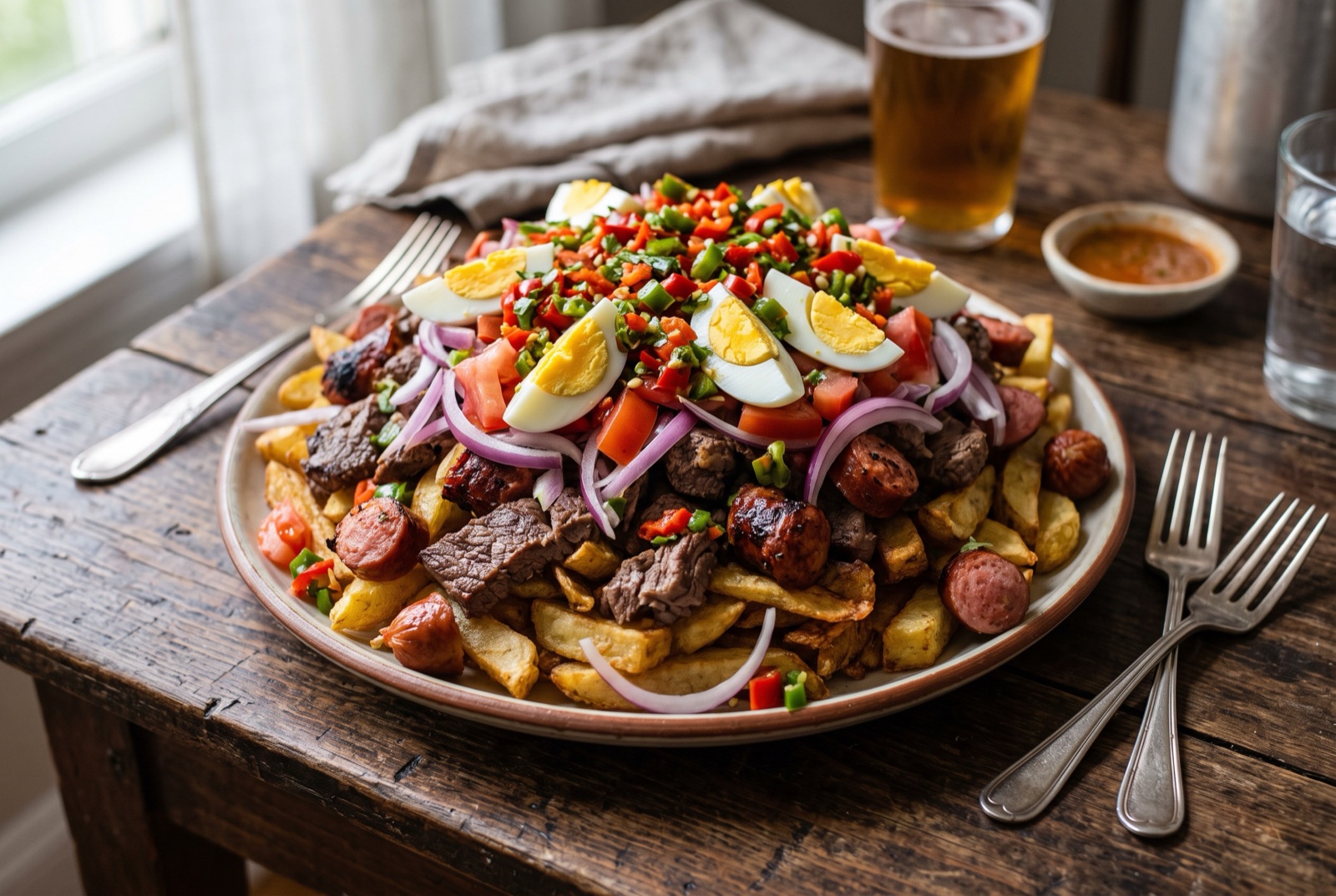
Pique macho arrives as a heap rather than a composed dish: a bed of thick-cut chips, then cubes of seared beef and slices of sausage still hissing from the pan, then a raw tangle of onion, tomato and locoto chilli thrown over the top with wedges of hard-boiled egg pushed in around the edges. Mustard and mayonnaise are squeezed over in stripes, and the whole thing is set in the middle of the table for everyone to attack at once. The flavour is savoury, greasy in the good way, sharpened by raw onion and vinegar, and then repeatedly interrupted by the chilli — the "macho" in the name is not decorative, and asking for it mild is entirely normal.

- Gate
- BoliviaCochabamba
- Prep
- 30 min
- Cook
- 40 min
- Total time
- 1 hr 10 min
- Serves
- 4
- Status
- Medium
- Nutrition / serving · estimated
- Calories 810 kcal
- Protein 40 g
- Carbs 58 g
- Fat 46 g
- Fiber 6 g
- Sodium 980 mg
Why this recipe works.
- Components are cooked separately at high heat, so the beef browns instead of stewing in its own liquid on the chips.
- The chips are twice-cooked, which is the only way they survive under wet toppings for more than a minute.
- Beer deglazes the pan into a thin pan juice, catching the fond that would otherwise be scrubbed away.
- The raw layer goes on at the last second, so the onion stays crunchy against the hot meat rather than wilting into it.
Ingredients.
16 itemsFor the chips
For the meat
For the topping
Equipment
- Deep pan or fryer for the chips
- Large heavy frying pan
- Wide serving platter
Instructions.
First-fry the chips
Heat the oil to 150 °C and cook the chips in batches for 6–7 minutes, until they are cooked through but still pale and floppy. Lift them out onto a rack and leave them to steam dry while you cook the meat.
Sear the beef hard
Season the beef generously with salt, then sear it in a very hot, lightly oiled pan in two batches. Leave each batch untouched for 2 minutes before turning, until the cubes have a dark brown crust and no grey patches, then set them aside.
Tip The pan should smell of roasted meat, not of boiling liquid. If liquid pools in the bottom, the heat is too low or the pan too full.
Colour the sausage and build the pan juice
Add the sausage slices to the same pan and fry until their cut faces blister and brown, about 3 minutes. Stir in the garlic, cumin and oregano for 30 seconds, then pour in the beer and soy sauce and scrape the base of the pan until the stuck brown bits dissolve into a thin, glossy juice.
Reunite and reduce
Return the beef and any resting juices to the pan and toss for 1–2 minutes, until everything is coated and the liquid has reduced to just a few spoonfuls clinging to the meat. Taste and correct the salt now — nothing gets seasoned after this point.
Second-fry the chips
Raise the oil to 190 °C and fry the chips again for 2–3 minutes, until they are deep gold, rigid and audibly rattle against each other in the basket. Drain briefly and salt immediately.
Pile and serve at once
Spread the chips across a wide platter, tip the meat and sausage over them with all the pan juice, then scatter on the onion, tomato and locoto and tuck the egg quarters around the edge. Zigzag the mayonnaise and mustard over the top, throw on the parsley and carry it to the table immediately.
Tips from our kitchen.
- Cut the beef into generous 3 cm cubes and sear them in two batches. Crowd the pan and the meat releases water, greys over, and never picks up any crust.
- Twice-cook the chips: a gentle first fry to cook them through, a hard second fry to armour the outside. Single-fried chips turn to paste under the toppings.
- Add the sausage to the pan only after the beef is out — it is already cooked, and it only needs to blister and take on colour at the cut faces.
- Slice the locoto and taste a sliver before deciding how much to use. The heat varies enormously between chillies, even from the same plant.
- Assemble at the very last moment and carry the platter straight to the table. Every minute it stands, the chips soften under the tomato juice.
- Serve it with several forks and no side plates — eating it directly off the shared platter is how it is done and it keeps the chips hot longer.
Substitutions.
- Locoto chilli → Rocoto from a Peruvian grocer, or red jalapeños plus a small piece of habanero
- Rocoto is effectively the same chilli under another name and is the closest available match. Removing seeds and white pith drops the heat sharply while keeping the flavour.
- Frankfurter-style sausage → Any soft, mild pre-cooked sausage — bratwurst, wieners or a smoked pork sausage
- Avoid heavily cured or chorizo-style sausages here; their spicing overwhelms the plate and their fat renders out too aggressively.
- Beef sirloin → Rump, skirt or flank steak, cut across the grain
- Any quick-cooking cut works as long as it can take fierce heat for a couple of minutes. Stewing cuts stay tough at this cooking time.
Variations.
- Pique de pollo
- Chicken thigh cubes replacing the beef, seared just as hard, for a lighter and slightly cheaper platter.
- Pique with charque
- A lowland spin using rehydrated dried beef instead of fresh, which makes the meat saltier and much chewier against the soft chips.
- Extra picante
- Locoto sliced into rings with the seeds left in and scattered on top, plus a bowl of llajua on the side for people who want more.
Storage & reheating.
This platter is built to be finished, not saved — the chips are irredeemable once they have sat under tomato and mayonnaise. If you have leftovers, pick out the meat and sausage, refrigerate them for up to 3 days and reheat in a hot dry pan; discard the soaked chips and cut fresh vegetables. The beef can also be seared several hours ahead and reheated hard at the last minute, which is a reasonable shortcut when cooking for a crowd.
Serve with
Cold beer, and a bowl of llajua for anyone who thinks the locoto on top was not enough.
The story behind Pique Macho.
This is bar food, and it behaves like bar food: it appears late, it is meant for a group, and it exists partly to keep drinkers upright. It comes from Cochabamba, in the second half of the twentieth century, which makes it modern by the standards of most dishes on a Bolivian menu. A specific origin is repeated in the city — a particular restaurant, a particular cook improvising a large plate for hungry customers — but the details vary depending on who is telling it and the documentation is not there, so it is safer to say only that Cochabamba invented it recently and the rest of the country adopted it fast.
What makes it interesting is how openly assembled it is. There is no simmering, no marinade, no sauce built in a pan; there are components cooked separately at high heat and then piled, and the seasoning arrives at the table in the form of squeezed condiments and raw chilli. That puts it in the same global family as loaded chips, poutine and other late-night platters, but the Bolivian version is distinguished by the locoto — a thick-fleshed, properly hot chilli eaten raw in slices rather than cooked into anything — and by the sausage, which is usually a soft frankfurter-style link rather than anything cured.
Portion size is part of the joke. A pique macho ordered for one person in Cochabamba can defeat two, and restaurants list it as a plate for sharing without irony. Bolivians will also tell you it has restorative properties the morning after, which puts it in direct competition with fricasé for the country's unofficial hangover cure — a rivalry decided mostly by whether you want your recovery hot and brothy or fried and salty.
Questions, answered.
What does the name pique macho mean?
Pique refers to the food being chopped or diced into pieces, and macho signals that it is aggressively spicy. Together the name is a warning about the raw locoto chilli scattered over the top. Bolivian restaurants routinely serve a milder version on request, and asking for it that way is unremarkable rather than embarrassing.
How spicy is pique macho really?
As spicy as you make it, because the heat comes from raw locoto added at the end rather than cooked into a sauce. Locoto is significantly hotter than a jalapeño, roughly in habanero territory in some fruits, so a whole one sliced with its seeds will dominate the platter. Deseeding it and using half gives noticeable warmth without pain.
Can I use frozen chips?
You can, and plenty of Bolivian kitchens do when they are busy. Cook them to the darker end of the packet instructions so they are properly rigid, since they need to hold up under hot meat and wet tomato. Freshly cut, twice-fried potatoes stay crisp noticeably longer and taste considerably better.
What can I use instead of locoto chilli?
Peruvian rocoto is the same chilli and the best substitute if a Latin grocer stocks it. Otherwise combine red jalapeños, which have the right thick, juicy flesh, with a small amount of habanero for the heat level. Ordinary chilli flakes are a poor stand-in because the raw, crunchy texture is part of the dish.
Is pique macho eaten as a starter or a main course?
Neither exactly. It is a shared platter ordered for a table, usually alongside drinks in the evening, and everyone eats from the same dish with their own fork. A single restaurant portion is generous enough to feed two or three people as a full meal, which is why it is almost never ordered individually.
You might also like.
All recipes →
Keep exploring Bolivia.
Bolivia has 9 more dishes in the atlas — Api con Pastel and Cuñapé, and 7 more.
Recipe by The DishRoute Kitchen · published August 20, 2026 · updated August 20, 2026