Majadito.
Beni Rice with Dried Beef and Plantain
Majadito beniano · say it: mah-hah-DEE-toh
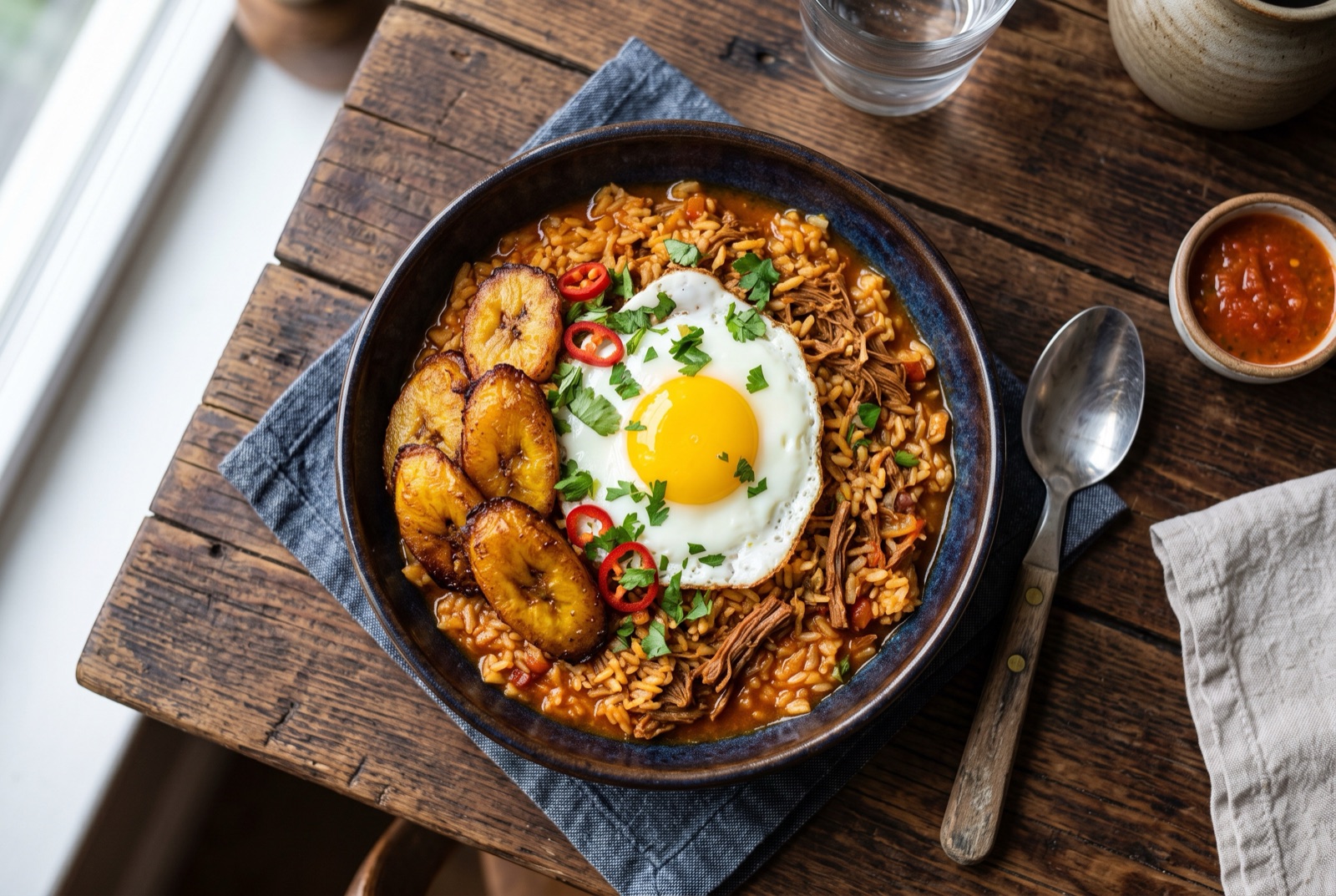
Majadito is the rice dish of the Bolivian lowlands, and its flavour comes almost entirely from charque — beef salted and dried in the sun until it keeps without refrigeration, then boiled, pounded and pulled apart into fibres. Those threads are fried in fat stained orange with urucú seeds along with onion, tomato and sweet pepper, then the rice goes in and drinks up the stock until it is either loose and spoonable or dry and separate, depending on which version the cook grew up with. On top go slices of plantain fried until the sugars catch, and a fried egg. It tastes salty, faintly smoky, sweet at the edges, and completely unlike anything cooked in the Andes.

- Gate
- BoliviaBeni and Santa Cruz
- Prep
- 25 min
- Cook
- 1 hr 20 min
- Total time
- 3 hr 45 min incl. 2 hr rest
- Serves
- 4
- Status
- Medium
- Nutrition / serving · estimated
- Calories 720 kcal
- Protein 38 g
- Carbs 95 g
- Fat 21 g
- Fiber 5 g
- Sugar 12 g
- Sodium 1100 mg
Why this recipe works.
- The charque is boiled and pounded before it ever touches fat, which is the only way to get soft threads instead of salty splinters.
- Annatto is infused into the oil rather than sprinkled in, giving the rice its colour without a gritty texture.
- A stock-to-rice ratio is given for both the wet and the dry style, so you can choose which version you are making.
- Plantain is fried at the right ripeness, so it caramelises rather than turning to starch.
Ingredients.
14 itemsFor the meat
For the rice
To finish
Equipment
- Heavy lidded pot or wide sauté pan
- Pestle or rolling pin for pounding the meat
- Frying pan
Instructions.
Soak and boil the dried beef
Cover the charque with cold water and leave it for 2 hours, then drain and simmer in fresh water for 30–40 minutes, until a piece pulls apart easily under a fork. Taste the water: if it makes you wince, tip it away and boil once more in fresh water. Keep the final cooking liquid — it is your stock.
Pound and shred
Drain the meat and let it cool enough to handle, then flatten each piece with a pestle or the end of a rolling pin until the fibres separate. Pull it apart with your fingers into loose threads no thicker than string.
Colour the oil
Warm the annatto seeds in the oil over low heat for about 2 minutes, until the fat is deep orange and the seeds have stopped releasing colour, then strain the seeds out and discard them.
Tip Do not let the oil smoke — annatto turns bitter quickly and the flavour cannot be rescued.
Fry the meat and sofrito
Fry the shredded meat in the orange oil over medium-high heat until the threads dry out and their edges begin to crisp, about 6 minutes. Add the onion and pepper and cook until soft, then the garlic, cumin and tomato, and keep going until the mixture darkens and the oil shows orange again around the edge of the pan.
Toast the rice
Tip in 400 g of rinsed rice and stir for 2 minutes, until every grain is coated in the coloured fat and turns from chalky to slightly translucent at the edges. Season carefully — the charque has already brought salt to the pan.
Cook the rice through
Pour in the stock, bring to a boil, then cover and cook over the lowest heat for 18 minutes without lifting the lid. Take it off the heat and leave it covered for a further 5 minutes, then fork it through: the grains should be separate and stained orange, with no wet stock in the bottom.
Fry the plantain and eggs
Fry the plantain slices in a little oil over medium heat until both faces are deep brown and the sugars have caught at the edges, about 3 minutes a side, then fry the eggs until the whites set and the yolks are still soft.
Plate it
Mound the rice on warm plates, lean two or three plantain slices against it, slide an egg on top and scatter over the parsley. Serve immediately, while the egg yolk is still liquid enough to run into the rice.
Tips from our kitchen.
- Taste the charque cooking water after the first boil. If it is still aggressively salty, change the water and boil again — the seasoning of the whole pot depends on this.
- Pound the boiled meat with a pestle or the end of a rolling pin, then pull it apart with your fingers. Shredding without pounding leaves tough strands that never soften.
- Warm the annatto seeds in oil over gentle heat only until the fat turns deep orange, about two minutes, then strain them out. Overheated seeds turn the oil bitter and muddy.
- Use plantains with black-blotched yellow skins. Green ones stay starchy and refuse to brown; fully black ones fall apart in the pan.
- Let the finished rice sit off the heat, covered, for five minutes before serving, so the last of the stock is absorbed evenly instead of pooling at the bottom.
Substitutions.
- Charque (salt-dried beef) → 500 g beef brisket, simmered until tender, cooled and shredded, then salted well
- You lose the concentrated, faintly funky quality that dried meat gives the rice, but the texture is close and the dish still works. Latin American grocers sell charque, and Brazilian carne seca is effectively the same thing.
- Urucú (annatto seeds) → 1 tsp annatto powder, or 1 tsp sweet paprika with a pinch of turmeric
- You are chasing colour more than flavour here. Powder dissolves straight into the oil and needs no straining.
- Plantain → A firm, barely ripe banana, fried briefly in butter
- Bananas are much sweeter and softer, so cut them thicker and fry them fast over high heat or they will disintegrate.
Variations.
- Majadito batido
- The wet version, made with half again as much stock and stirred frequently so the rice partly breaks down into a loose, spoonable mass.
- Majadito de charque con yuca
- Served with boiled cassava alongside the plantain, which is standard in much of Santa Cruz and turns the plate into a proper lunch.
- Majadito de pato
- A festive lowland version built on duck instead of dried beef, with the rendered duck fat replacing the annatto oil for richness.
Storage & reheating.
Cooked majadito keeps 3 days in the fridge and reheats better than most rice dishes because the dried meat holds its texture. Add a splash of stock and warm it covered in a pan over low heat, stirring once, until it steams through. Fry the plantain and egg fresh each time — reheated plantain goes leathery and a reheated fried egg is not worth eating. The rehydrated shredded charque itself freezes well for 2 months.
Serve with
Fried cassava and a slice of fresh white cheese, with llajua for anyone who wants heat on it.
The story behind Majadito.
Beni is flat, hot and seasonally flooded — cattle country crossed by rivers, with a food culture built around what survives the climate. Before refrigeration reached the region, drying beef in the sun with salt was the only reliable way to keep a slaughtered animal, and charque became a pantry ingredient rather than an emergency measure. Majadito is what that pantry produces when combined with rice, which grows well in the lowlands, and with the plantains and cassava that grow around every house. The name relates to the pounding — the dried meat is crushed and worked apart before it can be cooked.
The dish comes in two arguments. Majadito batido is cooked with more liquid and stirred so the rice partly breaks down into something between a risotto and a wet pilaf; majadito seco keeps the grains separate and drier. Beni tends to be associated with the wetter style and Santa Cruz with the drier, though households contradict this constantly and neither claim survives a serious conversation with a cook from either department. What is agreed is the topping: fried plantain and a fried egg, and often a slice of cassava or a piece of fresh cheese as well.
Charque is not unique to Bolivia — the same technique and a version of the same word run through Peru, northern Argentina and Brazil, where charque is the backbone of several regional dishes, and the English word jerky descends from the same Quechua root. That makes the boundary between Bolivian majadito and its lowland neighbours genuinely soft. Where it stands apart is in the urucú, the orange annatto colouring used with a free hand across eastern Bolivia, and in the insistence that the plate is not finished until something sweet and something fried are sitting on top of the rice.
Questions, answered.
What is charque and how is it different from jerky?
Charque is beef cured with salt and dried in the sun, traditionally in thick slabs rather than thin strips, and it is meant to be rehydrated and cooked rather than eaten as it is. Jerky descends from the same Andean technique and the same word, but modern jerky is dried thin, often smoked or sweetened, and is a snack. Using jerky in this recipe would make it far too sweet and chewy.
What is the difference between majadito batido and majadito seco?
It is a question of liquid. Batido uses noticeably more stock and is stirred as it cooks, so the rice softens into a loose, almost porridge-like consistency. Seco uses less liquid and is left alone, so the grains stay separate like a pilaf. Both are traditional in eastern Bolivia and cooks disagree, often within the same family, about which one is correct.
Do I have to soak the dried beef overnight?
Soaking for a couple of hours helps, but the important step is boiling it in fresh water and tasting as you go. Charque varies enormously in saltiness between producers, so one batch may need a single boil and another may need the water changed twice. Judge by tasting the cooking liquid rather than by the clock.
Can I make majadito without annatto?
Yes, though the rice will be pale straw rather than the orange colour it should be. Sweet paprika with a pinch of turmeric gets you close visually and adds a mild sweetness that is not out of place. Annatto contributes very little flavour of its own, so nothing important is lost beyond appearance.
Which rice works best for this dish?
Ordinary long-grain white rice, which is what is grown and eaten in the Bolivian lowlands. Basmati is too aromatic and its perfume fights the dried beef, while short-grain rice turns sticky and gluey. If you are making the wet batido version, a slightly starchier medium-grain rice is an advantage.
You might also like.
All recipes →
Keep exploring Bolivia.
Bolivia has 9 more dishes in the atlas — Api con Pastel and Cuñapé, and 7 more.
Recipe by The DishRoute Kitchen · published August 20, 2026 · updated August 20, 2026