Boortsog.
Mongolian Fried Dough Biscuits
Боорцог · say it: BOR-tsog
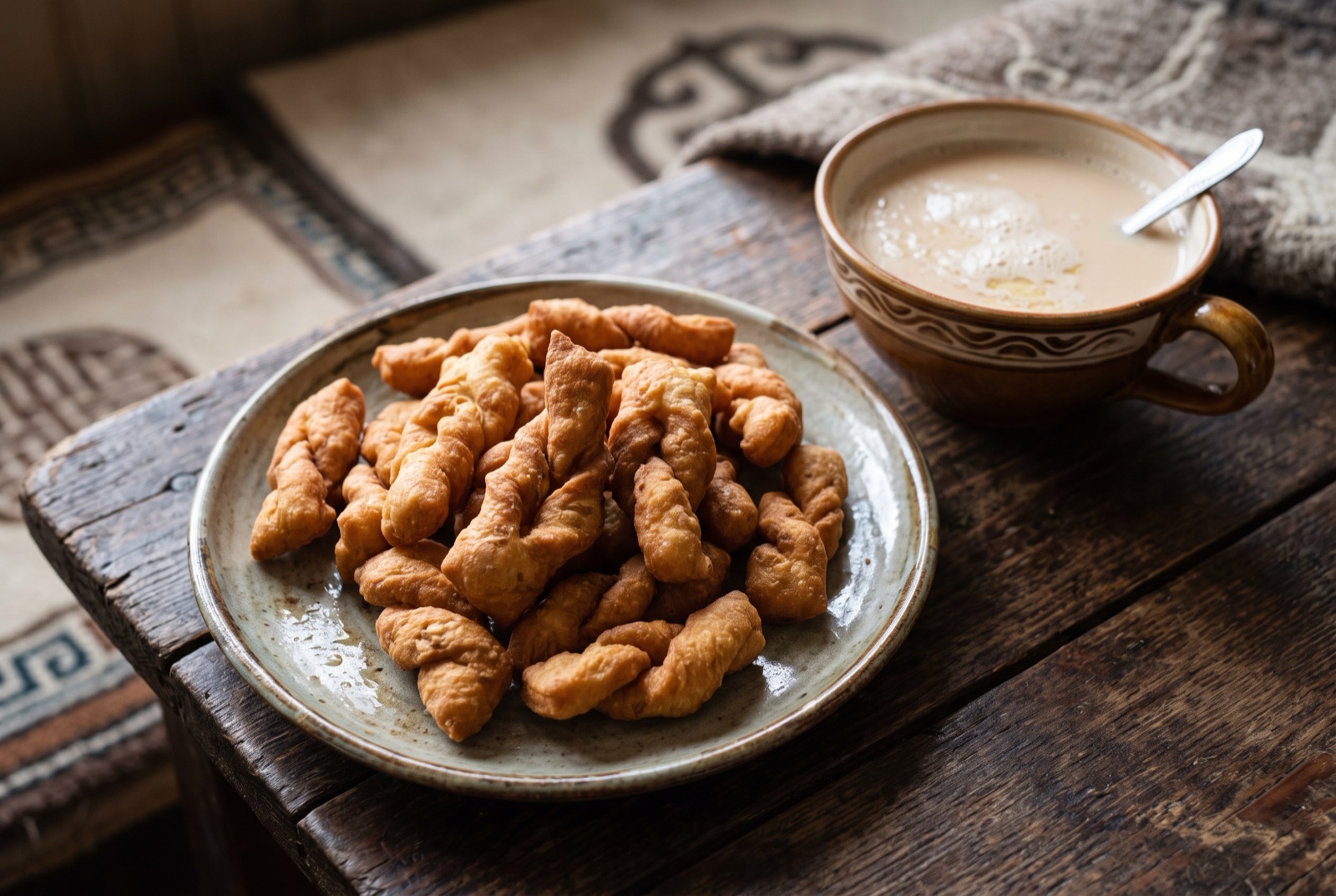
Boortsog is unleavened wheat dough, made firm rather than soft, cut into small shapes and fried at a moderate temperature until the inside is cooked dry instead of staying bready. The result is closer to a hard biscuit than a doughnut: crisp at the edges, dense and slightly chewy in the middle, sweet only faintly if at all. It keeps for weeks in a bag or a sack, travels without damage, and is eaten with salted milk tea at any hour of the day.

- Gate
- Mongolia
- Prep
- 25 min
- Cook
- 30 min
- Total time
- 1 hr 25 min incl. 30 min rest
- Serves
- 8
- Status
- Easy
- Nutrition / serving · estimated
- Calories 290 kcal
- Protein 6 g
- Carbs 38 g
- Fat 12 g
- Fiber 1 g
- Sugar 4 g
- Sodium 300 mg
Why this recipe works.
- A stiff dough ratio that fries dry and keeps, rather than a soft one that goes stale in a day.
- The frying temperature stated plainly, which is what decides raw centres.
- Three traditional shapes described, including the twisted knot.
- Both the everyday lightly sweet dough and the plain version for stacking.
Ingredients.
7 itemsEquipment
- Mixing bowl
- Rolling pin
- Deep saucepan or wok for frying
- Slotted spoon
- Cooling rack
- Kitchen thermometer
Instructions.
Make a firm dough
Whisk the milk, egg, melted butter, sugar and salt together in a bowl, then work in the flour until it comes together into a stiff, slightly dry dough. Knead on the worktop for about 6 minutes until smooth and elastic.
Tip It should feel noticeably firmer than bread dough. If it is soft enough to stick to your palm, knead in more flour a spoonful at a time.
Rest the dough
Wrap the dough and leave it at room temperature for 30 minutes so the gluten relaxes. Skipping this makes it spring back under the rolling pin and the cut pieces shrink into thick lumps.
Roll and cut the shapes
Roll the dough out on a lightly floured surface to a thickness of about 1 cm, then cut it into strips 2 cm wide and chop those into fingers, or into diamonds. For knots, slit each finger down the centre and pull one end back through the slit.
Tip Keep every piece the same thickness. A tray of mixed thicknesses cannot be fried to one doneness.
Heat the fat
Pour the oil into a deep pan to a depth of at least 5 cm and bring it to 160C. Test with a scrap of dough: it should sink briefly, then rise and bubble steadily rather than sizzling hard at the surface.
Fry in batches
Lower in enough pieces to cover the surface without touching, and fry for 3 to 4 minutes a side until deep golden and firm when pressed. Keep the fat at a steady moderate heat, adjusting the flame between batches.
Tip They float and colour quickly, but pull one out and break it open on the first batch to confirm the centre is dry before committing the rest.
Drain and cool completely
Lift the boortsog out with a slotted spoon onto a rack set over a tray and spread them in a single layer. Let them cool completely before bagging, since they crisp and harden as they cool and stacking them warm traps steam.
Tips from our kitchen.
- Keep the dough firm — it should feel like pasta dough, not bread dough. A slack dough soaks up fat and stays greasy inside.
- Fry at a moderate 160C, not hot. High heat colours the outside long before the middle is cooked and gives a doughy centre.
- Rest the dough at least 30 minutes before rolling, or it will fight back and shrink as you cut.
- Cut the pieces no thicker than a centimetre; anything fatter cannot dry through in the time the surface takes to colour.
- Fry in small batches. Crowding drops the fat temperature and the pieces absorb oil instead of sealing.
- Cool them on a rack in a single layer — stacked while warm, the trapped steam softens the crust you just made.
Substitutions.
- Neutral frying oil → Rendered mutton tail fat or beef dripping
- The traditional fat, and it gives a savoury, faintly meaty biscuit that goes better with salted tea than an oil-fried one does.
- Milk in the dough → Water
- Water gives a harder, plainer biscuit that keeps longer — this is closer to what is made for travel and for stacking at Tsagaan Sar.
- Egg → An extra tablespoon of milk
- The egg makes a slightly richer, more tender biscuit. Leaving it out is common and makes no difference to how the dough handles.
Variations.
- Boov
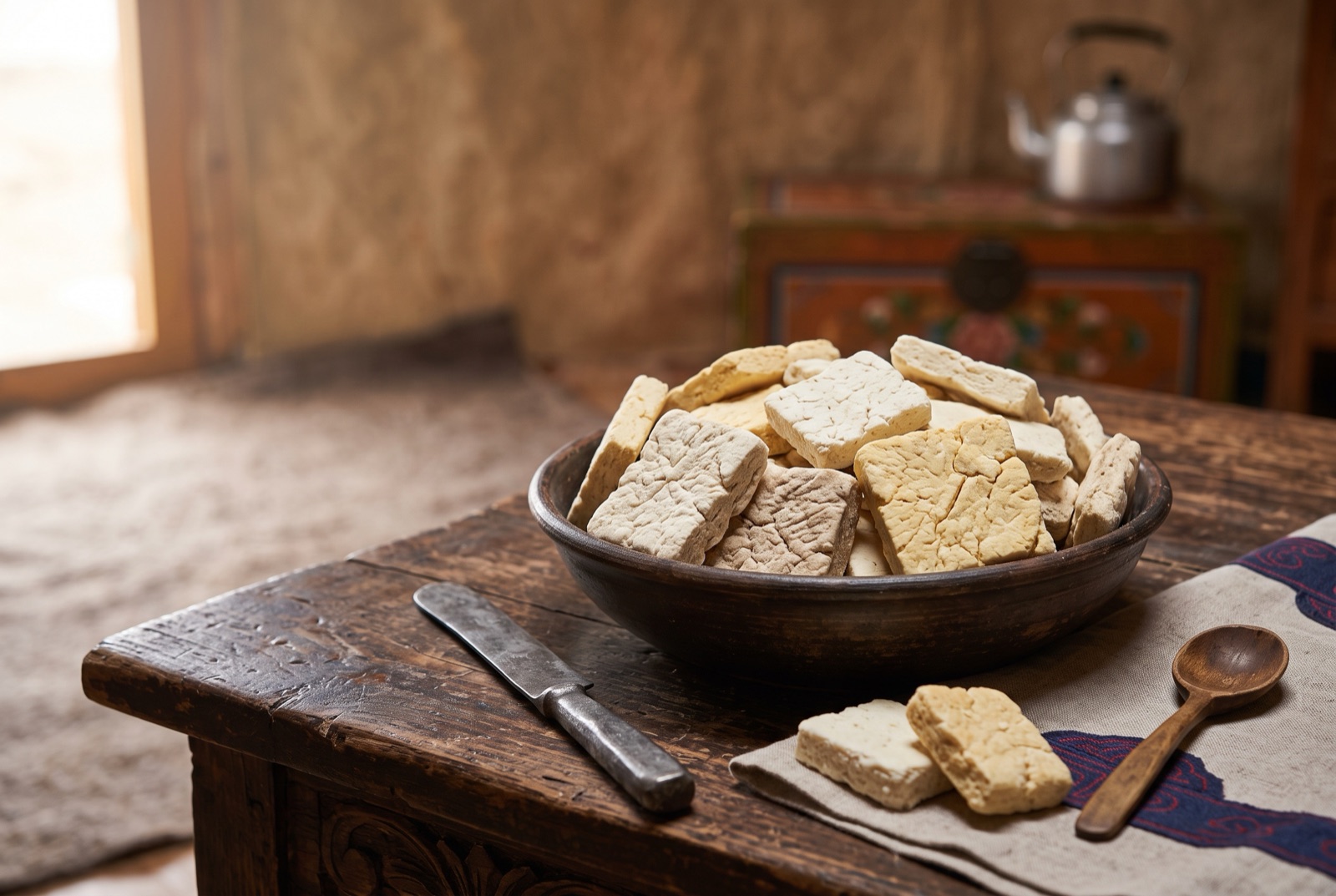
- Large flat rectangles, unsweetened and stamped with a carved wooden mould, fried and stacked in odd-numbered layers as the Tsagaan Sar tower.
- Twisted boortsog
- Strips slit down the middle and one end pulled back through the slit, giving a knot that fries with more crisp edges per piece.
- Sweet boortsog
- Double the sugar and a spoonful of honey in the dough, then eaten alone with tea rather than as an accompaniment to a meal.
Storage & reheating.
Boortsog keeps 2 to 3 weeks in a paper or cloth bag at room temperature, which is the point of it — the drier you fry it, the longer it holds. Do not use an airtight plastic box while there is any warmth left in the biscuits, because trapped steam softens them within hours. If they do go soft, 5 minutes in a low oven brings the crispness back. They freeze well in a bag for 3 months and thaw at room temperature in under an hour.
Serve with
Suutei tsai, the salted milk tea it is designed to be dipped into Urum or fresh butter spread on top Aaruul and a bowl of tarag
The story behind Boortsog.
Boortsog exists because a herding household needed something made of flour that would not go stale, mould or crumble in a saddlebag. Bread baked in an oven was not an option for most of Mongolian history — a ger has a stove, not an oven, and fuel is dried dung or scarce wood. Frying solves both problems at once. A pot of fat over the stove cooks dough quickly, and because frying drives off far more moisture than baking a soft loaf does, what comes out is dry enough to keep for weeks without any preservation beyond a cloth bag hung out of the way.
That dryness is the whole design, and it is why boortsog dough is made stiff and only lightly sweetened. A soft, sugary dough puffs, browns fast and stays damp inside, which is a doughnut and lasts two days. A firm dough fried at a moderate heat stays compact, cooks through to the centre and hardens as it cools. Traditionally it was fried in rendered mutton tail fat, which is what a household had in quantity, and the shapes were cut by hand with a knife — fingers, twisted knots, flat diamonds, plaits — different in every region and often in every family.
The same biscuit carries ceremonial weight. At Tsagaan Sar, the lunar new year, large flat boortsog called boov are stacked into a tower on a platter in odd-numbered layers, three for a young household and up to seven or nine for elders, then dressed with aaruul, sugar lumps and sweets. The tower stands on the table for the whole festival and guests take from it. Outside that fortnight boortsog is entirely ordinary: it goes on the table with suutei tsai, gets dipped in the tea to soften, is eaten with urum or fresh butter spread on top, and gets handed to children as the standard snack.
The form is shared across Inner Asia rather than uniquely Mongolian. Kazakhs make baursak, Kyrgyz and Tatars have their own versions, and the Kalmyk and Buryat communities make it under close variants of the same name. The Mongolian handling leans drier and less sweet than the Central Asian ones, because it is built to sit in a bag beside the tea rather than to be eaten warm.
Questions, answered.
Why is the inside of my boortsog still raw?
The fat was too hot. Frying above about 175C browns the surface in a minute while the centre is still uncooked dough. Boortsog needs a moderate 160C and several minutes a side so the heat reaches the middle before the outside is dark, and the pieces should be cut no thicker than a centimetre.
What is the difference between boortsog and boov?
They are the same dough treated differently. Boortsog is the everyday version, cut into small fingers, knots or diamonds and eaten with tea. Boov are large flat rectangles, usually unsweetened and often patterned with a wooden mould, made to be stacked into the ceremonial tower served at Tsagaan Sar, the Mongolian lunar new year.
How long does boortsog keep?
Two to three weeks at room temperature in a cloth or paper bag, provided it was fried dry enough. This keeping quality is the reason the biscuit exists: it was food that travelled in a saddlebag and sat in a ger without refrigeration. Airtight plastic shortens its life by trapping moisture.
Can boortsog be baked instead of fried?
You can bake the dough and it will produce an edible hard biscuit, but it is a different thing. Frying drives off much more moisture and gives the crisp shell and dense chew that define boortsog; a baked version is paler, drier in a floury way and lacks the fried edges.
Is boortsog sweet?
Only slightly, and often not at all. The everyday dough takes a spoonful or two of sugar for a whole batch, which reads as barely sweet, because it is served with salted milk tea rather than as a dessert. Sweeter versions with honey exist but are eaten on their own.
You might also like.
All recipes →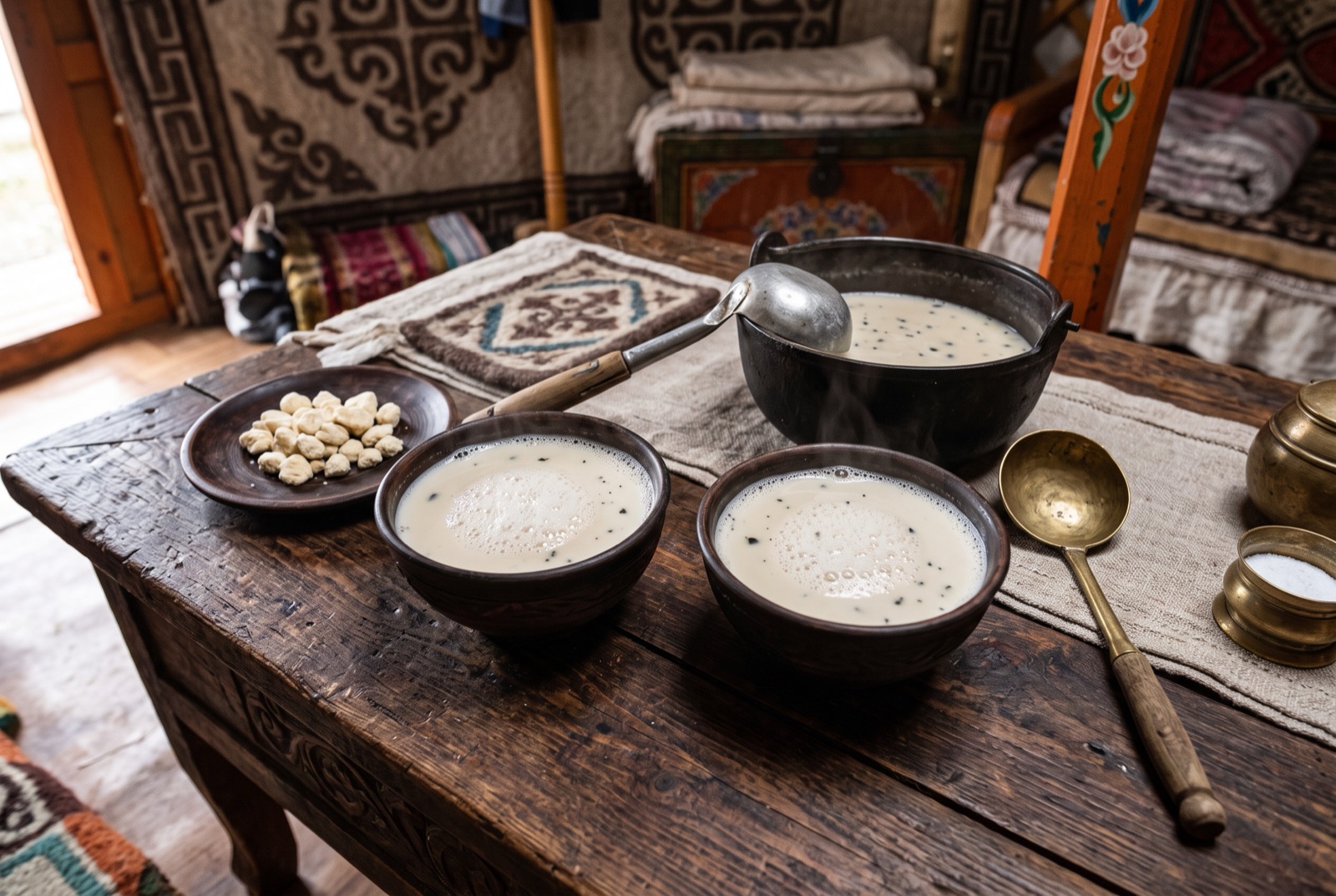
Keep exploring Mongolia.
Mongolia has 9 more dishes in the atlas — Aaruul and Bantan, and 7 more.
Recipe by The DishRoute Kitchen · published August 21, 2026 · updated August 21, 2026