Tamal Navideño.
Costa Rican Christmas Tamale
Tamal navideño · say it: tah-MAHL nah-vee-DEH-nyo
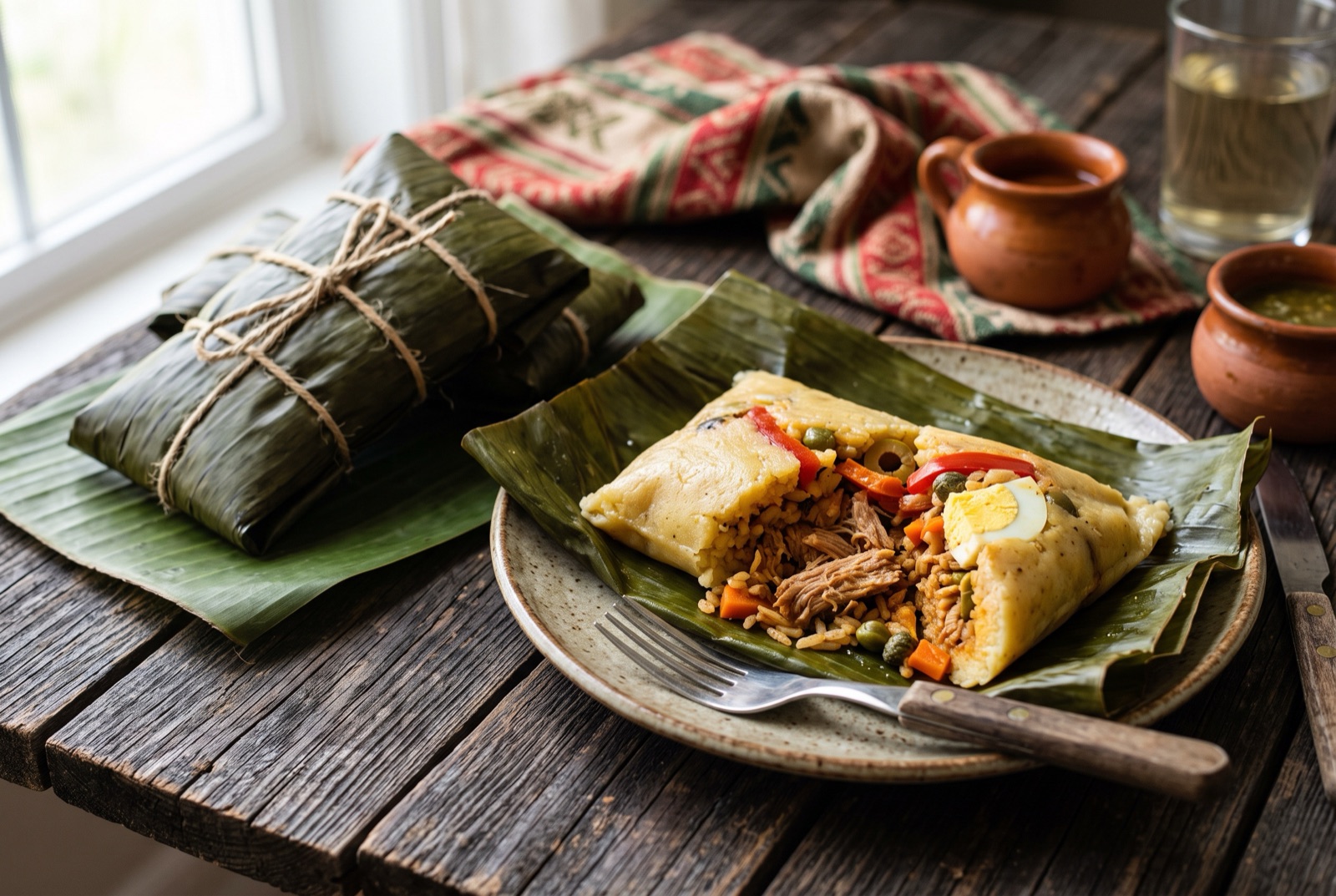
A Costa Rican tamal is flatter, softer and less rich than its Mexican cousin, and the reason is potato. Cooked potato is beaten into the corn masa along with pork broth until the mixture is loose enough to spread with a spoon, which gives a finished tamale that is dense and almost custardy rather than fluffy. On top go a few pieces of marinated pork, a spoon of rice, green beans, strips of sweet pepper and sometimes a prune or an olive. Two parcels are wrapped in plantain leaf and tied back to back into a piña, then boiled for an hour. The flavour is mild, corn-sweet and faintly smoky from the leaf, and every Tico family makes several hundred of them in a single December weekend.

- Gate
- Costa RicaCentral Valley
- Prep
- 1 hr 30 min
- Cook
- 2 hr
- Total time
- 3 hr 50 min incl. 20 min rest
- Serves
- 8
- Status
- Takes skill
- Nutrition / serving · estimated
- Calories 520 kcal
- Protein 24 g
- Carbs 58 g
- Fat 21 g
- Fiber 6 g
- Sodium 720 mg
Why this recipe works.
- Uses potato-enriched masa, the detail that makes a Costa Rican tamale different from a Mexican one.
- Masa is beaten with pork broth rather than water, so the corn carries meat flavour all the way through.
- Explains how to soften plantain leaves properly so they fold instead of splitting down the ribs.
- Written at a manageable home scale with clear guidance on multiplying it for a real tamaleada.
Ingredients.
17 itemsFor the pork and broth
For the masa
For the filling
For wrapping
Equipment
- Very large stockpot
- Kitchen string
- Large mixing bowl
- Potato masher or stand mixer
Instructions.
Cook the pork and make the broth
Simmer the pork with the onion, garlic, bay and cumin in 2 litres of salted water for about 1 hour, until the meat is tender enough to shred at the edges but still holds in pieces. Lift out the pork and strain the broth — you need at least 1.2 litres of it.
Prepare the leaves
Wipe each leaf rectangle clean, then pass it over a gas flame or through very hot water for a few seconds until it darkens, turns glossy and goes limp. Untreated leaf splits along the ribs the instant you fold it.
Beat the masa
Stir the achiote into the warm lard until the fat runs orange, then beat it into the masa harina with the mashed potato, salt and 1.2 litres of warm pork broth. Work it for a good 5 minutes until it drops from a spoon like thick mashed potato and looks smooth rather than grainy.
Tip Taste it now for salt. Once wrapped, nothing can be corrected.
Fill the parcels
Lay a leaf shiny side up, spoon on about 4 tablespoons of masa and spread it into a rough 12 cm square. Top with two pieces of pork, a spoon of rice, a few green beans, carrot batons, peas, two strips of pepper and an olive.
Wrap and tie in pairs
Fold the long sides of the leaf over the filling to meet, then fold both ends underneath to make a flat parcel. Set two parcels back to back and tie them together with string, firmly enough to hold but not so tight that masa squeezes out.
Boil the tamales
Lower the tied pairs into a large pot of boiling salted water, weigh them down with a plate so they stay submerged, and boil steadily for 1 hour. Top up with boiling water if the level drops below the top layer.
Test one
Pull out one pair, untie and open a parcel. The masa should be set firm and pull cleanly away from the leaf; if it is still wet in the centre, rewrap and boil the batch another 15 minutes.
Rest and serve
Drain the tamales and leave them tied for 20 minutes before serving — the masa firms as it cools. Untie at the table, open the leaf flat as a plate, and eat with Salsa Lizano and black coffee.
Tips from our kitchen.
- Pass the plantain leaves briefly over a flame or through hot water until they turn glossy and deep green — untreated leaf cracks along the ribs the moment you fold it.
- The masa should drop from a spoon like thick mashed potato. If it holds a stiff peak it will bake into a brick; loosen it with more warm broth.
- Taste the raw masa for salt. It is the bulk of the tamale and under-seasoned masa cannot be rescued after wrapping.
- Tie the parcels firmly but not tight enough to squeeze the masa out at the ends. String should hold the shape, not compress it.
- Boil one test tamale first, open it after 45 minutes, and check the masa has set firm rather than staying wet in the middle.
- Let boiled tamales rest 20 minutes before opening. Straight out of the pot the masa is still slack and will collapse.
Substitutions.
- Fresh plantain leaves → Frozen banana leaves, thawed, or baking parchment inside foil
- Frozen banana leaf is sold at Asian and Latin grocers and works identically. Parchment and foil hold the shape but contribute none of the green, tea-like aroma that is a real part of the flavour.
- Masa harina → Fresh masa from a tortilleria
- If you can buy fresh nixtamalised masa, use it — the flavour is markedly better. You will need less added liquid, so add the broth gradually.
- Pork shoulder → Chicken thigh, or a vegetarian filling of carrot, green beans and chickpeas
- Chicken tamales are common in Costa Rica. For a vegetarian version use a well-salted vegetable stock in the masa, since the pork broth is doing a lot of the seasoning.
Variations.
- Tamal de cerdo con ciruela
- The Central Valley classic with a single prune tucked in beside the pork, which sweetens the masa around it as it boils.
- Tamal asado
- A completely different Guanacaste sweet: a baked corn cake with cheese and sugar, unwrapped and cut into squares, sharing only the name.
- Tamal mudo
- Literally the "mute" tamale — masa only, no filling, made from the leftovers at the end of a tamaleada and eaten with coffee.
Storage & reheating.
Boiled tamales keep 5 days refrigerated in their wrappers and freeze beautifully for 3 months — this is how Costa Rican households eat them into January. Reheat from chilled by steaming or simmering the wrapped tamale for 15 minutes, or 30 minutes from frozen. Microwaving works in a pinch but dries the edges of the masa.
Serve with
Black coffee, Salsa Lizano at the table, and pickled chile for those who want it.
The story behind Tamal Navideño.
Tamale-making in Costa Rica is less a recipe than an annual event with a name: the tamaleada. Some time in the first half of December, an extended family gathers at one house, usually the grandmother's, and works through a production line that can run all day. One person cooks and beats the masa, another prepares the leaves, several spread and fill, and the tying is done by whoever has the hands for it. Output is measured in piñas — pairs of tamales tied together — and a serious tamaleada produces two or three hundred. They are then given away: to neighbours, to colleagues, to the family who gave you theirs last year. Receiving a piña obliges you to comment on the masa.
The form itself is old and shared across Mesoamerica; corn dough steamed in a leaf predates the Spanish arrival by a very long way, and versions exist from Mexico to Peru. What Costa Rica did with it is characteristic of the country's cooking generally — it softened everything. Where Mexican tamales are whipped with lard until aerated and wrapped tight in dried corn husk, Tico tamales are enriched with potato and pork broth rather than fat alone, spread flat, and wrapped in fresh plantain leaf, which is broad, flexible and lends a distinct green, faintly tea-like aroma during boiling. The filling is also more restrained: a little meat, a little rice, a few vegetables, not a dense core of stew.
Eating them is its own ritual. A tamal is untied at the table, the leaf opened flat as a plate, and eaten with a fork, usually with a splash of Salsa Lizano and a cup of coffee — for breakfast as often as for dinner, all through December and well into January because the freezer is full. Nobody in Costa Rica makes four tamales, which is what this recipe scales to; the honest advice is to double or triple it, invite people, and accept that the first three you wrap will look terrible.
Questions, answered.
How are Costa Rican tamales different from Mexican ones?
Costa Rican tamales are flatter, softer and less fatty. The masa is enriched with cooked potato and pork broth rather than being whipped with lard, so the texture is dense and almost custardy instead of light and crumbly. They are wrapped in broad fresh plantain leaves rather than dried corn husks, tied in pairs, and boiled rather than steamed, and the filling is a scattering of pork, rice and vegetables rather than a dense core of stewed meat.
Why did my tamales fall apart when I unwrapped them?
Usually one of three things: the masa was too loose, the parcels were not tied firmly enough so water got in, or you opened them straight out of the pot. Masa should be spreadable but not runny, string should hold each parcel closed on all sides, and boiled tamales need at least twenty minutes of resting before opening so the masa firms up as it cools.
Where can I buy plantain or banana leaves?
Asian, Caribbean and Latin American grocers sell them frozen in folded packets, which is the easiest route and works exactly like fresh. Thaw, rinse and wipe them, then pass them over a flame or dip them in hot water until they turn glossy and pliable. If you cannot find them at all, baking parchment wrapped in foil holds the shape, though you lose the leaf aroma.
Can I make tamales ahead and freeze them?
Yes, and Costa Ricans count on it. Boil them fully, cool completely in their wrappers, then freeze for up to three months. Reheat from frozen by simmering the wrapped tamale for about 30 minutes, or steaming for the same time. Freezing raw tamales is possible but the masa texture suffers, so cooking first is the better route.
What is a tamaleada?
A tamaleada is the December gathering where a Costa Rican family makes its Christmas tamales together, often several hundred in one day. Tasks are divided along a production line — beating masa, preparing leaves, filling, wrapping, tying, boiling — and the output is distributed among relatives and neighbours. It functions as much as a social event as a cooking session, and being invited to one is a genuine mark of closeness.
You might also like.
All recipes →
Keep exploring Costa Rica.
Costa Rica has 9 more dishes in the atlas — Agua Dulce and Casado, and 7 more.
All Costa Rica recipes Pork shoulder recipes Potato recipes Rice recipes maingluten freedairy freenut freeRecipe by The DishRoute Kitchen · published August 20, 2026 · updated August 20, 2026