Habichuelas con Dulce.
Dominican Sweet Cream of Red Beans
Habichuelas con dulce · say it: ah-bee-CHWEH-las kon DOOL-seh
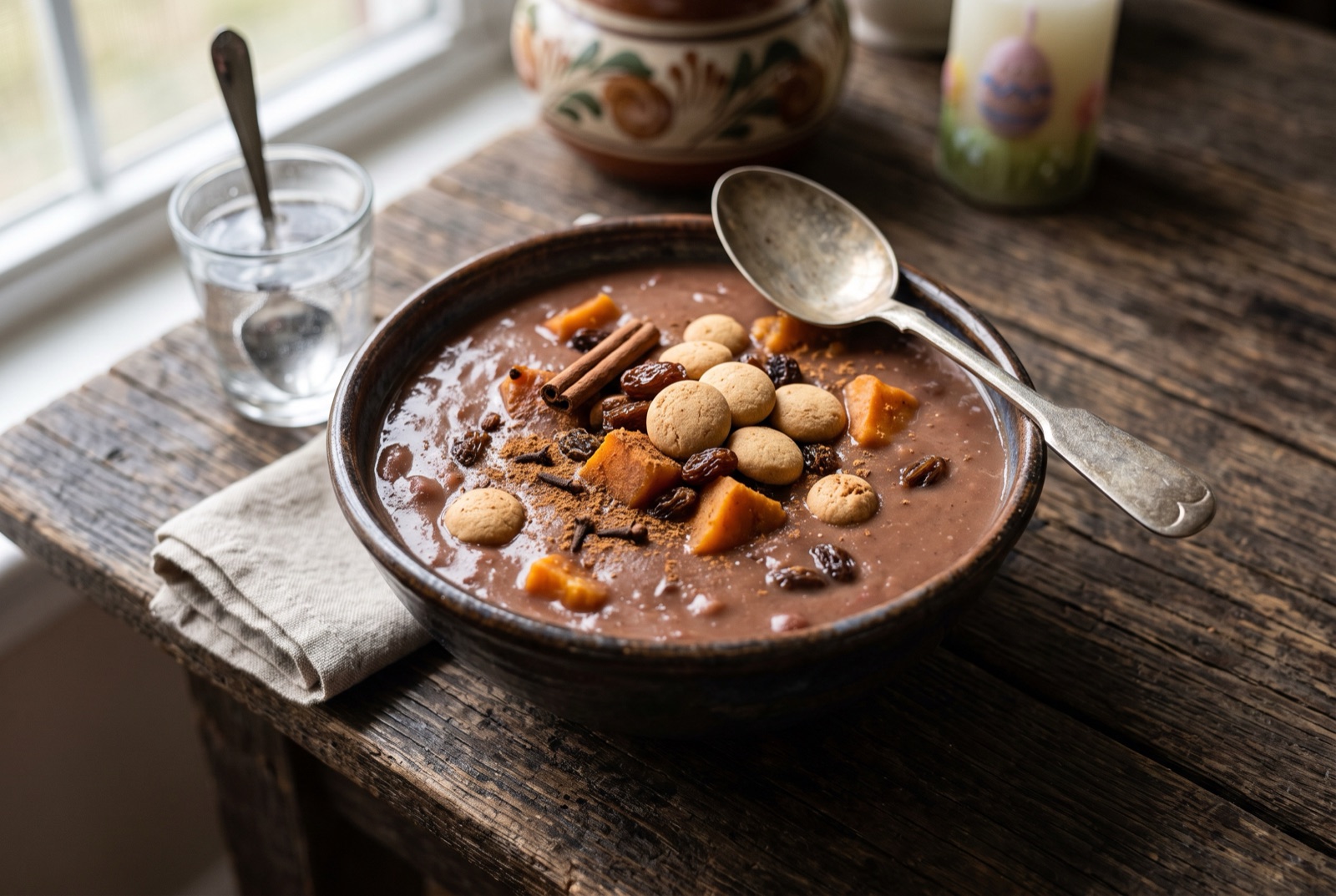
Habichuelas con dulce is a sweet, spiced bean cream — red beans cooked soft, blended with coconut milk and evaporated milk, strained, then simmered with sugar, cinnamon, cloves, raisins and cubes of sweet potato until it thickens into something between a thin pudding and a thick drink. It is served cold in a cup or bowl with small milk cookies floating on top. The beans do not taste like beans by the end; they read as a smooth, faintly earthy body underneath coconut and spice, in the same way that a chestnut dessert does not taste like a vegetable. Dominicans make it for Lent and eat it obsessively for the week around Easter, and almost nowhere else in the world is a sweet made this way.

- Gate
- Dominican Republic
- Prep
- 20 min
- Cook
- 1 hr
- Total time
- 4 hr 20 min incl. 3 hr rest
- Serves
- 8
- Status
- Medium
- Nutrition / serving · estimated
- Calories 430 kcal
- Protein 10 g
- Carbs 62 g
- Fat 17 g
- Fiber 6 g
- Sugar 42 g
- Sodium 230 mg
Why this recipe works.
- Blended and strained, which is what makes the base silky instead of gritty with bean skins.
- Sweet potato added late so it stays in distinct pieces rather than dissolving into the cream.
- Sweetness balanced between sugar, condensed and evaporated milk instead of dumping in one of them.
- Explains the chilling step, which is not optional — this dessert is designed to be eaten cold.
Ingredients.
13 itemsFor the base
The spices
To finish
To serve
Equipment
- Large heavy saucepan
- Blender or immersion blender
- Fine sieve
- Wooden spoon
Instructions.
Soften the beans fully
Simmer the cooked beans in 400 ml of the coconut milk for 10 minutes, until they crush to nothing between two fingers. Any residual firmness will survive as grit in the finished dessert.
Blend and strain
Blend the beans and their liquid until completely smooth, then push the purée through a fine sieve into a clean pot, working it through with the back of a ladle. Discard the skins left in the sieve.
Tip This is the step that separates a silky version from a rough one. Do not skip it.
Add the milks and spices
Stir in the remaining coconut milk, the evaporated and condensed milks, the sugar, cinnamon sticks, cloves, nutmeg and salt. Bring to a bare simmer over medium-low heat, stirring the base of the pot constantly.
Tip Sugar and milk scorch fast and the burnt taste cannot be removed. Keep the spoon moving and the heat low.
Reduce
Simmer gently for 30 minutes, stirring often, until the cream darkens slightly and thickens to the consistency of single cream. It should still pour easily — it will thicken again as it chills.
Add sweet potato and raisins
Add the cubed batata and the raisins and cook for a further 15 to 20 minutes, until a knife slides into the sweet potato but the cubes still hold their shape. Stir in the butter if using and take the pot off the heat.
Chill hard
Fish out the cinnamon sticks and cloves, cool the mixture to room temperature, then refrigerate for at least 3 hours until properly cold. Serve in cups with milk cookies dropped on top and a dusting of cinnamon.
Tips from our kitchen.
- Cook the beans well past the point you would stop for a savoury stew. Any firmness at all survives the blender as grit.
- Strain the purée through a sieve and push it with a ladle. It takes three minutes and is the single biggest difference between a good version and a rough one.
- Add the sweet potato only in the last twenty minutes, and cut it no smaller than 2 cm, or it will melt away entirely.
- Stir the bottom of the pot constantly once the milk goes in. The mixture is dense with sugar and scorches without warning.
- Taste for sweetness while it is hot, then remember it will read less sweet once cold — season slightly sweeter than feels right.
- Add the milk cookies at the moment of serving if you like them crisp, or five minutes early if you prefer them soft and swollen.
Substitutions.
- Evaporated milk → Full-fat milk simmered down by a third, or extra coconut milk
- Coconut milk instead of both dairy milks gives a fully dairy-free version that many Dominican families make anyway.
- Batata (Caribbean sweet potato) → Orange sweet potato, or cubes of ñame
- Orange sweet potato is softer and sweeter, so cut it slightly larger and add it a few minutes later.
- Galletas de leche (milk cookies) → Any plain, dry sweet biscuit such as Marie or rich tea
- You want something crisp and barely sweet. Anything buttery or filled dissolves into a slick on the surface.
Variations.
- With ginger and star anise
- A few slices of fresh ginger and a star anise simmered with the spices, which is common in the north and gives a sharper, more aromatic finish.
- Fully dairy-free
- Coconut milk in place of both evaporated and condensed milk, sweetened with brown sugar — closer to how the dish was made before tinned milk was ubiquitous.
- Habichuelas con dulce helado
- The chilled cream churned or frozen in moulds as an ice pop, sold across the country in the week before Easter.
Storage & reheating.
Keeps 4 days refrigerated in a covered container and thickens as it sits — loosen with a splash of milk or coconut milk and stir before serving. Always store it without the cookies, which turn to sludge. It freezes for 2 months and Dominicans often freeze it in portions or as ice pops; thaw in the fridge and whisk hard to bring the texture back together.
Serve with
Cold in cups with milk cookies on top, and a dusting of cinnamon; it is drunk as much as it is eaten.
The story behind Habichuelas con Dulce.
This is the dish that most reliably confuses visitors, and Dominicans enjoy that. Beans are savoury everywhere in the Caribbean, right up until Holy Week, when the same red kidney beans that go into lunch every other day of the year get boiled with coconut milk, sugar and cinnamon and turned into dessert. The dish is tied specifically to Lent — most strongly to Good Friday — and the usual explanation is a practical one: it belongs to a Catholic season when meat was avoided and cooks built rich food out of what was in the house. How exactly it took this particular form is not documented, and anyone offering a precise origin story is guessing.
What is well established is how seriously it is taken. In the run-up to Semana Santa, pots of habichuelas con dulce appear in enormous quantities, and it is customary to send some to neighbours and relatives; households compete quietly over whose is best. The disagreements are about details — whether to strain the beans or leave some texture, how much batata to include, whether ginger belongs, and above all whether the milk cookies should be dropped in early to soften or added at the last second to stay crisp.
The technique that matters is the blending and straining. Beans are cooked until completely soft, puréed with coconut milk, then pushed through a sieve so the skins and any grit are left behind. What returns to the pot is smooth, and the rest of the cooking is patient reduction with the spices, sweeteners and sweet potato — long enough for the batata to soften without disintegrating and for the whole thing to thicken by evaporation rather than by starch. It is then chilled hard, because habichuelas con dulce served warm is simply not the dish; the cold is what makes it refreshing rather than heavy.
Questions, answered.
Does it actually taste like beans?
Not in the way people expect. Once blended, strained and cooked with coconut milk, spice and sugar, the beans read as a smooth, mildly earthy body rather than as a savoury ingredient — much like chestnut or adzuki bean in East Asian sweets. If yours does taste strongly of beans, the likeliest cause is under-cooking or skipping the straining step.
Why is this eaten at Easter?
It is a Lenten dish, associated above all with Good Friday and the week of Semana Santa. The usual explanation is that it belongs to a Catholic season of abstaining from meat, when cooks built rich food from pantry staples. Beyond that the specific origin is not documented, and it is worth treating confident origin stories about it with some scepticism.
Why is mine grainy?
Bean skins. Blending alone does not break them down, so the purée has to go through a fine sieve before the sweetening stage — push it through with the back of a ladle and discard what stays behind. Under-cooked beans also stay grainy no matter how long you blend, so cook them until they collapse under light pressure.
Can I use tinned beans?
Yes, and many people do. Rinse two 400 g tins well to remove the brine flavour, then simmer them in fresh water for ten minutes before blending so they soften further. The result is slightly less deep than starting from dried beans, but the coconut milk and spices do most of the heavy lifting anyway.
How thick should it be?
Thin enough to drink from a cup while hot, because it thickens substantially as it cools. Aim for the consistency of single cream at the end of cooking; if it has already reached pudding thickness in the pot, it will set almost solid in the fridge. Thinning it later with milk is easy, so err on the loose side.
You might also like.
All recipes →
Dominican Republic40 min
Morir Soñando
Dominican Orange and Milk Cooler
Dominican Republic1 hr 45 min
Chicharrón de Pollo
Dominican Crisp Fried Chicken Bites
Dominican Republic55 min
Habichuelas Guisadas
Dominican Stewed Red Beans
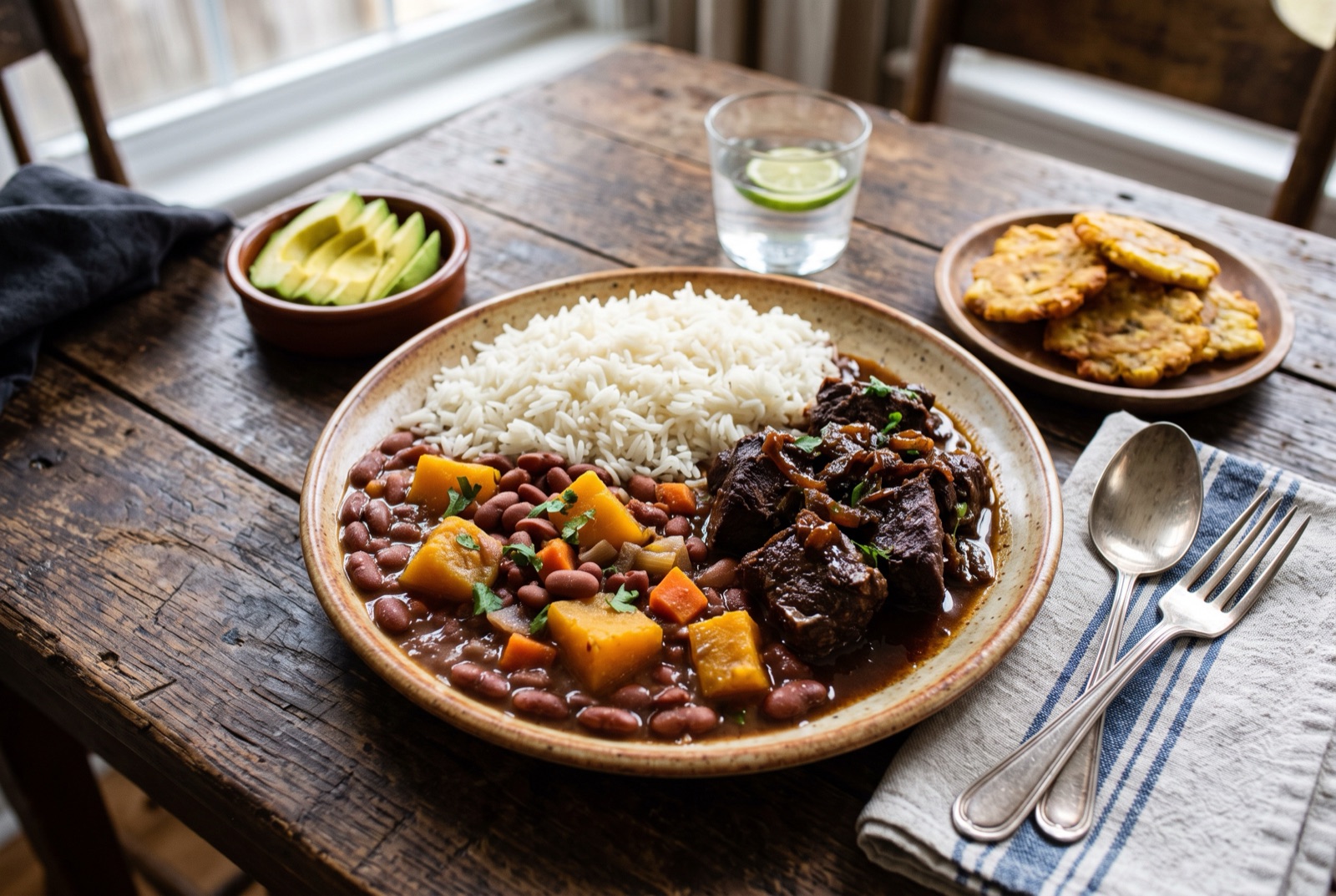
Dominican Republic2 hr 15 min
La Bandera Dominicana
The Dominican Flag Lunch Plate
Keep exploring Dominican Republic.
Dominican Republic has 9 more dishes in the atlas — Chicharrón de Pollo and Habichuelas Guisadas, and 7 more.
All Dominican Republic recipes Coconut milk recipes Sweet potato recipes Condensed milk recipes dessertdrinkvegetarianRecipe by The DishRoute Kitchen · published August 20, 2026 · updated August 20, 2026