Yaniqueques.
Dominican Fried Beach Flatbread
Yaniqueques · say it: yah-nee-KEH-kes
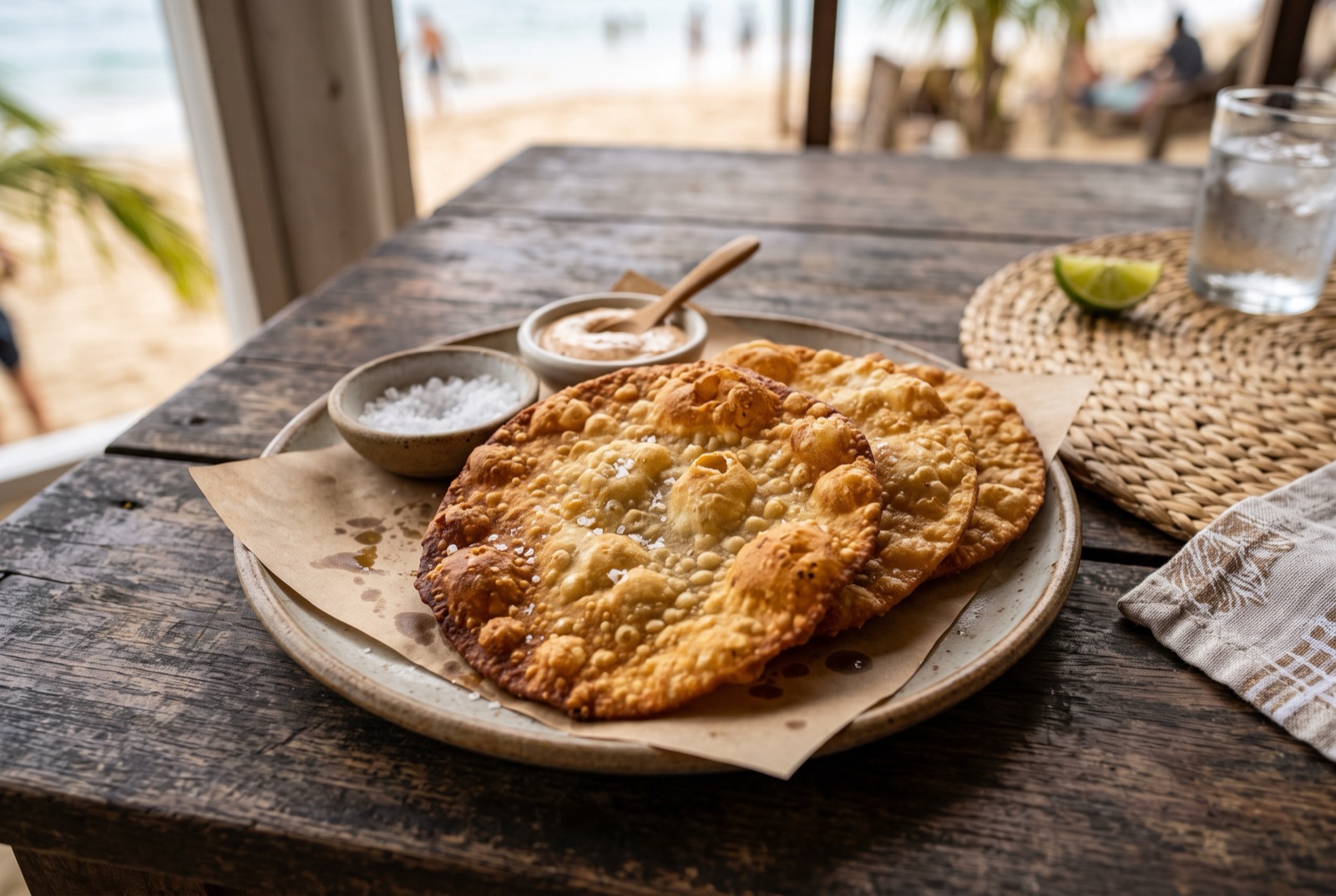
Yaniqueques are flat rounds of plain wheat dough — flour, a little fat, baking powder, salt and water, nothing more — rolled thin and fried until they bubble up, brown in patches and turn crisp at the edges while staying chewy in the middle. They taste of fried dough and salt, which is the entire appeal, and they are eaten hot, torn by hand, standing up, usually within a metre of the pan they came out of. On Dominican beaches they are sold from wide iron skillets set over gas rings, and the vendor salts each one as it lands on the paper. At home they take about half an hour and require no special equipment beyond a rolling pin and a deep pan.

- Gate
- Dominican RepublicBoca Chica
- Prep
- 15 min
- Cook
- 20 min
- Total time
- 1 hr 5 min incl. 30 min rest
- Serves
- 6
- Status
- Easy
- Nutrition / serving · estimated
- Calories 230 kcal
- Protein 4 g
- Carbs 30 g
- Fat 11 g
- Fiber 1 g
- Sodium 390 mg
Why this recipe works.
- A rested dough, which is what lets you roll the discs thin enough to puff instead of bloating.
- Oil temperature pinned down, since the difference between crisp and greasy here is about twenty degrees.
- Explains what a correct yaniqueque looks like in the pan — lifting, ballooning, blistered — not just how long to fry it.
- Five pantry ingredients, no yeast and no proving time beyond a short rest.
Ingredients.
7 itemsFor the dough
For frying
To finish
Equipment
- Rolling pin
- Deep frying pan or wok
- Cooking thermometer
- Wire rack
Instructions.
Mix the dough
Whisk the flour, baking powder and salt in a bowl, rub in the oil or melted butter with your fingertips, then add the warm water and bring it together into a shaggy mass with a fork.
Knead briefly
Turn the dough onto a work surface and knead for 3 to 4 minutes, until it goes from rough and tacky to smooth and elastic and springs back slowly when pressed. Add a little more water if it feels stiff.
Rest it
Wrap the dough and leave it at room temperature for 30 minutes. This is not optional — resting relaxes the gluten so the discs will roll thin and stay thin instead of shrinking back.
Roll the discs
Divide the dough into 12 pieces and roll each into a ball, then roll them out on a lightly floured surface to rounds about 15 cm across and 2 mm thick. Keep the rolled discs separated by baking paper.
Tip Held up to the light, a correctly rolled disc should be translucent enough to show the shadow of your fingers.
Heat the oil
Heat the frying oil to 180°C in a deep pan. Drop in a scrap of dough to check: it should rise to the surface within three seconds and sizzle in a steady stream of small bubbles.
Fry one or two at a time
Slide in a disc and immediately spoon hot oil over its surface. It should lift, balloon and blister within 30 seconds; turn it once and fry until both sides are patched with deep gold, about 90 seconds in total.
Salt and serve at once
Lift each yaniqueque onto a wire rack, scatter flaky salt over it while the surface is still glistening, and serve immediately while they are hot enough to steam when torn open.
Tips from our kitchen.
- Rest the dough at least 30 minutes. Unrested dough springs back as you roll it and will never get thin enough to balloon.
- Roll each disc to about 2 mm — thin enough to see the shadow of your hand through it when held up to the light.
- Prick the surface once or twice with a fork if you prefer flat, cracker-crisp yaniqueques. Leave them unpricked if you want them to puff into a dome.
- Test the oil with a scrap of dough: it should rise to the surface within three seconds and sizzle steadily rather than furiously.
- Spoon hot oil over the top of the disc for the first few seconds. It encourages the dough to inflate evenly instead of on one side.
- Salt them the second they come out of the pan and eat them within minutes; a cold yaniqueque is a completely different and much sadder object.
Substitutions.
- Butter or shortening in the dough → Neutral oil or coconut oil
- Any fat works and oil keeps the dough vegan. Butter gives slightly more flavour but browns a little faster in the pan.
- Baking powder → Leave it out entirely
- Some vendors use none at all. Without it you get a flatter, crisper, more cracker-like result, which many people prefer.
- Plain wheat flour → A gluten-free bread flour blend
- The dough will be less elastic and harder to roll thin — rest it longer and roll between sheets of baking paper.
Variations.
- Yaniqueque relleno
- Folded around fried fish, cheese or ham while still hot, which is how east-coast vendors turn a snack into a lunch.
- Sweet yaniqueque
- Dusted with sugar and cinnamon straight out of the pan instead of salt — a common treatment for the ones sold to children.
- Griddled johnnycake
- The older cocolo method: cooked dry on a hot iron pan instead of fried, giving a chewier, bread-like result.
Storage & reheating.
Yaniqueques are made to be eaten immediately and go soft and leathery within an hour. If you must hold them, keep them on a wire rack in a low oven for up to 30 minutes and never covered, since trapped steam destroys the crispness. The raw dough is the better make-ahead: it keeps 2 days refrigerated, wrapped tightly, and rolls out well straight from the fridge after ten minutes at room temperature.
Serve with
Eaten plain and hot with salt, or alongside fried fish and tostones with a cold drink — chola or beer.
The story behind Yaniqueques.
The name is a Spanish transcription of "johnny cake", and the trail behind it is unusually clear. In the late nineteenth century the sugar mills around San Pedro de Macorís recruited thousands of English-speaking workers from the Lesser Antilles — Tortola, St. Kitts, Nevis, Anguilla and beyond — who became known in the Dominican Republic as cocolos. They brought their own English-language institutions, their own music and dance traditions, and their own food, including a fried or griddled flatbread whose name Dominican Spanish absorbed as yaniqueque.
The Dominican version drifted from its relatives. Bahamian and North American johnnycakes are often cornmeal-based and baked or griddled; the yaniqueque is wheat, rolled thin as a plate and deep-fried, closer in spirit to an Indian puri or a Mexican buñuelo than to anything cornmeal. Along the east coast, and above all at Boca Chica, it became the defining beach snack, sold alongside fried fish and tostones by vendors walking the sand with stacked trays.
It is worth being clear that this is a humble thing: unleavened dough, cheap ingredients, no filling, no sauce, and a shelf life measured in minutes. Some vendors serve them plain with salt, some fold them around fried fish, and some sell them alongside chola — a sweet coconut milk drink. What makes them worth cooking at home is the moment they hit the oil: a properly rolled disc lifts off the bottom of the pan, inflates in a few seconds, and comes out blistered and light. Roll them too thick and you get a heavy, oily scone instead, which is the failure mode this recipe is written around.
Questions, answered.
Why did my yaniqueques not puff up?
Usually the dough was rolled too thick, or the oil was not hot enough. Puffing happens when the water in the dough flashes to steam faster than the surface can set, so you need thin dough and oil at around 180°C. Resting the dough matters too — an unrested dough shrinks back as you roll and ends up thicker than it looks.
Why are they greasy?
Cool oil, every time. Below about 170°C the dough absorbs oil instead of sealing, and adding several discs at once drops the temperature sharply. Fry one or two at a time, let the oil recover between batches, and drain on a wire rack rather than paper, which traps steam and softens the underside.
Are yaniqueques the same as johnnycakes?
They are related but not identical. The name came directly from the English "johnny cake" via English-speaking Antillean workers who settled around San Pedro de Macorís in the late 1800s. Bahamian and North American johnnycakes are frequently cornmeal-based and baked or griddled, whereas the Dominican version is wheat dough rolled thin and deep-fried.
Can I make the dough in advance?
Yes, and it is the sensible way to do it. The dough keeps well wrapped in the fridge for two days and actually rolls out more easily after a long rest because the gluten relaxes. Bring it back to room temperature for about ten minutes before rolling, and fry the discs to order rather than in advance.
What do I eat them with?
Traditionally almost nothing — hot, salted and torn by hand is the standard. On Dominican beaches they are also folded around fried fish, or eaten alongside tostones and a cup of chola, a sweet spiced coconut drink. At home they make an excellent scoop for beans, avocado or any stew with a lot of sauce.
You might also like.
All recipes →
Dominican Republic1 hr 45 min
Chicharrón de Pollo
Dominican Crisp Fried Chicken Bites
Dominican Republic4 hr 20 min
Habichuelas con Dulce
Dominican Sweet Cream of Red Beans
Dominican Republic55 min
Habichuelas Guisadas
Dominican Stewed Red Beans
Dominican Republic2 hr 15 min
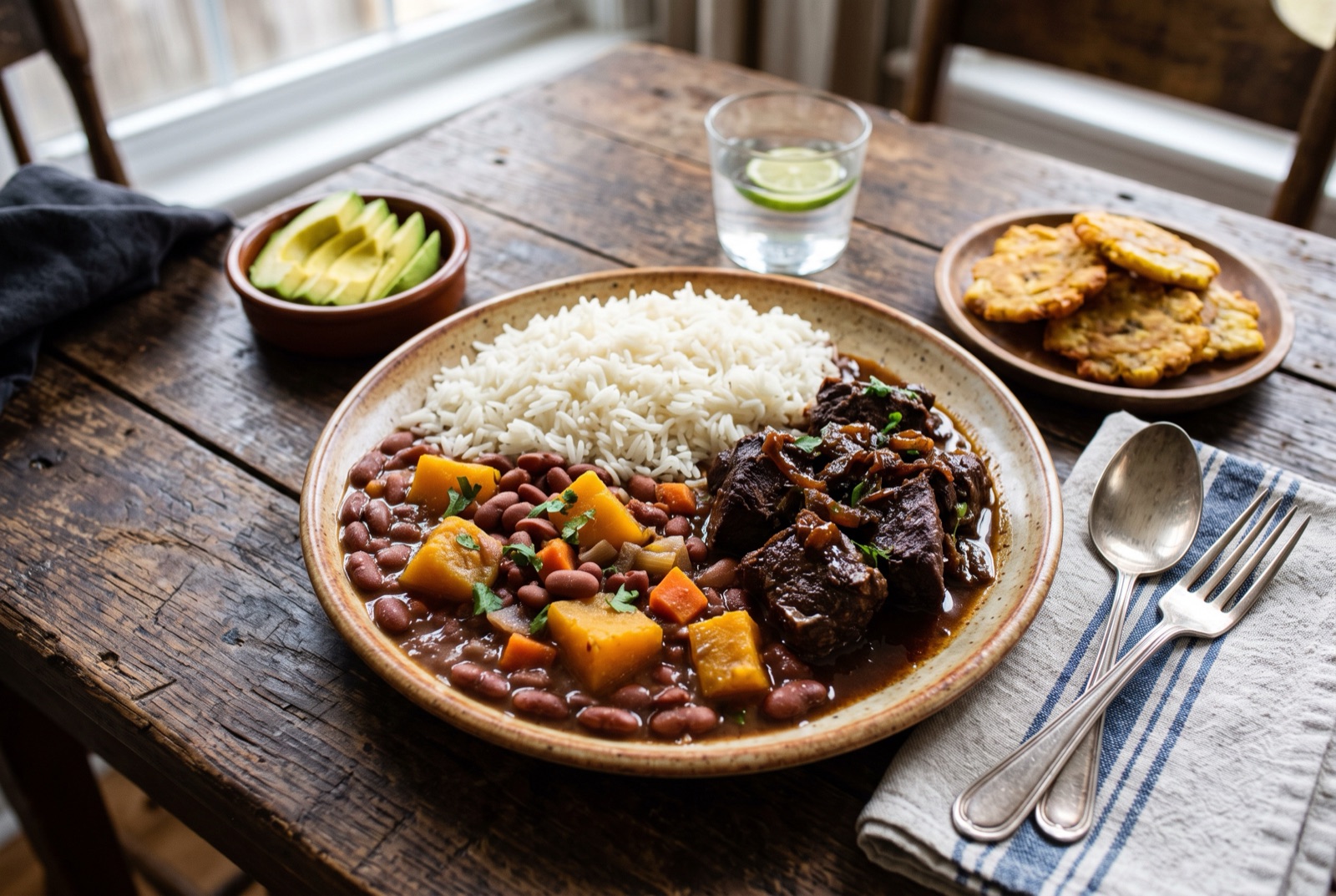
La Bandera Dominicana
The Dominican Flag Lunch Plate
Keep exploring Dominican Republic.
Dominican Republic has 9 more dishes in the atlas — Chicharrón de Pollo and Habichuelas con Dulce, and 7 more.
Recipe by The DishRoute Kitchen · published August 20, 2026 · updated August 20, 2026